Exponential Growth in the Real World: From Bacteria to Viral Videos
Jun 30, 2026
| Severna Park
What happens when you place a single penny in a jar and double the amount every day for a month? A few hundred dollars might seem possible. Even a few thousand dollars may sound high.
Thirty days later, the total can exceed $10 million!
You may ask yourself how a single penny leads to such a large number. Exponential growth provides the answer and reveals one of the most fascinating patterns in math, science, technology, and everyday life.
Let's explore how exponential growth works, where it appears, and when students encounter it in school.
What Is Exponential Growth?
Exponential growth is a quantity that increases by the same factor over equal intervals of time, causing the amount to become larger and larger.
In other words, each new increase comes from multiplying a number that has already grown.
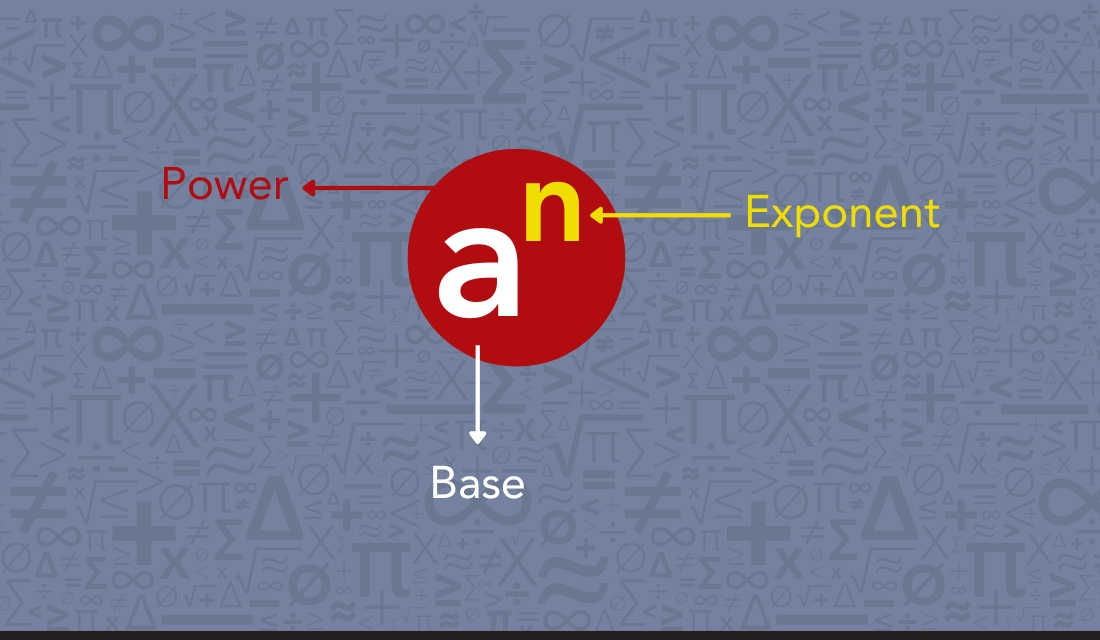
Mathematicians often represent exponential growth as y = a × bx, where:
The idea behind the formula is that every step builds on a quantity that is already larger than the last one. The compounding effect is what allows the numbers to explode.
Exponential growth makes more sense when we compare it with a pattern students learn much earlier in their math education: linear growth. Students typically encounter it in upper elementary and middle school before they formally study exponential growth in Algebra. That is one reason the concept can feel less intuitive at first.
We may add the same amount to a savings jar, read 10 pages each day, or walk the same distance each week. Linear growth comes from adding, while exponential growth comes from multiplying, which is what produced the ten-million-dollar result our opening riddle revealed.
What an Exponential Growth Graph Looks Like
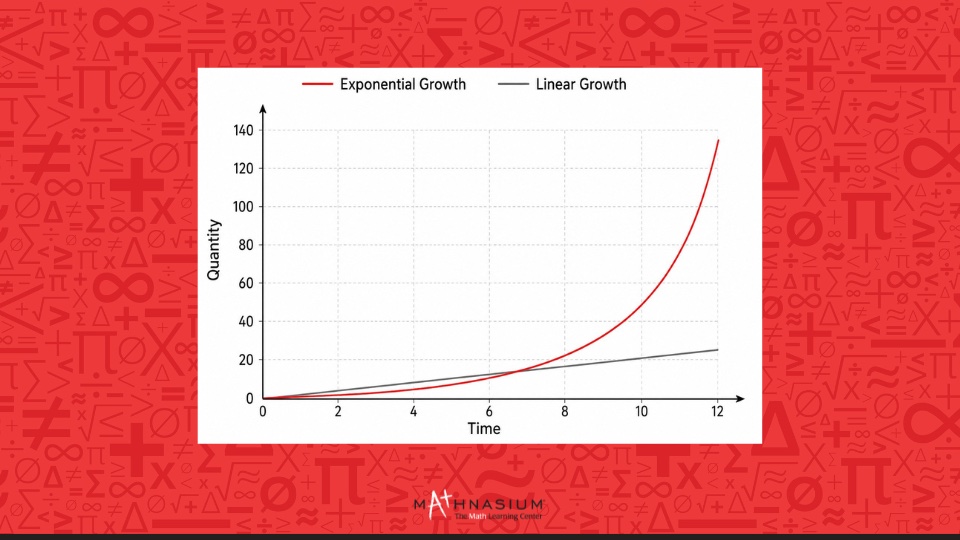
An exponential growth graph is often called a J-curve because the line remains relatively low at first before curving upward.
The comparison with a straight-line pattern highlights why exponential growth can produce such large numbers. Let's take a closer look.
Notice how the curve changes as the quantity grows. At first, each increase looks relatively small. Several intervals pass before the curve begins to separate noticeably from a straight line.
We might be surprised by how many everyday situations involve exponential growth. Most of us do not think about the world in such mathematical terms, but real-world applications can make math feel much closer and less intimidating.
Let's explore a few examples that show how math and everyday life connect.
1. Biology
Exponential growth plays an important role in many biological processes, particularly when populations reproduce rapidly under favorable conditions.
For example, a single bacterium divides into two every 20 minutes when conditions support rapid growth. With each round of division, the population doubles: two become four, four become eight. Within eight hours, a single cell can produce more than 16 million descendants.
Many infectious disease models and microbiology experiments use the same doubling pattern.
2. Digital world
The digital world provides another example of how exponential growth can spread information from a small starting point to a much larger audience.
Imagine what happens when a popular video begins spreading online. One person shares it with two friends, who then pass it along to others. Platform algorithms can amplify the effect even further, and within hours, a piece of content may move from obscure to widely recognized or even go viral.
The exponential engine is the same one the bacteria use, only the context changes.
3. Finance
Exponential growth also appears in personal finance, where time can become one of the most valuable factors in building savings.
Savings accounts and investments often grow through compound interest. If a student begins saving consistently in their teens, they can arrive at adulthood with a balance that grows steadily for years. Time and the multiplying factor do much of the work.
This is why financial advisors repeat the same advice: start early.
Let's put exponential growth into action by revisiting the viral video example and using real numbers.
Consider a social media post that you share with three friends. Now, each of them shares it with three more. The process continues for ten rounds.
Remember the formula y = a × bx? In our example, a = 1 because we start with a single post, b = 3 because each person shares it with three others, and x represents the number of sharing rounds.
Here is our formula in action:
Round 1: y = 1 × 3¹ = 3 people see it
Round 2: y = 1 × 3² = 9 people see it
Round 3: y = 1 × 3³ = 27 people see it
Round 10: y = 1 × 3¹⁰ = 59,049 people see it
More than 59,000 people saw the post after only ten rounds of sharing. The exponent tells us how many rounds happened, while the base tells us how many new people each person shared with. The growth factor makes the audience increase faster with every round.
If you are curious to find out more about exponents, our Mathnasium video offers a closer look at how they work.
When Students First Encounter Exponential Growth
Students encounter the building blocks of exponential growth long before they study the concept formally. The path typically unfolds over several years as students connect new concepts to skills they already know.
Upper elementary, grades 4 to 5. Students work with repeated multiplication and area models. The word exponential does not appear yet, but students build the arithmetic foundation for the concept.
Middle school, grades 6 to 8. Students learn exponent notation and evaluate expressions such as 3⁴ and powers of 10. They still spend most of their time graphing linear functions.
Algebra 1, grades 8 to 9. We enter the formal milestone. Students move from static exponents to exponential functions where the variable lives in the exponent. They graph the J-curve, identify growth factors, and learn to distinguish exponential from linear behavior.
As students move from multiplication to exponential functions, each new concept asks them to connect ideas rather than memorize procedures.
Supportive learning environments can help identify what students already understand, uncover gaps in learning, and guide them toward the next level of mathematical confidence.
At Mathnasium, curiosity and understanding grow together as students explore how math works in real-world situations.
How Mathnasium Helps Students Understand Complex Math Concepts
Mathnasium is a math-only learning center dedicated to helping K-12 students of all skill levels excel in math.
Exponential growth is one example of how math concepts build on earlier learning. Some students are still developing the foundations behind these ideas, while others are ready to explore them in greater depth.
We support both through the Mathnasium Method™, our proprietary teaching approach. Here is how it works:
Assessment and Personalized Learning Plans: Each student starts with a diagnostic assessment that identifies current skills, strengths, and gaps. From those findings, we build a personalized learning plan tailored to their goals, whether that means strengthening multiplication and exponent skills, mastering current coursework, or preparing for more advanced topics.
Teaching for Understanding: Our specially trained tutors use natural language and a mix of verbal, visual, mental, tactile, and written techniques to help students understand how mathematical ideas connect and build on one another.
Problem-Solving and Critical Thinking: We allow time for productive struggle so students can rely on their own reasoning. When we step in, we make sure to show both the how and the why behind the answer. Over time, this helps students build their own problem-solving skills and critical thinking tools.
An Engaging and Fun Learning Environment: Sessions include games, earned rewards, and consistent celebration of progress. As students strengthen their skills, many also develop greater confidence and a more positive attitude toward math.
The impact extends beyond the classroom:
94% of parents report improvement in their child's math skills and understanding
93% of parents report an improved attitude toward math after attending Mathnasium
90% of students saw improvement in their school grades
With over 1,100 learning centers across North America, there is likely a Mathnasium close to you.
Families across Severna Park and nearby areas, including Millersville, Glen Burnie, Pasadena, Arnold, and Anne Arundel County, trust Mathnasium of Severna Park to help their children build lasting math confidence at every level.
Whether your student is looking to catch up, keep up, or get ahead on their math journey, our local team is happy to assist!
Mathnasium of Severna Park is a math-only learning center for K-12 students in Severna Park,
MD. Trusted by over a million parents, Mathnasium uses personalized learning plans
and the proprietary Mathnasium Method™ to help students catch up, keep up, and get ahead on their math journey.
Our specially trained tutors deliver face-to-face instruction in a supportive and fun small-group environment,
working with students both in center and online to develop a deep understanding of math, build confidence,
and improve academic performance.
Mathnasium tutors explain the making ten strategy, how it works with ten frames, and how it helps kindergarten and early elementary students add confidently.
Find out if your child needs summer math support. Learn the warning signs Maryland parents should watch for and what grade-based targeted summer prep looks.
Parents everywhere are starting to think about a big, annual event: kids going back to school. Wanna know how Mathnasium of Severna Park can make this back-to-school season the best ever? Check out the top 2 habits to create an awesome year for your child..


 (410) 544-6284