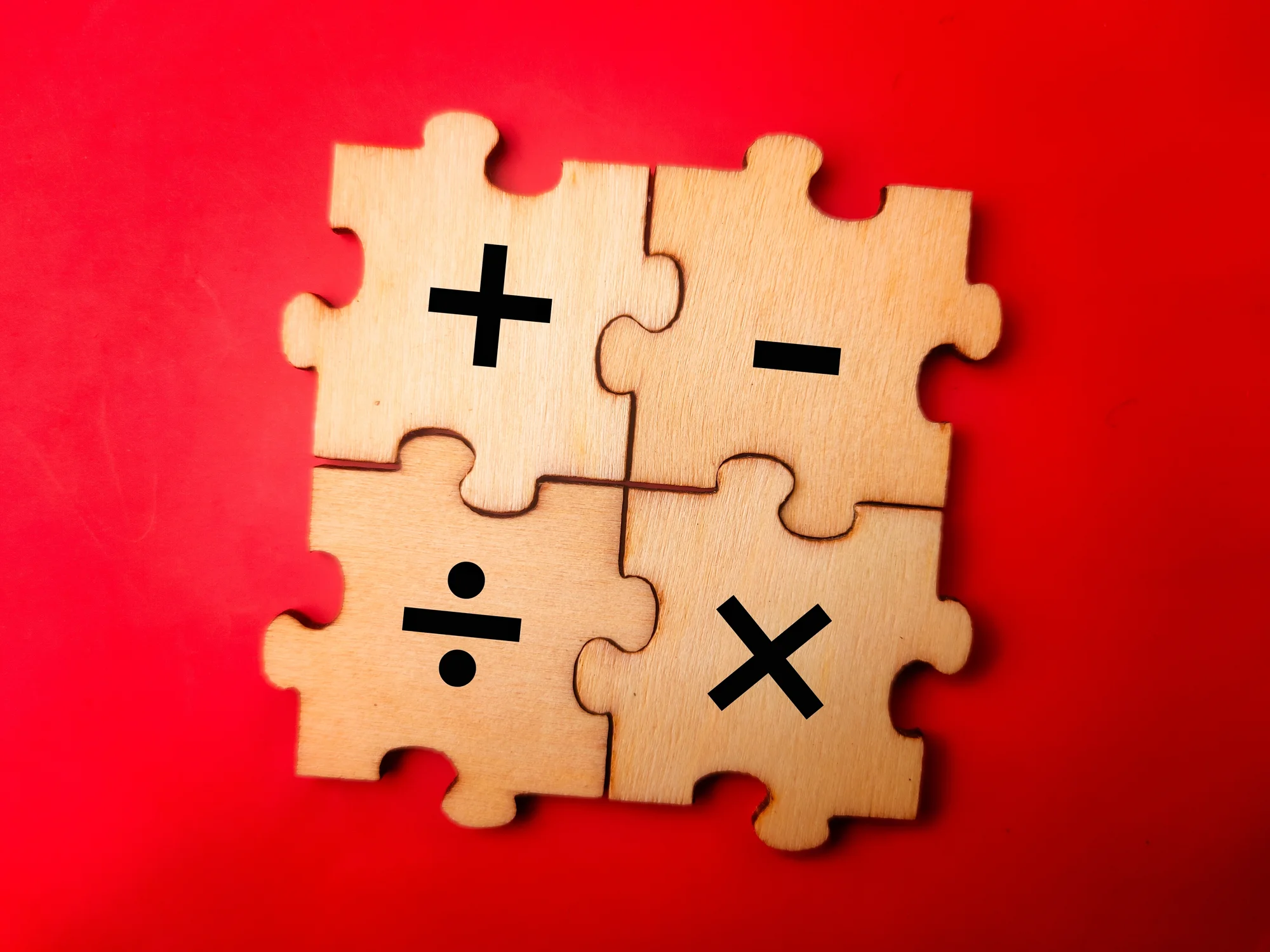
Think of math the way you'd think of building a house. Before the walls go up, before anything takes shape, you need a foundation that can hold the weight of everything above it.
In math, that foundation is made of four operations: addition, subtraction, multiplication, and division. Every equation your child will ever solve, every concept their teacher will introduce from here through high school, builds on these four skills.
But here's the thing: knowing how to calculate isn't the same as understanding what an operation actually does. And that distinction matters more than most people realize.
Today, Mathnasium tutors will walk you through what each operation really means, how they connect to one another, and how you can support your child's mastery at home.

4 Basic Math Skills
The four basic math skills, also called the four fundamental arithmetic operations, are addition, subtraction, multiplication, and division. They are the building blocks every higher math concept is built on, from fractions and algebra all the way through to calculus.
Let's take a closer look at each one.
1. Addition
Addition is the operation of combining two or more quantities to find a total: 3 + 4 = 7
At its core, it's about understanding what "more" means in a mathematical sense. When quantities join together, they create something larger than either part alone.
Think of it this way: 3 apples and 4 apples make 7 apples. Two groups of children joining for recess become one bigger group. That's addition at work in the real world.
It's also the first operation children encounter, and for good reason. Fluency here supports every operation that follows. Multiplication, for instance, is really repeated addition in a more efficient form.
The stronger a child's foundation, the more naturally everything else falls into place.
Because addition is the gateway, building it conceptually sets the tone for every operation that follows. Here are a few strategies Mathnasium tutors rely on to do exactly that.
-
Start with physical objects to build the concept of combining before moving to written problems. A handful of blocks or a bowl of grapes works just fine.
-
Use a number line to show addition as movement. Starting at 5 and jumping 3 steps forward lands you at 8. It makes the idea of "more" visible and concrete.
-
Practice doubles facts (2 + 2, 3 + 3, 4 + 4). They're easy to visualize and quickly become mental math shortcuts. If a child knows 6 + 6 = 12, solving 6 + 7 becomes simple: just one more than 12.
-
Try the "make a ten" strategy: to solve 8 + 5, move 2 from the 5 to the 8 to make 10, then add the remaining 3. This builds number sense rather than relying on memorization.
-
Use addition in everyday moments. Combining items at the grocery store, adding up game scores, splitting a bag of snacks. Addition describes something real, and the more children see that, the better it sticks.
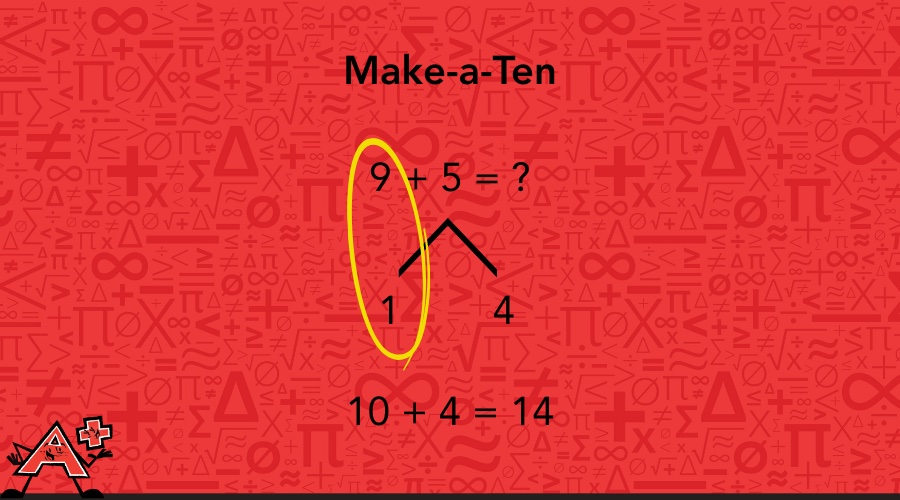
The "make a ten" strategy turns a tricky addition problem into two simple steps.
2. Subtraction
Subtraction is the operation of finding the difference between two quantities.
It shows up in three ways: taking away, comparing, or finding what's missing. 10 - 3 = 7 tells us how many are left, how far apart two numbers are, or what number completes the equation.
Subtraction is also the inverse of addition. They are two sides of the same coin.
If your child sees that relationship, they can check their own work naturally: if 9 - 4 = 5, then 5 + 4 should bring them right back to 9.
That connection supports missing-number problems and lays the groundwork for algebraic thinking later on.
Subtraction has more faces than most children expect. These approaches help them see all of them.
-
Frame subtraction as "what's missing?" rather than just "take away." 10 - 3 = ? becomes "what do I add to 3 to get to 10?" That small shift opens up a lot of flexibility.
-
Pose comparison questions: "how many more?" and "how many fewer?" These help children see subtraction as a way of measuring distance between two numbers.
-
Use a number line to show subtraction as movement in reverse. Starting at 10 and jumping 3 steps back lands you at 7. Paired with the addition number line, it makes the inverse relationship visible.
-
Practice with friendly numbers: round to the nearest 10, subtract, then adjust. To find 13 - 8, think "13 - 10 = 3, then add 1 back because I only needed to subtract 8." Answer: 5.
-
Use the addition-subtraction relationship to check answers. If 9 - 4 = 5, verify it with 5 + 4 = 9. Children who do this naturally are already thinking like mathematicians.
📕 You May Also Like: What Are Inverse Operations? A Complete Overview
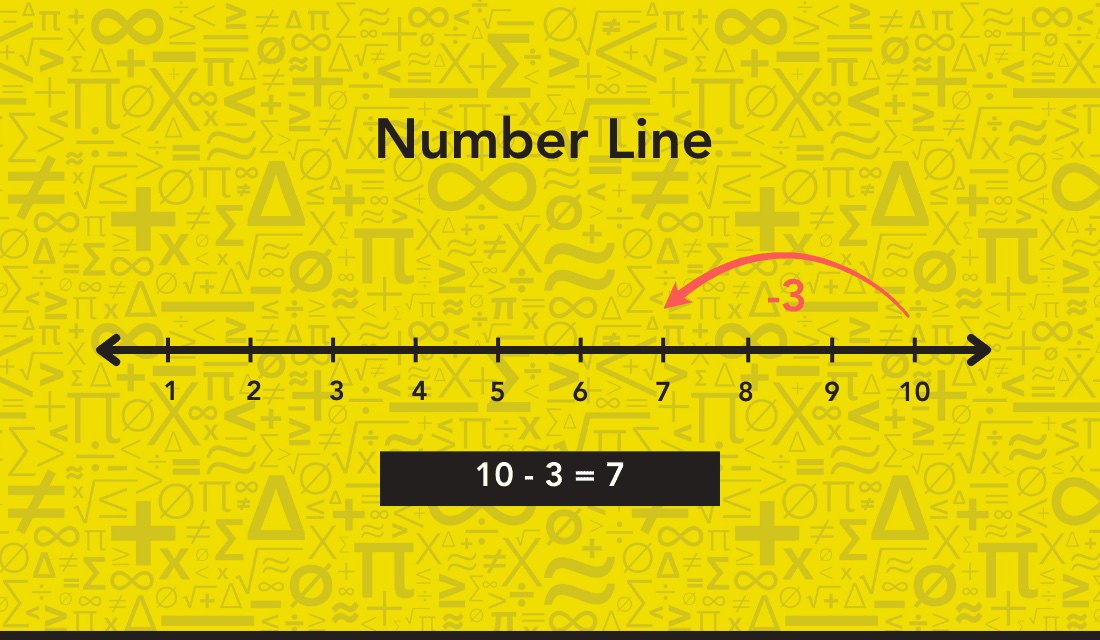
The number line makes subtraction visible: movement in reverse, one step at a time.
3. Multiplication
Multiplication is the process of forming a total from equal groups. 3 × 4 means three groups of four, which gives us 12.
From there, the connection to repeated addition becomes clear: 4 + 4 + 4 = 12 arrives at the same answer, just less efficiently.
Understanding multiplication this way means grasping what it means to scale a quantity and that carries a long way.
Multiplication underpins fractions, ratios, algebra, and virtually everything that follows in middle and high school math. Students who grasp it conceptually arrive at those topics prepared.
Multiplication opens up fast once equal groups click. These strategies help build that understanding step by step.
-
Begin with skip counting. Counting by 2s, 5s, and 10s is multiplication in disguise. It builds the rhythm of equal groups before any symbols appear.
-
Build on repeated addition. 3 × 4 means 4 + 4 + 4. Making this connection explicit helps children understand what multiplication actually does.
-
Use arrays to make equal groups visible. 3 rows of 4 dots is 3 × 4. Drawing or building these with objects helps children see what the numbers actually represent.
-
Start with confidence-building facts. 0s, 1s, 2s, 5s, 10s, and 11s all follow clear patterns and give students early wins that build momentum toward harder facts.
-
Explore patterns in the times tables together. The 9s always add up to 9 (9 × 2 = 18, 1 + 8 = 9). The 5s always end in 0 or 5. The multiplication table is symmetrical: 3 × 4 and 4 × 3 are always the same. Math has structure worth noticing, and discovering it together makes it memorable.
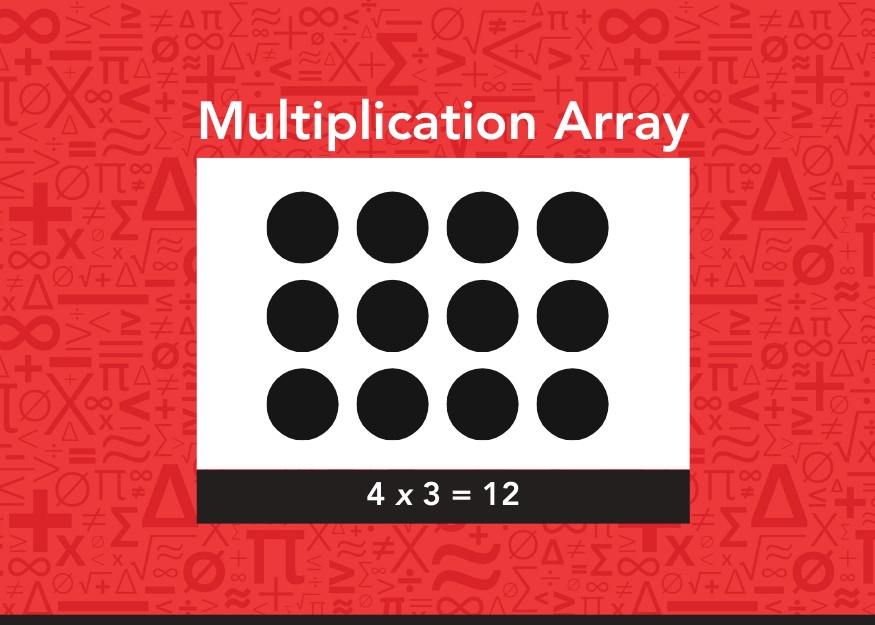
Arrays turn abstract multiplication into something children can see and count.
4. Division
Division is the process of splitting a quantity into equal groups.
12 ÷ 3 can mean "12 items shared among 3 groups: how many in each?" or "How many groups of 3 can I make from 12?" Both questions give the same answer, but they describe different situations.
Children who are comfortable with both interpretations are far more flexible when problems get complex.
Division is also the inverse of multiplication. If 3 × 4 = 12, then 12 ÷ 3 = 4 and 12 ÷ 4 = 3. That relationship is worth making explicit early.
Fractions, ratios, and proportional reasoning all build directly on division. It is one of the most consequential skills in the entire K-12 sequence.
These strategies help children build division understanding through things they can see, touch, and relate to.
-
Start with equal sharing using physical objects. Give your child a pile of coins, snacks, or blocks and ask them to share equally. "Here are 18 lemons. Can you split them between 3 bowls?" That fair-sharing model is usually the first way children naturally grasp what division does.
-
Use a number line to show division as backward hops. Starting at 12 and hopping back in steps of 3 lands you at zero after 4 hops. That's 12 ÷ 3 = 4, counted out one step at a time.
-
Connect division to repeated subtraction. 20 ÷ 4 means subtracting 4 repeatedly until you hit zero. Count how many times: that's your answer.
-
Reinforce the multiplication-division relationship with fact families. If 4 × 6 = 24, then 24 ÷ 6 = 4 and 24 ÷ 4 = 6. Same three numbers, three different truths. Children who see this connection check their own work naturally and arrive at algebra better prepared.
📕 You May Also Like: 7 Creative Kid-Friendly Techniques to Learn Division
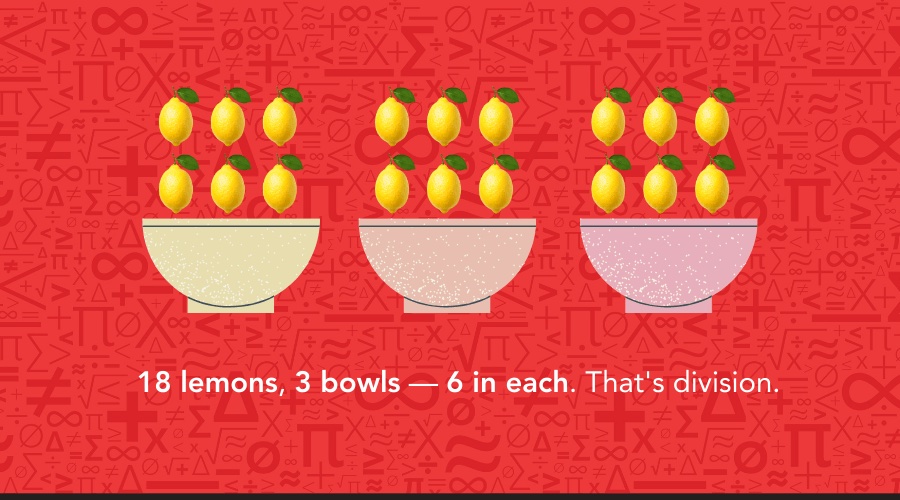
Equal sharing is usually the first way children naturally grasp what division does.
How Mathnasium Helps Students Master Any Math Skill
Mathnasium is a math-only learning center dedicated to empowering students of all skill levels to learn and master math.
Our tutors use the Mathnasium Method™, a proprietary teaching approach designed to unlock each student’s true math potential.
To build a deep understanding of any math skill, including basic operations, our approach includes:
-
Personalized learning plans: Each student begins with a diagnostic assessment to help us pinpoint their strengths and knowledge gaps. Using these insights, we create a learning plan customized to each student’s needs.
-
Teaching for understanding: We phrase math concepts in everyday language and use a combination of verbal, visual, mental, tactile, and written teaching techniques to help students truly make sense of what they’re learning.
-
Caring, supportive tutors: Our tutors are trained in math and in the emotional side of teaching. This means they know how to encourage a student who’s stuck and how to challenge one who’s ready to advance.
-
Problem-solving and critical thinking skills: During sessions, we always allow time for productive struggle, then rejoin students to check and correct their processes. This helps them learn to rely on their own thinking. We guide them through both the how and the why behind each math problem, not just the answer. This approach develops the problem-solving and critical thinking tools they’ll use in math and life.
-
A confidence-building, fun learning environment: We often hear students say our sessions don’t feel like lessons at all. That’s because we incorporate game-based activities and plenty of rewards to keep students motivated and engaged.
Families see measurable results:
-
94% of parents report an improvement in their child's math skills and understanding
-
93% of parents report an improved attitude towards math after attending Mathnasium
-
90% of students saw an improvement in their school grades
Mathnasium operates over 1,100 learning centers, bringing top-rated math tutors and our proven method close to your community.
Mathnasium of Paoli is a trusted local center with years of experience helping students in and around Paoli, PA, build lasting math skills and confidence.
If your child is looking to catch up, keep up, or get ahead in math, our team is ready to assist!
📅 Schedule a Free Diagnostic Assessment at Mathnasium of Paoli
Not near Paoli?
📍 Find Mathnasium Learning Centers Near You


 (610) 644-2306