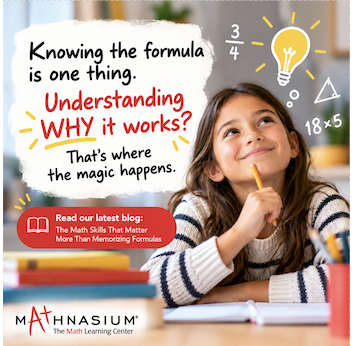
Why number sense, problem-solving, and flexible thinking are the real building blocks of math success.
When you think back to your own math classes, what do you remember? Maybe it's the quadratic formula, the steps for long division, or the familiar phrase "Please Excuse My Dear Aunt Sally."
For many of us, learning math meant memorizing formulas, rules, and procedures. And while those tools certainly have their place, there's something even more important when it comes to building strong math students: understanding why math works, not just remembering how to do it.
At Mathnasium of Park City, we believe that developing strong mathematical thinking skills helps students become more confident, capable, and independent learners.
So, what are the skills that really matter?
1. Number Sense: Understanding How Numbers Work
Number sense is the ability to understand numbers, their relationships, and how they behave. It's one of the most important foundations for math success.
For example, consider the problem:
49 + 36 = ?
A student relying solely on a memorized procedure might immediately stack the numbers and begin adding.
A student with strong number sense might think:
49 is just one away from 50. I'll take 1 from 36 to make 50 + 35 = 85.
Both methods get the correct answer, but the second demonstrates a deeper understanding of numbers and their relationships.
Strong number sense helps students estimate, recognize patterns, catch mistakes, and approach unfamiliar problems with confidence.
Try this at home: Ask your child, "What's another way you could solve that?" It's a simple question that encourages flexible thinking.
2. Mental Math: Building Confidence Without a Calculator
Mental math isn't just about being fast. It's about being comfortable working with numbers and choosing efficient strategies.
Consider calculating 25 × 16.
Rather than reaching for a calculator or working through traditional multiplication, a student might recognize that:
25 × 4 = 100
And since 16 is four groups of 4:
25 × 16 = 100 × 4 = 400.
Mental math strengthens working memory, improves number fluency, and helps students recognize when an answer doesn't make sense.
And these skills extend well beyond the classroom, from calculating discounts while shopping to estimating how long a road trip will take.
Try this at home: While shopping, ask your child to estimate the total cost of a few items before you reach the register.
3. Problem-Solving: Knowing What to Do When the Answer Isn't Obvious
One of the biggest differences between memorizing math and understanding math becomes clear when students encounter a problem they haven't seen before.
A student who has memorized a specific procedure may feel stuck if a question looks different from the examples they've practiced.
But a strong problem-solver knows how to break a challenge into smaller pieces, look for patterns, draw a picture, or try a different approach.
These are skills that apply far beyond math class.
Try this at home: Instead of immediately showing your child how to solve a difficult problem, ask:
- "What do you already know?"
- "Can you break this into smaller steps?"
- "Could you draw a picture to help?"
- "Does your answer make sense?"
These questions help children develop the confidence to work through challenges independently.
4. Flexible Thinking: Discovering There's More Than One Way
One of the most powerful realizations a child can have in math is that there isn't always just one way to solve a problem.
Take 18 × 5, for example.
A student might:
- Multiply 10 × 5 and 8 × 5, then add the results.
- Recognize that 18 × 10 = 180, then divide by 2.
- Think of 20 × 5 = 100, then subtract 2 × 5.
Each strategy leads to 90.
Being able to approach a problem in different ways helps students develop a deeper understanding of mathematical relationships. It also gives them options when one method doesn't immediately make sense.
Try this at home: Ask your child to explain how they arrived at an answer, even when it's correct. You might be surprised by their creativity!
5. Mathematical Reasoning: Understanding the "Why"
Memorizing that a negative times a negative equals a positive might help a student pass a quiz.
But understanding why that rule works helps them apply it confidently in new situations.
Mathematical reasoning is the ability to explain, justify, and make connections between ideas.
It's what allows students to move beyond simply following instructions and begin thinking like mathematicians.
A child who can explain why an answer makes sense is demonstrating a level of understanding that memorization alone can't provide.
Try this at home: Make "How do you know?" a regular part of math conversations. Encourage your child to explain their thinking rather than focusing only on whether the answer is right.
So, Does Memorization Still Matter?
Absolutely!
Knowing multiplication facts, recognizing common formulas, and recalling basic math rules are all valuable. When students can retrieve these facts easily, they have more mental energy available for complex problem-solving.
But... memorization works best when it's built on understanding.
Think of it this way: memorized facts and formulas are the tools in a student's toolbox. Number sense, reasoning, and problem-solving are the skills that teach them which tool to use, when to use it, and why it works.
Students need both.
Building Thinkers, Not Just Test-Takers
At Mathnasium of Park City, our goal isn't simply to help students get through tonight's homework or prepare for the next test.
We want them to develop the mathematical understanding and confidence that will serve them throughout their education and beyond.
Through individualized learning plans, guided instruction, and a focus on foundational skills, we help students strengthen their number sense, develop problem-solving strategies, and discover that math can actually make sense.
Because the most valuable thing a child can learn in math isn't a formula.
It's the confidence to think through a problem and figure it out.
---
Curious about your child's math foundation?
At Mathnasium of Park City, we offer a free math assessment to identify your child's strengths, uncover any gaps, and help you understand where they stand.
Visit www.mathnasium.com/parkcity or call 435-272-4994 to schedule a free assessment.


 (435) 272-4994