A honeycomb is made of thousands of six-sided cells, each one identical, fitting together with no gaps and no wasted space. Bees have been building this structure for millions of years.
The shape they use is the hexagon, and nature keeps returning to it for good reason. Geometry class is where we learn to describe that reason precisely, calculate the hexagon's measurements, and figure out why it's nature's favorite building block.
Today, our tutors break down what a hexagon is, explore its properties and angles, walk through how to find the perimeter and area of a regular hexagon, and look at where hexagons show up in the world around us.

What Is a Hexagon?
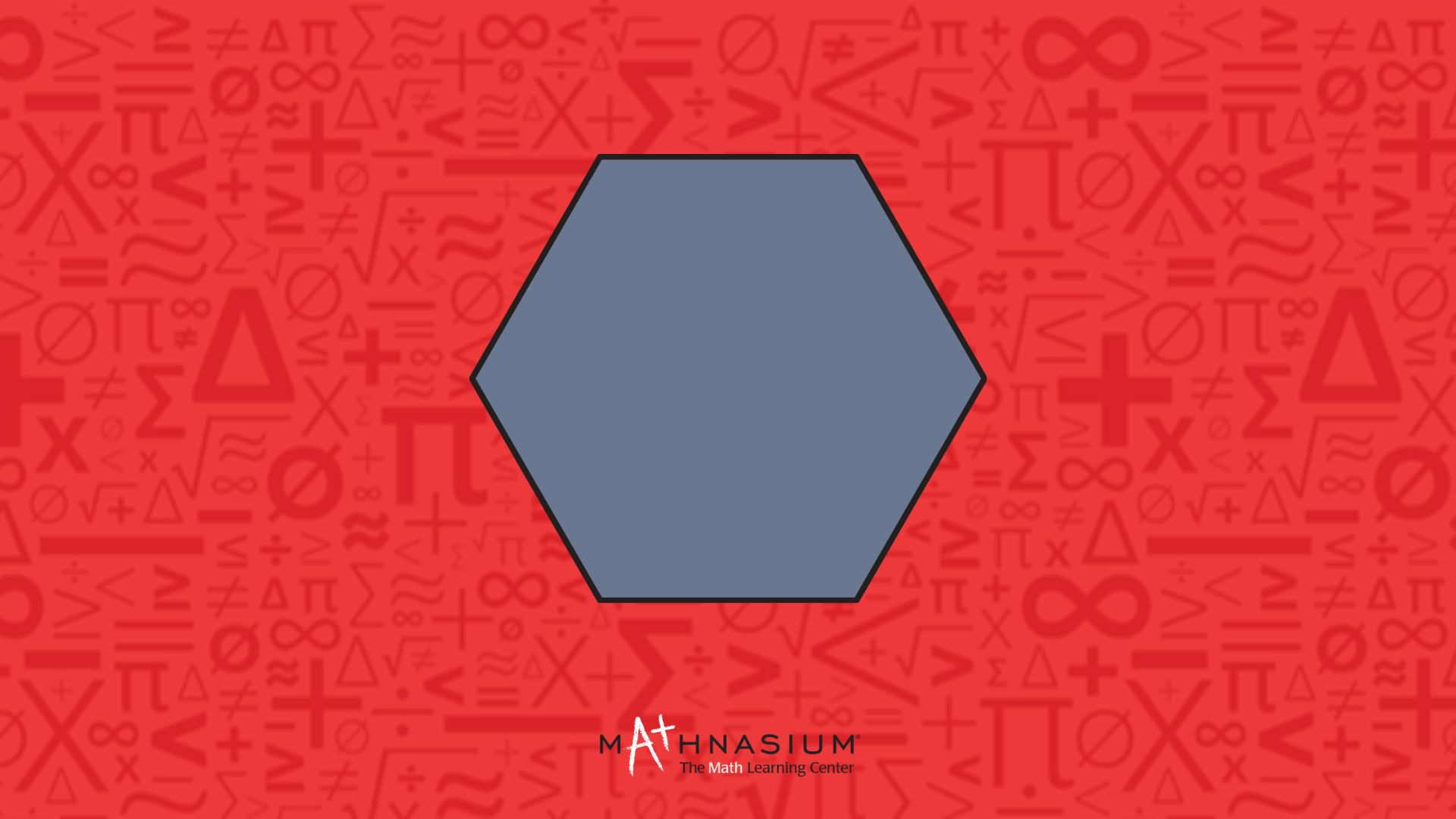
A hexagon is a polygon with exactly six straight sides and six angles.
The word hexagon comes from the Greek words hex, meaning six, and gonia, meaning angle. The name tells us what to count.
Hexagons belong to the same polygon family as triangles, quadrilaterals, and pentagons.
Properties of a Hexagon
Every hexagon, no matter how it is drawn, shares the same set of properties:
📕 You May Also Like: Regular vs. Irregular Polygons: What's the Difference?
Types of Hexagons
Not every hexagon looks like the ones in a geometry textbook. Hexagons vary in symmetry, side length, and the direction their vertices point.
Here is how we classify them.
1. Regular Hexagon
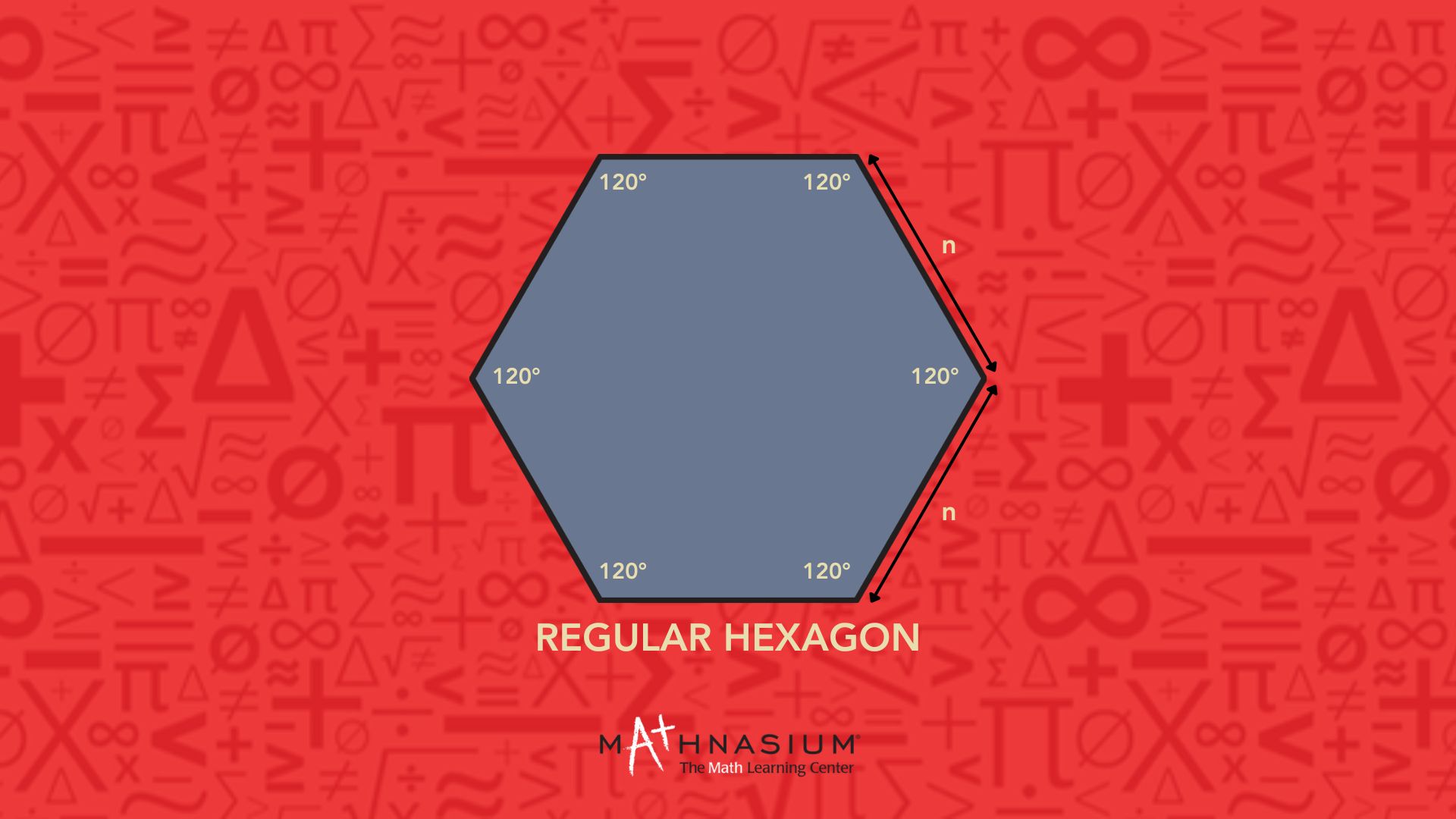
A regular hexagon has six sides of equal length and six angles of equal measure. Both conditions have to be true at the same time.
This is why our regular hexagon is also perfectly symmetrical.
2. Irregular Hexagon
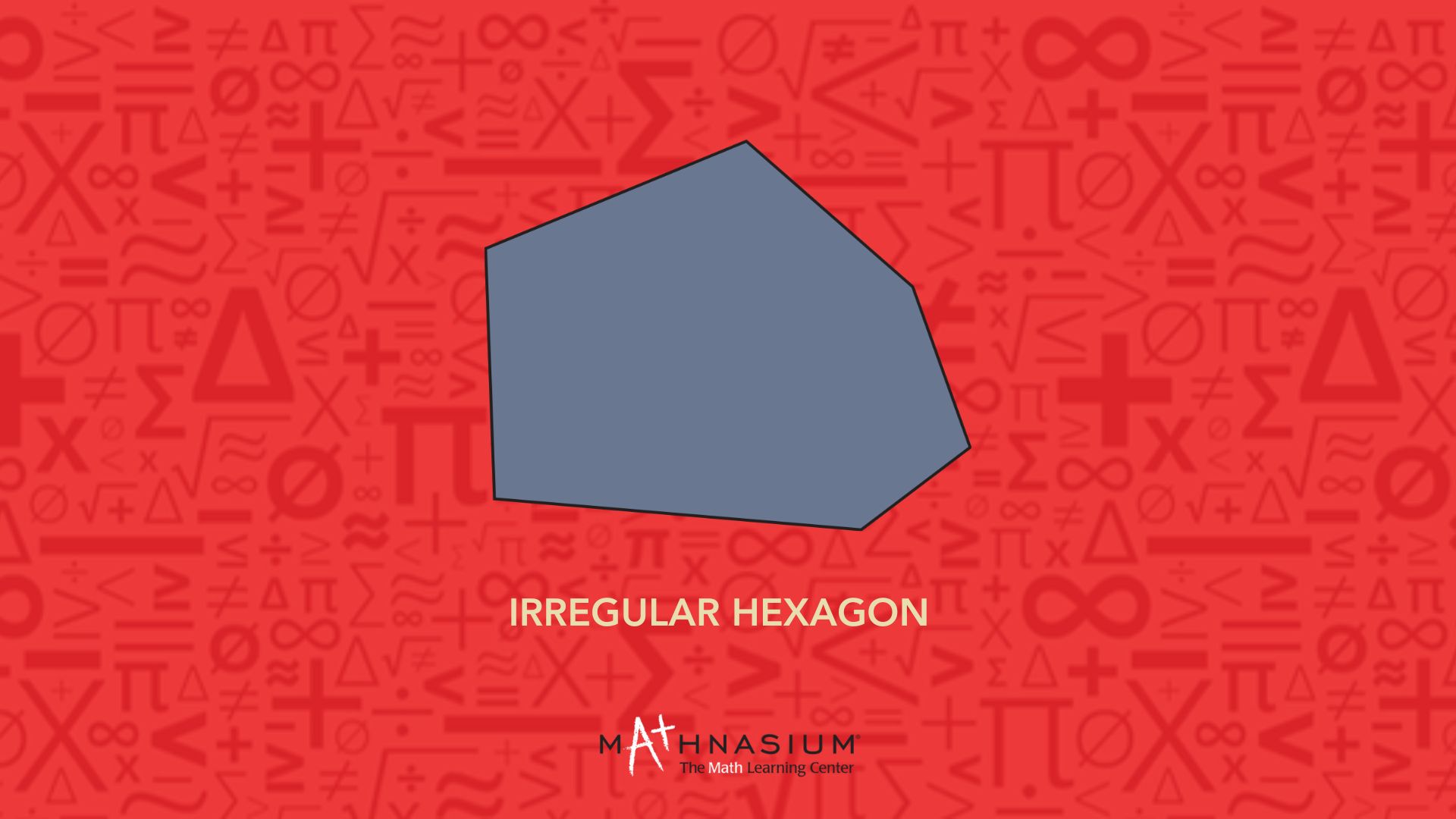
An irregular hexagon is any hexagon where the sides, the angles, or both are unequal. We only need one of those conditions to be unmet for the hexagon to be irregular.
-
Sides may be different lengths
-
Angles may be different measures
-
Interior angles still add up to 720°
3. Convex Hexagon
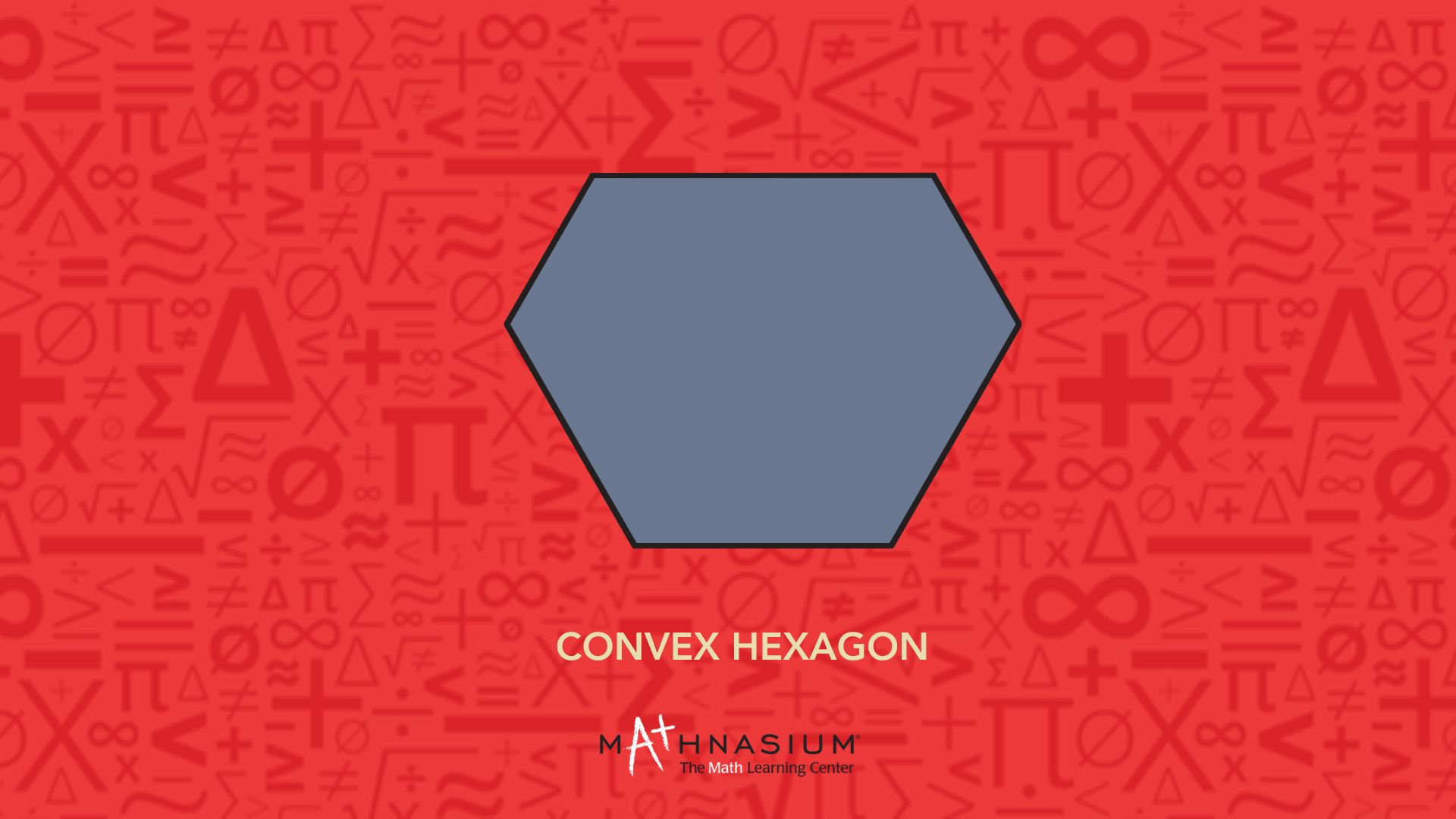
In a convex hexagon, every vertex points outward, and every interior angle stays below 180°.
We can think of it as a shape that bulges outward at every point, with no indentations anywhere. Every regular hexagon is convex.
4. Concave Hexagon
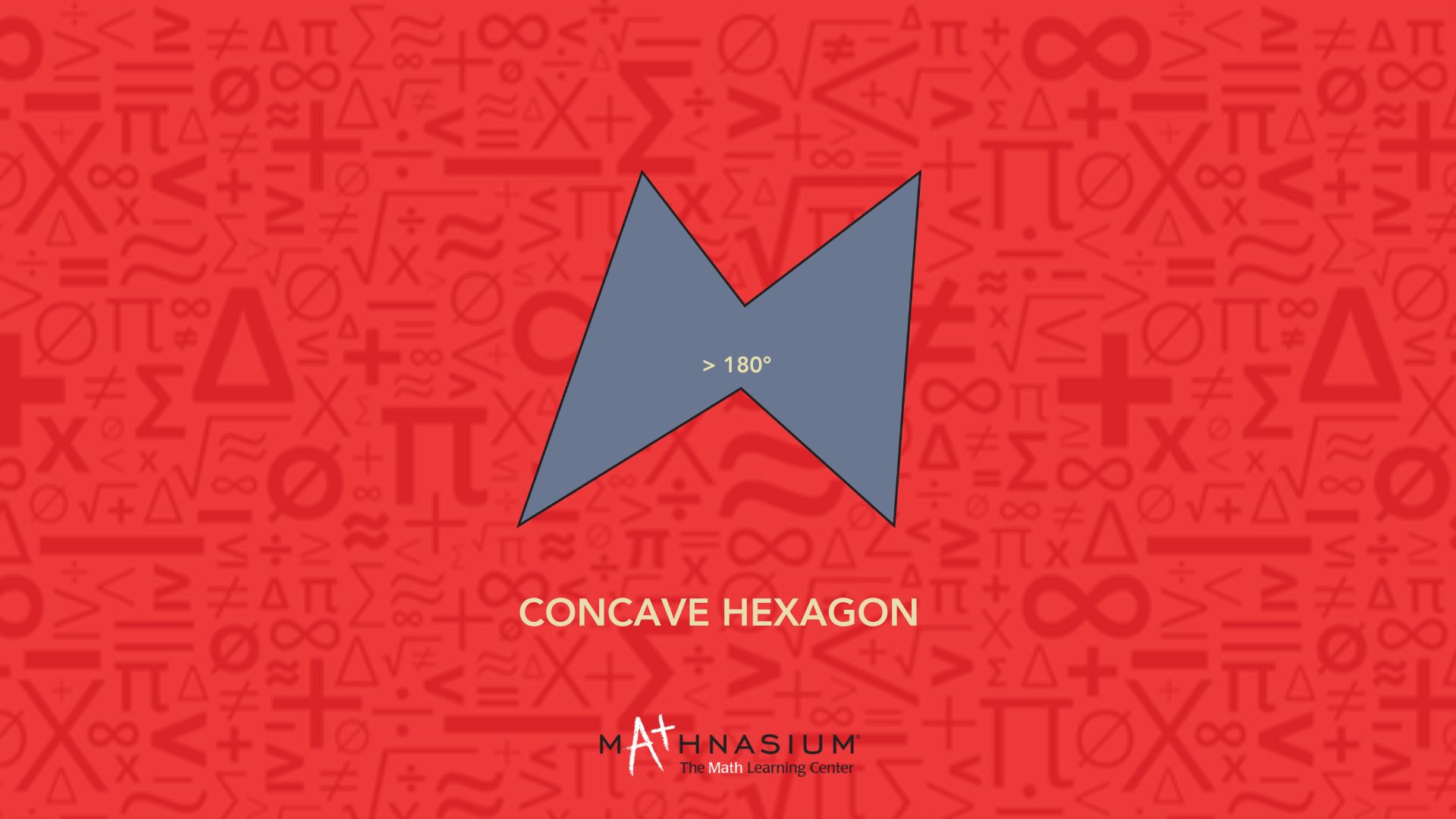
A concave hexagon has at least one vertex that turns inward, giving the shape an indentation.
We can think of it as a shape with a dent in it. The interior angle at that inward vertex exceeds 180°. A concave hexagon is always irregular.
📕 You May Also Like: Types of Angles: How to Identify Straight, Right, Acute, and Obtuse Angles?
The Interior Angles of a Regular Hexagon
The interior angles of a regular hexagon add up to 720°.
How do we figure out the measure of just one angle, and where does that total come from?
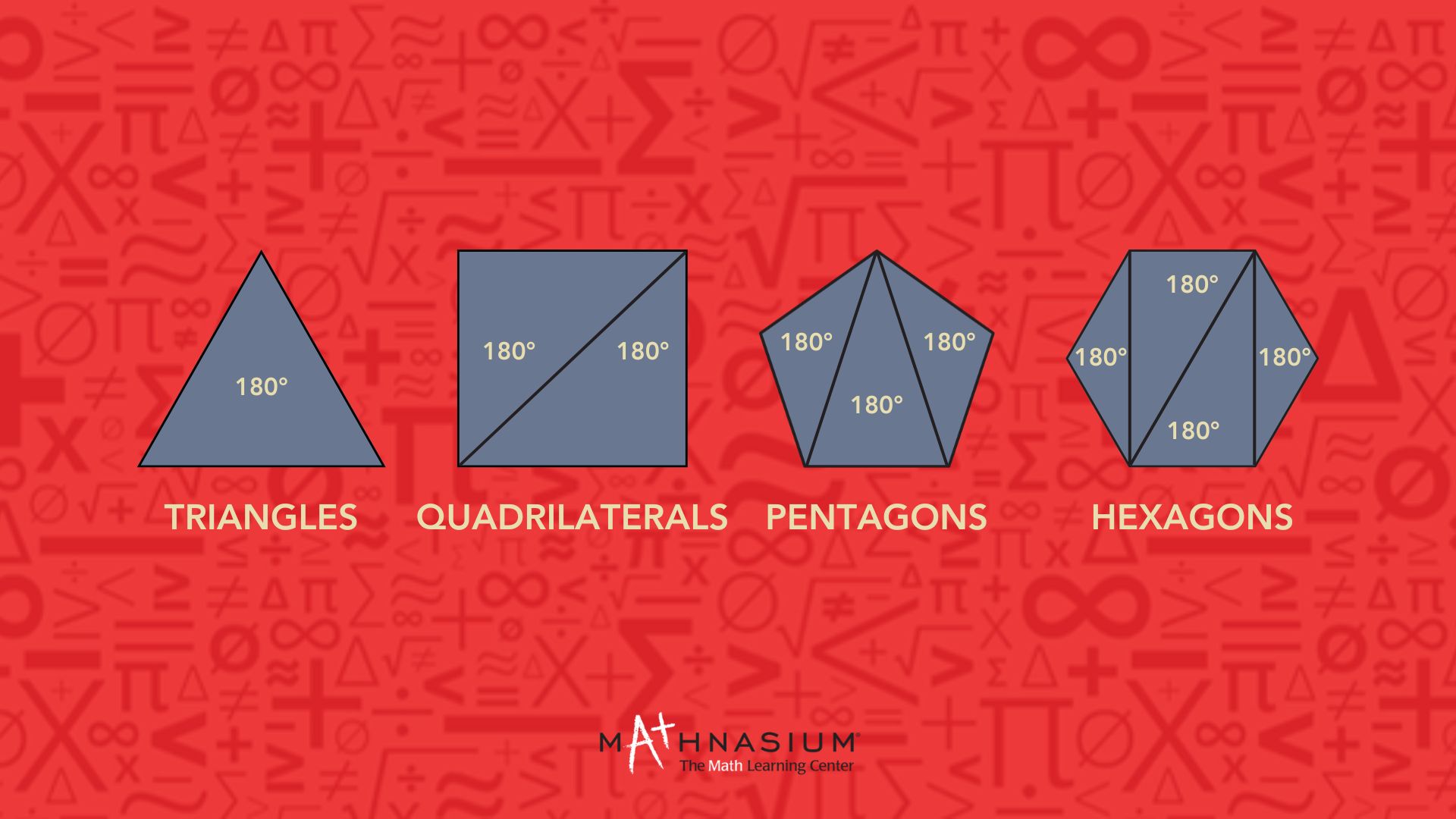
Both answers start with triangles. We pick any single vertex of the hexagon and draw straight lines to every other vertex that is not directly connected to it.
How many triangles do we get? Four, every time, no matter what the hexagon looks like.
Every triangle has an angle sum of 180°. So four triangles give us:
4 × 180° = 720°
This relationship holds for every polygon. Each time we add one more side, we get one more triangle inside it, and each time we remove a side, we lose one. The number of triangles is always two less than the number of sides.
That pattern gives us a formula we can use for any polygon:
Sum of interior angles (S) = (n − 2) × 180°
For a hexagon, n = 6 represents the number of sides:
S = (6 − 2)180°
S = 4180°
S = 720°
Now we know where 720° comes from. All six angles in a regular hexagon are equal, so we divide the total equally among all six:
720° ÷ 6 = 120°
Each interior angle of a regular hexagon measures 120°.
📕 You May Also Like: How to Complete the Square? A Simple Guide
How to Find the Perimeter of a Regular Hexagon
The perimeter of a regular hexagon is the total distance around its six equal sides.
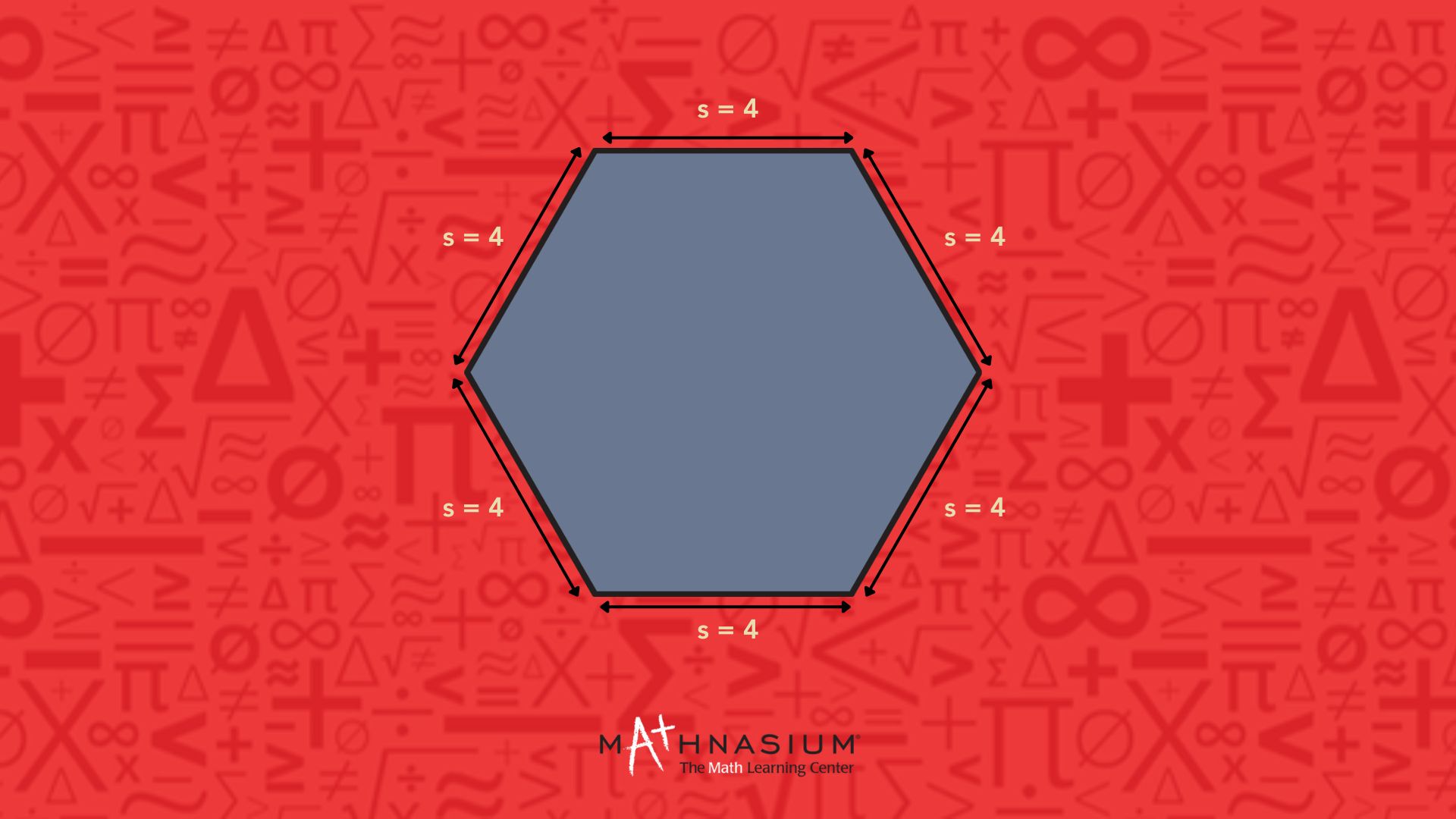
Because all six sides are equal, we do not need to measure each one separately. We use a single side length, which we call s, and multiply it by six:
P = 6 × s
Let us try it with a hexagon where each side measures 4 inches:
P = 6 × 4
P = 24 inches
The total distance around that hexagon is 24 inches.
How to Find the Area of a Regular Hexagon
The area of a regular hexagon is the total space it encloses. To find it, we use a method that connects directly to what we already know about the shape.
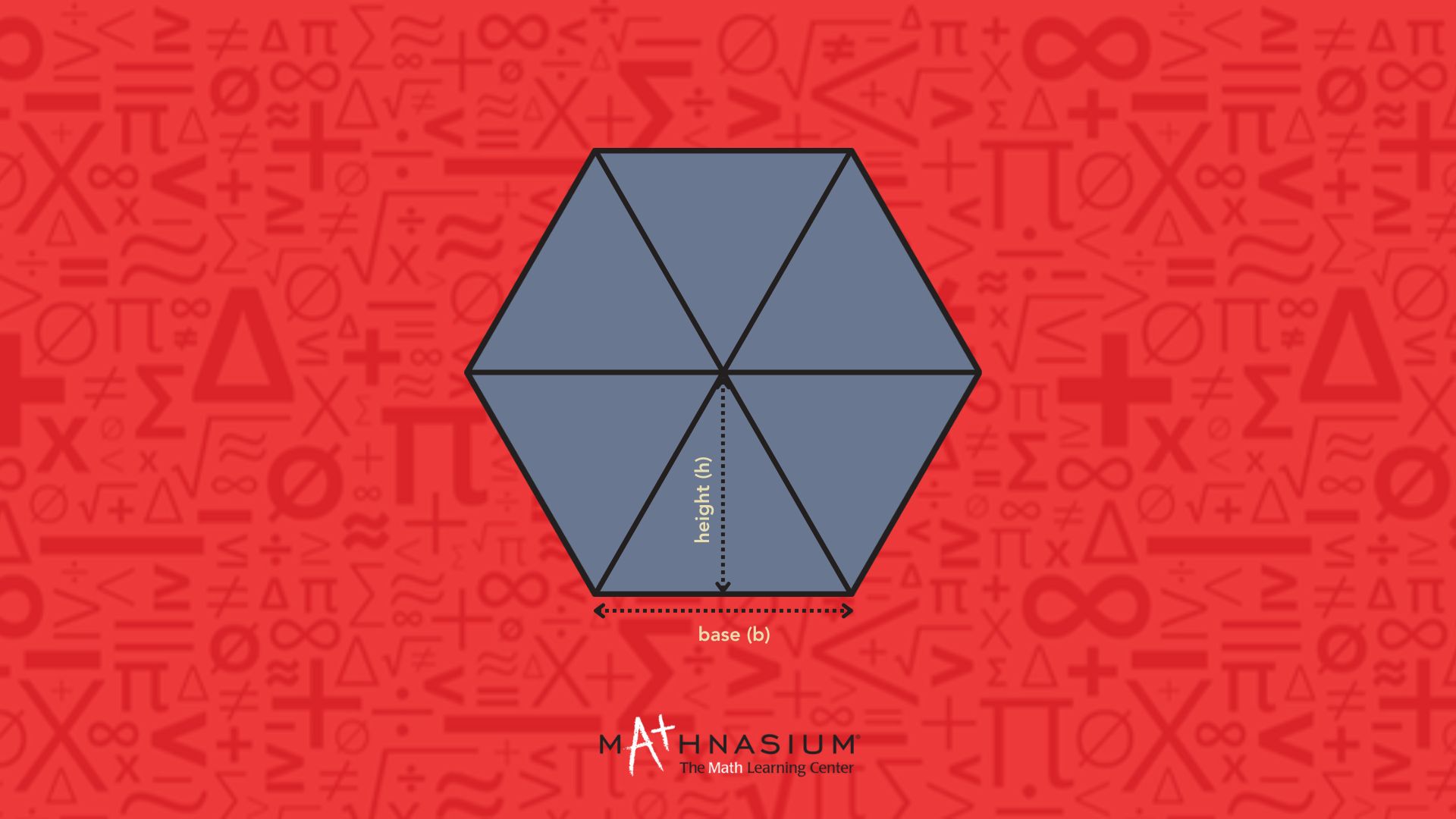
We draw lines from the center of the hexagon to each of the six vertices. Remember what happens?
The hexagon splits into six identical triangles. And because all six sides of a regular hexagon are equal, each of those triangles is equilateral. This means all three sides are equal and all three angles measure 60°.
That means we can find the area of the whole hexagon by finding the area of one triangle and multiplying by six.
The area of a triangle is:
Area of triangle = \(\frac{1}{2}\) × base × height
In each equilateral triangle, the base is the side of the hexagon, which we call s. The height of an equilateral triangle with side s is:
height = \(\frac{\sqrt{3}}{2}s\)
So the area of one equilateral triangle is:
Area of triangle = \(\frac{1}{2}s × (\frac{\sqrt{3}}{2}s)\)
Area of triangle = \(\frac{\sqrt{3}}{2}s^2\)
The hexagon contains six of these triangles, so we multiply by six:
Area of hexagon = 6 × \((\frac{\sqrt{3}}{2}s^2)\)
Area of hexagon = \(\frac{3\sqrt{3}}{2}s^2\)
Now, let us try it with a hexagon where each side measures 4 inches:
A = \(\frac{3\sqrt{3}}{2}s^2 × 4^2\)
A = \(\frac{3\sqrt{3}}{2}s^2 × 16\)
A = \(24\sqrt{3}\)
A ≈ 41.57 square inches
The total area of that hexagon is approximately 41.57 square inches.
📕 You May Also Like: How to Calculate the Area of Triangles - A Beginner's Guide
Where Hexagons Show Up in Nature
We find hexagons throughout the natural world because six-sided shapes provide the highest possible structural efficiency, allowing patterns to pack tightly together with zero wasted space.
Let us look at why nature keeps returning to this geometry.
A. Honeycombs
A honeycomb is a clear example of hexagons in nature. Bees build each cell with six equal sides so that the chambers fit together with no gaps.
A hexagon uses less wax to enclose a given amount of space than any other shape that can tile a flat surface without gaps. For a bee colony producing thousands of cells, that efficiency adds up.

B. Snowflakes
Every snowflake has six-fold symmetry. The water molecules that make up ice naturally bond at angles of 60 degrees, which is the same angle we find at every vertex of a regular hexagon.
No two snowflakes look identical, but every snowflake reflects that same underlying hexagonal structure.
C. Basalt Columns
When lava cools slowly and evenly, the material contracts and cracks into columns. The most efficient way for those cracks to form is in a pattern that minimizes stress across the surface, and that pattern is hexagonal.
The Giant's Causeway in Northern Ireland is a famous example, with thousands of hexagonal basalt columns packed tightly together.
D. Dragonfly Eyes
A dragonfly's compound eye consists of thousands of tiny lenses packed together. Each lens is hexagonal, allowing the maximum number of lenses to fit into the available space with no gaps.
The same efficiency that drives honeybees drives dragonfly vision.
📕 You May Also Like: What Is a Tessellation in Math? Definition, Types & Real-World Examples
Quiz: How Well Do You Know Hexagons?
Our tutors put together six questions to test what we covered in this guide. Work through each one carefully.
Question 1: How many sides does a hexagon have?
a) 5
b) 6
c) 7
d) 8
Question 2: What is the sum of the interior angles of any hexagon?
a) 540°
b) 630°
c) 720°
d) 900°
Question 3: Which of the following is always true of a concave hexagon?
a) All sides are equal
b) All angles measure 120°
c) At least one interior angle exceeds 180°
d) It is always regular
Question 4: A regular hexagon has how many lines of symmetry?
a) 3
b) 4
c) 6
d) 8
Question 5: A regular hexagon has a side length of 7 inches. What is its perimeter?
a) 35 inches
b) 42 inches
c) 49 inches
d) 56 inches
Question 6: A regular hexagon has a side length of 2 inches. What is its area?
a) 6√3 square inches
b) 8√3 square inches
c) 10√3 square inches
d) 12√3 square inches
Once you have finished, check your answers below to see how well you know your hexagons.

At Mathnasium, our specially trained tutors help students understand the reasoning behind every concept, building geometry skills that carry forward through every stage of their math education.
How Mathnasium Helps Students Master Geometry
Mathnasium is a math-only learning center helping K-12 students catch up, keep up, and get ahead in math.
Geometry is where abstract ideas become visible. Shapes, angles, and math rules all connect, and a gap in one concept tends to show up in the lessons that follow.
We’ve built our proprietary teaching approach, the Mathnasium Method™, around developing that understanding concept by concept, tailoring our instruction to each student's individual needs and learning style.
It begins with a diagnostic assessment that identifies each student's strengths and knowledge gaps. From those insights, we build a personalized learning plan tailored to the student's needs and goals.
With the personalized learning plan in place, our specially trained tutors deliver face-to-face math instruction in a supportive and engaging environment.
We use clear, everyday language and a mix of verbal, visual, mental, tactile, and written techniques so each concept lands in a way that carries forward.
A concept that causes difficulty gets broken down into manageable steps, with attention to both the how and the why behind the answer. Students build the problem-solving and critical thinking tools they carry into every math topic that follows.
Fun is an important part of how we work. Sessions are often game-based, students earn rewards along the way, and we celebrate every bit of progress. Confidence grows session by session.
The results speak for themselves:
-
94% of parents report an improvement in their child's math skills and understanding
-
93% of parents report their child's improved attitude toward math after attending Mathnasium
-
90% of students saw an improvement in their school grades
With over 1,100 learning centers across North America, Mathnasium brings top-rated math instruction close to home.
For families in and around Plano, TX, Mathnasium of Plano is a trusted local center with years of experience helping students build lasting confidence in geometry and every math concept that follows.
Whether your child needs to catch up, keep up, or get ahead, our team is happy to help.
📅 Schedule a Free Diagnostic Assessment at Mathnasium of Plano
Not near Plano?
📍 Find a Mathnasium Learning Center Near You
Pssst! Check Your Answers Here
How did you do? Compare your answers here:
Question 1: b) 6
Question 2: c) 720°
Question 3: c) At least one interior angle exceeds 180°
Question 4: c) 6
Question 5: b) 42 inches
Question 6: a) 6√3 square inches


 (972) 393-6284