

Potomac
10154 River Road
Potomac, MD 20854

Students usually first encounter logarithms in Algebra 2, typically in 10th or 11th grade. The notation can feel more complicated than the idea behind it. The entire concept comes down to one basic question: “What exponent do I need to turn one number into another?”
Because logarithms build directly on exponents, they give students a useful way to solve exponential equations, especially when the exponent is not easy to recognize.
We are Mathnasium of Potomac, and today we break down what logarithms are, how to read them step by step, and why we use them in Algebra 2. You will also see how students solve standard logarithm problems in class, complete with step-by-step examples and practice questions.

A logarithm is the inverse of exponentiation. It tells us which power we need to make one number from another. Let’s first take a look at a simple math statement:
log2(8) = 3
We can read it as “What exponent must 2 be raised to in order to equal 8?” The answer is 3.
Every logarithm contains three different parts:
It starts with a base, which is the number raised to a power (in this example, 2).
It sets a target result that we want to reach (8).
It solves for the exponent needed to produce that target (3).
The symbol “log” tells us to find the exponent that connects the base to the target result. We can use the same structure to read any logarithm.
logb(a) = c
Here, b is the base, a is the target result, and c is the exponent. Now let’s use a different example to see where each part appears
log3(81) = 4
The table below shows what each number represents:
|
log3(81) = 4
|
What it tells us
|
|
3
|
The base
|
|
81
|
The target result
|
|
4
|
The exponent
|
📕 You May Also Like: What Is an Exponent? A Complete, Beginner-Friendly Guide
In math, logarithms and exponents describe the same calculation but from different starting points. Let’s start with a logarithm.
log5(125) = 3
What can we see here? This tells us that 3 is the exponent we need to make 125 (target result) from 5 (base).
We can write the same information in exponential form:
53 = 125
To convert from logarithmic form to exponential form, we keep the base the same. Then, we move the logarithm’s answer into the exponent and write the number inside the parentheses as the result:
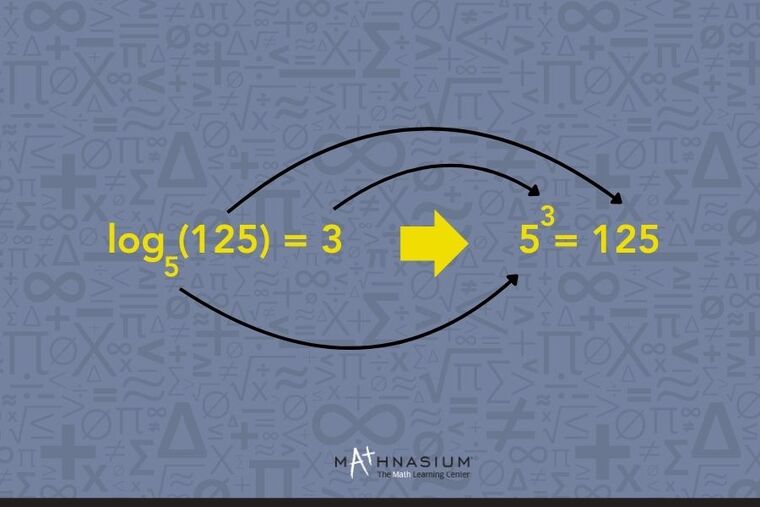
With exponentiation, we know the base and exponent and just calculate the result, while with a logarithm, we know the base and result and find the exponent.

We use logarithms in Algebra 2 to find an unknown exponent when we cannot recognize it from the base and result of an exponential equation. We also use logarithms with exponents we already know, such as to practice reading and writing logarithmic notation.
In some exponential equations, like 2x=8, the answer is clear. The exponent tells us we need to multiply 2 by itself three times to get 8.
2 x 2 x 2 = 23 = 8
But how do we solve for x in 2x=7? We can use nearby multiplication facts to narrow down the answer. If we multiply 2 by itself twice, we get 4. The next number is 3, and if we multiply it by itself three times, the result is 8.
2 x 2 = 22 = 4
2 x 2 x 2 = 23 = 8
Since 7 falls between 4 and 8, the exponent in the equation 2x = 7 must fall between 2 and 3. However, we still do not know its exact value. To find its exact value, we evaluate the logarithm log2(7) with a calculator.
log2(7) ≈ 2.81
If we rewrite this into an exponential equation, we get 22.81 ≈ 7.
📕 You May Also Like: 9 Tips to Help Your Child Master Multiplication Facts
The next few examples will help us reinforce our knowledge of logarithms and how they work. Let’s do them together.
Let’s write 72 = 49 in logarithmic form.
First, we need to identify what the base, exponent, and target result in our equation are.
The base is 7.
The exponent is 2
The target result is 49.
Now that we know what each number is, we can write the logarithm. The base goes right under the symbol ‘’log’’, the target result goes in parentheses, and the exponent goes to the other side of the equation symbol.
72 = 49 ➝ log7 (49) = 2
Now, what does log4 (64) = 3 look like in its exponential form? Let’s find out.
In the equation in front of us, we first identify its parts (the base, exponent, and target result).
The base is 4.
The exponent is 3
The target result is 64.
After we found out what each number represents, we can write the exponential equation. The base (4) goes first. Then we write the exponent (3) above it (slightly to the right). Finally, the target result goes on the other side of the equation symbol.
log4 (64) = 3 ➝ 43 = 64
Let’s now evaluate a logarithm log3 (20) = x.
This logarithm asks us what exponent we need to raise 3 to in order to get 20.
We can first estimate the answer. If we multiply 3 by itself, we get 9. Then, if we use the next whole number (3) and multiply 3 by itself three times, we get 27. Since there are no numbers in between to multiply with, we can say that the exponent we need is between 2 and 3.
As most calculators have a ‘’log’’, to calculate log3(20) enter log(20)÷log(3)
log3(20) = log(20) log(3) ≈ 2.73
In exponential form, this means:
32.73 ≈ 20
📕 You May Also Like: How Estimation and Rounding Support Number Sense in Math
Our tutors prepared a few practice challenges for you to put your knowledge to work. Try them on your own and check the answers at the end of this guide.
Challenge 1: Write 82 = 64 in logarithmic form.
Challenge 2: Write log9(81) = 2 in exponential form.
Challenge 3: Evaluate log5(125).
Challenge 4: Evaluate log2(32).
Challenge 5: Evaluate log4(30).
 At Mathnasium, we make sure that concepts like logarithms land by using natural language and clear explanations step-by-step.
Mathnasium is a math-only learning center that helps K-12 students catch up, keep up, and get ahead in math.
Whether your student needs to rebuild foundational skills, master specific concepts like logarithms, or is looking for additional challenges, Mathnasium provides a personalized path forward.
To provide that support, we use the Mathnasium Method™, our proprietary teaching approach, to meet students where they are and guide them forward step by step.
Each student starts their Mathnasium journey with a diagnostic assessment that helps us identify their current skills, knowledge gaps, and learning goals. With those insights, we build a personalized learning plan tailored to their needs and pace.
Our specially trained tutors follow the plan closely and provide live, face-to-face instruction in a caring and fun group environment. We use mental, verbal, visual, tactile, and written techniques so that any math concept can land. For example, these techniques help them see how logarithms and exponents connect.
If students get stuck on any math concepts like logarithms, we break them down into manageable steps and teach both the how and the why behind them.
As time goes on, students learn to do the same independently. They walk out of our centers with the problem-solving skills and critical thinking tools they can use in the math classroom and beyond.
Fun is an important part of how we work. Sessions often include game-based and hands-on activities that keep students engaged and make learning more enjoyable. Students earn rewards along the way, and we celebrate every bit of progress, so confidence grows alongside mastery.
The results speak for themselves:
94% of parents report an improvement in their child's math skills and understanding
93% of parents report their child's improved attitude toward math after attending Mathnasium
90% of students saw an improvement in their school grades
With over 1,100 active learning centers, Mathnasium brings top-rated math instruction close to your community.
For families in and near Potomac, Maryland, Mathnasium of Potomac is a trusted local center with years of experience helping students excel in math.
If your child needs help with math concepts like logarithms, a free diagnostic assessment is a great place to start. Using what we learn, we create a personalized learning plan that helps your child master the skills they need next.
📅 Schedule a Free Assessment at Mathnasium of Potomac
Not near Potomac?
📍 Find a Mathnasium Learning Center Near You
If you’ve given our practice challenges a try, here are the answers.
Challenge 1: 82 = 64 in logarithmic form is: log8(64) = 2
Challenge 2: log9(81) = 2 in exponential form: 92 = 81
Challenge 3: log5(125) = 3
Challenge 4: log2(32) = 5
Challenge 5: log4(30) ≈ 2.45
How did you do?
Mathnasium of Potomac is a math-only learning center for K-12 students in Potomac, MD. Trusted by over a million parents, Mathnasium uses personalized learning plans and the proprietary Mathnasium Method™ to help students catch up, keep up, and get ahead on their math journey.
Our specially trained tutors deliver face-to-face instruction in a supportive and fun small-group environment, working with students both in center and online to develop a deep understanding of math, build confidence, and improve academic performance.
Schedule Free Assessment
 (301) 747-6284
 (877) 968-6284











