We usually notice that fraction operations get tricky the moment denominators don't match, like trying to solve \(\Large\frac{4}{8}\) + \(\Large\frac{2}{7}\), or figuring out which one is bigger.
That's where multiples come to our rescue. Multiples are the key tool we use to make fraction operations a lot easier.
We're Mathnasium of Queen Creek, and today we’ll show you what multiples are and four ways they make working with fractions easier, so you can add, subtract, compare, scale up, and simplify with ease.

What Is a Multiple in Math?
A multiple of a number is the product we get when we multiply that number by a whole number (1, 2, 3, 4, and so on)
For example:
-
The multiples of 4 are 4, 8, 12, 16, 20, … because they come from 4 × 1, 4 × 2, 4 × 3, 4 × 4, 4 × 5, and so on.
-
21 is a multiple of 7 because 7 × 3 =21, and 21 is also a multiple of 3 because 3 × 7 =21.
Multiples get particularly useful the moment we start working with fractions.
If we line up two fractions that have different bottom numbers (denominators), lining up their multiples helps students find the one number they share.
That single idea is what makes all four strategies below work.
📕 You May Also Like: What Is the Least Common Multiple? A Kid-Friendly Guide
4 Ways Multiples Make Fraction Operations Easier
As soon as we feel comfortable with multiples, fractions start to make a lot more sense. The same skill shows up again and again, whether we’re adding, subtracting, comparing, scaling up, or simplifying fractions.
Here are four ways multiples make fraction problems easier to solve.
1. Finding Shared Slice Sizes (Adding & Subtracting)
To add or subtract fractions, their denominators have to match first. Multiples show us exactly what that matching number should be.
Let’s find out what fraction is behind this addition \(\Large\frac{1}{4}\) + \(\Large\frac{1}{6}\).
Step 1: List Multiples of Each Denominator
We start by listing out a few multiples of 4 and a few multiples of 6, until one number shows up in both lists.
-
Multiples of 4: 4, 8, 12, 16...
-
Multiples of 6: 6, 12, 18...
The first number that appears in both is 12, so that becomes our shared denominator.
Step 2: Convert Both Fractions
Now that we know the target denominator, each fraction needs a new look to match it.
For \(\Large\frac{1}{4}\) to have a denominator of 12, we multiply the top and bottom numbers by 3 because 4 × 3=12.
\(\Large\frac{1×3}{4×3}\) = \(\Large\frac{3}{12}\)
For \(\Large\frac{1}{6}\) to have 12 as a denominator, we multiply both parts by 2 because 6 × 2=12.
\(\Large\frac{1×2}{6×2}\) = \(\Large\frac{2}{12}\)
So, the fractions we are working with now are \(\Large\frac{3}{12}\) and \(\Large\frac{2}{12}\).
Step 3: Add the Top Numbers
With matching denominators (12) in place, we only need to add our new fractions.
\(\Large\frac{3}{12}\) + \(\Large\frac{2}{12}\) = \(\Large\frac{5}{12}\)
And subtraction? The steps are exactly the same. We still list the multiples to find a shared denominator and convert fractions just like we do with addition above.
The only difference is that at the very end, instead of adding the top numbers together, we simply subtract them.
📕 You May Also Like: Adding and Subtracting Fractions with Unlike Denominators - A Kid-Friendly Guide
2. Fair Comparisons (Which Fraction Is Bigger?)
Two fractions with different denominators can look close in size, but their top numbers (numerators) alone won't tell us which is actually greater if the denominators don't match. Multiples give us a fair, shared baseline to compare from.
To find out which fraction is greater, \(\Large\frac{2}{3}\) or \(\Large\frac{3}{5}\), we follow three simple steps.
Step 1: List Multiples of Each Denominator
We list out a few multiples of 3 and a few multiples of 5, looking for the first number that shows up in both.
-
Multiples of 3: 3, 6, 9, 12, 15
-
Multiples of 5: 5, 10, 15
15 is the first number both lists share, so that becomes our common denominator.
Step 2: Convert Both Fractions
Next, we need to rewrite both fractions so their denominators become 15.
The first fraction’s (\(\Large\frac{2}{3}\)) denominator is 3, but we need to make it 15. So, we multiply the top and bottom numbers by 5 because 3 × 5=15.
\(\Large\frac{2×5}{3×5}\) = \(\Large\frac{10}{15}\)
We do the same for the other fraction (\(\Large\frac{3}{5}\)). Its denominator is 5, and to make it 15, we multiply both the numerator and denominator by 3.
\(\Large\frac{3×3}{5×3}\) = \(\Large\frac{9}{15}\)
Step 3: Compare Directly
With the same denominator in place, the numerators tell us everything we need to know. \(\Large\frac{10}{15}\) is greater than \(\Large\frac{9}{15}\). If we go back to our original fractions, we can safely say that \(\Large\frac{2}{3}\) wins over \(\Large\frac{3}{5}\).
In other words, once fractions share a denominator, spotting the bigger one is as simple as comparing whole numbers.
📕 You May Also Like: How to Compare Fractions? A Kid-Friendly Guide
3. Building Equivalent Fractions (Scaling Up)
If we want to generate a chain of equivalent fractions, we just list multiples of the numerator and denominator at the same rate.
So, with that in mind, let's find fractions equivalent to to \(\Large\frac{3}{4}\).
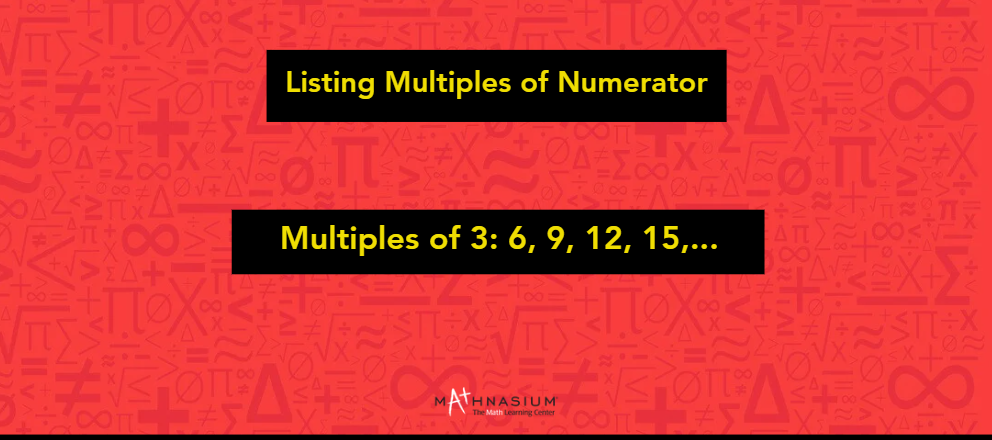
Step 1: List Multiples of the Numerator
First, we multiply the top number (numerator), 3, by 2, 3, 4, and 5 to build out a list. Since we are scaling up the existing numerator (3), we do not multiply by 1.
Step 2: List Multiples of the Denominator
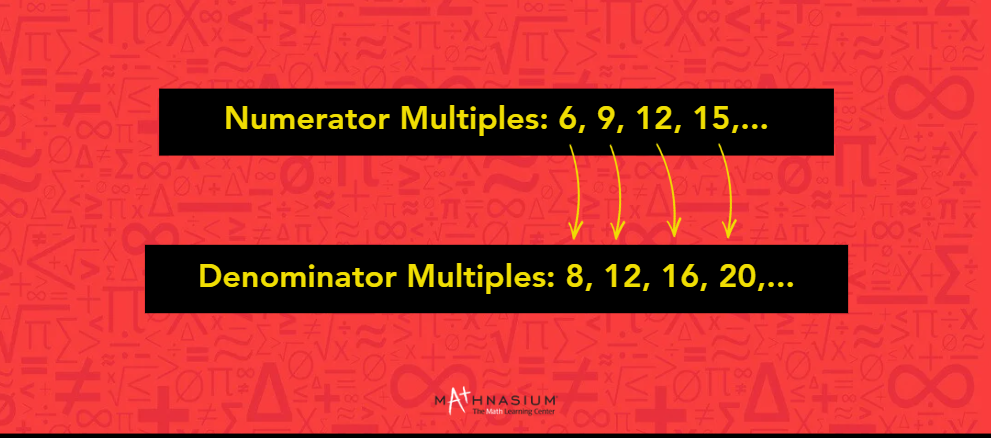
We multiply the bottom number (4) as well, using the same set of numbers (2, 3, 4, 5).
Step 3: Stack Numerator and Denominator Multiples Together
Now that we have multiples of both the numerator and denominator, we pair each numerator with its matching denominator.
That gives us a full chain of equivalent fractions.
\(\Large\frac{3}{4}\) = \(\Large\frac{6}{8}\) = \(\Large\frac{9}{12}\) = \(\Large\frac{12}{16}\) = \(\Large\frac{15}{20}\)
Every new equivalent fraction comes from multiplying the top and bottom by the same number, whether that's 2, 3, 4, or 5.
-
2 gives us \(\Large\frac{6}{8}\)
-
3 gives us \(\Large\frac{9}{12}\)
-
4 gives us \(\Large\frac{12}{16}\)
-
5 gives us \(\Large\frac{15}{20}\)
📕 You May Also Like: Equivalent Fractions Explained: A Kid-Friendly Guide
4. Simplifying Final Answers (Scaling Down)
To simplify any fraction like \(\Large\frac{8}{12}\) down to its simplest form, we need to find the one number that both the top and bottom are multiples of.
Let’s simplify \(\Large\frac{8}{12}\).
Step 1: Find a Shared Number
We ask, ‘’What number are 8 and 12 both multiples of?’’
We can test a few small numbers to see which one divides evenly into both.
-
2 works, since 8 ÷ 2 =4 and 12 ÷ 2 =6, but we can go bigger.
-
3 doesn't work, since 8 divided by 3 doesn't come out to a whole number.
-
By trying 4 next, we find that 8 ÷ 4 =2 and 12 ÷ 4 =3, both whole numbers.
That means 8 and 12 are both multiples of 4, since 4 × 2 = 8 and 4 × 3 =12.
Step 2: Divide Both Numbers
Now that we know that shared number, we divide the top and bottom by it.
Step 3: Write the Simplified Fraction
The division gives us the fraction in its smallest form.
\(\Large\frac{8}{12}\) = \(\Large\frac{2}{3}\)
That shared number we were looking for (4) turns a bulkier fraction into its simplest form in one clean step.
Whether we are adding, subtracting, comparing, building, or simplifying fractions, we are using the same skill each time, which is finding the number two fractions share.
📕 You May Also Like: Simplifying Fractions: Quick Steps to Reduce and Compare
 At Mathnasium, our specially trained tutors help students see how multiples and fractions connect, turning a tricky concept into one that clicks.
How Mathnasium Helps Students Master Fractions (and Any Other Math Concept)
Mathnasium is a math-only learning center dedicated to helping K-12 students build strong math skills and confidence.
We teach concepts like fractions not through rote memorization but through our proprietary teaching approach called the Mathnasium Method™, designed around each student's individual needs and learning style.
Each student starts their Mathnasium journey with a diagnostic assessment that helps us spot current skills and knowledge gaps. With that insight, we then build toward a personalized learning plan with a session frequency that fits their pace.
We phrase math in plain, everyday language instead of heavy jargon, blending verbal, visual, mental, tactile, and written techniques so each concept truly lands.
Our tutors are trained in both math and the emotional side of teaching, so they know how to support a student who feels overwhelmed and how to challenge one who's ready to move ahead.
We also give students room for productive struggle before stepping back in to check their reasoning, teaching both the how and the why behind the math so they build critical-thinking skills that carry into future courses.
Sessions often don't look like lectures. Games, earned rewards, and steady celebration of progress keep learning enjoyable and help students grow in confidence with every visit.
And the results speak for themselves:
-
94% of parents report an improvement in their child's math skills and understanding
-
93% of parents report their child's improved attitude toward math
-
90% of students saw an improvement in their school grades
With over 1,100 learning centers, Mathnasium brings top-rated math instruction close to your community.
If you’re in or near Queen Creek, AZ, Mathnasium of Queen Creek is a trusted local center with years of experience helping students become confident math thinkers.
Our commitment to student success is reflected in the support of our community, with more than 200 five-star Google reviews from local families.
Here’s what one parent had to say about their experience with Mathnasium of Queen Creek.

Whether your child needs to catch up, keep up, or get ahead in math, we are happy to help.
📅 Schedule a Free Diagnostic Assessment at Mathnasium of Queen Creek
Not near our center?
📍 Find a Mathnasium Learning Center Near You


 (480) 279-3122
 (480) 279-3122