Adding and subtracting decimals gets tricky when the numbers have different lengths. The digits do not line up on their own, and without the right setup, it is easy to add or subtract the wrong columns.
Today, our tutors at Mathnasium will cover the one rule that makes the setup work, explain placeholder zeros, and work through examples for both addition and subtraction, from clean calculations all the way to regrouping.

How to Line Up Decimals
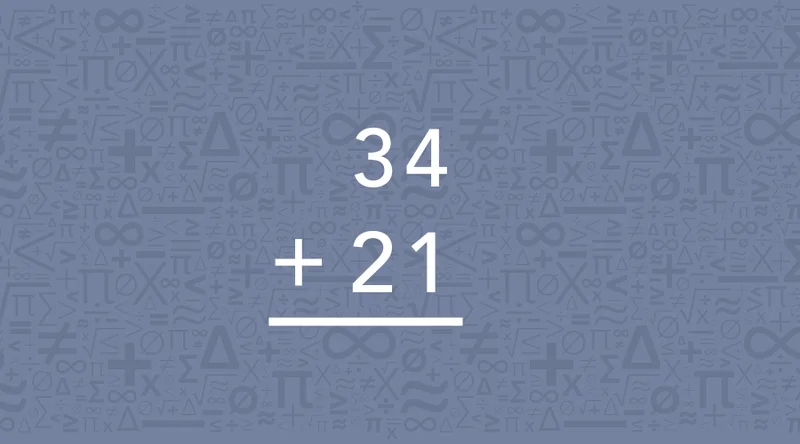
To line up decimals, we write one number above the other and place the decimal points in a straight vertical column. This is the same logic we already use with whole numbers.
For example, in 34 + 21, we line up the ones under the ones and the tens under the tens before we add anything, like so:
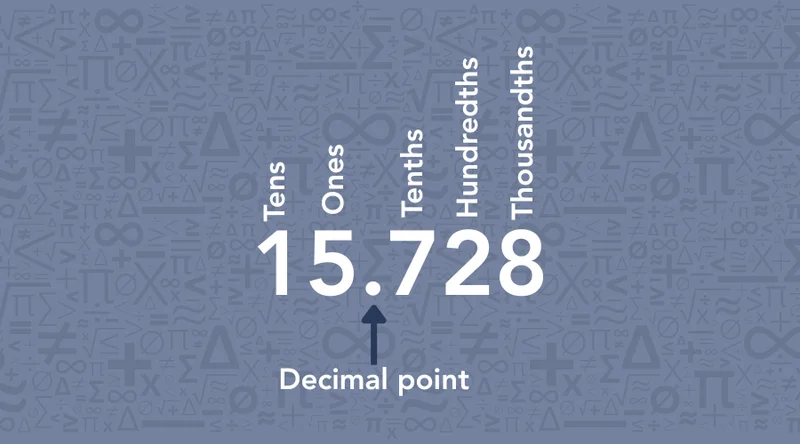
Decimals work the same way. The only difference is that we have extra columns sitting to the right of the decimal point:
-
Tenths
-
Hundredths
-
Thousandths
The process of lining up decimals comes down to two steps, and once we have them down, setting up any decimal addition or subtraction problem takes only a few seconds.
Step 1: Stack the Numbers With the Decimal Points Aligned
We write one number above the other because it lets us see the columns clearly. Each column represents a unit, and we need to make sure we are adding the right units together.
Let's start with 3.25 + 2.41. We write 3.25 first.
Now we need to write 2.41 underneath. So, where do we start? We need to find the decimal point of 2.41 and place it directly below the decimal point of 3.25. The decimal point is our anchor. Everything else follows from it.
Let’s look at the columns now.
-
The 3 and the 2 are in the ones column.
-
The 2 and the 4 are in the tenths column.
-
The 5 and the 1 are in the hundredths column.
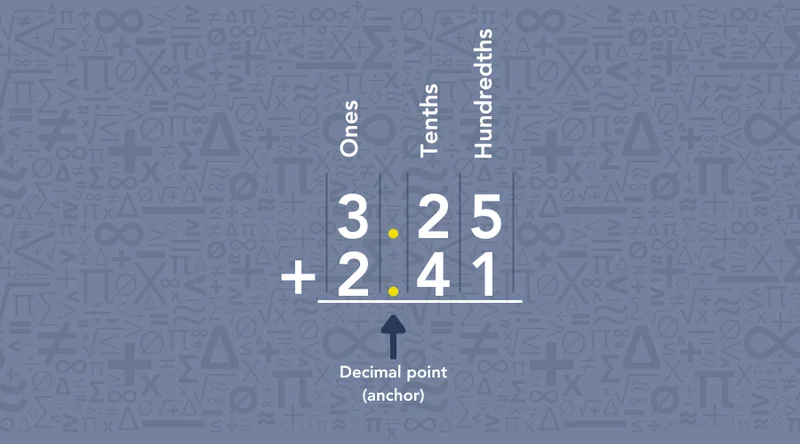
Every digit has landed in the right place, and we are ready to calculate.
For problems where both numbers have the same number of decimal places, this step is all we need.
But sometimes one number is shorter than the other, and that is where placeholder zeros come in.
📕 You May Also Like: Decimal Place Value Made Easy: A Fun, Kid-Friendly Guide
Step 2: Add Placeholder Zeros Where Needed
Placeholder zeros fill empty decimal columns so every number reaches the same decimal place.
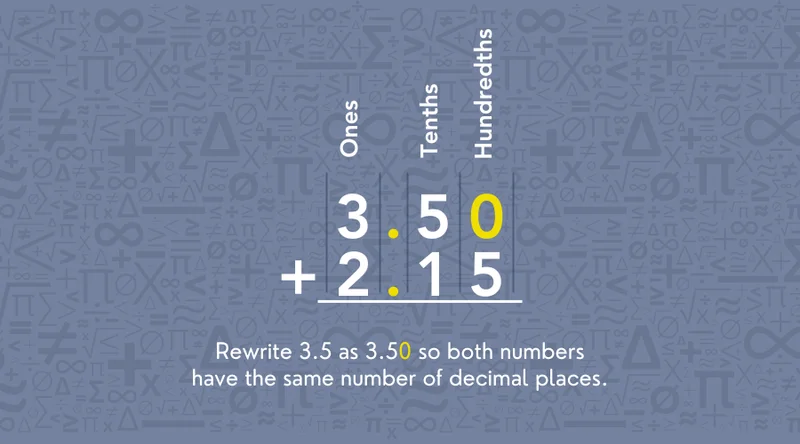
They do not change the value of the number. 3.5 and 3.50 are the same, but 3.50 makes the empty hundredths column visible, so we do not lose track of it during the calculation.
Let's look at 3.5 + 2.15. Do we notice anything different about the two numbers?
The number 3.5 has one decimal place, and 2.15 has two. We need to write 3.5 as 3.50 to fill the empty hundredths column so both numbers reach the same decimal place and every column has a digit to work with.
📕 You May Also Like: How to Move the Decimal Point: A Place-Value Explanation
How to Add Decimals (Solved Examples)
To add decimals, we use the same column-by-column process as whole number addition. The only difference is that we line up the decimal points first, bring the decimal point straight down into the answer, and add placeholder zeros where needed.
Let's work through three examples, starting simple and building from there.
Level 1: Adding Decimals With the Same Number of Decimal Places
Same decimal places means no placeholder zeros are needed. We move straight to the addition. Let's add 4.62 and 3.15.
Before we begin, let's check our alignment by reading the columns from left to right.
-
Ones: 4 and 3.
-
Tenths: 6 and 1.
-
Hundredths: 2 and 5.

Every digit sits directly above or below a digit that represents the same unit. Our alignment is good.
Now we calculate, and this time we move from right to left. Why do we start from the right? Because carrying, if it happens, always moves to the left. Starting from the right means we never miss a carry.
-
Hundredths: 2 + 5 = 7.
-
Tenths: 6 + 1 = 7.
-
Ones: 4 + 3 = 7.
And that gives us our answer.
4.62 + 3.15 = 7.77

Level 2: Adding Decimals With Different Lengths
Numbers with different decimal lengths need a placeholder zero before we begin. Let's work through 6.4 + 3.25.
How many decimal places does 6.4 have? One. And how many does 3.25 have? Two.
The hundredths column of 6.4 is empty, so following the placeholder zero rule we covered earlier, we write 6.4 as 6.40.
Before we begin, let's check our alignment by reading the columns from left to right.
-
Ones: 6 and 3.
-
Tenths: 4 and 2.
-
Hundredths: 0 and 5.
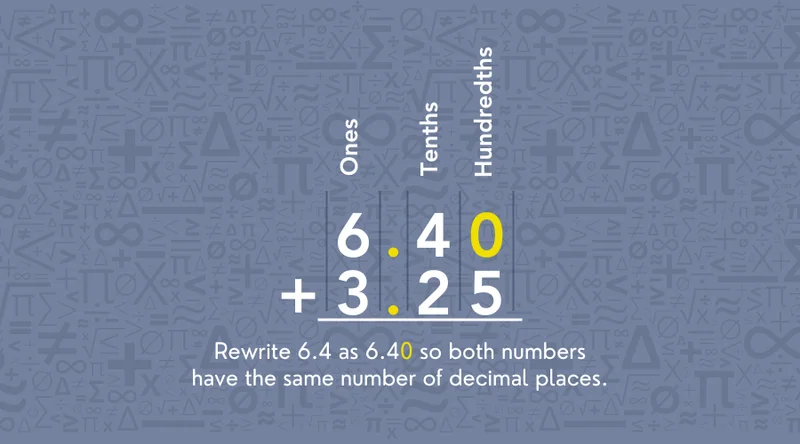
Every digit sits directly above or below a digit that represents the same unit. Our alignment is good.
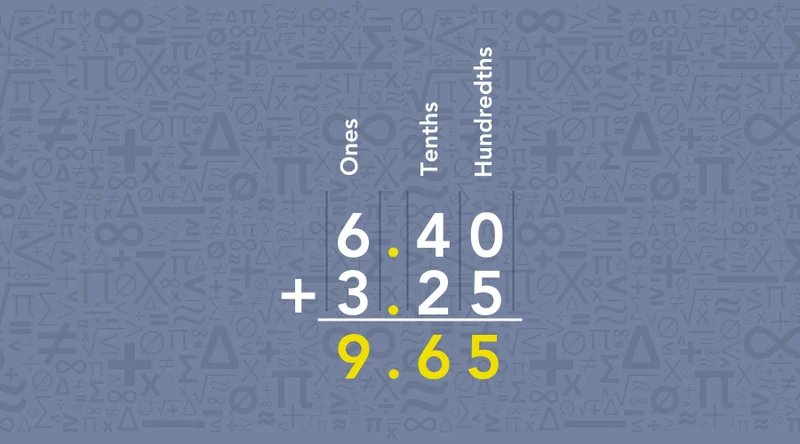
Now we calculate from right to left, starting from the rightmost column just as we did in Level 1.
-
Hundredths: 0 + 5 = 5.
-
Tenths: 4 + 2 = 6
-
Ones: 6 + 3 = 9.
And there we have it.
6.4 + 3.25 = 9.65
Level 3: Adding Decimals With Carrying
The carry step in decimal addition works the same way as it does with whole numbers. The only thing to remember is that the decimal point stays exactly where it is. Let's work through 0.8 + 0.7.
Both numbers reach the tenths place, so no placeholder zeros are needed. We stack the numbers with the decimal points aligned.
Before we begin, let's check our alignment by reading the columns from left to right.
-
Ones: 0 and 0.
-
Tenths: 8 and 7.
Every digit sits directly above or below a digit that represents the same unit. Our alignment is good.

Now we calculate from right to left.

And we are done.
0.8 + 0.7 = 1.5

📕 You May Also Like: 8 Common Mistakes Kids Make with Decimals & How to Fix Them
How to Subtract Decimals (Solved Examples)
To subtract decimals, we follow the same process as decimal addition. We line up the decimal points first, add placeholder zeros where needed, and subtract column by column from right to left.
These three examples will take us from a clean subtraction all the way to subtracting from a whole number.
Level 1: Subtracting Decimals Without Regrouping
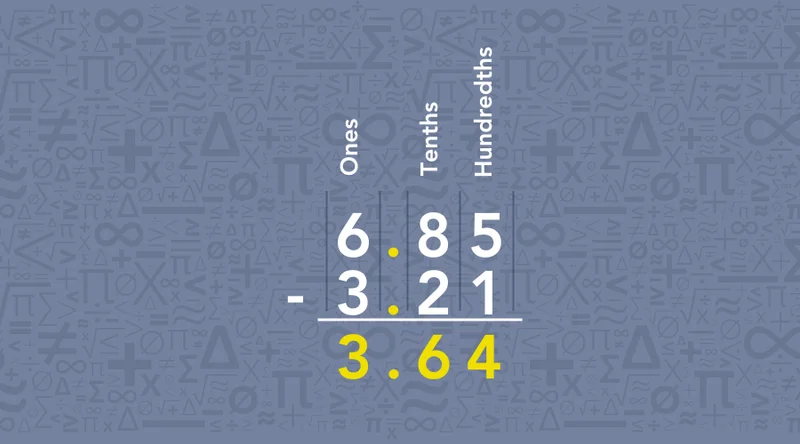
Same decimal places means we move straight to the subtraction, no placeholder zeros required. Let's subtract 6.85 and 3.21.
First, we read across the columns before we touch anything.
-
Ones: 6 and 3.
-
Tenths: 8 and 2.
-
Hundredths: 5 and 1.

Every digit has a matching digit in the same unit below it. We are good to go.
Now we subtract from right to left.
-
Hundredths: 5 - 1 = 4. We write 4 in the hundredths column.
-
Tenths: 8 - 2 = 6. We write 6 in the tenths column.
-
Ones: 6 - 3 = 3. We write 3 in the ones column.
The decimal point drops straight down into the answer, sitting in the same position it held throughout the problem.
And we get our solution.
6.85 - 3.21 = 3.64
Level 2: Subtracting Decimals With Regrouping and Placeholder Zeros
Numbers with different decimal lengths need a placeholder zero before we begin.
In 4.9 - 1.75, we have a gap to fill before we can subtract. The number 4.9 does not reach the hundredths place, so we write it as 4.90 to match the length of 1.75.
Let's scan the columns from left to right.
-
Ones: 4 and 1.
-
Tenths: 9 and 7.
-
Hundredths: 0 and 5.
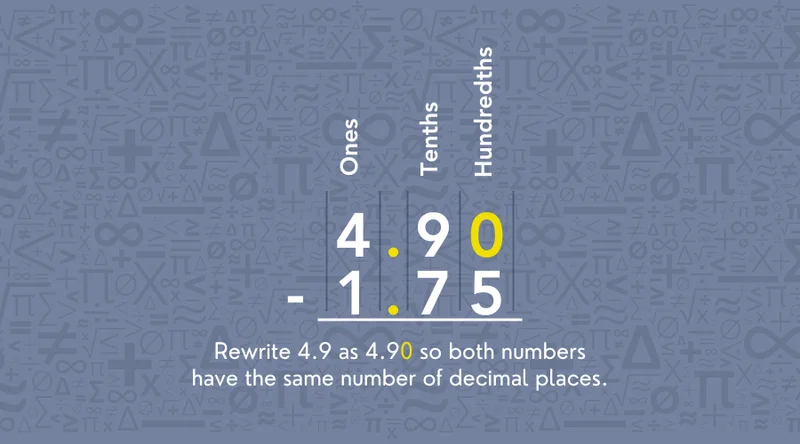
The digits are aligned, and every column has a digit in both rows. Now let's subtract from right to left.
-
Hundredths: The hundredths column needs more to work with, so we borrow from the tenths column. One tenth is the same as 10 hundredths, so the 9 in the tenths column becomes 8 and the 0 in the hundredths column becomes 10.
Now we subtract: 10 - 5 = 5. We write 5 in the hundredths column.
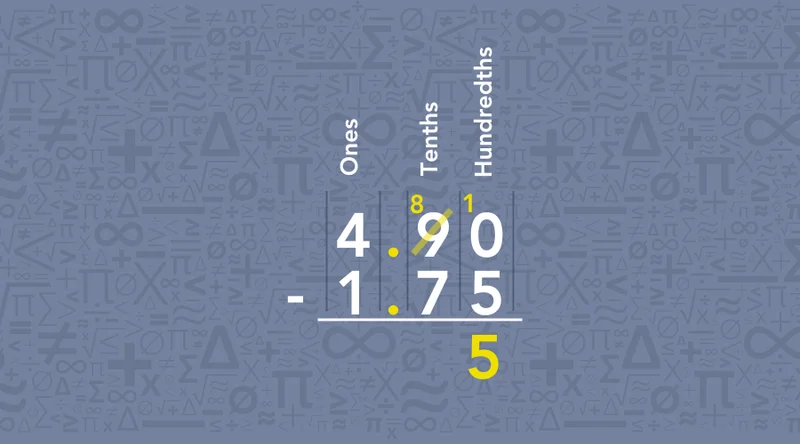
That gives us our answer.
4.9 - 1.75 = 3.15

Level 3: Subtracting Decimals From Whole Numbers
Every whole number has a decimal point sitting to its right, even when it is not written.
In 3 - 1.4, the number 3 is the same as 3.0. We write the decimal point and add one placeholder zero to bring 3 to the tenths place, matching the length of 1.4.
A quick column check before we begin.
-
Ones: 3 and 1.
-
Tenths: 0 and 4.
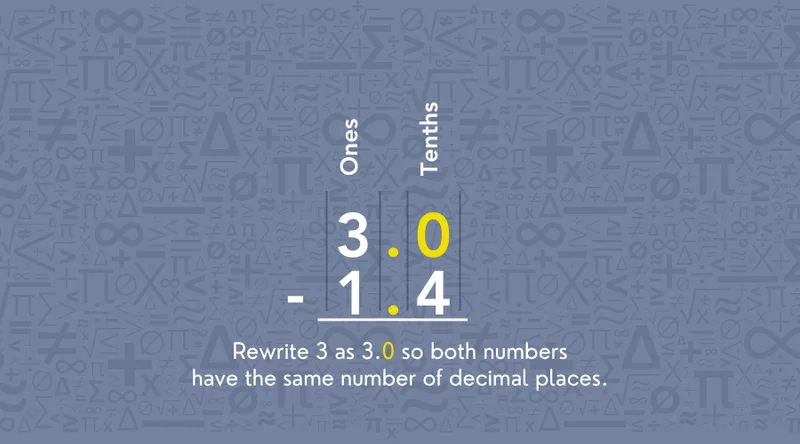
Everything lines up. Now let's subtract from right to left.
Now we subtract: 10 - 4 = 6. We write 6 in the tenths column.

Our final answer is ready.
3 - 1.4 = 1.6

📕 You May Also Like: How to Order Decimals from Least to Greatest: A Step-by-Step Method
Your Turn: Add and Subtract These Decimals
We have covered the lineup rule, placeholder zeros, and worked through examples for both addition and subtraction. Now it is your turn to put it all together.
Work through each problem on paper using the steps we covered.
Addition:
-
5.43 + 2.14
-
8.3 + 4.56
-
1.6 + 2.7
Subtraction:
-
9.76 - 4.32
-
6.4 - 2.85
-
4 - 1.6
Check your answers at the bottom of the page.

At Mathnasium, our specially trained tutors guide students through the reasoning behind every rule, from lining up decimal points to placing placeholder zeros, so the process becomes second nature.
How Mathnasium Helps Students Master Decimals
Mathnasium is a math-only learning center dedicated to helping K–12 students of all skill levels excel in math.
Decimals come up across all areas of math, from measurement to algebra. Whether your child is just getting started with decimal operations or wants to sharpen their skills, we can support them.
We do that through the Mathnasium Method™, our proprietary teaching approach designed around each student's needs and learning style.
-
Assessment and Personalized Learning Plans: Each student begins with a diagnostic assessment that identifies current skills, strengths, and knowledge gaps. From those findings, we build a personalized learning plan tailored to their goals, whether that means mastering the lineup rule, eliminating placeholder zero errors, or building fluency across all decimal operations.
-
Teaching for Understanding: Our specially trained tutors use natural language and a mix of verbal, visual, mental, tactile, and written techniques so each concept lands before we move forward.
-
Problem-Solving and Critical Thinking: We allow time for productive struggle so students can rely on their own reasoning. When we step in, we explain both the how and the why behind each answer, so students build problem-solving and critical thinking skills they can use in math and beyond.
-
An Engaging and Fun Learning Environment: Sessions include games, earned rewards, and consistent celebration of progress. Students build confidence alongside fluency, and many develop a more positive relationship with math over time.
The results speak for themselves:
-
94% of parents report an improvement in their child's math skills and understanding
-
93% of parents report an improved attitude toward math after attending Mathnasium
-
90% of students saw an improvement in their school grades
With over 1,100 learning centers across North America, there is likely a Mathnasium close to you.
Families across Ramsey, Mahwah, Allendale, Upper Saddle River, Ho-Ho-Kus, and Waldwick trust Mathnasium of Ramsey to help their children build lasting math confidence at every level.
If decimal addition and subtraction or any other math concept is giving your child trouble, our team is ready to help.
📅 Schedule a Free Assessment at Mathnasium of Ramsey
Not near Ramsey?
📍 Find a Mathnasium Learning Center Near You
Pssst! Check Your Answers Here
How did you do?
Addition
-
5.43 + 2.14 = 7.57 — same decimal places, no placeholder zeros needed
-
8.3 + 4.56 = 12.86 — write 8.3 as 8.30 before adding
-
1.6 + 2.7 = 4.3 — 6 + 7 = 13, write 3 in the tenths column and carry 1 into the ones column
Subtraction
-
9.76 - 4.32 = 5.44 — same decimal places, no placeholder zeros needed
-
6.4 - 2.85 = 3.55 — write 6.4 as 6.40, then exchange 1 from the tenths column into the hundredths column
-
4 - 1.6 = 2.4 — write 4 as 4.0, then exchange 1 from the ones column into the tenths column


 (201) 891-6284