Multiplication and division have equal precedence, so you work them left to right. The same rule applies to addition and subtraction. That is the part PEMDAS does not show clearly, and it is where most order-of-operations errors come from.
If your child has ever followed every step and still gotten the answer wrong, this is likely why. In our experience, these errors come from a misunderstanding of how the acronym works, not carelessness. More practice, but with the same misreading, won’t help. Our specially trained tutors at Mathnasium have seen it trip up students from 5th grade onward.
PEMDAS is a useful memory tool. Here is where it tends to get misread, and how to fix it.

How PEMDAS Gets Misread
PEMDAS gets misread because a vertical list looks like a strict ranking.
Your child sees multiplication listed before division and addition listed before subtraction, which makes them look sequential. They are not.
The acronym stands for:
-
Parentheses
-
Exponents
-
Multiplication
-
Division
-
Addition
-
Subtraction
That reading is correct for the first two levels. Where it breaks down is at two specific pairs.
Here is what that looks like in practice. Take the expression: 12 ÷ 3 × 2
The correct approach, left to right:
-
12 ÷ 3 = 4
-
then 4 × 2 = 8
-
Answer: 8
The common misread, multiplication first:
The only difference is the order of the steps. Once your child knows to look for this, the fix is straightforward.
📕 You May Also Like: 7 Strategies to Help Your Child Move Beyond Memorization in Multiplication
What Each Tier of the Order of Operations Means
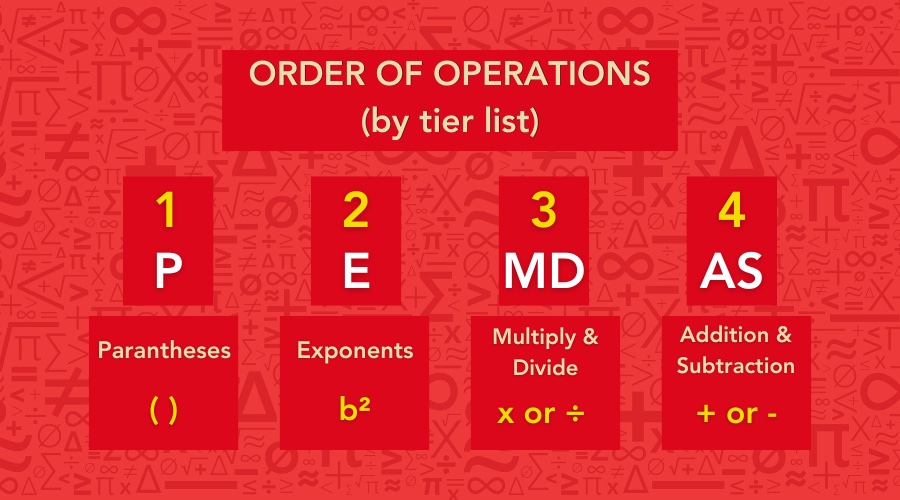
The order of operations works across four levels, not six individual steps.
Two of those levels are pairs, and that is where most of the confusion comes from. Here is what each one means and what your child should do when they see it.
Order of operations to follow:
1. P - Parentheses:
2. E - Exponents
3. MD - Multiply & Divide
4. AS - Addition & Subtraction
Tier 1: Parentheses Show Where to Start
Parentheses tell your child where to begin. Whatever is inside gets evaluated first, but the full order of operations still applies inside them.
Take the expression: (12 ÷ 3 × 2) + 5
The parentheses tell us to resolve the interior before dealing with the addition outside.
Inside, we identify multiplication and division as a paired level and work left to right:
-
12 ÷ 3 = 4
-
then 4 × 2 = 8
-
that gives us 8 + 5 = 13
If your child treats parentheses as a done step and moves on, they will likely make the same multiplication/division and addition/subtraction errors inside the grouping.
Tier 2: Exponents Come Second and Stand Alone
After parentheses, your child evaluates exponents before anything else. Exponents don't share a level with any other operation, so there's no left-to-right judgment call to make.
Just resolve the exponent and move on.
Let's take a look at this expression: 2 + 3² × 4
We handle the exponent first: 3² = 9, giving us 2 + 9 × 4.
From there, we identify multiplication and division as a paired level and work left to right:
-
9 × 4 = 36
-
giving us 2 + 36 = 38
Exponents are the straightforward part. Your child resolves the exponent and moves on. The paired levels that follow are where attention matters.
📕 You May Also Like: What Is an Exponent? A Complete, Beginner-Friendly Guide
Tier 3: Multiplication and Division Are a Paired Level
Multiplication and division share equal priority.
When your child sees both in the same expression, they don't pick the one that comes first in the acronym. They work left to right through whichever ones appear.
Take the expression: 12 ÷ 3 × 2
If your child reads PEMDAS as a strict ranking, they'll see M before D and multiply first:
-
3 × 2 = 6
-
then 12 ÷ 6 = 2.
That is wrong.
Working left to right through the multiplication and division pair gives
-
12 ÷ 3 = 4
-
then 4 × 2 = 8
That is the correct answer, and the only difference is the order of the steps.
Division is just multiplying by a reciprocal, so neither operation outranks the other. The acronym does not show that. It lists them in a sequence that looks like a ranking, and your child ends up trusting the letter order over what they actually see in the expression.
Your child avoids these errors by learning to identify the level first, then working left to right within it. Drilling the acronym alone does not build that habit.
📕 You May Also Like: How to Do Long Division? Explained for 4th Graders
Tier 4: Addition and Subtraction Work the Same Way
Addition and subtraction share equal priority and follow the same logic as multiplication and division.
When your child sees both in the same expression, they work left to right through whichever ones appear.
Let’s work this through an example: 10 − 3 + 2
If your child treats addition as a higher priority, they add first:
-
3 + 2 = 5
-
then 10 − 5 = 5
That's wrong.
Working left to right through the addition and subtraction pair gives:
-
10 − 3 = 7
-
then 7 + 2 = 9
This happens for the same reason as the multiplication and division errors.
The acronym lists A before S, so your child assumes a ranking that isn't there. The fix is the same: identify the level, then work left to right.

At Mathnasium, tutors help students understand why the steps work, not just how to follow them.
Other Names for PEMDAS
If your child has come across BODMAS or GEMDAS in a different textbook or on a worksheet from another country, they are looking at a different name for the same four-level structure.
Here is what each one stands for:
BODMAS:
-
Brackets
-
Orders
-
Division
-
Multiplication
-
Addition
-
Subtraction
Common in the UK, Australia, and parts of Canada. "Brackets" covers what PEMDAS calls parentheses. "Orders" covers exponents.
Division appears before multiplication here, but the same left-to-right rule applies. Both share equal priority.
GEMDAS:
-
Grouping
-
Exponents
-
Multiplication
-
Division
-
Addition
-
Subtraction
This variant replaces "Parentheses" with "Grouping" to make clear that brackets, braces, and absolute value symbols all count as grouping symbols. All three describe the same underlying structure.
📕 You May Also Like: What Is an Expression in Math? A Beginner-Friendly Guide
Order of Operations Practice Problems
Work through these six expressions with your child before checking the answers below.
Task 1 - Beginner: 8 + 4 × 2
Task 2 - Easy: 12 ÷ 3 × 2
Task 3 - Medium: 10 − 3 + 2
Task 4 - Medium-Hard: (12 ÷ 3 × 2) + 5
Task 5 - Hard: 2 + 3² × 4 − (6 ÷ 2 + 1)
Task 6 - Trick Question: 8 ÷ 2(2 + 2).

At Mathnasium, tutors work through problems like these with your child, helping them understand why each step works, not just how to follow it.
How Mathnasium of Ramsey Builds True Mathematical Understanding
At Mathnasium, the math-only learning center, our specially trained tutors know how to imprint the concepts like PEMDAS and teach our students the way the knowledge sticks.
Your child starts with a diagnostic assessment that identifies exactly where their understanding breaks down. From there, we build a personalized learning plan around what your child needs. Using the Mathnasium Method™, our proprietary teaching approach, our specially trained tutors use verbal, visual, written, tactile, and hands-on techniques to build reasoning habits alongside skills.
Your child works in a caring, small-group setting, face-to-face, either in-center or through live online sessions.
Here are some results for perspective:
-
94% of parents report an improvement in their child's math skills and understanding.
-
93% of parents report their child's improved attitude toward math after attending Mathnasium.
-
90% of students saw an improvement in their school grades.
With over 1,100 centers, there’s likely a Mathnasium center close to your community.
Mathnasium of Ramsey works with families across Ramsey, Mahwah, and Upper Saddle River, supporting students from Mary Hubbard Elementary, Betsy Ross Elementary, Bogert Elementary, Joyce Kilmer Elementary, John Dater Elementary, and Ramsey High School.
Whether your child is working to align with the New Jersey Student Learning Standards (NJSLS), preparing for the upcoming NJSLA assessments, or looking to tackle advanced honors math coursework, our team is ready to help.
Mathnasium of Ramsey is located right off Spring Street and Franklin Turnpike, just in front of the Kohl's complex.
📅 Schedule a Free Diagnostic Assessment at Mathnasium of Ramsey
Not near Ramsey?
📍 Find a Mathnasium Learning Center Near You
Pssst! Check your Answers Here
Task 1 - Multiplication comes before addition, so solve 4 × 2 = 8 first.
Then 8 + 8 = 16.
Answer: 16
Task 2 - Multiplication and division share equal priority.
Work left to right: 12 ÷ 3 = 4, then 4 × 2 = 8.
Answer: 8
Task 3 - Addition and subtraction share equal priority.
Work left to right: 10 − 3 = 7, then 7 + 2 = 9.
Answer: 9
Task 4 - Parentheses first.
Inside, work left to right through the multiplication and division pair: 12 ÷ 3 = 4, then 4 × 2 = 8.
Then add: 8 + 5 = 13.
Answer: 13
Task 5 - Parentheses first: inside (6 ÷ 2 + 1), work left to right: 6 ÷ 2 = 3, then 3 + 1 = 4.
Expression becomes: 2 + 3² × 4 − 4.
Exponents are next: 3² = 9. Expression becomes: 2 + 9 × 4 − 4.
Then we do the multiplication: 9 × 4 = 36. Expression becomes: 2 + 36 − 4.
The last comes addition and subtraction from left to right: 2 + 36 = 38, then 38 − 4 = 34.
Answer: 34
Task 6 — This expression looks ambiguous, but under standard US school rules, there is one correct answer.
Parentheses first: 2 + 2 = 4. Expression becomes: 8 ÷ 2 × 4.
Working left to right through the division and multiplication pair: 8 ÷ 2 = 4, then 4 × 4 = 16.
Answer: 16.
Certain calculators and older textbooks treat implied multiplication, the 2 written directly next to the parentheses, as having higher priority than explicit division, which gives 8 ÷ 8 = 1.
That is a non-standard convention. US school rules follow the strict left-to-right order for division and multiplication.
If your child ever writes an expression that could be read more than one way, add parentheses to make the intended order clear. That habit prevents ambiguity.


 (201) 891-6284