Sixth grade marks the beginning of middle school, a transition that brings new teachers, a fairly new environment, and just as importantly, a new level of independence.
Math transitions right along with it. How? Concepts grow more abstract, problems demand more reasoning, and students are expected to work through challenges with greater confidence in their own thinking.
To give students a clear foothold, Common Core identifies four critical areas that form the backbone of 6th-grade math and lay the groundwork for everything that follows. At Mathnasium, we work with 6th graders every day and know exactly what this period asks of them.
Today, our tutors are here to shed light on what these four critical areas are and share practical, Mathnasium-approved strategies to help your child master them at home.
The 4 Critical Math Areas for 6th Grade
6th-grade math covers a lot of ground, but Common Core narrows the focus to four areas that carry the most weight for this year and the ones that follow.
And while not every state uses Common Core, these four areas reflect what most 6th-grade curricula across the country cover.
1. Ratios and Proportional Relationships
Ratios show up everywhere in daily life, in something as simple as a recipe or as practical as comparing prices. 6th grade is where students learn to work with them in a structured, mathematical way.
By the end of the year, students are expected to understand and work comfortably with:
-
Ratio concepts and the language used to describe relationships between quantities
-
Unit rates and how to use them to solve real-world problems
-
Percentages and how to calculate and apply them
-
Tables, graphs, and equations as tools for representing proportional relationships
-
Ratios, rates, and unit conversions across practical, everyday contexts
📕 You May Also Like: 6 Ways to Help Your Middle Schooler Understand Proportionality
2. The Number System (Rational Numbers)
Up until now, most of the numbers students worked with were positive. In 6th grade, that changes. The number system opens up considerably, and students are expected to reason across it with confidence.
This year, students build fluency with:
📕 You May Also Like: How to Add Positive and Negative Integers: A Complete Guide
3. Expressions and Equations
This is where algebra quietly enters the picture. Students begin working with variables, learning to write and manipulate expressions before moving on to solving equations and inequalities.
By 6th grade, students are expected to have a solid grasp of:
-
Writing and evaluating both numerical and algebraic expressions
-
Properties of operations, such as distributive, associative, and commutative, and how to use them to generate equivalent expressions
-
The relationship between independent and dependent variables
-
One-variable equations and inequalities
-
Quantitative relationships expressed and analyzed through equations
📕 You May Also Like: 5 Effective Tips for Students Struggling with Algebraic Expressions
4. Statistical Thinking
Most students arrive in 6th grade having worked with basic graphs and simple data sets. This year, the bar rises. Students learn to ask better questions, read data more critically, and draw conclusions that actually mean something.
That progression includes:
-
Understanding what makes a question statistical and why that distinction matters
-
Describing distributions and identifying patterns within a data set
-
Calculating mean, median, and mode, and knowing which one tells the most useful story
-
Measuring variation using range and interquartile range
-
Creating and reading histograms, box plots, and dot plots
-
Using data to answer real-world questions with reasoned conclusion
In 6th grade, students move from arithmetic into the world of ratios, rational numbers, algebraic expressions, and data analysis.
Proven Strategies to Support 6th Grade Math Success
As a parent, knowing what your child is learning and expected to master is a great start. But at Mathnasium, we believe you can do more than just follow along, and it doesn't take much.
Each strategy you’ll find here is practical, low-pressure, and designed to reinforce exactly what your child is working on this year.
1. Use Visual Models for Ratios and Proportions
A 2024 study published in Educational Research Review found something most Mathnasium tutors would readily agree with: students grasp math better and remember it longer when visuals are part of the learning.
When it comes to ratios and proportions, a well-placed diagram or model can go a long way toward making things click.
Parents can lean into this, too. We’ve put together a few ideas to try at home:
-
Create ratio tables together when cooking: if 2 cups of flour makes 12 cookies, how much do you need for 18?
-
Draw double number lines to compare quantities: 3 hours and 180 minutes sitting side by side on parallel lines makes the relationship hard to miss
-
Use bar models to visualize part-to-whole relationships when working with percentages

Bar models give students a way to see what a percentage actually means before they calculate anything.
2. Build Number Line Fluency for Rational Numbers
A number line does something that a page of problems can't: it shows students where a number lives in relation to everything else. For 6th graders working with negative numbers and fractions, that sense of position is exactly what builds confidence.
A number line is also one of the easiest tools to recreate at home:
-
Draw a number line from -10 to 10 and practice placing fractions, decimals, and integers on it together
-
Fold it in half at zero to show opposites and give absolute value a visual meaning
-
Rather than finding common denominators, practice comparing fractions by placing them on the number line and seeing which sits further right
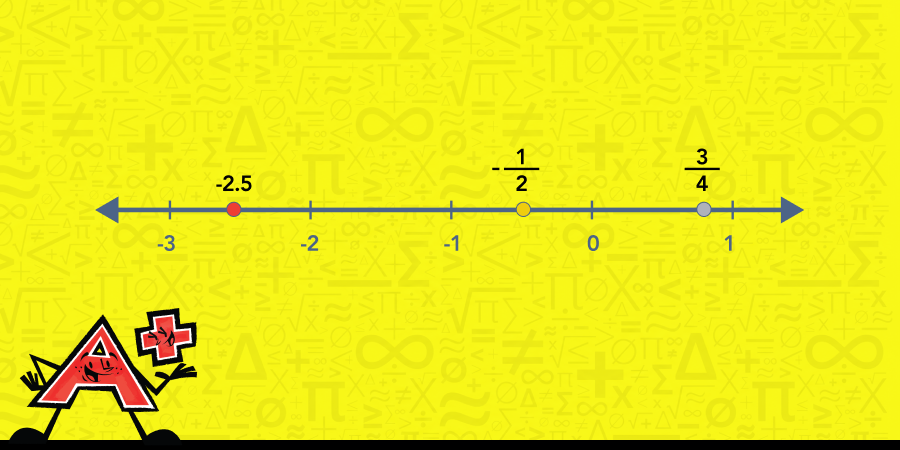
A number line gives students a reliable reference point for placing and comparing rational numbers, fractions, decimals, and negatives.
3. Make Variables Concrete Before Abstract
Variables tend to feel like a wall the first time students encounter them. Our tutors find that the best way past that wall is to make the concept physical and familiar before introducing the notation.
To bring this approach home, our tutors recommend:
-
Trying "mystery number" problems together: "I'm thinking of a number. When I double it and add 3, I get 11. What's my number?" This is algebra, just without the x yet
-
Using a balance scale as a mental model for equations: whatever you do to one side, you do to the other
-
Practicing translating everyday language into math: "5 more than a number" becomes x + 5, and working in both directions builds fluency fast
📕 You May Also Like: How to Prepare Your Student for Algebra: From Graphs to Variables
4. Help Your Child Reason Through Fraction Division
Dividing a fraction by a fraction is one of the most distinctly 6th-grade skills and one of the most misunderstood. Quite a few students arrive knowing how to flip and multiply, but not why it works.
Our tutors always lead with the idea first, and parents can do the same:
-
Start with a real scenario: "We have \(\Large\frac{3}{4}\) of a pizza and each person gets \(\Large\frac{1}{2}\) a slice; how many people can we serve?" The situation makes the operation feel necessary rather than arbitrary
-
Connect it to the question of how many groups: \(\Large\frac{3}{4}\) ÷ \(\Large\frac{1}{2}\) means "how many halves fit into three-fourths?" That’s a question students can reason through before any procedure is introduced.
-
Use a visual rectangle model to show the division physically, then connect what they see to the steps they'll use on paper.
-
Before calculating, estimate: “Will \(\Large\frac{3}{4}\) ÷ \(\Large\frac{1}{2}\) be more or less than 1?” Building that habit keeps students grounded in what the answer should look like.
📕 You May Also Like: Multiplying and Dividing Fractions: The Why Behind the How
5. Collect and Analyze Real Data Together
Most 6th graders don't realize they're already surrounded by statistics. The data is there, in the weather app or on a fitness tracker, and what this year asks of them is to look at it more critically: to spot patterns, question outliers, and decide which numbers actually tell the story.
Here is a simple week-long project you can do together at home:
-
Step 1: Choose something to track daily for a week; screen time is a good starting point because students already have a personal stake in the numbers.
-
Step 2: At the end of the week, represent the data in a dot plot or histogram.
-
Step 3: Calculate the mean, median, and mode, then discuss which measure best represents the week as a whole.
-
Step 4: Look for outliers; if one day looks very different from the rest, ask why.
-
Step 5: Repeat the following week and compare the two data sets using range or interquartile range to talk about consistency.
📕 You May Also Like: How Do We Measure Rainfall? A Fun DIY Guide
6. Develop Mental Math Strategies
We're rounding out our strategies with one that supports everything else on this list: mental math. More than a party trick, it reflects genuine number sense that helps students check their own work and reason through unfamiliar problems.
Our tutors recommend building it gradually, starting with:
-
Breaking percentages into friendlier parts when calculating: 15% of 60 becomes 10% + 5%, which is 6 + 3 = 9. This is a much faster route than setting up a formal calculation
-
Using round numbers as a starting point for multiplication: 27 × 4 becomes (25 × 4) + (2 × 4) = 100 + 8 = 108, which is easier to hold in your head
-
Applying the distributive property out loud when multiplying larger numbers: 8 × 17 is the same as 8 × 10 + 8 × 7, and naming the property as you use it helps students recognize it when it appears in algebra.
-
Estimating before calculating a decimal multiplication problem: Should 3.7 × 8.9 be close to 32? Getting into the habit of asking that question first keeps answers grounded in reality
-
Spotting patterns in decimals: If 24 ÷ 6 = 4, then 2.4 ÷ 6 = 0.4; recognizing that connection builds confidence with decimal operations across the board
📕 You May Also Like: 5 Ways Mental Math Supports Long-Term Math Success
Master 6th Grade Math at Mathnasium
Mathnasium is a math-only learning center dedicated to helping K–12 students of all skill levels learn and master math.
Over the years, we've worked with thousands of 6th graders, whether they were looking to catch up after falling behind, keep up with the pace of middle school math, or get ahead of what's coming next.
We offer a dedicated middle school program that guides students through the concepts that define this year: ratios and proportional reasoning, rational numbers, algebraic expressions, and statistical thinking. Our tutors don't just cover the material, but make sure students genuinely understand it.
Behind our middle school program, and every program we offer, is a proprietary teaching approach we call the Mathnasium Method™. Unlike one-size-fits-all curricula, our approach is personalized and designed to unlock each student's math potential while building the problem-solving and critical thinking skills that carry well beyond 6th grade.
To support true mastery of math, the Mathnasium Method™ includes:
-
Personalization on a granular level: Each student begins their Mathnasium journey with a diagnostic assessment. This helps us identify their strengths as well as potential knowledge gaps. Using these insights, we create a learning plan customized to each student’s needs. From one student to the next, learning plans are never the same.
-
Teaching for understanding: We use natural, everyday language to phrase math concepts. We also employ a mix of verbal, visual, mental, tactile, and written teaching techniques to help students truly make sense of the concepts they’re learning.
-
Caring, supportive tutors: Our tutors are specially trained in math as well as the technical and emotional aspects of teaching. This means they know how to encourage a student who’s overwhelmed and how to challenge one who’s ready to advance.
-
Problem-solving and critical thinking skills: During sessions, we always allow time for productive struggle, then rejoin students to check and correct their processes. This helps them learn to rely on their own thinking. We guide them through both the how and the why behind each math problem, not only the final answer. This approach develops the problem-solving and critical thinking tools they’ll use in math and life.
-
A confidence-building, fun learning environment: We often hear students say our sessions don’t feel like lessons at all. That’s because we incorporate game-based activities and plenty of rewards to keep students motivated and engaged.
Families report measurable results:
-
94% of parents report an improvement in their child's math skills and understanding
-
93% of parents report an improved attitude towards math after attending Mathnasium
-
90% of students saw an improvement in their school grades
With over 1,100 centers across the country, Mathnasium brings top-rated math instruction close to your community.
Whether your 6th grader is looking to catch up, keep up, or get ahead in math, your local Mathnasium Learning Center is ready to help.
Contact your nearest center today to schedule a diagnostic assessment and get a personalized learning plan that puts them on the best path to math mastery.


 (702) 608-4804