Students typically work with rational numbers in upper elementary and middle school, then learn about irrational numbers in grade 8, when the two concepts get explored together as part of the full system beyond whole numbers and simple fractions. That timing is part of why the two ideas can blur together at first.
The confusion makes sense. Some numbers that look complicated, like repeating decimals, actually turn out to be rational. Meanwhile, some numbers might look familiar when you see them written as decimals, like π, but their digits go on forever without repeating or ending.
We need to know whether a number is rational or irrational because that affects how we work with it later, including how we simplify, estimate, compare, and use it in further calculations.
Today, we're going to define both types clearly, build a simple way to tell them apart, and practice classifying a few tricky examples.

What Is a Rational Number?
A rational number is any number that can be written as a fraction of two integers, what we'd call a ratio, which is exactly where the name “rational” comes from.
Plenty of numbers, including whole numbers and negative numbers, that don't look like fractions at first glance still count.
Take \(\Large\frac{1}{2}\), 3, and −7:
-
\(\Large\frac{1}{2}\) is already a fraction,
-
we can write 3 as \(\Large\frac{3}{1}\),
-
-7 can be written as \(\Large\frac{-7}{1}\).
All three are rational numbers because we can write them as fractions.
Rational numbers can also show up as decimals. When a decimal terminates, which means it stops, or repeats in a predictable pattern, it's rational.
-
We can see this with 0.75. The decimal stops after two digits, and we can write it as \(\Large\frac{75}{100}\), or \(\Large\frac{3}{4}\). That makes 0.75 rational.
-
Repeating decimals can be rational, too. Take 0.333.... The digits keep going, so the number may look confusing at first. But 0.333... equals \(\Large\frac{1}{3}\). Because we can write it as a fraction, 0.333... is also rational.
📕 You May Also Like: What Is a Rational Number? A Simple & Complete Guide
What Is an Irrational Number?
An irrational number is any number that cannot be written as a fraction of two integers.
Let’s take \(\sqrt{2}\) as an example. Its decimal, 1.41421..., goes on forever without ever settling into a repeating pattern. No matter which two whole numbers we try to divide, we can never land on \(\sqrt{2}\) exactly. That's what makes it irrational.
Now, we’ll look at π. Its digits, 3.14159..., also continue forever without repeating. That's why we use the symbol π instead of writing out its decimal value in full. We can keep calculating digits, but we never reach an end or a repeating pattern.
For irrational numbers, the decimal keeps going and going, but the digits never repeat in a predictable pattern.
📕 You May Also Like: Is Pi a Rational or Irrational Number? A Kid-Friendly Guide
How to Tell Rational and Irrational Numbers Apart
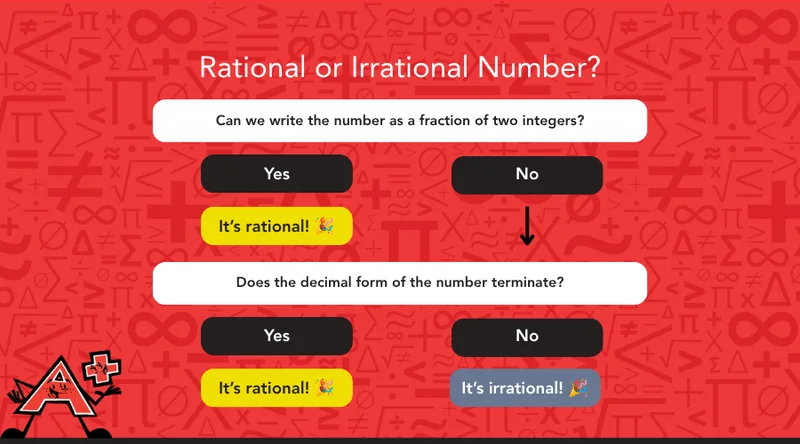
Rational and irrational numbers can look a lot alike at first, especially in decimal form. So we’ll use these steps to decide which type of number we have.
Let's try it with 0.454545..., which should be rational, and \(\sqrt{5}\), which should be irrational.
Can the Number Be Written as a Fraction of Two Integers?
We start by asking “Can we write this number as one integer over another?”
-
0.454545... isn't written as a fraction, so we can't answer this question with confidence yet. That means we need to go further and look at its decimal form.
-
\(\sqrt{5}\) doesn't obviously reduce to a fraction of two whole numbers, so we can't answer this question with confidence yet. That means we need to go further and look at its decimal form.
Does the Decimal Form of the Number Terminate or Repeat?
If a number's decimal form stops completely or repeats in a predictable pattern, it's rational.
-
The decimal form of 0.454545... repeats in a predictable pattern (45 repeating), so it's rational.
-
The decimal form of \(\sqrt{5}\) is 2.23606… It doesn't terminate or settle into a repeating pattern no matter how many digits we calculate. That confirms \(\sqrt{5}\) is irrational.
We can organize the logic in a simple flowchart and use the same questions for any number we need to classify.
Your Turn: Rational or Irrational?
Now it's your turn to run a few numbers through the same questions we just covered. Classify each one below as rational or irrational, and check your answers at the bottom of the page.
-
\(\sqrt{7}\)
-
0.666...
-
π
-
−12
-
0.32
📕 You May Also Like: How to Help Your Child Practice Math at Home (Grades 1-8)

Mathnasium is a math-only learning center for students of all skill levels.
How Mathnasium Helps Students With Rational and Irrational Numbers (and Beyond)
As a math-only learning center, Mathnasium helps K–12 students of all skill levels excel in math.
We’ve worked with thousands of students, and we know that abstract number concepts become clearer when students understand what the numbers mean, how they behave, and how they fit into the larger number system.
Rational and irrational numbers are a great example. Students need to do more than memorize which numbers belong in which category.
That's the thinking behind the Mathnasium Method™, our proprietary teaching approach. We do not just rely on rote memorization but help students truly understand what they are learning.
Each student begins with a diagnostic assessment that helps us understand what they know, how they think, and where they are ready to grow next. From there, we create a personalized learning plan focused on the skills the student needs most, including number sense, decimal understanding, fraction fluency, and the reasoning behind number classification.
Our specially trained tutors explain math in clear, everyday language, using visual, verbal, tactile, and written techniques to help students make sense of abstract ideas.
We give students space to work through problems on their own, then rejoin them to check their reasoning. For example, instead of simply telling them whether a number is rational or irrational, we help them explain how they know. This helps students develop problem-solving skills and critical thinking tools they can use across math topics.
Many of our activities are hands-on or game-based. We use reward systems and consistent encouragement to keep students engaged. And we celebrate progress because confidence grows with every win.
The impact is clear in the results:
-
94% of parents report improvement in their child’s math skills and understanding
-
93% of parents report a more positive attitude toward math after attending Mathnasium
-
90% of students saw improvement in their school grades
Mathnasium operates over 1,100 learning centers across the U.S., bringing our proven approach close to your community.
For families in and near South Arlington, TX, Mathnasium of South Arlington is a trusted source of focused math support designed to help students build solid number sense, understand number classification, and master other skills they need for algebra and beyond.
If your child finds it hard to understand rational and irrational numbers, the ideas behind them, or any other math topic, a free diagnostic assessment is a great place to start. Using the results, we’ll create a personalized learning plan that helps your child strengthen the skills they need next.
📅 Schedule a Free Assessment at Mathnasium of South Arlington
Not near South Arlington?
📍 Find a Mathnasium Learning Center Near You
Pssst! Check Your Answers Here
Ready to see how you did? Here's the reasoning behind each answer.
-
\(\sqrt{7}\) → Irrational; its decimal, ≈ 2.6457513… , never terminates or repeats, and it cannot be written as an exact fraction.
-
0.666... → Rational; it's a repeating decimal equal to the fraction \(\Large\frac{2}{3}\).
-
π → Irrational; its decimal goes on forever without repeating.
-
−12 → Rational; it can be written as the fraction \(\Large\frac{-12}{1}\).
-
0.32 → Rational; it terminates, and it's equal to the fraction \(\Large\frac{32}{100}\) = \(\Large\frac{8}{25}\).


 (833) 579-6284