Have you ever tried balancing a seesaw or a set of scales? If we add a weight to one side, the whole thing tips over unless we put the exact same weight on the other.
Algebra equations follow the same principle. When we solve for x, we cannot change one side without breaking the balance. To keep everything level, we use the properties of equality.
That's why our Mathnasium tutors will explain the four core properties of equality, how each one works, and how to use them to solve equations safely.

What Is a Property of Equality in Algebra?
A property of equality is a rule that lets us change both sides of an equation the same way without breaking the balance between them.
At Mathnasium, we like to picture an equation as a perfectly leveled scale. Both sides carry the same weight, which is what the equals sign tells us. A property of equality lets us “adjust weights”, as long as we do the same thing to both sides.
Why do we have to adjust both sides? If we change only one side, the scale tilts and breaks the equality. We have to do the same operation on both sides to keep the equation balanced and true.
Let's see that in action with a simple equation like x = 5.
Here we see that x is equal to 5. That means that our scale is already in balance.

But if we decide to add 3 to the left side, we have to add 3 to the right side too, or the scale tips.
x + 3 = 5 + 3
When we simplify the right side, we get:
x + 3 = 8
The equation stays true because we added the same number to both sides.
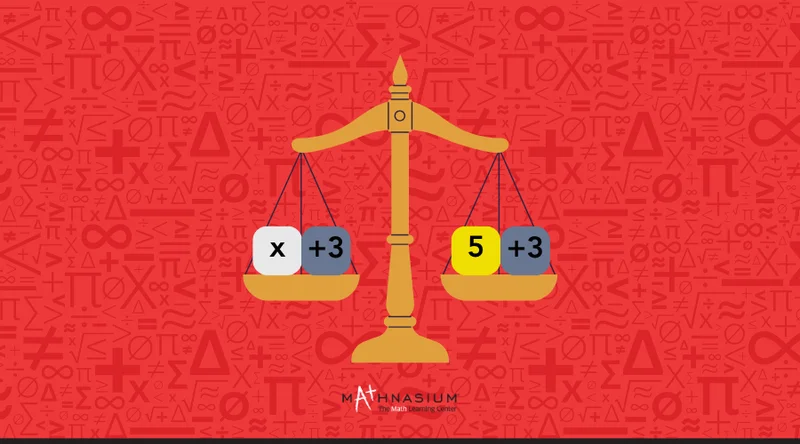
That's what a property of equality does. It lets us change both sides the same way, so the balance never breaks.

4 Core Properties of Equality For Solving Equations
The four properties of equality for solving equations are addition, subtraction, multiplication, and division. We use these four rules together to isolate x, one operation at a time, until it sits alone on one side of the equation.
We already know why these keep an equation balanced. But how do we pick which one to use?
We do that by recognizing the operation already in the equation, then applying its inverse. That's exactly what the properties of equality let us do.
So if we see addition, we do the opposite and subtract. We follow that same logic for the other three operations, too.
Let's have a quick look at all four properties of equality we'll cover today before we dive deeper into each.
|
Property
|
The Rule
|
What We Do
|
What It Undoes
|
|
Addition Property of Equality
|
If a = b, then a + c = b + c
|
Add the same number to both sides.
|
Subtraction
|
|
Subtraction Property of Equality
|
If a = b, then a − c = b − c
|
Subtract the same number from both sides.
|
Addition
|
|
Multiplication Property of Equality
|
If a = b, then ac = bc
(as long as c ≠ 0)
|
Multiply both sides by the same number.
|
Division
|
|
Division Property of Equality
|
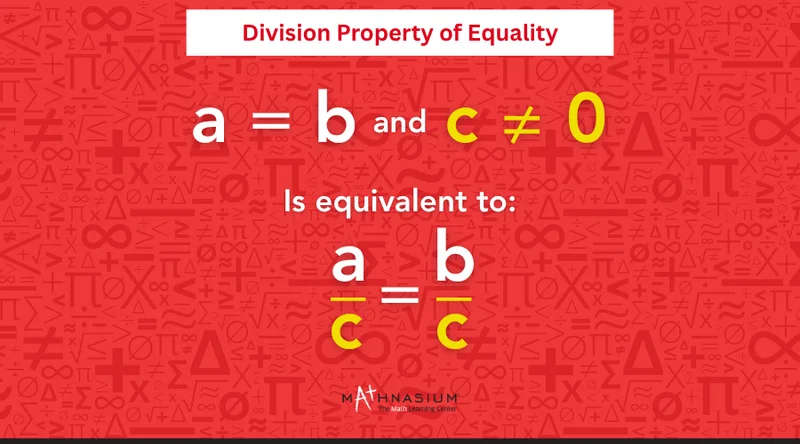
If a = b, then \(\frac{a}{c} = \frac{b}{c}\)
(as long as c ≠ 0)
|
Divide both sides by the same number.
|
Multiplication
|
1. Addition Property of Equality
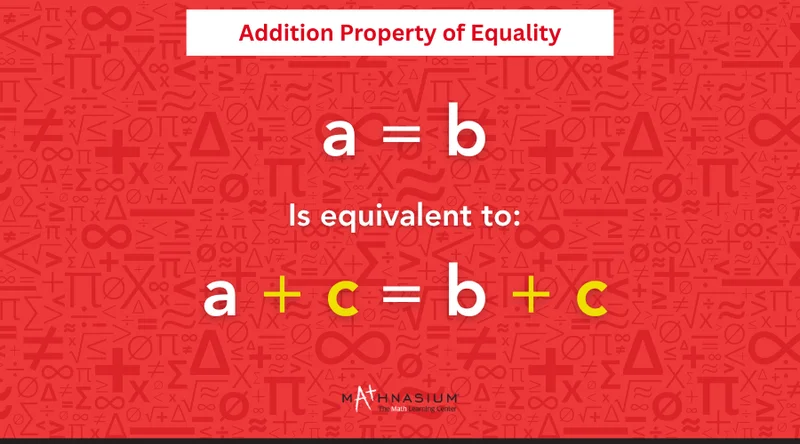
The addition property of equality states that if a = b, then a + c = b + c. In plain words, we can add the same number to both sides of an equation without breaking the balance between them.
We reach for this property any time x has a number subtracted from it.
Let's see how that maps onto a real equation. Take x − 8 = 12 as an example.
The rule tells us we can add the same number, c, to both a and b, and the equation stays true.
Since 8 is subtracted from x, we add 8 to both sides to keep the equation balanced:
x − 8 + 8 = 12 + 8
x = 20
Let's check our answer. We put 20 back in for x.
20 − 8 = 12
12 = 12
📕 You May Also Like: What Are Number Properties in Math? A Complete Overview [+Quiz]
2. Subtraction Property of Equality
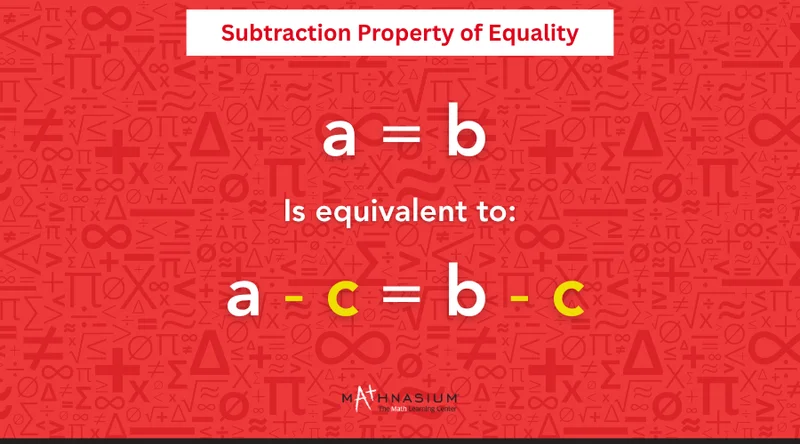
The subtraction property of equality lets us remove the same amount from both sides of an equation without breaking the balance between them. Written as a rule, if a = b, then a − c = b − c.
Let’s see how that works with x + 6 = 15.
This time, x has a number added to it, so we go the other direction and subtract.
The rule says we can subtract c from both a and b in an equation.
We have 6 added to x here, so we subtract 6 from both sides.
x + 6 − 6 = 15 − 6
x = 9
To double-check, we plug 9 back in where x was.
9 + 6 = 15
15 = 15
📕 You May Also Like: How to Solve Basic Equations — A Parent and Student Guide
3. Multiplication Property of Equality
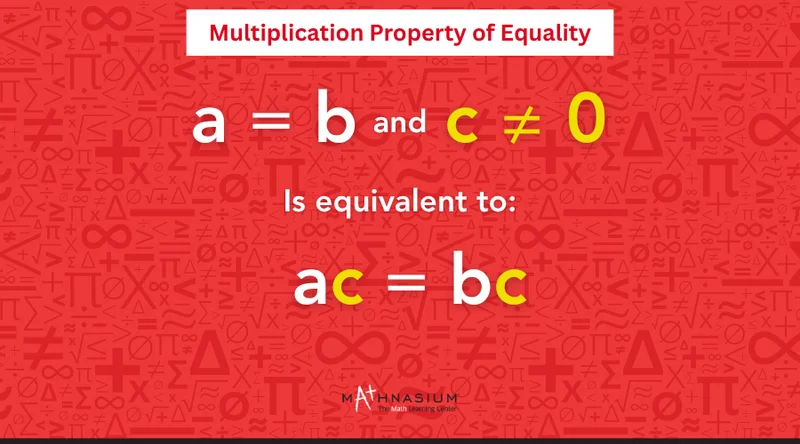
We apply the multiplication property of equality when we need to scale both sides of an equation by the same factor. The formal rule states that multiplying a = b by c gives us a × c = b × c, as long as c is not zero.
Let’s look at \(\Large\frac{x}{4}\) = 3.
Here, our variable x sits in a division problem, which means we use multiplication to undo the operation and clear the fraction.
Under this rule, we multiply both a and b by 4 to keep the equation balanced.
\(\Large\frac{x}{4}\) ⋅ 4 = 3 ⋅ 4
x = 12
We check if the equation is true by putting 12 back where x was.
\(\Large\frac{12}{4}\) = 3
3 = 3
📕 You May Also Like: Simplifying Fractions: Quick Steps to Reduce and Compare
4. Division Property of Equality
The division property of equality lets us divide both sides of an equation by the same number, and the balance holds the whole way through. The rule says that if a = b, dividing both sides by the same c keeps \(\frac{a}{c} = \frac{b}{c}\) true, as long as c isn't zero.
Let's solve this equation, 6x = 42, and apply our rule.
Here we can see multiplication at work, so division is the operation that undoes it.
This rule lets us divide a and b by the same number without disturbing the equation's balance. Here we can see that 6 is the coefficient of our variable. That means that we divide by 6 on both sides.
\(\Large\frac{6x}{6} = \Large\frac{42}{6}\)
x = 7
To confirm, we substitute 7 back in for x.
6 ⋅ 7 = 42
42 = 42
📕 You May Also Like: Solving Multi-Step Equations with Variables on Both Sides
FAQs About the Properties of Equality
Here are the questions our tutors hear most about the properties of equality.
1. Why can't we multiply or divide by zero when using these properties?
Multiplying both sides of an equation by zero always gives us 0 = 0, no matter what the original numbers were. While that statement is true, it erases the equation's original information and prevents us from finding x.
As for division, we can never divide by zero because division by zero is mathematically undefined.
2. Are there other properties of equality besides these four?
Yes. A few more properties exist, and they work a bit differently because they describe how equality behaves as a relationship.
|
Property
|
The Rule
|
What It Means
|
|
Reflexive
|
a = a
|
A number always equals itself
|
|
Symmetric
|
If a = b, then b = a
|
The two sides of an equation can switch places
|
|
Transitive
|
If a = b and b = c,
then a = c
|
Two things equal to the same third thing are equal to each other
|
|
Substitution
|
If a = b, then a can replace b in any expression or equation
|
Equal values can be swapped for each other anywhere
|
3. How are properties of equality different from properties of inequality?
Both allow us to perform the same operation on both sides, but inequalities follow one extra rule. If we multiply or divide an inequality by a negative number, the inequality sign flips direction.
Equations never require that flip. The equals sign stays exactly as it is, no matter what numbers we multiply or divide by, as long as we do not divide by zero.

Mathnasium tutors use personalized learning plans and hands-on techniques to help students make sense of the math in front of them.
How Mathnasium Helps Students Master Any Math Concept
Mathnasium is a math-only learning center dedicated to helping K–12 students of all skill levels learn and master math.
Whether a student needs support with foundational concepts like solving equations or is ready to move into properties of equality and more advanced algebra, we teach for deep understanding. That means showing a student what's actually behind a rule, so applying it later comes naturally.
To help students reach that level of understanding, we use a proprietary teaching approach called the Mathnasium Method™.
Students begin with a diagnostic assessment that gives us a clear picture of their strengths and knowledge gaps, allowing us to build a personalized learning plan targeted at their specific needs.
With the plan in place, our specially trained instructors follow it closely and deliver face-to-face instruction in a caring and fun environment.
During sessions, we always allow time for productive struggle, then rejoin students to check their work. We guide them through both the how and the why, so they build the critical thinking tools and problem-solving skills to use in math and everyday life.
Our activities are often game-based and hands-on, and that keeps students engaged while they enjoy the process. We celebrate every step of progress, so confidence grows right alongside skill.
Families see measurable results:
-
94% of parents report an improvement in their child's math skills and understanding
-
93% of parents report their child's improved attitude toward math after attending Mathnasium
-
90% of students saw an improvement in their school grades
With a network of over 1,100 learning centers across North America, there is likely a Mathnasium near you.
Families across South Arlington and the surrounding area can visit Mathnasium of South Arlington, a trusted local center with a proven record of building confident math thinkers.
Whether your student is looking to catch up, keep up, or get ahead, our local team can support them.
📅 Schedule a Free Diagnostic Assessment at Mathnasium of South Arlington
Not near South Arlington?
📍 Find Mathnasium Learning Centers Near You


 (833) 579-6284