Many parents want to help their kids with math, then find themselves stuck halfway through a problem. In a national survey by the National Center for Families Learning, 60.1% of parents with children in grades K–8 said they have trouble helping with math at home.
If you are in that situation, that feeling does not necessarily come down to your math skills. Explaining math takes a different kind of understanding than doing it.
Today, Mathnasium educational specialists explain four reasons parents feel lost when helping with math at home and cover local tips for South Elgin families.

1. You Know the Rule, but May Have Forgotten Why It Works
You learned math in school and may still remember the rules you used to solve problems. When your child brings a math problem, you might recognize it right away and know exactly how to get the answer. Then they ask a different question: “Why does this work?”
That can be harder to answer than you expect, even when you know the procedure well. You know what to do but may not have thought about why each step works in years.
Take addition with regrouping. Say your child is solving 27 + 15. You might remember these steps.
-
Add the ones. 7 + 5 = 12.
-
Write the 2 and carry the 1.
-
Add the tens, including the carried 1. 2 + 1 + 1 = 4.
You get the correct answer, 42, without needing to think about why the regrouping works.
Now your child asks why the 1 gets carried over. To answer, you need to explain that 12 ones can be regrouped as 1 ten and 2 ones, and that this ten belongs in the tens column.
At that point, helping with homework takes more than remembering a rule. You need to understand how place value works, how numbers can be broken apart and recombined, and how each step connects to the next.
It’s normal to need a moment here. To explain a concept takes a different kind of understanding than using it yourself. When you haven’t had to explain something in years, it makes sense to work through it again.
You don’t need to know every answer right away. Try these steps instead.
-
Ask your child what they’ve learned in class.
-
Work through the example together.
-
Take time to understand the reasoning behind each step.
You may find yourself seeing a familiar math rule in a new way, too.

2. The Vocabulary and Visual Models Are New to Most Parents
Math homework now includes terms and diagrams many parents never used in school. Your child’s worksheet might ask them to “decompose 15” or “draw a tape diagram,” and the instructions assume you already know what those words mean.
Here are three you’re likely to see:
1. Number bond
A number bond is a diagram that shows how a number breaks into parts. One circle holds the whole and connects to smaller circles that hold its parts.
Your child might use number bonds to add 47 + 25. First, they break 47 into 40 and 7, and 25 into 20 and 5. Then they add the tens (40 + 20 = 60) and the ones (7 + 5 = 12). Finally, they combine 60 and 12 to get 72.

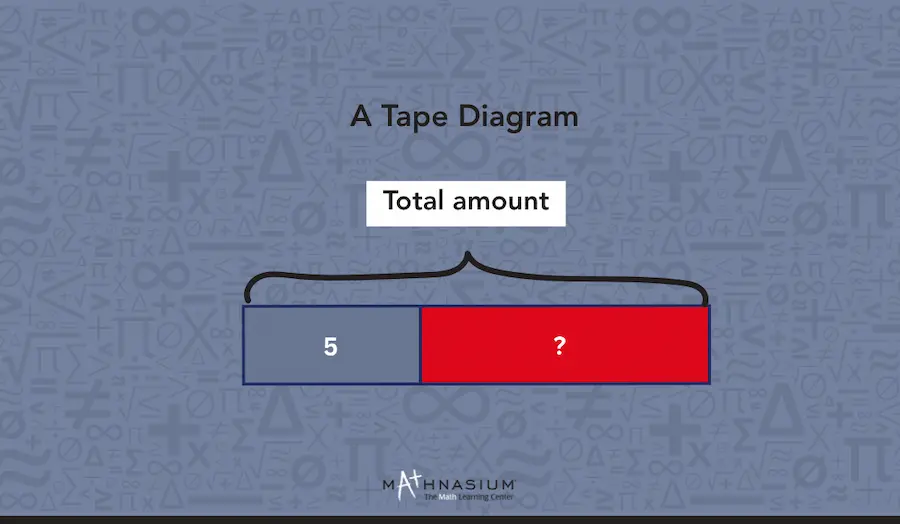
2. Tape diagram
A tape diagram uses rectangular bars to show the amounts in a word problem. Each bar stands for a quantity, so your child can see how the parts combine or compare.
3. Area model
An area model shows multiplication as a rectangle split into smaller sections. To solve 24 × 6, your child might split the rectangle into 20 × 6 and 4 × 6, then add 120 + 24 to get 144.
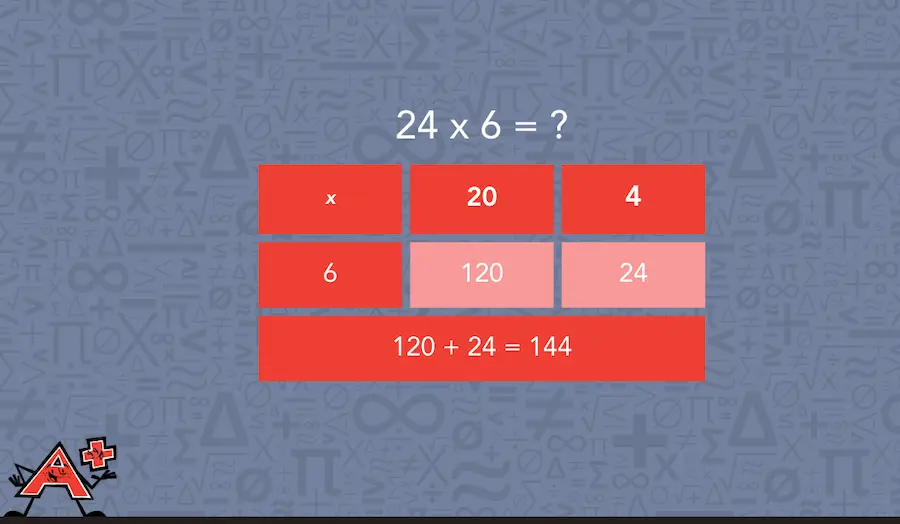
These models may look unfamiliar, but they offer new ways to show familiar math concepts. A number bond breaks a number into parts, a tape diagram makes quantities easier to compare, and an area model shows how multiplication can be broken into smaller steps.
You don’t need to learn every model yourself. Start with an example from your child’s textbook and work through it together, paying attention to how each step connects to the math problem.
📕 You May Also Like: How to Nurture Confident Math Thinkers, Not Just Answer-Getters
3. Kids Can Push Back When Parents Try to Help
Kids sometimes resist a parent’s help with math homework, even when the parent knows how to solve the problem.
In the National Center for Families Learning survey, 41% of parents said pushback from their kids made homework help harder. More parents named this than said they didn’t understand the subject matter (33.5%).
Pushback can come from a couple of places, such as:
-
Two methods compete. Your child spent the day learning one way to solve a problem. When you show a different way at home, your child may want to stick with the teacher’s method, since that’s the one they’ll use in class and on tests.
-
Your child wants to figure it out alone. Some kids want to work through problems on their own. Hearing the answer from a parent can feel like losing that chance.
A few simple approaches can make it easier to help with homework while giving your child room to work through problems independently:
-
Ask before you explain. Start with questions like “What did your teacher do first?” or “Where did you get stuck?” Your child’s answer shows you which method the class is using.
-
Let your child teach you. Ask your child to walk you through the class method step by step. It gives you a look at the strategy and gives your child practice explaining their thinking.
-
Help with one step, not the whole problem. Point to the step where your child is stuck and leave the rest to them.
-
Let your child try first. Agree that your child attempts each problem before asking for help. You step in when they ask.
-
Bring math into everyday moments. Card games, cooking, and shopping give you a lower-pressure way to do math together. The Illinois study found parents’ involvement was more positive during math activities than during homework.
📕 You May Also Like: How Positive Math Talk Encourages a Growth Mindset at Home
4. Your Own Feelings About Math Shape How Helping Feels
When you want your child to do well, math homework can feel like more than a daily school task. Previous experiences with math and hopes for your child can influence how you respond when they struggle.
-
Your own history with math: Some parents remember math as the class that made them nervous. Those feelings can return the moment a learner asks for help.
-
Expectations about how fast learning should happen: Parents may expect a concept to make sense after one or two explanations, so frustration can build on both sides when it doesn’t. In reality, some math concepts need more practice or a different explanation before they become clear.
-
Feeling responsible for your child's progress: It’s natural to care about your child’s education and wonder whether you could have explained something better. Still, supporting your child doesn’t mean taking responsibility for every learning difficulty.
-
Worry about what this means for the future: Although math gaps should be taken seriously, some parents start connecting tonight’s worksheet to high school courses or college options. When that happens, one missed concept can start to feel urgent, and that worry can change how you respond in the moment. You might react strongly to a mistake, or overlook what your child needs tonight, such as a break or a simpler example.
These feelings come from caring about your child. Once you notice them, you can change the tone of math time. Here are a few places to start.
-
Name the feeling before you respond. “I’m worried about next year’s placement” leads to a different reaction than “My child isn’t trying.”
-
Keep comments about your own math ability out of math time. Try “Let’s figure this out together” instead of “I was never good at this either.”
-
Measure the evening by one step forward. A concept your child understands a little better counts, even if the worksheet isn’t finished.
-
Stop when either of you is frustrated. You can return to the problem tomorrow, after both of you have had a break.
How South Elgin Families Can Support Math Learning at Home
Parents in South Elgin can support their children’s math learning at home in a few simple ways.
Tip 1: Find Out What and How Your Child Is Learning in Class
Your child’s teacher can help you identify what to practice at home and which methods the class uses. Class notes and graded worksheets show the exact steps the teacher expects.
A few other sources can fill in the picture:
-
Grade-level parent roadmaps. The Council of the Great City Schools publishes free parent roadmaps for math for grades K–8 and high school, with Spanish versions for K–8. Illinois’s math standards are based on the Common Core, so these guides line up with what U-46 classrooms cover.
-
Your child’s IAR math report. If your child is in grades 3–8, check the Illinois Assessment of Readiness math report from last spring. It rates your child’s readiness as higher, middle, or lower for specific groups of math standards. You can view it online through the IAR Family Portal.
Your child may not always be able to explain what they learned in class, especially with a new topic. That’s normal. When your child can’t put the steps into words, the notebook or a sample problem from the teacher can fill in the gaps.
If visual models in your child’s math homework feel confusing, the Mathnasium math glossary can help you understand unfamiliar terms and concepts before working through them together.
Tip 2: Visit the South Elgin Branch Library
With a library card, families can print free activities for PreK–8 in English and Spanish. The library also hosts STEM-themed programs for kids, so check the events calendar for what’s coming up at the South Elgin Branch.
If you have a younger child, look for math-themed picture books in the children’s section. Reading a story together gives your child a chance to compare and spot patterns without it feeling like a lesson.
These shared activities can also help you build positive associations with math, especially if your own experiences with it in school were less than enjoyable.
Tip 3: Build Math Into Everyday Routines
Everyday outings give your child low-pressure math practice. Here are a few ideas.
-
On a walk along the Fox River, ask your child to estimate how long it will take, then check the time when you finish.
-
During errands on Randall Road, have your child compare prices or estimate the total before you reach the register.
-
At home, ask your child to double or halve a recipe.
For older kids and teens, Elgin Community College’s Kids’ College offers classes like coding and money skills, where math shows up in a practical way.
These activities can give you and your child a chance to discuss what you’ve learned, exchange ideas, share skills, and apply math in everyday activities together.
Tip 4: Know When to Bring in Extra Support
Some topics take more practice than a few minutes at home can cover. Watch for signs that your child needs more support. The same topic may cause trouble week after week, or math time may regularly end in frustration for both of you.
When that happens, a math-only learning center like Mathnasium of South Elgin can help. Our tutors work with your child at their own pace and teach in a way that matches how they learn.
📕 You May Also Like: How to Navigate a Math Placement Disagreement With Your Child's Teacher

At Mathnasium, we help students put early setbacks into perspective and keep moving forward with a clear plan, whatever course they're in.
How Mathnasium Helps South Elgin Students Stay on Track in Math
Mathnasium of South Elgin is a math-only learning center dedicated to helping K–12 students of all skill levels excel in math.
We work with families across South Elgin and Thornwood, including students from Kenyon Woods Middle School, South Elgin High School, and St. Charles North High School. If supporting your child’s math learning feels hard to manage at home, our tutors can take on the explaining.
Our proprietary teaching approach, the Mathnasium Method™, is designed around each student's needs and learning style to help them learn and master math.
Here’s how it works.
Every student starts with a diagnostic assessment that shows their current skill level, their knowledge gaps, and what they're ready to learn next. Our specially trained tutors then build a personalized learning plan around exactly what that student needs.
We use natural language and a mix of verbal, visual, mental, tactile, and written techniques to help students make sense of the concepts they're learning.
Whenever a concept feels stuck, we break it into manageable pieces and teach both the how and the why behind it. Session by session, our students build problem-solving skills and critical-thinking tools they can use in math and beyond.
Fun is a big part of our approach. Game-based activities, rewards for progress, and celebrations of every win, big or small, keep our sessions lively.
Families see real impact even beyond classroom success:
-
94% of parents report an improvement in their child's math skills and understanding
-
93% of parents report their child's improved attitude toward math after attending Mathnasium
-
90% of students saw an improvement in their school grades
Whether your student is looking to catch up, keep up, or get ahead in math, our dedicated local team is happy to help!
📅 Schedule a Free Diagnostic Assessment at Mathnasium of South Elgin
Not near South Elgin?
📍 Find Mathnasium Learning Centers Near You


 (224) 535-8755
 (224) 535-8755