Late August brings the same routine back for South Elgin and District U-46 families every year. Backpacks come out, bedtimes get earlier, and the classroom routine starts creeping back in.
Summer is for rest, family time, and fun, and it should stay that way. However, even a few weeks away from structured math can leave skills rusty, and teachers may see it in fall when those first days back end up feeling harder for students than they need to be.
As District U-46 prepares to open its doors on August 27, South Elgin families can use the weeks leading up to school to help their kids hold onto what they learned, rebuild confidence, and walk into day one ready.
Mathnasium's education specialists built this simple, realistic two-week review framework, organized by grade, to make that window count.

The 2-Week Grade-by-Grade Framework for Back-to-School Math Prep
This two-week back-to-school framework runs eight paths, one for each grade from 1st through 8th, timed to wrap up right before U-46's first bell on August 27. Inside each path, your child follows the same rhythm:
The final two to three days work the same way in every grade. Your child spends them on problems they've already solved, so the two weeks end in confidence, wrapping up as a review. That's what turns a review into a tune-up instead of a repeat of the school year that just ended.
How Parents Should Use This Plan
Three ground rules apply no matter which grade you're reviewing.
-
Keep it short. Ten to fifteen minutes a day, four or five days a week, covers what these final two weeks before August 27 need. Sessions any longer than that tend to create more resistance than progress with young learners.
-
Keep it flexible. Fold these activities into a routine you already have: the breakfast table, the few minutes after dinner, or a stretch of afternoon downtime. None of these activities need a workbook or a set desk.
-
Keep it low-pressure. Skip the formal quizzes and the long worksheets. Treat this as a light warm-up that wakes your child's math brain back up and sends them into the school year on a high note.
📕 You May Also Like: How Positive Math Talk Encourages a Growth Mindset at Home
Entering 1st Grade
You'll spend these ten days helping your child build number sense to 20 and get comfortable with addition within 10.
Days 1-3: Place Value With 10-Frames
Draw two 10-frames on paper, simple two-by-five grids, and hand your child some coins or buttons. Give them a target number, say 13, and have them fill one frame completely before adding 3 more to the second. Have them say out loud that 13 is 10 and 3. That verbal step locks in the fact as much as the counting does.
Days 4-7: Missing Addends to 10
Hide a few of ten small items under an opaque cup while your young learner's eyes are closed, then let them see what's left, say, 6 showing. Ask how many are hiding underneath. It's the same thinking as 6 + 4 = 10, just without a worksheet in sight, and it's a skill they'll lean on all year.
Days 8-10: Confidence Finish With Story Problems
Close out the ten days with quick story problems your child can already solve, like "You have 5 grapes, and I give you 3 more. How many do you have now?" Let them answer out loud and celebrate right at the table. Ending on problems they can nail sends your child into the first day of school feeling confident.
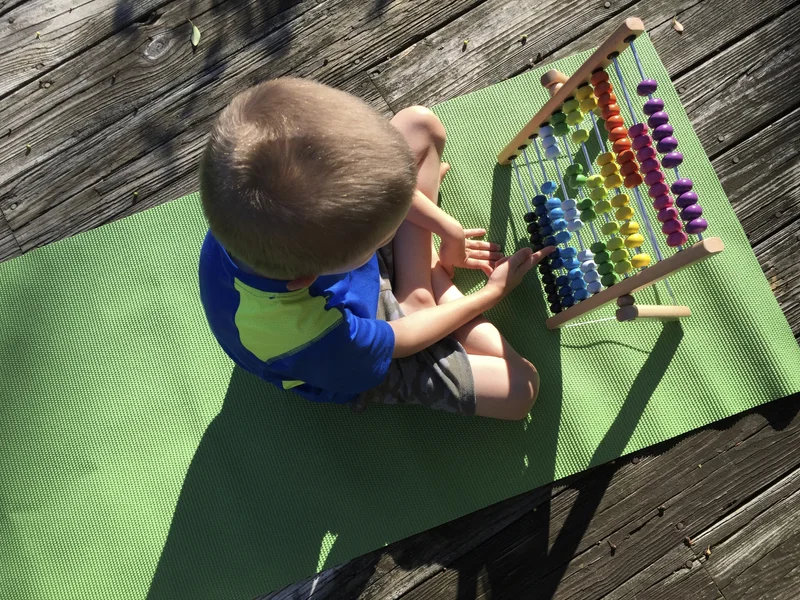
Simple hands-on tools like an abacus or counting beads help young learners build strong number sense up to 10 and 20 at home.
Entering 2nd Grade
Your student builds two-digit place value and quick mental math with landmark numbers over these ten days.
Days 1-3: Place Value and Expanded Form
Rubber-band ten toothpicks together to make a ten, and leave a few loose as ones. Call out a number, say 47, and have your student build it with 4 bundles and 7 loose toothpicks, then write 40 + 7 = 47.
Days 4-7: Mental Plus and Minus 10
Point to a two-digit number on a calendar or 100-chart, say 34, and ask your student to name 10 more and 10 less without counting on their fingers. The tens digit changes, the ones digit stays put, and that pattern is the whole skill.
Days 8-10: Confidence Finish With Doubles Facts
Doubles facts (6 + 6, 7 + 7, 8 + 8) are usually solid by now, so treat the last three days as a speed round. Quick, timed doubles drills give your young learner an easy, fast win right before school starts.
Entering 3rd Grade
Your young learner tackles multiplication groundwork and a telling-time refresher across these ten days.
Days 1-3: Equal Groups and Arrays
Give your child 12 small items, coins or snacks work well, and ask them to arrange the items into equal rows, 3 rows of 4 or 2 rows of 6. Have them say out loud what the rows show, 3 groups of 4 make 12.
Days 4-7: Time to the Nearest 5 Minutes
Practice reading an analog clock to the nearest 5 minutes, then add interval questions on top of it. Ask something like "If it's 2:15 now, what time will it be in 20 minutes?" That interval piece is usually what needs the most practice.
Days 8-10: Confidence Finish With Addition Fluency
Deal out a deck of cards and race through quick addition within 20 for a fast-paced finish. Speed matters more than difficulty here, and it shows your student how quickly their math brain bounces back after a summer off.
📕 You May Also Like: Is My 3rd Grader Really Ready for Multiplication? The Foundation Check
Entering 4th Grade
Your child works through fact families, multi-digit regrouping, and an early look at fractions this stretch.
Days 1-3: Multiplication and Division Fact Families
Roll two dice, say a 4 and a 6, and have your child state all four related facts (4 x 6 = 24, 6 x 4 = 24, \(\Large\frac{24}{4}\) = 6, and \(\Large\frac{24}{6}\) = 4).
Days 4-7: Multi-Digit Addition and Subtraction
Work through one 3-digit problem a day on paper, something like 432 - 185, with attention to neat columns and clean regrouping. Getting the borrowing and carrying steps right here keeps small errors from snowballing later in 4th grade.
Days 8-10: Confidence Finish With Visual Fractions
Fold paper strips into halves, fourths, and eighths, then ask your young learner to prove that pieces match up, \(\Large\frac{2}{4}\) next to \(\Large\frac{1}{2}\), for example. Seeing the fractions side by side makes the idea click faster than an explanation could.

A few focused minutes at home each day can help South Elgin families keep these two weeks on track before U-46's first bell on August 27.
Entering 5th Grade
Your student zeroes in on fractions and multi-digit multiplication these ten days, the two skills 5th grade leans on most.
Days 1-3: Equivalent Fractions
Give your student a fraction pair with a missing number, like \(\Large\frac{3}{4} = \Large\frac{?}{12}\), and ask what you'd multiply top and bottom by to make them equal. A few rounds of this cements how equivalent fractions work.
Days 4-7: Multi-Digit Multiplication
Work through one multiplication problem a day, something like 24 x 15, using the area model or the standard algorithm, whichever your child's class uses. Clean, organized steps matter here as much as the right answer.
Days 8-10: Confidence Finish With Decimal Place Value
Hand your learner a receipt or price tag, say $12.45, and ask them to name the digit in the tenths and hundredths place, then round to the nearest dollar. Money makes this concept concrete, so they can check their own answer on the spot.
📕 You May Also Like: 8 Common Mistakes Kids Make with Decimals & How to Fix Them
Entering 6th Grade
Your young learner works on ratios and percent conversions these ten days, the two ideas 6th grade leans on most.
Days 1-3: Ratios and Rates
Pull out a handful of two colors of socks or snacks and have your child describe the mix as a ratio, 3 red to 2 blue, or 3 to 2. Then ask what happens if you double everything, since 6 to 4 is still the same ratio.
Days 4-7: Decimal and Percent Conversions
Practice converting a few familiar fractions, \(\Large\frac{1}{4}\), \(\Large\frac{1}{2}\), and \(\Large\frac{3}{4}\), into decimals and then percentages. Once your student has 0.25 and 25% memorized for these benchmarks, new fractions get much easier to estimate.
Days 8-10: Confidence Finish With Decimal Operations
Add and subtract a few prices on a mock receipt for the last three days, keeping the focus on lining up decimal points correctly. It's a fast way for your young learner to feel sharp with decimals before school starts.
Entering 7th Grade
Your child spends these ten days on negative numbers, proportions, and one-step equations, the groundwork for pre-algebra this year.
Days 1-3: Integer Operations on a Number Line
Use a deck of cards, red for negative and black for positive, to practice adding and subtracting integers. Rules like -5 + 8 = 3 or 4 - (-3) = 7 stick faster with cards in hand than with numbers alone.
Days 4-7: Proportions
Solve a proportion a day, something like \(\Large\frac{x}{12} = \Large\frac{3}{4}\), using cross-multiplication or a scaling factor, whichever clicks faster for your child. Either method gets to the same answer, so let them pick.
Days 8-10: Confidence Finish With One-Step Equations
Practice isolating a variable in equations like x + 7 = 15 or 4x = 36. Because each one takes a single step to solve, your student gets a quick, easy win heading into the first day of school.
Entering 8th Grade
Your student sharpens exponent rules, two-step equations, and slope these final ten days, the building blocks for Algebra 1.
Days 1-3: Exponent Rules and Integer Operations
Review the product rule for exponents, x3 times x2 equals x5, alongside signed multiplication and division, like -6 times -4 equals 24. Mixing the two keeps both fresh at once.
Days 4-7: Two-Step Equations
Solve a two-step equation a day, something like 3x - 5 = 16, and talk through why addition or subtraction gets undone before multiplication or division. That order is the part most students forget under pressure.
Days 8-10: Confidence Finish With Slope
Give your child a simple graph and ask them to find the slope using rise over run. Connecting a formula to something they can see on paper makes algebra feel less abstract right before 8th grade starts.
📕 You May Also Like: Good Grades May Hide Math Gaps: Here Is How and Why
What to Do If Review Reveals Significant Skill Gaps
Significant knowledge gaps look different from a little rust. Deep frustration, tearful meltdowns, or missing skills from a grade or two back all point to something bigger than a few weeks off from school. If your child hits one of these signs during the review, treat it as useful information, not something to worry about.
Math builds in a strict order, a point the National Mathematics Advisory Panel has emphasized, so a foundation that's been shaky since last year or the year before won't fix itself in fifteen minutes at the kitchen table.
Home activities like these keep your student's facts fresh, but they don't reach far enough back to repair a gap that started before this summer.
You don't have to be the one who delivers that news to your child. Trained specialists at Mathnasium of South Elgin can run a structured assessment, pinpoint exactly where to start, and close the gap without straining the relationship you have at home.

Mathnasium tutors use personalized learning plans and proven teaching techniques to support students at any stage of their math journey.
How Mathnasium of South Elgin Supports Students Year-Round
Mathnasium is a math-only learning center helping students of all skill levels excel in math.
We work with many students in the final weeks of summer who want to shake off rust, firm up fact fluency, or walk into a new school year with confidence.
To support them, we use the Mathnasium Method™, our proprietary teaching approach built around what each student needs.
It starts with a diagnostic assessment that pinpoints your child's strengths, knowledge gaps, goals, and how they learn best, giving us a clear picture of where to begin.
From those insights, we build a personalized learning plan that helps them catch up, keep up, or get ahead, whether that means firming up multiplication facts before the first day back, building confidence with ratios and equations ahead of a new middle school, or getting a head start on next year's material.
Our specially trained tutors then deliver face-to-face instruction using verbal, visual, mental, tactile, and written techniques, teaching the how and the why so your student builds real problem-solving skills.
That support continues year-round, with homework help, test prep, and curriculum support for U-46 students, building lasting confidence and numerical fluency.
Students stay engaged through game-based activities, earned rewards, and consistent recognition of progress, and the numbers show it.
-
94% of parents report an improvement in their child's math skills and understanding
-
93% of parents report their child's improved attitude toward math after attending Mathnasium
-
90% of students saw an improvement in their school grades
With over 1,100 centers, we bring the Mathnasium Method™ close to your neighborhood.
For families in and near South Elgin, IL, Mathnasium of South Elgin is a trusted local center with years of experience building confident math thinkers. Elgin students who need extra reps on multiplication and division facts should check out Mathnasium's Math Facts program, which builds that fluency into every session.
Ready to get started?
📅 Schedule a Free Diagnostic Assessment at Mathnasium of South Elgin
Not near South Elgin?
📍 Find Mathnasium Learning Centers Near You


 (224) 535-8755
 (224) 535-8755