You've probably heard of the Dead Sea, but did you know it sits about 430 meters below sea level? It is the lowest point on Earth's surface, and its elevation is written as a negative number.
The Dead Sea is just one of many places where negative numbers describe something real, such as a temperature, a bank balance, or a countdown.
With that as our starting point, Mathnasium tutors explain what negative numbers mean, why zero is the key reference point, and where negative numbers show up in everyday life.
What Are Negative Numbers (In Plain Terms)?
Negative numbers describe positions or quantities on the opposite side of zero from positive numbers. To understand what they mean, we first need to understand the role zero plays in each situation.
In many real-world measurements, zero acts as a reference point rather than simply representing "nothing." It marks the place from which we measure in opposite directions.
One simple way to picture this is an elevator. The lobby is floor 0, and every floor above it has a positive number: 1, 2, 3. Floors below the lobby are labeled −1, −2, −3. Just like the floors above the lobby, they represent existing places. The only difference is their position relative to floor 0.
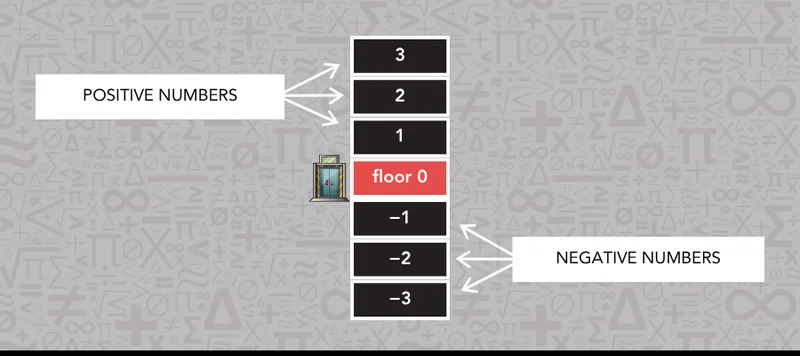
Whenever we see a negative number, we should first identify the reference point. We can then see where the number sits in relation to it.
📕 You May Also Like: How to Add Positive and Negative Integers: A Complete Guide
Why Large Digits Mean Smaller Values in Negative Numbers
Negative numbers often seem confusing because they behave differently from positive numbers. For example, 7 is greater than 2, but −7 is smaller than −2 because we measure negative numbers in the opposite direction from zero.
The negative sign tells us we are moving backward or downward from zero, while the digit shows how many steps we have traveled. When we move a greater distance in that downward direction, our value becomes smaller.
The same pattern shows up on a number line, so the correct order from smallest to largest is −7, −6, −5, −4, −3, −2, −1, 0, 1, 2, 3, 4, 5, 6, 7.
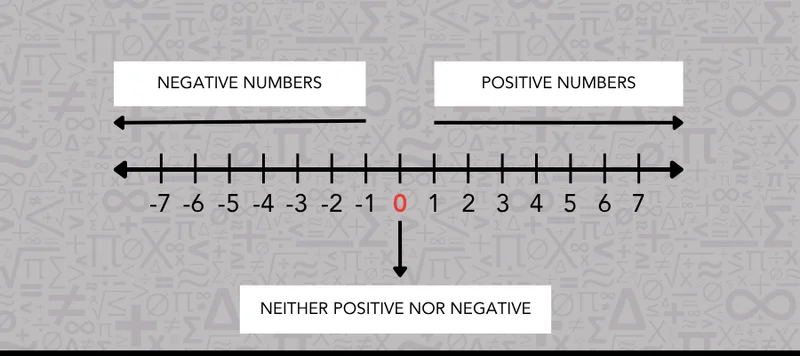
Remember the Dead Sea from the beginning of the article? We can see the same pattern here. An elevation of −430 meters is lower than −100 meters because it sits farther below sea level. Even though 430 is greater than 100, −430 represents the smaller value.
Under the New Jersey Student Learning Standards, Grade 6 students learn to compare positive and negative numbers by using their positions on a number line and to explain what those comparisons mean in real-world situations.
By Grade 7, they build on that understanding by performing operations with positive and negative rational numbers in multi-step problems.
📕 You May Also Like: How to Subtract Positive and Negative Integers? A Simple Guide
Negative Numbers in Everyday Life
Negative numbers help us describe many situations we encounter every day. Our tutors will walk through four familiar examples that show how the same idea works in different contexts.
1. Temperature
Temperature gives us one of the clearest real-world uses of negative numbers, since 0°C marks the freezing point of water under standard conditions.
When the temperature drops below that point, we write it as a negative number. If the thermometer shows −5°C, the air is 5 degrees below freezing. Another drop of 3 degrees moves us three steps farther below zero.
Let’s trace that movement on the temperature scale:
-
Start at −5°C
-
Move down 1 degree to −6°C
-
Move down another degree to −7°C
-
Move down one more degree to −8°C
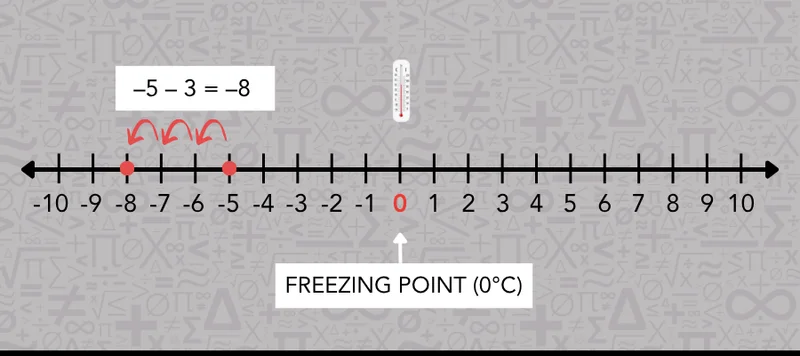
We can also write that same movement as: −5 − 3 = −8°C.
The subtraction sign tells us to move 3 degrees farther down the temperature scale, which is why the temperature changes from −5°C to −8°C. Since −8°C sits farther below zero than −5°C, it represents a colder temperature.
Weather forecasts and science classes use negative numbers since they show how far the temperature has fallen below the freezing point.
2. Money and Debt
When we look at our finances, zero means we neither owe money nor have money available. We have money to spend when the balance is positive, while a negative balance shows how much we owe.
Here is one simple example. Suppose we receive $10 as a weekly allowance and want to buy a book that costs $15. We only have $10, so we need to borrow the remaining $5 from a parent.
Let's look at the balance:
We end up at −$5 because the book costs $5 more than the money we had. That missing $5 is the amount we borrowed, so the negative balance represents the debt we now owe.
The next time we receive our $10 allowance, the first $5 goes toward repaying the debt before any money becomes available to spend again.
📕 You May Also Like: Financial Literacy for Kids: Teaching Money Management Through Math
3. Sport Scorekeeping
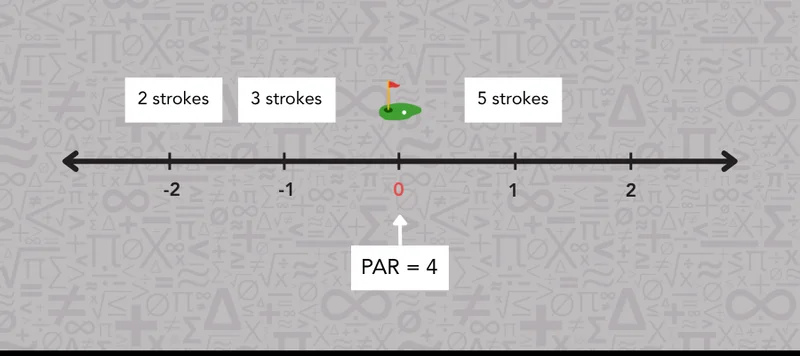
In golf, every hole has a target number of strokes called par. If a hole has a par of 4, players are expected to hit the ball into the hole in four strokes. We can think of par as zero because we measure every score in relation to it.
Here is how the scoring system may work:
-
Par: 4 strokes (this is 0 in golf scoring)
-
Finish in 2 strokes → −2 (two strokes under par)
-
Finish in 3 strokes → −1 (one stroke under par)
-
Finish in 4 strokes → 0 (exactly par)
-
Finish in 5 strokes → +1 (one stroke over par)
In golf, negative numbers represent better performance because they show the player completed the hole in fewer strokes than par.
📕 You May Also Like: 9 Math Skills Kids Use Every Day Without Realizing It
4. Time and Countdowns
Time also uses reference points. One familiar example is a rocket launch countdown, where zero marks the moment of launch. T-minus 10 seconds means the rocket will launch in another 10 seconds.
Let's see how the countdown moves toward launch:
-
T-minus 6 → 6 seconds before launch
-
T-minus 3 → 3 seconds before launch
-
T-minus 1 → 1 second before launch
The word "minus" tells us we're measuring time before the event (launch). We can think of T-minus 6 as −6 because it represents 6 seconds before the reference point. As the countdown approaches zero, the launch gets closer.
📕 You May Also Like: Math for Life: Why Math Skills Matter Beyond School

At Mathnasium, we connect classroom math to everyday experiences so students can understand concepts with confidence.
How Mathnasium Helps Students Understand Negative Numbers
Mathnasium is a math-only learning center dedicated to helping K–12 students of all skill levels excel in math.
Whether students are encountering negative numbers for the first time, working to build confidence with integers before pre-algebra, or looking to deepen their number sense at any level, we can support them.
Our proprietary teaching approach, the Mathnasium Method™, is designed around each student's needs and learning style to help them learn and master math. Our approach includes:
-
Assessment and Personalized Learning Plans: Each student begins their Mathnasium journey with a diagnostic assessment that identifies current skills, strengths, and gaps. From those findings, we build a personalized learning plan tailored to their goals, whether that means strengthening foundational number sense, building confidence with integers, or preparing for more advanced math concepts.
-
Teaching for Understanding: Our specially trained tutors use natural language and a mix of verbal, visual, mental, tactile, and written techniques so each concept lands before we move forward.
-
Problem-Solving and Critical Thinking: We give students time to work through problems independently. That productive struggle helps them learn to trust their own reasoning. When we do step in, we explain both the how and the why behind each answer, so students build problem-solving and critical thinking skills they can use in math and beyond.
-
An Engaging and Fun Learning Environment: Sessions include games, earned rewards, and consistent celebration of progress. Students build confidence alongside fluency, and many develop a more positive relationship with math over time.
The impact extends beyond the classroom:
-
94% of parents report improvement in their child's math skills and understanding
-
93% of parents report an improved attitude toward math after attending Mathnasium
-
90% of students saw improvement in their school grades
With over 1,100 learning centers across North America, there is likely a Mathnasium close to you.
Families across Englewood and nearby areas, including Tenafly, Englewood Cliffs, and Bergenfield, trust Mathnasium of Englewood to help their children build lasting confidence in math.
If negative numbers or any other math concept is giving your child trouble, our team is ready to help.
📅 Schedule a Free Assessment at Mathnasium of Englewood
Not near Englewood?
📍 Find a Mathnasium Learning Center Near You


 (201) 431-5510