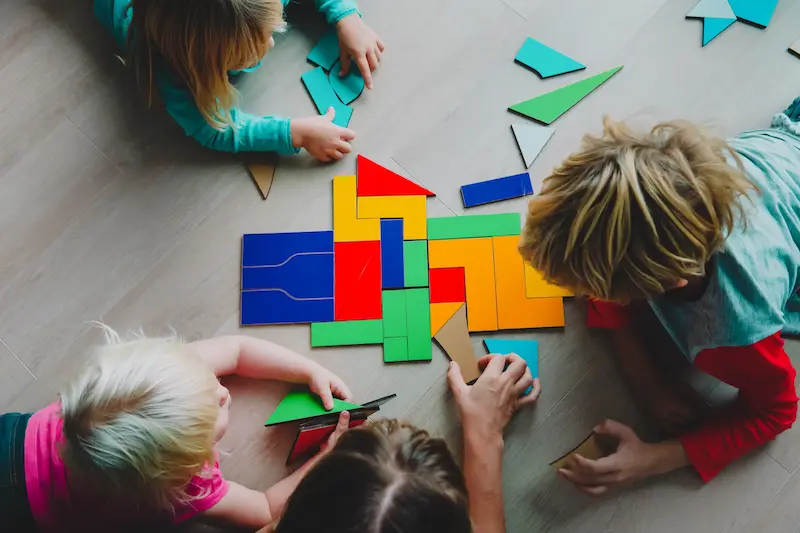
Mathematics often gets an undeserved reputation for being difficult or abstract because procedures and problem-solving can become the main focus.
We can easily forget that math also describes the world around us, and recognizing those connections can make concepts more intuitive and help us understand why they work.
In fact, children already rely on mathematical ideas through ordinary experiences, like sorting objects by size or estimating whether a bag is big enough to hold their school supplies, even before anyone teaches them what those ideas mean mathematically.
So, where does this everyday math learning happen? Today, our Mathnasium education specialists will look at several familiar environments where mathematical thinking develops naturally and show what it looks like in practice.
What Makes the Home a Geometry Classroom
Before children write digits or learn to calculate area, they read space. Whether they judge where objects fit or notice distance and shape, children are already developing an early feel for geometry.
This intuitive understanding helps build spatial reasoning, or the ability to visualize objects, understand dimensions, and mentally picture movement or position. Children may not know the mathematical names for these ideas yet, but they already use them as they interact with their surroundings.
For example, you may see your child:
-
Stack blocks or build structures with cushions and boxes, which introduce angles, physical balance, and the relationship between height and stability.
-
Fit objects into bags, drawers, or containers, which develops an intuitive understanding of volume, shape matching, and spatial visualization.
-
Find their way through familiar spaces, remember where objects belong, or recreate rooms and neighborhoods with toys, which builds spatial mapping and early coordinate thinking.
As children begin learning geometry more formally, these familiar experiences connect to concepts they encounter in the school curriculum:
|
What Students Do at Home
|
Geometric Concept
|
Where It Appears in School
|
|
Fitting shapes into containers
|
Spatial visualization and volume
|
Geometry: 3D shapes and surface area
|
|
Building structures with blocks
|
Angles, balance, and symmetry
|
Geometry: angles and structural reasoning
|
|
Drawing maps of familiar spaces
|
Coordinates, scale, and direction
|
Coordinate geometry and mapping
|
|
Sorting objects by shape and size
|
Classification and properties of shapes
|
Shape properties and quadrilateral classification
|
How Everyday Experiences Build Number Sense
Mathematics is a dynamic language that gives children a way to understand change, sequences, quantities, and relationships through numbers.
Daily routines, meals, and errands give children plenty of opportunities to estimate, compare, and predict. They may experience these moments in everyday life, while the same thinking gradually builds their number sense.
Let’s look at some common examples:
-
Patterns and sequences. Music follows a regular beat, tiles in a bathroom repeat a set layout, and building-block designs can grow by adding the same number of pieces each time. As children notice how these patterns repeat or change and anticipate what comes next, they develop the predictive thinking that later supports algebra.
-
Time and duration. Estimating five more minutes before leaving the house or calculating how long until a favorite show starts builds an intuitive grasp of time as a measurable quantity. Children begin to reason with time in much the same way they later work with other units of measurement.
-
Quantities and portions. Children may check whether there is enough juice for everyone at the table or divide snacks equally among friends or siblings. These comparisons help build the proportional reasoning that becomes increasingly important in middle school math.
Now we can translate these everyday experiences into the curriculum language children encounter at school:
|
Daily Routine
|
Number Concept
|
Where It Appears in School
|
|
Noticing repeating patterns
|
Sequences and predictive reasoning
|
Patterns and algebraic thinking
|
|
Estimating time and reading timers
|
Measurement and elapsed time
|
Time problems and rate calculations
|
|
Counting down to events
|
Number sequence and subtraction
|
Number lines and countdown problems
|
|
Comparing quantities and portions
|
Ratio, proportion, and estimation
|
Fractions and proportional reasoning
|
📕 You May Also Like: What Is Number Sense & Why It Matters in Early Math Education
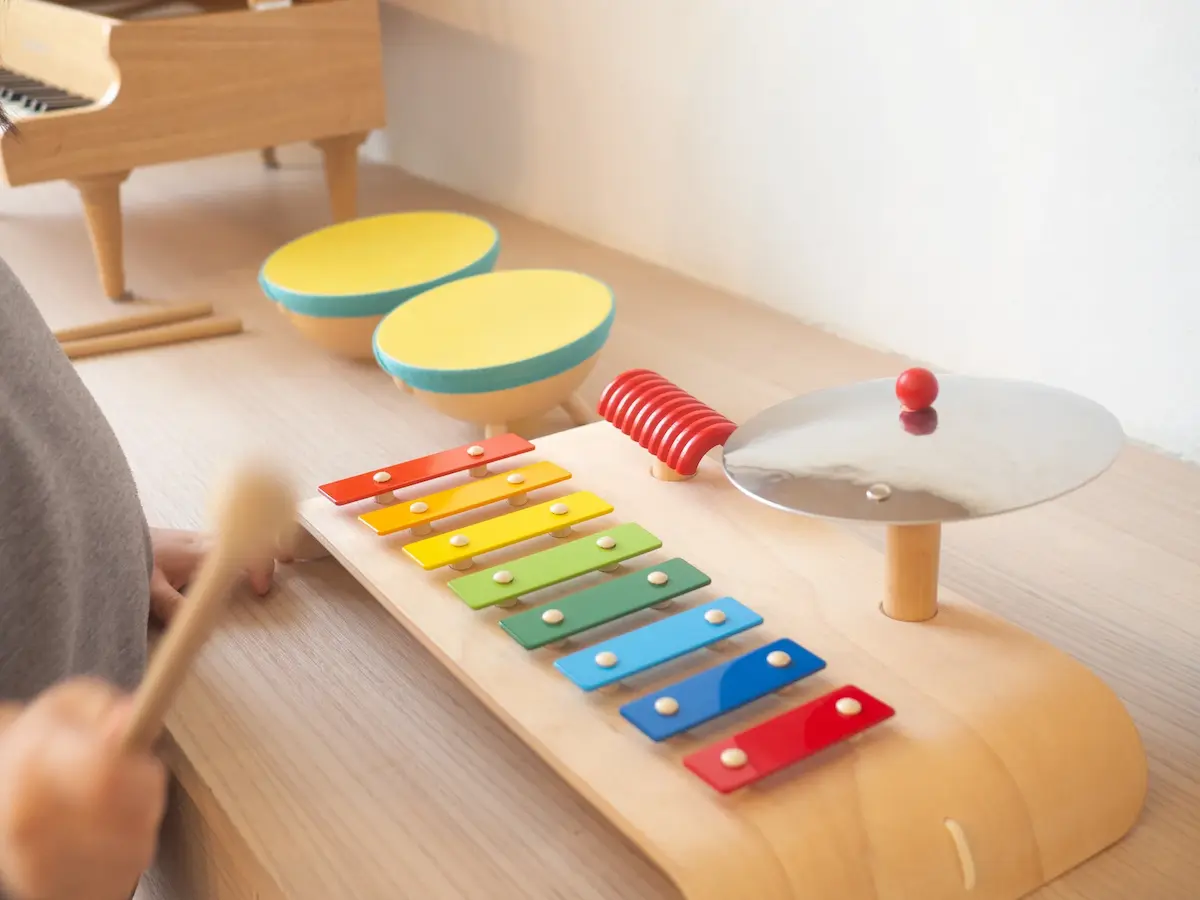
Turns out that keeping the beat and thinking mathematically both ask children to recognize a pattern and anticipate what comes next.
How Games Build Applied Math Through Play
Games are already among the most math-rich activities children choose to do voluntarily, usually because they simply enjoy them.
Every round of play builds math skills while children focus on the game itself. In trying to win, they may practice probability, multiplication, and mental arithmetic before they learn the mathematical language behind what they are doing.
Here is what that looks like across four games children already enjoy:
-
Yahtzee builds addition and multiplication of dice groups alongside probability reasoning as children compare possible combinations and decide which dice to keep or roll again.
-
Monopoly builds familiarity with money, making change, addition, subtraction, and comparison through property purchases and rent.
-
SET builds pattern recognition, logical classification, and quick comparative reasoning as children scan for groups of three cards that meet specific conditions.
-
Battleship develops coordinate reasoning, systematic elimination, and spatial logic as children track positions and use previous hits and misses to decide where to look next.
What these games have in common is that math helps children make decisions as they play, whether they are comparing options, planning a move, or working out what might happen next.
If you want to help your child express the mathematical thinking behind what they are already doing, you can occasionally ask how they decided on their next move or why they chose a particular strategy, encouraging them to explain the reasoning behind their choice.
📕 You May Also Like: 10 Fun Math Games to Play at Home with Your Child

Roll, count, decide, repeat. Even a simple turn of the dice can involve more math than it seems.
What Everyday Conversations Teach Children About Flexible Thinking
Research suggests that everyday conversations can help children develop flexible thinking, the ability to consider multiple possibilities and adjust their ideas as they learn something new.
Children practice this whenever a conversation invites them to explain a choice, predict what might happen, or reconsider an idea. The subject itself may have nothing to do with math, yet the habit of looking beyond the first answer can later support mathematical problem-solving.
Maybe you’ve sometimes asked your child, “It looks like it might rain, so what else could we do today?” While this may sound unrelated, that simple question models flexible problem-solving.
Later, when encountering a multiplication problem like finding 15 × 4, that same habit can help your child see more than one way to solve it. They might break 15 into 10 and 5, then calculate 10 × 4 + 5 × 4, or double 15 twice to get 60.
This kind of questioning can take on a more deliberate role once children begin learning math formally. At Mathnasium, we build on it through the Socratic method. Our tutors use purposeful questions to guide students toward mathematical understanding and help them explain the reasoning behind their answers.
Parents can encourage the same habit simply by giving children room to explain their ideas and consider other possibilities during everyday conversations.
📕 You May Also Like: 8 Strategies for Parents Practicing Math With Their Children
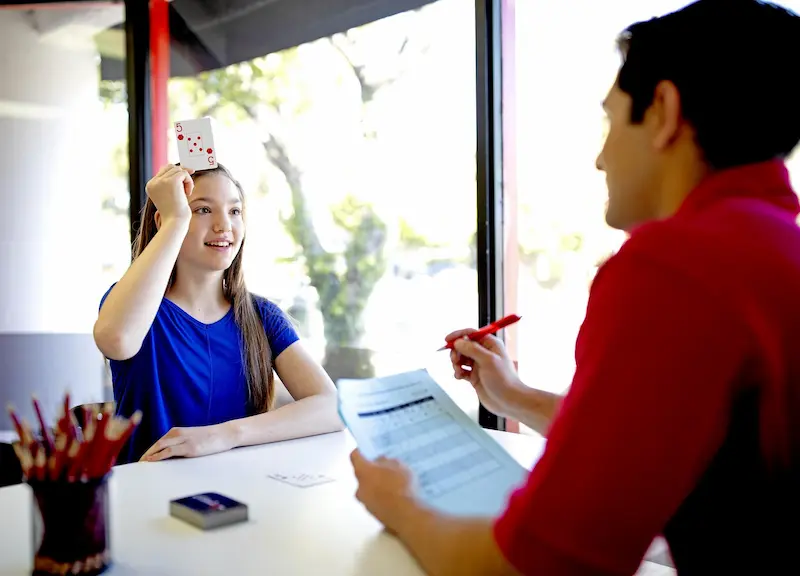
At Mathnasium, students build mathematical thinking that supports both learning and exploration.
How Mathnasium Creates an Engaging Math Learning Environment
Mathnasium is a math-only learning center dedicated to helping K–12 students of all skill levels excel in math.
In our learning center, math goes beyond working through worksheets. We bring concepts into context through real-world examples, interactive games, and hands-on activities. Students can use what they know in different situations, think through problems, and discover how mathematical ideas work in practice.
We bring these elements together through the Mathnasium Method™, our proprietary teaching approach designed around each student’s needs and learning style to help them learn and master math.
Our approach includes:
-
Assessment and Personalized Learning Plans: Each student begins their Mathnasium journey with a diagnostic assessment that identifies current skills, strengths, and gaps. From those findings, we build a personalized learning plan tailored to their goals.
-
Teaching for Understanding: Our specially trained tutors use natural language and a mix of verbal, visual, mental, tactile, and written techniques so each concept lands before we move forward. Different ways of presenting a concept give students more than one path to understanding, whether they benefit from visual prompts, physical objects they can manipulate, or verbal explanations.
-
Problem-Solving and Critical Thinking: We give students time to work through problems independently. That productive struggle helps them learn to trust their own reasoning. When we do step in, we explain both the how and the why behind each answer, so students build problem-solving and critical thinking skills they can use in math and beyond. That balance between independence and guidance helps students stay engaged without feeling overwhelmed.
-
An Engaging and Fun Learning Environment: Sessions include games, earned rewards, and consistent celebration of progress, so students actively participate, solve problems, and engage with math instead of simply listening to a lesson. They build confidence alongside fluency, and many develop a more positive relationship with math over time.
The impact extends beyond the classroom:
-
94% of parents report an improvement in their child's math skills and understanding
-
93% of parents report their child's improved attitude toward math after attending Mathnasium
-
90% of students saw an improvement in their school grades
With over 1,100 learning centers across North America, there is likely a Mathnasium close to you.
Families throughout Englewood and nearby communities, including Tenafly, Englewood Cliffs, and Bergenfield, trust Mathnasium of Englewood to help their children build lasting confidence in math.
Whether you want to build on everyday math moments or support your child in new areas, our team is ready to help.
📅 Schedule a Free Assessment at Mathnasium of Englewood
Not near Englewood?
📍 Find a Mathnasium Learning Center Near You


 (201) 431-5510