When math study starts to wobble, maybe times tables keep tripping them up, or fractions just won't click, who do kids turn to first? Parents.
They sit down with their child to study math together, bringing patience and whatever math they remember from their own school years.
However, studying math together doesn't always go smoothly.
Math is taught differently today than it was a generation ago. Students need explanations that go beyond just showing the steps. Mix in the emotions that surface, and study sessions can turn tense faster than anyone expects. That's completely normal.
To support parents through this process, seasoned Mathnasium tutors have put together a set of practical, at-home strategies for learning math together that build progress without frustration.

1. Prioritize Understanding Over Recall
Say your child gets stuck on a multiplication fact like 6 × 8. A common instinct is to push memorization or repeat it until it sticks. That might get them through today, but it leaves the same hesitation in place the next time the fact comes up.
Instead, pause and anchor the fact in meaning. Ask what 6 × 8 represents. Six groups of eight. Eight added six times. You might sketch the groups or connect the fact to something nearby that they already know.
If the math is tied to an idea, it becomes easier to recall and easier to rebuild if it’s forgotten.
Math educators refer to this as conceptual learning. Research shows that learners who understand the meaning behind math ideas recall them more reliably and apply them more effectively to new or real-life problems.
During study time, parents can encourage understanding by slowing the conversation down:
-
Have your child describe what the problem is really asking
-
Ask how they would explain the idea to a friend
-
Suggest drawing a quick picture to make the math visible
-
Talk through a rough estimate before calculating
With understanding at the foundation, students lean less on rote memory and gain the confidence to reason their way through when something slips.
📕 You May Also Like: Critical Thinking vs. Memorizing: What Really Builds Math Skills?
2. Praise Progress Over Accuracy
It'd be wrong to say accuracy isn't important in math. But leading with it can raise the pressure on a child quickly. When every answer feels like it's being judged right or wrong, kids tend to rush, play it safe, or, worst case scenario, shut down.
So what should you do?
Turn your attention to progress. Notice the strategy your child tried, or simply how they stuck with a problem longer this time around.
That kind of feedback is more likely to keep them engaged because it shows learning is about getting better, not being perfect.
This idea connects to psychologist and Stanford professor Carol Dweck’s work on the growth mindset. She found that recognizing effort and progress builds more resilience than focusing only on right answers.
Say your child is simplifying this expression: 2(x + 5)
They write: 2x + 5
Instead of saying, “That’s wrong,” you might say, “I like that you multiplied the 2 by the x. You remembered that the number outside the parentheses needs to be distributed. Let’s look at what still needs to happen with the 5.”
As you call out their good thinking in the moment, they gain confidence to experiment and bounce back from errors.

Progress deserves recognition, even before the answer is perfect.
3. Have Your Child Explain Their Thinking
Children working silently can hide misconceptions easily. A page full of answers, right or wrong, doesn't show how a child approached the problem or where their reasoning first went off track.
Asking a child to explain their thinking brings those hidden steps to the surface. As they talk through how they set up a problem, you can hear whether they understand the relationships involved or are relying on a rule they don't fully grasp yet.
A notable cognitive study on self-explanation shows that talking through math helps students notice gaps in their own understanding and begin filling them in.
Your role as a parent here is simple: listen and guide.
Imagine your child is asked to find the area of a rectangle that is 6 units long and 4 units wide. As they explain their thinking, they start adding the sides together. That explanation tells you more than the answer ever could. They’re mixing up area and perimeter.
That explanation gives you a clear place to focus next.
📕 You May Also Like: How to Nurture Math Thinkers, Not Just Answer-Getters
4. Break Problems into Smaller Steps
When a student gets stuck midway through a problem, the goal is to slow things down and break the work into smaller steps.
Large math problems can overload working memory. A long division task or a dense word problem can feel overwhelming all at once.
Chunking the work restores clarity. It helps students stay independent by turning one big problem into a series of doable moves.
Take a multi-step word problem like this: A classroom has 4 rows of desks with 6 desks in each row. Then, 5 more desks are added. How many desks are there in total?
All at once, that’s a lot to hold in your head. Instead of tackling it in one go, guide your child to chunk it:
-
Step 1: What is happening first? Four rows with six desks each.
-
Step 2: What math matches that part? Multiplication: 4 × 6.
-
Step 3: What happens next? Five more desks are added.
-
Step 4: What math matches that step? Addition.
-
Step 5: What is the final question asking for? The total number of desks.
Breaking the problem into steps like this keeps your child in the driver's seat. Instead of solving it for them, you're helping them organize their own thinking.
5. Use Visuals and Manipulatives
Math feels heavier when everything stays abstract. Visuals and manipulatives lighten the load by giving students something they can see or touch instead of holding it all in their heads.
Studies confirm it. A recent meta-analysis found that visualization-based strategies in math significantly improve both understanding and retention. Simply put, when students can see the math, it sticks.
You know how, when students start working with negative numbers, they get confused about which direction to move or how operations work? They might get stuck on -2 + 4.
Pull out a number line, start at -2, and move 4 spaces to the right. Suddenly, they can see the movement landing on 2.
Then there's the a-ha moment.
This approach works across many concepts. Mathnasium tutors regularly recommend:
-
Number lines to show addition, subtraction, and negative numbers
-
Arrays or area models to make multiplication visible
-
Counters or small objects for fractions, ratios, or grouping
-
Bar models or boxes to organize word problems
-
Drawings to compare quantities or show part–whole relationships
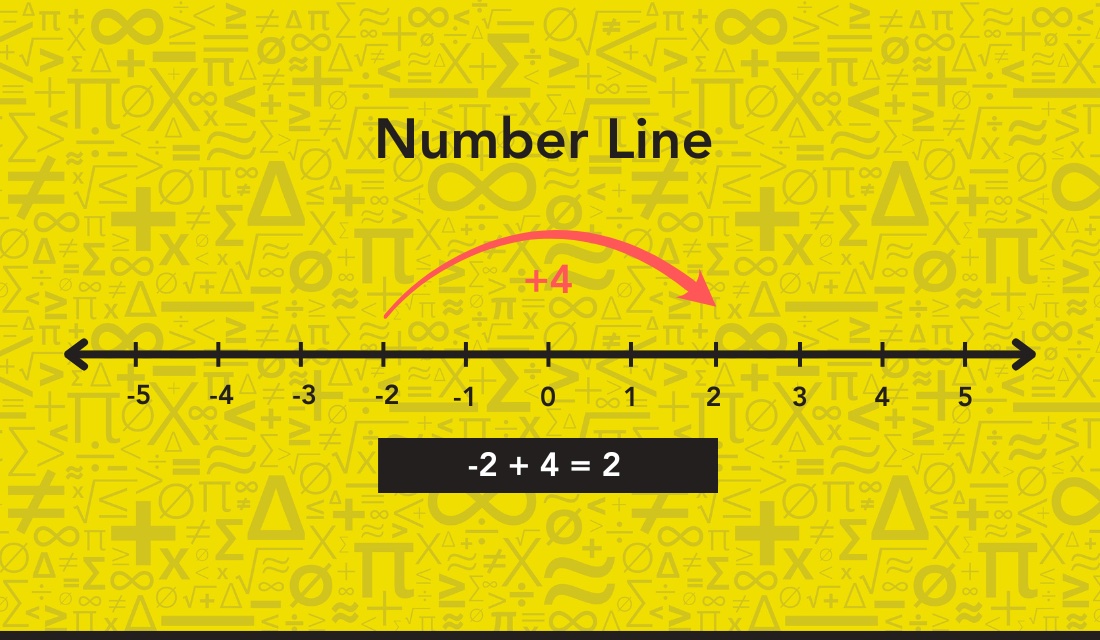
Number lines help students make sense of integers by showing direction and distance, and they also support work with fractions, decimals, and comparisons.
6. Practice Patience with Productive Struggle
Struggle isn’t always a bad sign in math. There’s a difference between a student feeling stuck and a student still thinking. The tricky part is knowing when to step in and when to give them space.
Jumping in too quickly can weaken confidence. Students learn more when they have time to test a strategy, adjust it, and keep going. Productive struggle looks like hesitation paired with effort, not frustration or shutdown.
Imagine your child is solving a fraction problem like \(\Large\frac{3}{4}\)+\(\Large\frac{1}{8}\).
They pause, try to add the numerators, stop, and rethink. Instead of correcting them right away, you give them a moment and ask a guiding question like, “What do these fractions need before they can be added?”
That small nudge helps them reconnect to the idea of common denominators without taking over the work.
Patience in these moments helps students trust their own problem-solving and builds resilience that carries into harder math later on.
📕 You May Also Like: How Tutors Use Productive Struggle in Math (At-Home Guide)
7. Use Mistakes as Learning Springboards
One thing we see consistently in our learning centers is that students, especially younger ones, carry a lot of weight around mistakes. An error can feel embarrassing or risky, even when no one reacts negatively.
Part of our work at Mathnasium is helping students rethink mistakes, and that work matters at home too.
A correct answer can look like success, but it doesn’t always tell the full story. A student might follow a procedure without understanding the idea behind it. Mistakes, on the other hand, show exactly where reasoning starts to break down and what needs to be targeted.
Research in cognitive science shows that the brain becomes more active after mistakes than after correct answers. That extra processing helps students adjust their thinking, which supports learning and improvement.
In other words, mistakes are not setbacks but opportunities.
Parents can support this mindset by:
-
Asking what part of the problem felt confusing
-
Saying, “Let’s look at this together,” instead of fixing it immediately
-
Asking what they were thinking when they chose that step
-
Reworking the problem using a different example or representation
-
Sharing times they’ve had to rethink a mistake themselves
📕 You May Also Like: Why Parents Should Teach Kids to Embrace Math Mistakes
8. Connect Math to the Real World
Last but definitely not least, math needs a life outside of worksheets. As students spot math showing up in everyday moments, the ideas tend to stick because they actually feel useful.
A review of educational studies explains that applying math in real situations helps students build stronger problem-solving skills and a better attitude toward math overall.
This doesn’t mean planning big projects or formal lessons at home. Everyday routines already do a lot of the work.
If you’re looking for easy ways to bring math into daily life, try the following:
-
Cooking with fractions while measuring or adjusting a recipe
-
Estimating totals or comparing prices at the store
-
Measuring for small home projects or rearranging furniture
-
Keeping track of time, like planning how long an activity will take
-
Splitting quantities, such as sharing snacks or dividing game scores

Mathasium is a math-only learning center where students grow into confident problem-solvers.
How Mathnasium Fosters Confident Math Thinkers
Mathnasium is a math-only learning center for students of all skill levels. Trusted by over one million parents, our learning centers have proven effective at transforming not only students’ math skills, but also how they think and feel about the subject.
Behind each of our programs is not a one-size-fits-all solution but a proprietary teaching approach called the Mathnasium Method™.
Designed to foster confident math thinkers, our approach includes:
-
Personalized learning: Each student begins with a diagnostic assessment. This helps us identify their strengths, potential knowledge gaps, and how they approach math overall. Using these insights, we design a learning plan customized to each student’s needs.
-
Teaching for understanding: We use natural, everyday language to phrase math concepts. We also use a combination of verbal, visual, mental, tactile, and written teaching techniques to help students truly make sense of what they’re learning.
-
Caring, supportive tutors: Our tutors are specially trained in math as well as the technical and emotional aspects of teaching. This means they know how to encourage a student who’s overwhelmed and how to challenge one who’s ready to stretch their thinking.
-
Problem-solving and critical thinking skills: During sessions, we always allow time for productive struggle, then rejoin students to check and correct their processes. This helps them learn to rely on their own thinking. We guide them through both the how and the why behind each math problem. This approach develops the problem-solving and critical thinking tools they’ll use in math and life.
-
Singular focus on math: We are dedicated to math and math only. This singular focus on math allows us to dive deeper into how students best learn, absorb, and retain math skills.
-
A confidence-building, fun learning environment: We often hear students say our sessions don’t feel like lessons at all. That’s because we incorporate game-based activities and plenty of rewards to keep students motivated and engaged.
This approach delivers measurable growth and lasting mindset shifts:
Families in Irvine, CA, and nearby communities trust the local team at Mathnasium of University Irvine to turn challenges into confidence and math into something their child can feel good about.
📅 Schedule a Free Assessment at Mathnasium of University Irvine
Not near Irvine?
📍 Find Mathnasium Learning Centers Near You


 (949) 296-6284