As the end of the school year approaches, many families start thinking about keeping math skills fresh over the summer or making the transition to the next grade as smooth as possible. Without a clear focus, that effort may not target the skills that will matter most when September arrives.
Our education specialists put together this K-8 guide to help you choose the right focus for your child's grade, spot common knowledge gaps, and decide whether home practice or structured support is the better fit.

Summer Math Priorities by Grade
Summer gives students a few months away from regular math practice, and some areas are more likely to need a refresher before school begins again.
From our experience, some math skills deserve more attention than others at each grade level. Let's look at where summer practice is most likely to pay off.
Grades K to 2: Number Sense and Fact Building
Fact fluency and number sense are the foundation on which we build everything else in elementary math. Here is what each grade is typically working toward:
To see where your child stands, try a quick math check at home:
If your child relies on finger counting or long pauses, fact fluency deserves extra attention this summer.
📕 You May Also Like: 5 Easy Steps to Help Your Child Build Math Fact Fluency
Grades 3 to 4: Multiplication, Division, and Multi-Digit Operations
Grades 3 and 4 are when children move beyond basic arithmetic and begin applying multiplication and division to larger numbers and multi-step problems.
Here's how that progression looks across both grades:
-
Grade 3: Multiplication and division fact fluency, along with understanding how the two operations are connected.
-
Grade 4: Multi-digit multiplication and division, place value to one million, and early fraction concepts.
One of the most important ideas students develop at this grade band is the relationship between multiplication and division. If your child confidently answers 6 × 7 = 42, ask what 42 ÷ 7 equals and why. Since 6 equal groups of 7 make 42, we also know that 42 ÷ 7 = 6 because division tells us how many equal groups of 7 make 42.
If your child knows both answers but cannot explain how the two facts are connected, it indicates a conceptual gap in their understanding of multiplication and division that should be addressed before Grade 5.
📕 You May Also Like: 5 Strategies to Help Your Child Make Sense of Division
Grade 5: The Transition Year
Grade 5 bridges elementary arithmetic and middle school reasoning, with a particular focus on:
-
Fraction operations, including addition, subtraction, multiplication, and division
-
Decimal fluency and early algebraic thinking
Because understanding fractions supports many of the other skills students develop in Grade 5, you can see how comfortable your child is by asking them to solve \(\Large\frac{3}{4}\) + \(\Large\frac{2}{3}\) and explain why each step is needed.
Since the denominators are different, we first find a common denominator of 12, because fractions can only be added when they describe equal-sized parts. That gives us \(\Large\frac{9}{12}\) + \(\Large\frac{8}{12}\) = \(\Large\frac{17}{12}\) .
If your child finds the answer but cannot explain why a common denominator is needed, or relies on decimals or a calculator instead, fraction understanding may be a good focus for summer learning.
📕 You May Also Like: 7 Tips to Help Your Child Build Solid Fraction Understanding
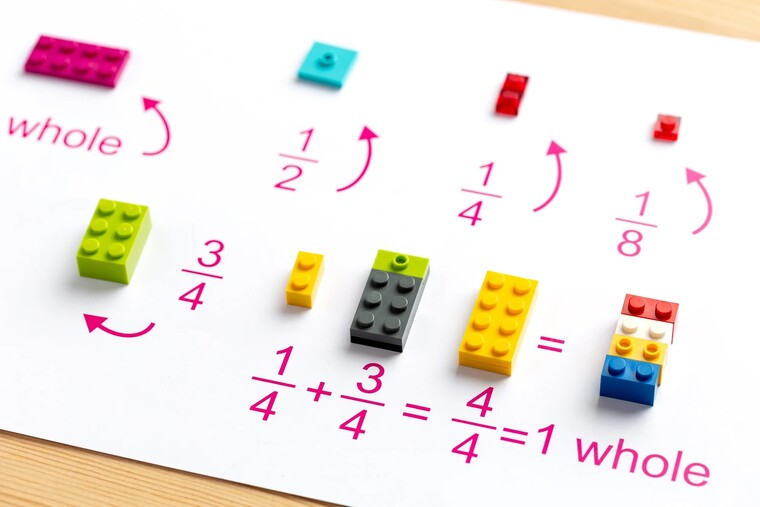 We can only add fractions once they represent equal-sized parts of the same whole, just as 1/4 + 3/4 = 1.
Grades 6 to 7: Fraction Fluency and Proportional Thinking
Fraction fluency and proportional thinking are the skills that determine whether middle school math stays manageable or becomes a persistent struggle.
The New Jersey Student Learning Standards identify ratios and proportional relationships as a major focus in Grades 6 and 7 because they build directly on fraction fluency and prepare students for algebra.
The focus shifts slightly from one grade to the next:
Since ratios, percentages, and proportional relationships all build on fraction fluency, this simple comparison problem can tell you a lot about your child's readiness:
-
Write \(\Large\frac{3}{4}\) and \(\Large\frac{5}{8}\) and invite your child to explain which fraction is larger without converting to decimals.
-
One common strategy is to find equivalent fractions. Since \(\Large\frac{3}{4}\) is the same as \(\Large\frac{6}{8}\) , we can compare \(\Large\frac{6}{8}\) with \(\Large\frac{5}{8}\) . Because 6 is greater than 5, we realize that \(\Large\frac{3}{4}\) is the larger fraction.
An answer based only on the digits, or a quick reach for a calculator, usually means that comparing and reasoning with fractions deserves more attention.
📕 You May Also Like: 6 Ways to Help Your Middle Schooler Understand Proportionality
Grade 8: Algebra Readiness Before High School
Algebra foundations determine how comfortably students transition into high school math. Grade 8 focuses on building algebraic thinking, beginning with understanding the equal sign as a statement of balance because every multi-step equation depends on it.
To see how comfortable your child is with early algebra, start by solving x + 7 = 15 together. We should subtract 7 from both sides because the equal sign tells us both sides of the equation must stay equal. Since 15 − 7 = 8, x = 8.
If we treat the equal sign only as a signal to "find the answer", it can lead to mistakes once equations require the same operation on both sides. For example, in x + 7 = 15 + 2, we subtract 7 from both sides: x + 7 − 7 = 15 + 2 − 7. That leaves x = 10. If we subtract 7 from only one side, we change the value of one side but not the other, so the equation is no longer equal.
Difficulty explaining equation balance usually means algebra is a good place to spend part of your summer practice.
📕 You May Also Like: How to Make Sure Your Child Is Ready for Algebra
Home Practice or Tutoring: Which Path Fits Your Child?
We can support math learning at home in many everyday ways, but some knowledge gaps need more than short practice sessions between busy family routines. The areas we covered usually fall into one of two categories, and each responds differently to practice.
-
Home practice works well for procedural gaps, where your child knows the process but executes it slowly, inconsistently, or with repeated errors. Fact recall that still relies on finger-counting is a good example. Because the understanding is already in place, short, regular repetition is often enough to build fluency.
-
Structured tutoring is often the better fit for conceptual gaps, where your child can follow familiar steps but cannot explain why they work or use them when the format changes. Fraction fluency or algebraic balance falls into this category. Home practice alone rarely closes these gaps because rebuilding conceptual understanding usually goes beyond the light support most families can realistically provide at home.
Many of the grade-level skills involve conceptual understanding, which makes experienced instruction especially valuable for identifying learning gaps and helping students build mathematical reasoning step by step.
That's the same approach we take at Mathnasium, where our teaching method is designed to build deep conceptual understanding while strengthening procedural fluency.
📕 You May Also Like: The Surprising Benefits of Personalized Math Tutoring for Each Student
 At Mathnasium, we help students turn summer into a season of steady progress so they're ready for whatever comes next.
How Mathnasium Supports Students Over the Summer
Mathnasium is a math-only learning center dedicated to helping K–12 students of all skill levels excel in math.
Regular Mathnasium sessions continue throughout the summer and can be scheduled flexibly around vacations and other family plans. Participating centers may also offer dedicated summer math programs and camps with hands-on activities and STEM challenges.
No matter which option families choose, every student learns through our proprietary teaching approach, the Mathnasium Method™, which is designed around each student's needs and learning style to help them learn and master math.
Our approach includes:
-
Assessment and Personalized Learning Plans: Each student begins their Mathnasium journey with a diagnostic assessment that identifies current skills, strengths, and gaps. From those findings, we build a personalized learning plan tailored to their goals.
-
Teaching for Understanding: Our specially trained tutors use natural language and a mix of verbal, visual, mental, tactile, and written techniques so each concept lands before we move forward.
-
Problem-Solving and Critical Thinking: We give students time to work through problems independently. That productive struggle helps them learn to trust their own reasoning. When we do step in, we explain both the how and the why behind each answer, so students build problem-solving and critical thinking skills they can use in math and beyond.
-
An Engaging and Fun Learning Environment: Sessions include games, earned rewards, and consistent celebration of progress. Many centers also incorporate puzzles and enrichment-style activities that keep our learners engaged while stretching their mathematical thinking. Students build confidence alongside fluency, and many develop a more positive relationship with math over time.
Families who work with us see real results in their children's math performance:
-
94% of parents report improvement in their child's math skills and understanding
-
93% of parents report an improved attitude toward math after attending Mathnasium
-
90% of students saw improvement in their school grades
With over 1,100 learning centers across North America, there is likely a Mathnasium close to you.
Families across Sparta and nearby areas, including Lafayette, Ogdensburg, Newton, Hamburg, and Byram, trust Mathnasium of Sparta to help their children build lasting confidence in math.
If summer math preparation or any other math concept is giving your child trouble, our team is ready to help.
📅 Schedule a Free Assessment at Mathnasium of Sparta
Not near Sparta?
📍 Find a Mathnasium Learning Center Near You


 (973) 726-6284
 (973) 726-6284