Research by Schielack and Seeley, published in Teaching Children Mathematics, found that students encounter major changes in instructional materials and approaches, work expectations, school structure, and the general level of difficulty of the material at this stage.
As a Virginia-based Mathnasium center, we are familiar with the Virginia Standards of Learning and often align our instruction with them. We know what Grade 6 expects, and we help students get there all the time.
Today, we put together a practical guide for Virginia parents: what the SOL standards require by the end of 5th grade, what middle school readiness actually looks like in a child's everyday approach to math, and a quick skill check-up your child can work through at home.

What Virginia's SOL Standards Require by the End of 5th Grade
We put this list together based on the Virginia Standards of Learning for Mathematics (SOL), Grade 5.
We also advise you to cross-reference it with the official Virginia Department of Education website at doe.virginia.gov for the most current and complete version, as standards are periodically updated.
Here is what the SOL expects your 5th grader to be able to do before middle school begins.
1. Number and Operations
This is the most consequential skill area for middle school readiness. Fraction and decimal fluency underpin virtually everything your child will encounter in Grade 6.
-
Add, subtract, multiply, and divide fractions with unlike denominators confidently
-
Multiply fractions by whole numbers and by other fractions
-
Solve real-world problems involving fractions and mixed numbers
-
Read, write, compare, and round decimals to the thousandths place
-
Perform addition, subtraction, multiplication, and division with decimals
-
Convert between fractions and decimals in simple cases
-
Demonstrate fluency with multi-digit multiplication and division with whole numbers
📕 You May Also Like: Adding and Subtracting Fractions with Unlike Denominators - A Kid-Friendly Guide
2. Measurement and Geometry
By the end of 5th grade, your student should be able to:
📕 You May Also Like: 10 Geometry Concepts Students Should Master Before 10th Grade
3. Expressions, Patterns, and Basic Algebraic Thinking
Most parents associate algebra with middle school, but the groundwork starts here. These skills lay the logical thinking foundation that prealgebra builds on directly.
-
Write and interpret simple numerical expressions
-
Use parentheses, brackets, or braces in expressions and follow the order of operations
-
Identify the rule behind a number pattern and use it to predict what comes next
📕 You May Also Like: How to Make Sure Your Child Is Ready for Algebra
4. Data and Reasoning
At our centers, we find that data and reasoning skills are often the last ones parents think to check before middle school, and among the first to show gaps once Grade 6 begins. The SOL expects your 5th grader to:
-
Represent and interpret data using line plots, bar graphs, and tables
-
Solve problems using data from line plots, including those with fractional measurements
-
Use logical reasoning to justify solutions and check whether an answer makes sense in context
What Middle School Math Readiness Looks Like in Virginia
Here, we focused on the habits, confidence patterns, and communication skills that characterize a 5th grader who is ready for the middle school transition. Most ready students will not be perfect at all of these. They simply need to show the overall pattern.
A. Confidence and Independence With Core Skills
Readiness goes beyond knowing the material. It shows up in how your student engages with math when the problem is unfamiliar, when the first attempt fails, or when the work gets long.
Based on years of working with students at this stage, these are the patterns we have come to associate with a middle-school-ready fifth grader.
-
Can work through multi-step problems with only occasional prompting
-
Feels mostly comfortable with fractions, decimals, and multi-digit operations, may still make mistakes but these topics no longer feel intimidating
-
Makes some careless errors in basic operations, but can catch and fix many of them with a second look
-
Usually tries something when a problem looks a little different from what they have seen, rather than waiting to be shown how
-
Can finish a reasonable set of practice problems without feeling completely drained or overwhelmed
B. Problem-Solving Habits
By the end of Grade 5, exposure to fractions, decimals, measurement, and multi-step operations should have shaped a set of problem-solving habits your child will lean on heavily in middle school. These include:
-
Reads word problems carefully and can usually identify what is being asked before diving into calculations
-
Tries sensible strategies rather than guessing, drawing a diagram, making a table, writing an expression, or breaking the problem into smaller steps
-
Often checks whether an answer makes sense in context, pausing to ask whether a volume of 3 cubic units could really describe a large box, for example
-
Does not give up immediately when the first approach does not work; usually tries another strategy with a little encouragement
📕 You May Also Like: How to Nurture Confident Math Thinkers, Not Just Answer-Getters
C. Mathematical Communication
Finally, there is communication. Virginia's middle school math standards expect students to explain and justify their reasoning, and in our experience, this is the readiness indicator parents are least likely to think about until Grade 6 makes it visible.
Efficient mathematical communication shows up in how your child speaks about their work:
-
Explaining why a strategy works, for example: "I convert to common denominators so the pieces are the same size before I add."
-
Using key math vocabulary fairly correctly: numerator, denominator, decimal place, round, estimate, volume, prism, expression, parentheses, order of operations, pattern
-
Asking clearer questions when something is unclear, such as "Do I multiply the fractions or add them here?" or "Should I use the formula or count cubes?"
-
Being willing to say "I don't get this part yet" rather than nodding along and pretending they understand
 How your child talks about their math thinking is one of the clearest indicators of middle school readiness.
Quick Middle School Math Readiness Check
This short skills check we’ve put together may give you a clearer picture of where your child stands before middle school begins. Have your child work through these problems on paper or in a notebook.
Section 1: Fractions
Work through these fraction challenges:
-
\(\Large\frac{3}{4}\) + \(\Large\frac{5}{6}\) =
-
\(\Large\frac{7}{8}\) - \(\Large\frac{2}{3}\) =
-
4 × \(\Large\frac{3}{5}\) =
-
Word problem: Maria has 2\(\Large\frac{1}{2}\) cups of flour. She uses \(\Large\frac{3}{4}\) cup for a recipe. How many cups are left?
Section 2: Decimals
Check how comfortable they are with decimal operations:
-
Write the number: three and forty-seven thousandths
-
Round 4.567 to the nearest hundredth
-
3.42 + 5.7 =
-
0.6 × 0.4 =
-
Convert \(\Large\frac{3}{4}\) to a decimal
Section 3: Whole Numbers and Multi-Step Problems
To see where they stand with whole numbers and multi-step challenges, try:
-
347 × 26 =
-
Word problem: A school buys 48 boxes of pencils. Each box has 24 pencils. How many pencils are there in total?
Section 4: Volume and Measurement
Have them work through these simple volume and measurement activities:
-
A rectangular prism is 5 cm long, 3 cm wide, and 4 cm tall. What is its volume, and what unit should you use?
-
Convert 2.5 meters to centimeters
Section 5: Expressions and Order of Operations
Finally, have your child apply what they learned about expressions and order of operations with:
-
Evaluate: 8 + (6 × 4)
-
Write a numerical expression for: "Add 7 and 3, then multiply the sum by 5."
Section 6: Data and Reasoning
This section goes beyond calculation. Have your child read the information carefully and explain their thinking out loud where possible.
-
Here is a line plot showing the lengths of pencils in a class.
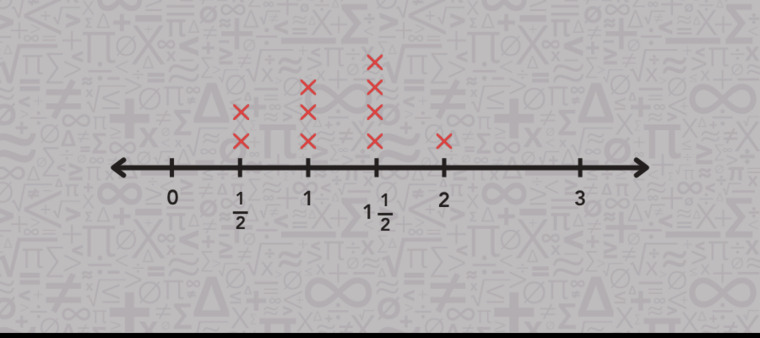
- How many pencils are there in total?
- What is the most common length?
- What is the total length of all pencils that are 1\(\Large\frac{1}{2}\) inches?
2. Rectangle A is 8 cm long and 5 cm wide. Rectangle B is 10 cm long and 4 cm wide.
- Which rectangle has the larger area?
- Show your work and explain your answer in one sentence.
📕 You May Also Like: Mathnasium’s 5th Grade Level Quiz
 With personalized learning plans and interactive teaching strategies, Mathnasium helps students of all skill levels build solid math foundations.
How Mathnasium Supports Middle School Math Readiness
Mathnasium is a math-only learning center empowering K-12 students of all skill levels to excel in math.
We regularly work with elementary schoolers, building the foundations that middle school will demand. For students still in Grade 5 looking to shore up the skills covered in this guide, our Elementary School Program is designed exactly for that.
For students who have already made the jump to middle school and are finding the gap wider than expected, our Middle School Program picks up from wherever they are and moves forward.
Both are powered not by a one-size-fits-all curriculum but by the Mathnasium Method™, our proprietary teaching approach designed around each student's individual needs and learning style.
It starts with a diagnostic assessment, a relaxed interaction where we get to see your child's strengths and knowledge gaps, including the foundational skills that need to be solid before or during middle school. From those insights, we design a personalized learning plan tailored to their goals.
With the plan ready, our instructors follow it closely, delivering face-to-face math instruction in a supportive and engaging setting. We use plain, everyday language to explain math and draw on a mix of verbal, visual, mental, tactile, and written techniques so concepts truly land for each student.
When students get stuck, our instructors are there, breaking down complex problems into manageable parts and showing both the how and the why behind the answer. Over time, students develop trust in their own reasoning and build the critical thinking tools they carry into math and beyond.
Fun is a core part of the method too. Game-based activities, earned rewards, and consistent celebration of progress keep students engaged, make learning enjoyable, and help them stay aware of how far they have come.
The results speak for themselves:
-
94% of parents report an improvement in their child's math skills and understanding
-
93% of parents report their child's improved attitude toward math after attending Mathnasium
-
90% of students saw an improvement in their school grades
With over 1,100 centers, we bring the Mathnasium Method™ close to your community.
If you are in or near Richmond, VA, Mathnasium of Tuckahoe brings our proven approach to families across the Tuckahoe area and greater Richmond, helping students at every grade level become confident math thinkers.
Whatever the goal your child has set, we can help them get there.
📅 Schedule a Free Assessment at Mathnasium of Tuckahoe
Not near Tuckahoe?
📍 Find a Mathnasium Learning Center Near You
Pssst! Check Your Readiness Quiz Results Here
If your child has given our readiness quiz a try, you can see the results below.
Section 1: Fractions
-
\(\Large\frac{3}{4}\) + \(\Large\frac{5}{6}\) = \(\Large\frac{19}{12}\) = 1\(\Large\frac{7}{12}\)
-
\(\Large\frac{7}{8}\) - \(\Large\frac{2}{3}\) = \(\Large\frac{5}{24}\)
-
4 × \(\Large\frac{3}{5}\) = 2\(\Large\frac{2}{5}\)
-
Word problem: Maria has 2\(\Large\frac{1}{2}\) - \(\Large\frac{3}{4}\) = 2\(\Large\frac{2}{4}\) - \(\Large\frac{3}{4}\) = 1\(\Large\frac{3}{4}\)
Section 2: Decimals
-
Three and forty-seven thousandths: 3.047
-
Round 4.567 to the nearest hundredth: 4.57
-
3.42 + 5.7 = 9.12
-
0.6 × 0.4 = 0.24
-
\(\Large\frac{3}{4}\) = 0.75
Section 3: Whole Numbers and Multi-Step Problems
-
347 × 26 = 9,022
-
A school buys 48 boxes of pencils. Each box has 24 pencils. How many pencils are there in total? 48 × 24 = 1,152 pencils
Section 4: Volume and Measurement
-
A rectangular prism is 5 cm long, 3 cm wide, and 4 cm tall. What is its volume, and what unit should you use?
-
Convert 2.5 meters to centimeters: 2.5 meters = 250 centimeters
Section 5: Expressions and Order of Operations
-
Evaluate: 8 + (6 × 4): 8 + (6 × 4) = 8 + 24 = 32
-
Write a numerical expression for: "Add 7 and 3, then multiply the sum by 5."
Section 6: Data & Reasoning
-
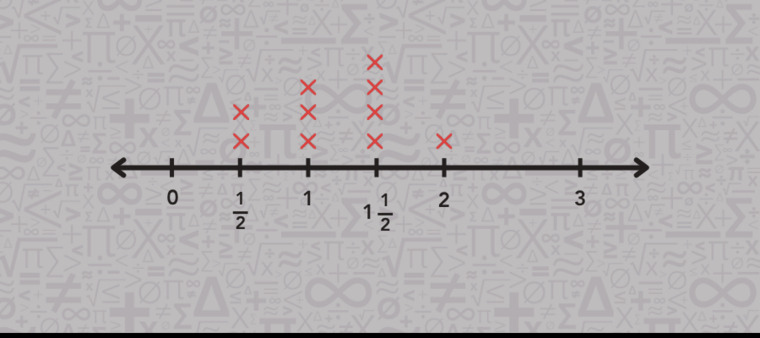
- Total pencils: 2 + 3 + 4 + 1 = 10
- Most common length: 1\(\Large\frac{1}{2}\) inches
- Total length of pencils that are 1\(\Large\frac{1}{2}\) inches: 4 × 1\(\Large\frac{1}{2}\) = 4 × \(\Large\frac{3}{2}\) = 6 inches
2. Rectangle area reasoning:
- They have the same area (both 40 cm²).
- Example explanation: “Both rectangles have an area of 40 cm², so neither is larger; they are equal.”


 (804) 282-3805