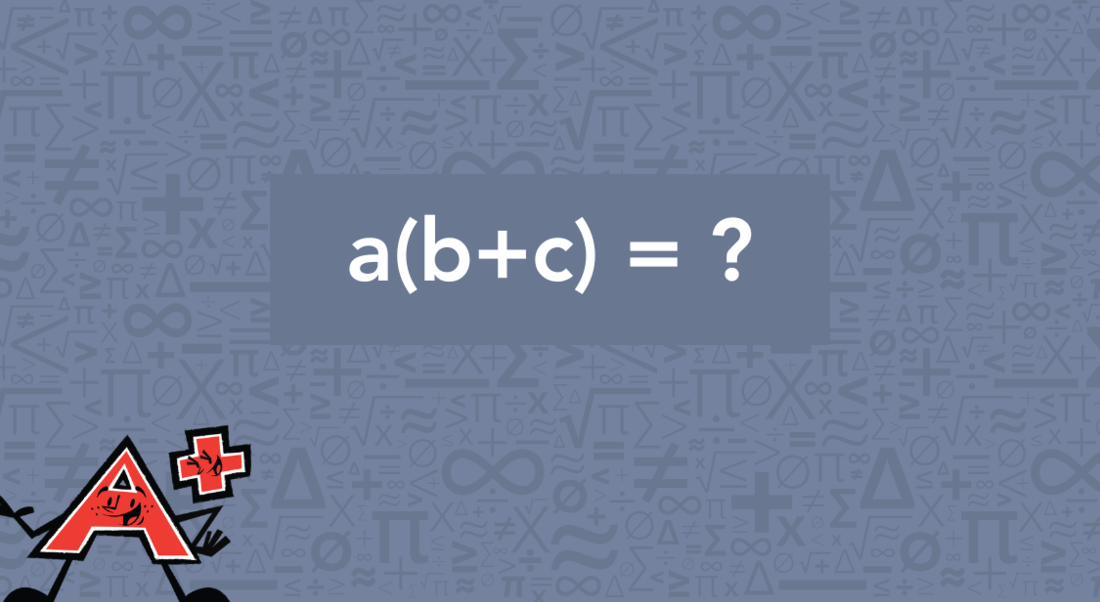
Take an equation like 3(x + 4) = 21. How do we start solving this? Do we distribute first? Solve first? Do something else entirely?
That's exactly what this guide is here to answer!
We'll walk you through what distribution means, why order matters, how to work through equations step by step, and give you a chance to practice.

What Does It Mean to Distribute?
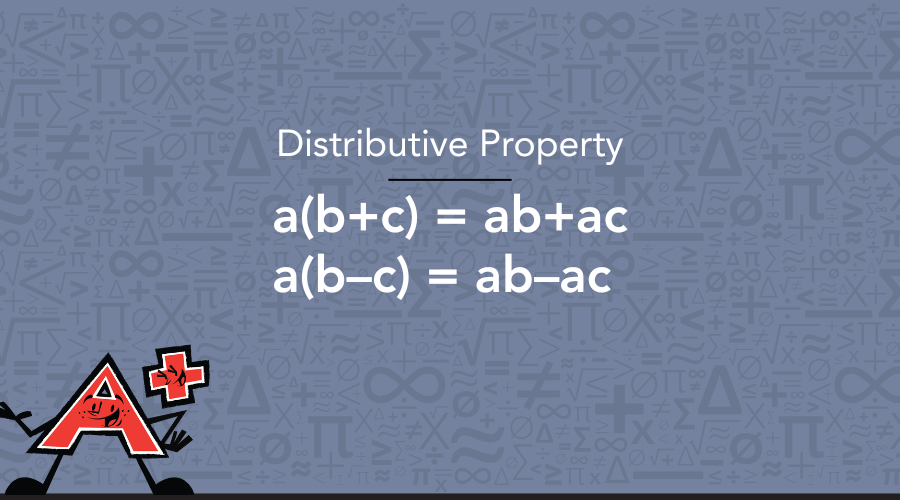
When we distribute, we multiply the number outside the parentheses by every term inside, whether those terms are being added or subtracted. No term gets left out.
Take 3(4 + 2). We can solve this in two ways:
Now let's try the same with subtraction: 3(4 − 2).
-
The first is to subtract inside the parentheses first: 3(2) = 6.
-
The second is to distribute, keeping the minus sign with the second term: 3 × 4 − 3 × 2 = 12 − 6 = 6.
We get the same answers with two different paths.
That's the distributive property in action. It works because multiplication distributes evenly across both addition and subtraction, meaning every term inside gets multiplied by the number outside.
Now, what happens when one of those terms is a variable? Take 3(x + 2). Can we add x and 2 first? We can't. X and 2 are not like terms, so there's nothing to simplify inside the parentheses.
Distributing is our only way forward:
3(x + 2) = 3x + 6
And that's exactly why distribution matters when we move into equations.
📕 You May Also Like: What Are Number Properties in Math? A Complete Overview [+Quiz]
Why We Distribute Before Solving
When we look at an equation like 2(x + 3) = 10, the order of operations (PEMDAS) tells us to handle the parentheses first.
If the terms inside were like terms, say, (3 + 5), we could simplify inside straight away. But x and 3 are not like terms, so we can't combine them. We need another way to clear those parentheses.
That's where distribution comes in. We multiply the 2 by every term inside:
-
2(x + 3) = 10
-
2x + 6 = 10
Now we have something we can work with. We subtract 6 from both sides:
2x = 4
Then divide by 2:
x = 2
Let's check: 2(2 + 3) = 2(5) = 10. Correct again!
Without distributing first, we'd have no path to x. Distribution is what clears the parentheses and makes the equation solvable.
📕 You May Also Like: How to Evaluate Expressions by Substituting Values
How to Distribute and Then Solve Equations
Every time we solve an equation with parentheses, we follow the same sequence. Let's walk through it using 4(x + 3) + 2 = 22.
First, we identify the number sitting directly outside the parentheses. Here, that's the 4, and it multiplies every term inside (x + 3):
4 × x = 4x and 4 × 3 = 12
Now we rewrite the equation without the parentheses:
4x + 12 + 2 = 22
We have two constants on the left side, 12 and 2, so we combine them:
-
4x + 12 + 2 = 22
-
4x + 14 = 22
Now we isolate the variable. We subtract 14 from both sides:
-
4x + 14 - 14 = 22 - 14
-
4x = 8
Then we divide both sides by 4:
Finally, we substitute x = 2 back into the original equation to check:
4(2 + 3) + 2 = 4(5) + 2 = 20 + 2 = 22
All good!
That's the full process. Now let's see how it holds up when things get a little more complex.
📕 You May Also Like: How to Solve Basic Equations — A Parent and Student Guide
More Examples: Distributing and Solving
Let's work through a few examples together, starting simple and stepping up the complexity as we go.
Example 1: Distributing Across Subtraction
This time, we have subtraction inside the parentheses. We’ll solve 2(x − 5) = 4.
We distribute the 2 across both terms inside the parentheses:
-
2 × x = 2x
-
2 × (−5) = −10
Notice that the minus sign stays with the second term. Our equation now reads:
2x − 10 = 4
We add 10 to both sides:
-
2x − 10 + 10 = 4 + 10
-
2x = 14
Then we divide both sides by 2:
To check, we substitute x = 7 back into the original equation:
2(7 − 5) = 2(2) = 4
The answer checks out.
Example 2: Variable on Both Sides
Let's solve 3(x + 2) = x + 14.
We distribute the 3 across both terms inside the parentheses:
Our equation now reads:
3x + 6 = x + 14
Now we have a variable on both sides. We collect the variable terms on one side by subtracting x from both sides:
-
3x − x + 6 = x − x + 14
-
2x + 6 = 14
Then we subtract 6 from both sides:
-
2x + 6 − 6 = 14 − 6
-
2x = 8
Then we divide both sides by 2:
Finally, to check our answer, we substitute x = 4 back into the original equation:
3(4 + 2) = 3(6) = 18 and 4 + 14 = 18
Both sides give us 18, so we're good.
Example 3: Distributing on Both Sides
Now, let’s take on 2(x + 3) = 3(x − 1).
Both sides have parentheses, so we distribute both before doing anything else.
Our equation now reads:
2x + 6 = 3x − 3
We collect the variable terms on one side by subtracting 2x from both sides:
Then we add 3 to both sides:
Let’s not forget to check the result. We substitute x = 9 back into the original equation:
2(9 + 3) = 2(12) = 24 and 3(9 − 1) = 3(8) = 24
Both sides land on 24, so x = 9 is correct.
Common Mistakes When Distributing and Solving in Equations
Our instructors notice the same errors coming up as students work through equations with parentheses. They are completely normal, and when you know what to watch for, they’re easier to catch.
1. Distributing to only the first term
The most common one. When we see 2(x + 3), every term inside gets multiplied, not just the first. Writing 2x + 3 instead of 2x + 6 means the 3 never got multiplied.
In this case, we recommend a quick check: count the terms inside the parentheses and confirm we completed the same number of multiplication steps.
2. Forgetting to distribute a negative sign
When a negative number sits outside the parentheses, it flips the sign of every term inside. So −2(x + 3) becomes −2x − 6, not −2x + 6. This one catches many students off guard and is a frequent source of sign errors in algebra. Always double-check this step.
3. Combining unlike terms after distributing
After distributing 3(x + 3) = 21, we get 3x + 9 = 21. A number and a variable term are never like terms, so we cannot combine them. 3x and 9 stay separate until we use inverse operations to isolate x.
📕 You May Also Like: 7 Common Mistakes Students Make in Math Word Problems
Your Turn: Put Distribution to the Test
Time to check what you’ve learned today. Work through each equation step by step and check your answers at the bottom of the guide.
-
4(x + 2) = 20
-
3(x − 4) = 9
-
2(x + 5) = x + 14
-
3(x + 1) = 2(x + 4)
 To help concepts like the distributive property and solving equations truly make sense, Mathnasium uses multi-faceted teaching techniques tailored to each student.
How Mathnasium Helps Students Master Any Math Concept
Mathnasium is a math-only learning center dedicated to helping K–12 students of all skill levels learn and master math.
Whether a student needs support with foundational concepts like the distributive property and solving equations or is ready to move into more advanced algebra, we teach for deep understanding, not rote memorization.
To help students reach that level of understanding, we use a proprietary teaching approach called the Mathnasium Method™.
Students begin with a diagnostic assessment that gives us a clear picture of their strengths and knowledge gaps. Using those insights, we build a personalized learning plan targeted at exactly what each student needs.
With the plan in place, our specially trained instructors follow it closely, delivering face-to-face instruction in a caring and fun environment.
During sessions, we always allow time for productive struggle, then rejoin students to check their work. We guide them through both the how and the why, so they build the critical thinking tools and problem-solving skills to use in math and everyday life.
Our activities are often game-based and hands-on, keeping students engaged and genuinely enjoying the process. We celebrate every step of progress, so confidence grows right alongside skill.
Families see measurable results:
-
94% of parents report an improvement in their child's math skills and understanding
-
93% of parents report their child's improved attitude toward math after attending Mathnasium
-
90% of students saw an improvement in their school grades
With a network of over 1,100 learning centers across North America, there is likely a Mathnasium near you.
If you are in or near Richmond, VA, Mathnasium of Tuckahoe brings our proven approach to families across the Tuckahoe area and greater Richmond, helping students of all skill levels become confident math thinkers.
Whether your student is looking to catch up, keep up, or get ahead, our local team can support them.
📅 Schedule a Free Assessment at Mathnasium of Tuckahoe
Not near Tuckahoe?
📍 Find a Mathnasium Learning Center Near You
Psst! Check Your Answers Here
If you've worked through our practice problems, check your results below.
Challenge 1: 4(x + 2) = 20
Challenge 2: 3(x − 4) = 9
Challenge 3: 2(x + 5) = x + 14
Challenge 4: 3(x + 1) = 2(x + 4)


 (804) 282-3805