Have you ever noticed how a butterfly’s wings or a leaf can look almost perfectly balanced from one side to the other? Nature gives us plenty of examples of matching shapes.
In math, we call this kind of balance symmetry. We can look for it in shapes by picturing an imaginary line through them and comparing what we see on each side.
Today, our tutor will break down how to find lines of symmetry in all kinds of shapes step by step.

Review: What Is Symmetry?
Symmetry means the two parts of a shape match like mirror images. If we can fold a shape along a line and both sides match exactly, that line is called a line of symmetry.
Depending on the shape, we may find different lines of symmetry:
-
Vertical lines divide the shape into left and right halves.
-
Horizontal lines divide the shape into top and bottom halves.
-
Diagonal lines of symmetry from one corner of a shape toward the opposite corner.
Let’s see how this works with a rectangle:
-
Vertical fold: Take the rectangle straight down the middle from top to bottom. The left side matches the right, so that crease gives us a vertical line of symmetry.
-
Horizontal fold: Now fold to the middle from left to right. This time, the top half covers the bottom half neatly, which gives us a horizontal line of symmetry.
-
Diagonal fold: If we tried folding the rectangle corner to corner, the two halves would miss each other. So the diagonal does not count as a line of symmetry.
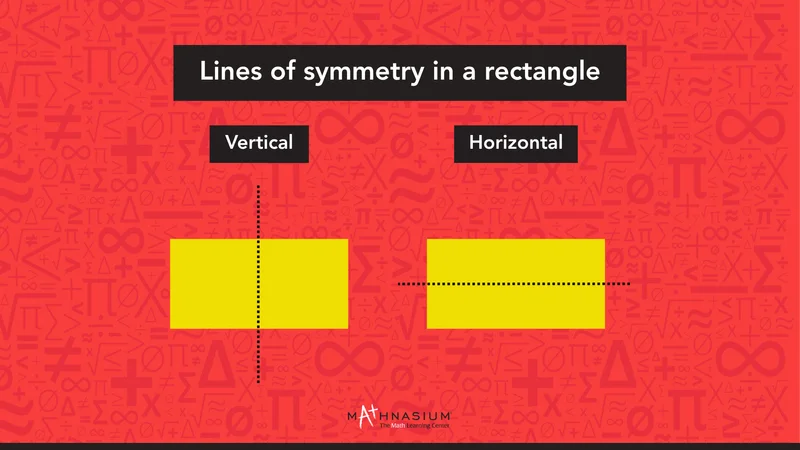
Different shapes can have several lines of symmetry, just one, or none at all.
We can spot the same kind of matching balance in plenty of things around us.
Take a pair of eyeglasses. If we draw an imaginary line straight down the middle, the left and right sides line up closely, with one lens, one arm, and one side of the frame on each half.
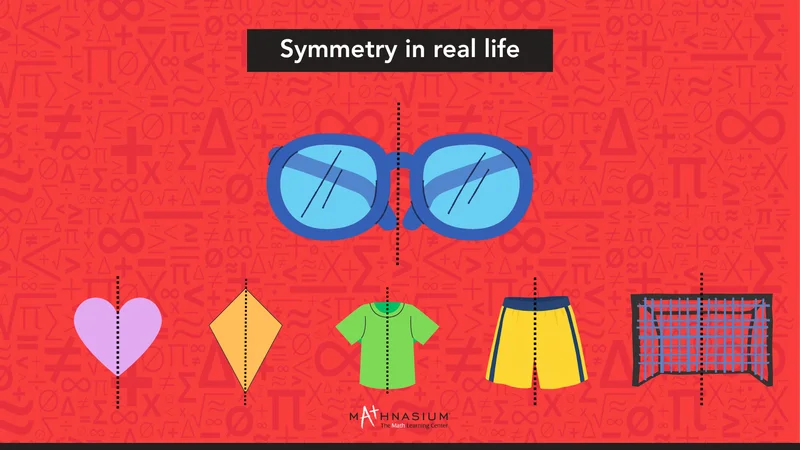
Here are a few other familiar objects where you might notice symmetry:
|
Real-life example
|
How it’s symmetric
|
|
Heart shape
|
A vertical line down the center gives the heart two mirror-image sides.
|
|
Toy kite
|
Fold it along its center line, and the left half can line up with the right.
|
|
T-shirt
|
The middle of the shirt can act as a vertical line of symmetry, with the sleeves and sides matching across it.
|
|
Pair of shorts
|
A vertical line through the center can divide the shorts into matching left and right halves.
|
|
Soccer goal
|
If we split the frame with a vertical line through the center, the left and right sides will line up.
|

How to Find Lines of Symmetry in Any Shape
To find all the lines of symmetry in a shape, we work through these steps:
-
Look for a possible dividing line through the shape.
-
Imagine folding along the line and see if the two sides match.
-
Try other directions to make sure you found all symmetry lines.
At Mathnasium, we like using examples to make steps clear, so let’s walk through these steps with a square.
Step 1: Look for a possible dividing line
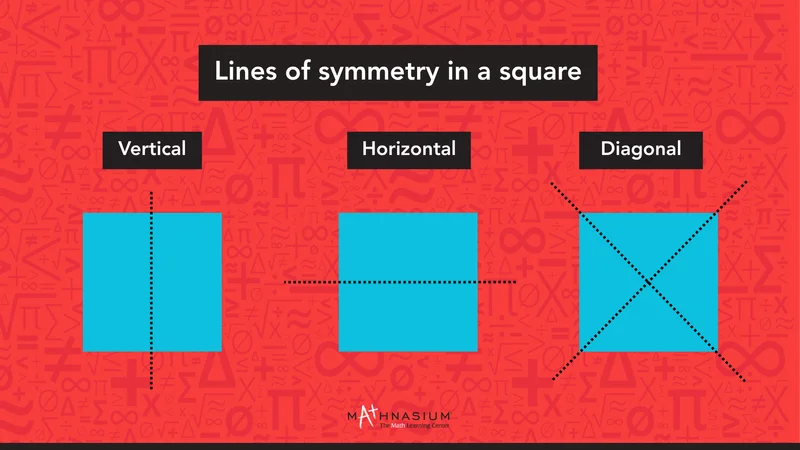
With a square, we can check lines that pass through the middle and see whether they divide the square into two matching halves.
Every line of symmetry we find will pass through this center point. We can test a line from top to bottom, one from left to right, and then the two lines that connect opposite corners.
Step 2: Imagine folding along the line and see if the two sides match
We look at the vertical line through the center first. If we fold the square along that line, the left half lands exactly on the right half.
The same thing happens with a horizontal line through the center, so both of these are lines of symmetry.
Then, we imagine folding the square along either diagonal. The two triangular halves land exactly on top of each other, so both diagonals are also lines of symmetry.
Step 3: Try other directions to make sure you found all symmetry lines
Now we check whether any other line through the square would make the two sides match.
If we tilt the line away from the vertical, horizontal, or diagonal directions, the edges and corners no longer line up. So we have found all the possible lines of symmetry.
Altogether, our square has 4 lines of symmetry:
-
1 vertical
-
1 horizontal
-
2 diagonal
📕 You May Also Like: What Is Reflection in Math? Definition, Examples & How-to
Lines of Symmetry in Common Shapes
During our sessions, we’ve noticed that students sometimes miss one or more lines of symmetry when they first start working with the concept. That’s why our tutors put together a quick overview of common shapes and the lines of symmetry each one has.
1. Symmetry in Triangles
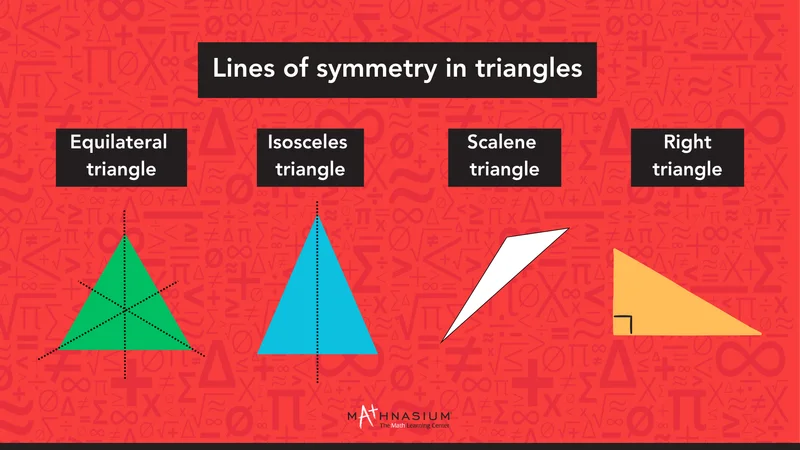
Triangles can have different numbers of lines of symmetry depending on their side lengths and angles. Let’s compare the main types.
-
An equilateral triangle. An equilateral triangle has 3 equal sides and 3 equal angles. It also has 3 lines of symmetry, each running from one vertex to the midpoint of the opposite side. Along any of these lines, the two halves match exactly.
-
An isosceles triangle. When 2 sides of a triangle are equal, we call it an isosceles triangle. Its 1 line of symmetry runs from the vertex where those equal sides meet straight through the middle of the opposite side.
-
A scalene triangle. In a scalene triangle, all 3 sides have different lengths and all three angles are different sizes. No line can divide it into matching mirror halves, so it has no lines of symmetry.
-
A right triangle. We call a triangle a right triangle when one of its angles measures 90°. In most right triangles, we won’t find any lines of symmetry unless the two legs are equal. In that case, we get a right isosceles triangle with 1 line of symmetry running from the right-angle vertex to the midpoint of the opposite side.
📕 You May Also Like: Types of Triangles for Grades 4–8: A Complete Guide
2. Symmetry in Quadrilaterals
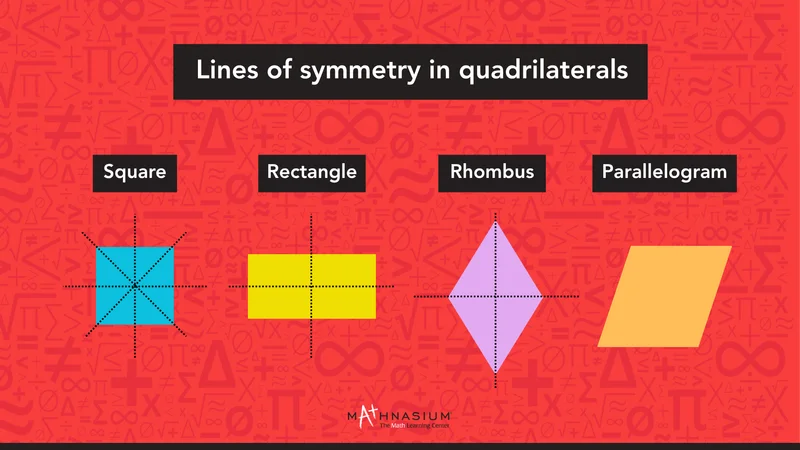
A quadrilateral is any shape with 4 sides. Depending on how those sides and angles are arranged, we can find several lines of symmetry, just one, or none at all. Take a look at the common quadrilaterals.
-
A square. We’ve already identified that a square has 4 lines of symmetry. Two run through the middle points of opposite sides, and the other two connect opposite corners.
-
A rectangle. In a rectangle, we can divide the shape evenly from top to bottom or from left to right, giving us 2 lines of symmetry. The diagonals are not lines of symmetry because they do not divide the rectangle into matching halves.
-
A rhombus. Picture a square pushed sideways, and you’ll get a rhombus. All 4 sides still have the same length, but the corners no longer have to be right angles. If we draw either diagonal from one corner to the opposite corner, the two sides match. So, a rhombus has 2 lines of symmetry, both along its diagonals.
-
A parallelogram. In a parallelogram, opposite sides are parallel and equal in length, just like in a rectangle. Unlike a rectangle, though, its angles do not have to be 90°. The sides and angles of a typical parallelogram do not line up in a way that creates mirror-image halves, so it has no lines of symmetry.
📕 You May Also Like: How to Use Origami to Teach Geometry - Kid-Friendly Guide
3. Symmetry in Circles
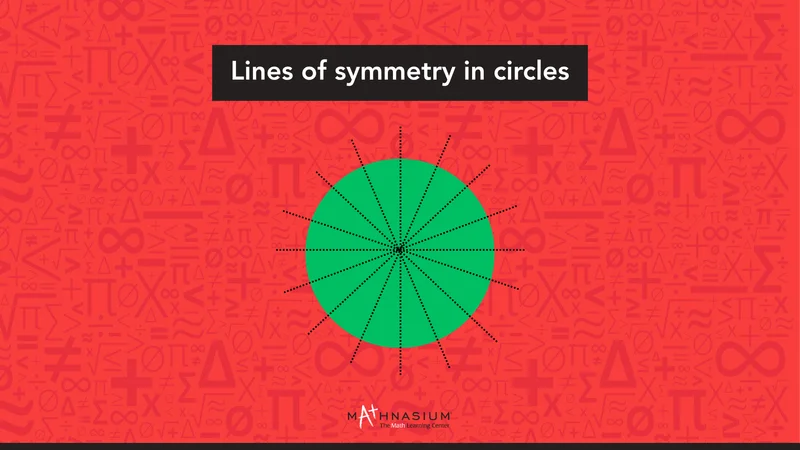
Every line that passes through the center of a circle is a line of symmetry, which means a circle has infinitely many. No matter which direction we draw that line, both halves match perfectly because every point on the circle is the same distance from the center.
Need a little more practice with lines of symmetry? Our geometry tutors at Mathnasium of Tuskawilla can help you make sense of this concept and work through other geometry topics step by step.
Your Turn! Identify the Lines of Symmetry
For each shape below, decide whether the dashed line is a true line of symmetry and explain why. You can check your answers at the bottom of the page.
Challenge 1
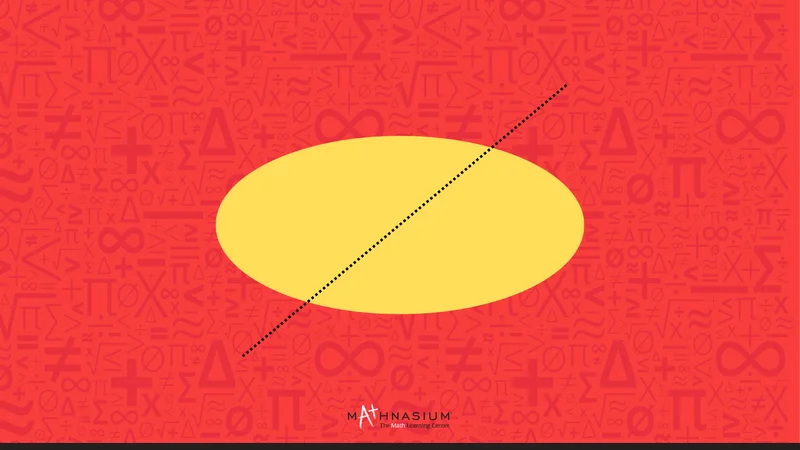
Is this a line of symmetry?
Challenge 2
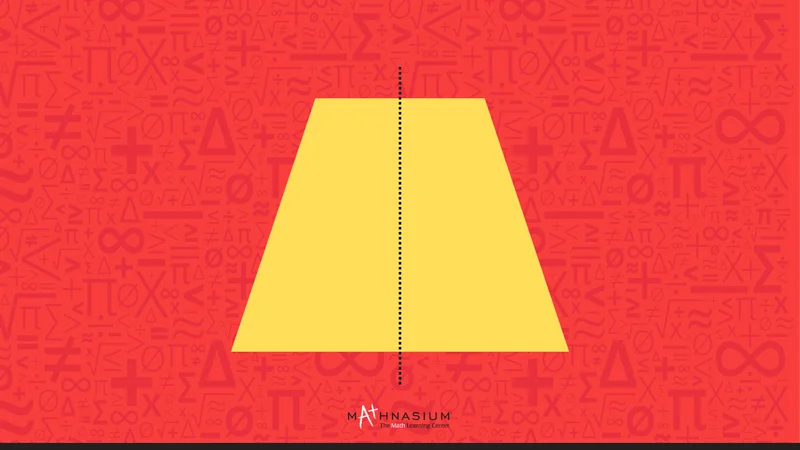
Does this line create matching halves?
Remember that a line passing through the center does not automatically make it a line of symmetry. Before you decide, compare the shape on both sides of the line and make sure they match.
📕 You May Also Like: 5 Ways Math Practice Impacts Brain Development + Benefits

Mathnasium tutors use different teaching techniques and hands-on activities to help make concepts like symmetry clear.
How Mathnasium Helps Students Make Sense of Symmetry (and Any Other Math Topic)
Mathnasium is a math-only learning center dedicated to helping K–12 students of all skill levels excel in math.
We aim to build true understanding of math concepts, such as symmetry, so students can use those skills in later topics and apply them to unfamiliar problems.
To support that understanding, we use the Mathnasium Method™, our proprietary teaching approach, to meet students where they are and guide them forward step by step.
Each student begins with a diagnostic assessment that helps us understand their current skill level, knowledge gaps, goals, and how they think and feel about math. For geometry, that may include looking at how comfortably they compare shapes, notice spatial relationships, and use visual information to explain their reasoning.
Using these insights, we build a personalized learning plan focused on the skills the student needs most, whether that means identifying lines of symmetry, reinforcing spatial reasoning, working with geometric properties, or preparing for more advanced geometry.
Our specially trained tutors follow that plan closely and provide live, face-to-face instruction in a caring and fun group environment. They use mental, verbal, visual, tactile, and written techniques to help students fold, draw, rotate, and compare shapes so they can see why a line does or does not divide a figure into matching reflected halves.
Students also get room to think through problems before tutors step in. Our tutors guide them through the problem instead of simply giving the right answers. This helps students build critical thinking, problem-solving skills, and greater independence in math.
Fun is part of the approach, too. We use hands-on and game-based activities, rewards, and consistent encouragement to keep students engaged as they explore symmetry, shapes, and other visual math concepts.
The results speak for themselves:
-
94% of parents report an improvement in their child's math skills and understanding
-
93% of parents report their child's improved attitude toward math after attending Mathnasium
-
90% of students saw an improvement in their school grades
With over 1,100 learning centers across North America, there is likely a Mathnasium close to you.
For families in and near Winter Springs, Florida, Mathnasium of Tuskawilla brings that same approach close to home, with specially trained tutors who help students make sense of symmetry, spatial relationships, and the geometry concepts that build from them.
If your child is finding symmetry or other math concepts difficult, a free diagnostic assessment is a great place to start. Using what we learn, we create a personalized learning plan focused on the skills they need next.
📅 Schedule a Free Assessment at Mathnasium of Tuskawilla
Not near Tuskawilla?
📍 Find a Mathnasium Learning Center Near You
Pssst…! Check Your Answers Here
Did you spot the fake line of symmetry? Here are the answers to the practice questions above.
Challenge 1
No, this is not a line of symmetry.
Although the dashed line passes through the center of the oval, it is tilted diagonally. An oval only has two lines of symmetry: straight down the middle vertically and straight across horizontally. Because this line is diagonal, the two sides will not match exactly when you fold the shape along it.
Challenge 2
Yes, this is a line of symmetry.
This is an isosceles trapezoid, which means its two non-parallel sides are equal in length. The dashed line runs through the midpoints of the two parallel sides, dividing the trapezoid into two matching halves. If we fold along that line, the two slanted sides line up exactly, so the dashed line is a line of symmetry.


 (407) 243-6284