If your child has ever asked the titular question in geometry class, the honest answer is: everywhere. The formula a² + b² = c² shows up in construction, medical imaging, GPS systems, and video games. It's rarely called by name, but the math is there.
At Mathnasium, our tutors use real-world examples like these to help students see why the math they're learning matters. Here are seven of them, with the calculations behind each one.

7 Pythagorean Theorem Real-Life Examples (With Calculations)
Each example below includes the real calculation so your child can see exactly how the formula works outside the classroom.
1. Construction and Architecture
Before framing a wall or laying a foundation, contractors check whether corners are actually square.
For example, along Florida's Space Coast, where new residential neighborhoods are under construction year-round, this is a calculation crews run on every job. A corner that looks like a right angle may be slightly off, and that error builds across an entire structure.
The solution is the 3-4-5 method:
If it measures 5 feet, the corner is a perfect right angle.
This works because 3, 4, and 5 form a Pythagorean triple. A set of whole numbers that perfectly fit the theorem:
3² + 4² = 5²
9 + 16 = 25
The math is so reliable and simple that construction crews use it without a calculator.
📕 You May Also Like: Types of Angles: How to Identify Straight, Right, Acute, and Obtuse Angles?
2. Screen Sizes and Diagonals
A TV advertised as 55 inches is not 55 inches wide. It is measured diagonally across the screen from corner to corner. Manufacturers design modern screens to a standard widescreen aspect ratio of 16:9, meaning that for every 16 inches of width, the screen has 9 inches of height.
To find the actual footprint of a 55-inch TV, manufacturers rely on the Pythagorean theorem. A standard 55-inch display measures approximately 48 inches wide and 27 inches tall.
The calculation:
48² + 27² = 2,304 + 729 = 3,033
Taking the square root of 3,033 gives 55.07 inches, confirming why retailers use 55 inches as the standard shorthand.
The same geometric relationship is used to size every digital display, from the smartphone in your hand to a cinema screen. Your child works through the same calculation in geometry class, just without the screen measurements attached.
📕 You May Also Like: 10 Geometry Concepts Students Should Master Before 10th Grade
3. Navigation and GPS
A GPS navigation system calculates the straight-line distance between coordinates using the same distance formula students learn in middle school.
Imagine you travel 5 miles north and then 12 miles east on city streets. Your odometer shows 17 total miles traveled, but you are only 13 miles from your starting point as the crow flies.
Your mapping app calculates this direct distance because 5, 12, and 13 form a perfect Pythagorean triple:
5² + 12² = 13²
25 + 144 = 169
While we drive around blocks and buildings, GPS satellites calculate the direct hypotenuse between your phone and your destination.
Advanced systems extend this formula into 3D to account for changes in altitude, like driving up a mountain highway.
Your child works through the same distance formula in geometry class.

Behind every turn-by-turn direction is geometry working in the background.
4. Sports and Athletic Training
Coaches and scouts use the Pythagorean theorem to calculate diagonal distances that standard field markings don't show.
A baseball diamond is not actually a diamond shape. It is a perfect square with 90-foot base paths. When a base runner attempts to steal second base, the catcher has to throw from home plate all the way across the square. To find that distance, you calculate the hypotenuse:
90² + 90² = distance²
8,100 + 8,100 = 16,200
Taking the square root of 16,200 gives approximately 127.3 feet. Knowing this distance allows coaches to calculate how fast a catcher's "pop time" needs to be to beat a runner stealing second.
Football coaches use the same calculation. A wide receiver running a route 20 yards downfield and 15 yards across the field is not running along the yard lines.
The straight-line distance from the quarterback to where the receiver catches the ball is the hypotenuse.
5. Woodworking and DIY Home Projects
Whether a carpenter is framing a house or you are building a backyard storage shed, the Pythagorean theorem prevents wasted lumber and costly mistakes. Before the saw comes out, the formula tells you the length needed for any diagonal support, ramp, or stair railing.
Take a simple shed ramp with a vertical rise of 9 inches and a horizontal distance of 12 inches. To find the length of the plank needed, you set up the theorem:
9² + 12² = plank length²
81 + 144 = 225
The square root of 225 is exactly 15, so the plank gets cut at 15 inches. Guessing a diagonal length leads to gaps, weak joints, and unstable structures. The Pythagorean theorem removes the guesswork entirely.
Your child works through the same calculation in geometry class, just without the lumber.
6. Video Games and Computer Graphics
If your child has ever wondered how a video game knows their character was just hit by an enemy arrow or caught in an explosion, the answer is geometry running in the background.
Game developers use the Pythagorean theorem to run collision detection thousands of times per second.
To determine whether two objects are touching, a game engine tracks their coordinates on the screen, treating the horizontal and vertical distances between them as the two sides of a right triangle.
In 2D games, the engine calculates the distance using standard geometry:
a² + b² = c²
In 3D games, developers expand the theorem to account for depth:
a² + b² + c² = d²
If that final calculated distance drops below the combined size of your child's character and the incoming projectile, the game registers a collision, triggers a sound effect, and drops the health bar.
Every frame of every video game your child plays runs this calculation in the background.
📕 You May Also Like: Your Child's Video Game Habit is Actually Building Math Skills (And Here's the Proof)
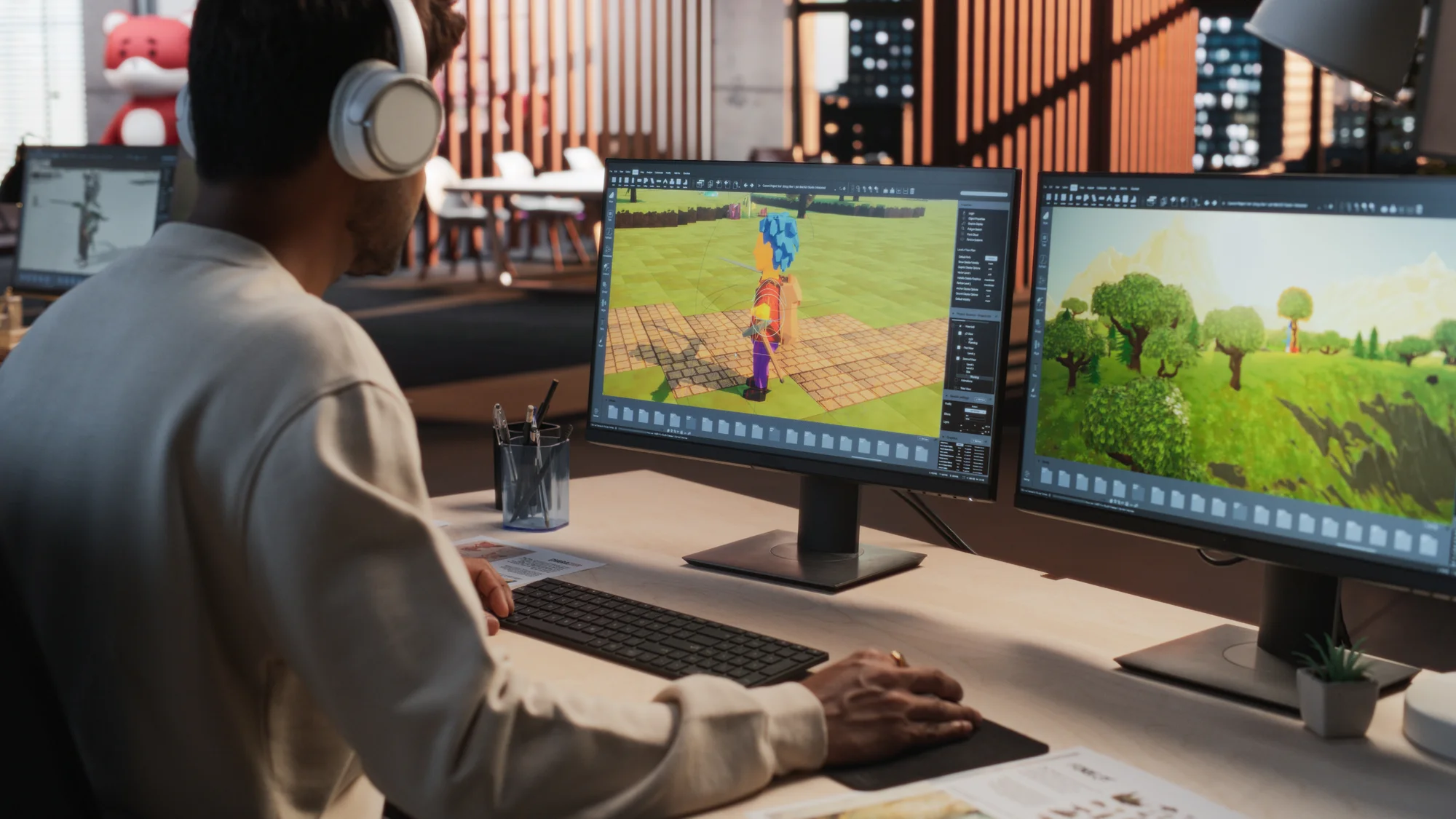
The math your child learns in geometry class is what makes every frame of a video game possible.
7. Aviation and Air Traffic Control
To keep thousands of aircraft flying safely through crowded skies, air traffic controllers rely on geometry running in the background of every flight.
When a plane is preparing to land, a flat 2D radar screen is not enough. Controllers need the straight-line distance from the runway to an aircraft moving through three-dimensional space at altitude. Aviation software solves this by running the 3D version of the theorem:
a² + b² + c² = d²
The software calculates three distances:
-
The north-south distance to the runway (a)
-
The east-west distance to the runway (b)
-
The plane's altitude above the runway (c)
Take a simplified example: a plane is 3 miles north of the runway, 4 miles east, and flying at approximately 1 mile of altitude.
3² + 4² + 1² = 9 + 16 + 1 = 26
The square root of 26 is approximately 5.1 miles. That is the true distance air traffic control software uses, not the flat 5-mile ground distance a standard map would show. The difference matters at landing speed.
Air traffic control systems use this geometry to guide pilots safely through low-visibility conditions and to ensure planes maintain a safe distance from each other.
The same formula can be found on your child's geometry worksheet.
Why Students Struggle to See the Connection
Students struggle to connect the Pythagorean theorem to real life because they learn it as a worksheet formula, not as a tool. The classroom presentation focuses on applying the formula to labeled triangles.
Without real-world context, the underlying idea that this formula describes a relationship present in almost every right angle in the physical world never gets established. When the context changes, the formula stops feeling familiar. This is backed up by the research published by ERIC, which shows that students develop a deeper understanding of geometry when they see it applied to real situations rather than practiced on worksheets alone.
The formula itself never changes. Once your child understands that a² + b² = c² describes the physical relationship between the three sides of any right triangle, they can spot it anywhere.
Your child needs to look for two things:
The worksheet version and the construction site version are the same problem. The numbers and the stakes are different, but the geometry is identical.
📕 You May Also Like: Pythagoras’ Theorem Explained: Right Triangles Made Simple | Mathnasium Schoolhouse

At Mathnasium, tutors help students see the math they are learning as a tool they can use in the real world.
How Mathnasium of Viera Builds Real Math Understanding
Mathnasium is a math-only learning center where students develop a deep understanding of concepts like the Pythagorean Theorem easily. Every student begins with a diagnostic assessment that identifies their current skills, knowledge gaps, and goals. From those insights, specially trained tutors build a personalized learning plan tailored to what each student needs.
The Mathnasium Method™ is a proprietary teaching approach designed to build understanding, so a concept like the Pythagorean theorem starts making sense as a tool students can apply anywhere.
Students work in a caring and fun group environment with face-to-face instruction, available in-center or online. Whether your child needs to catch up, keep up, or get ahead, Mathnasium meets them where they are.
The results speak for themselves:
-
94% of parents report an improvement in their child's math skills and understanding
-
93% of parents report their child's improved attitude toward math after attending Mathnasium
-
90% of students saw an improvement in their school grades
With over 1,100 centers, we bring the Mathnasium Method™ close to your community.
Mathnasium of Viera, a math learning center, serves families in and around Melbourne, FL, including students from Viera High School, Viera Charter School, Quest Elementary, and Manatee Elementary.
Once your child understands what the Pythagorean theorem actually describes, they can use it anywhere, not just on a worksheet.
📅 Schedule a Free Assessment at Mathnasium of Viera
Not near Viera?
📍 Find a Mathnasium Learning Center Near You


 (321) 242-6284