The word "rational" often makes us think of logic or reason, but in mathematics, it takes on a completely different meaning in the phrase "rational numbers." Whole numbers, fractions, and many decimals we work with every day all belong to this number family.
Once we understand what all of these numbers have in common, it becomes much easier to recognize rational numbers in homework and everyday life.
Let's take a closer look at how to identify them, what they look like in decimal form, and where they appear in everyday life as students progress from upper elementary to middle and high school.

What Is a Rational Number?
A rational number is any number that can be written as a fraction or ratio of two integers.
In other words, a rational number is in the form \(\Large\frac{a}{b}\), where a and b are both integers and b is not zero.
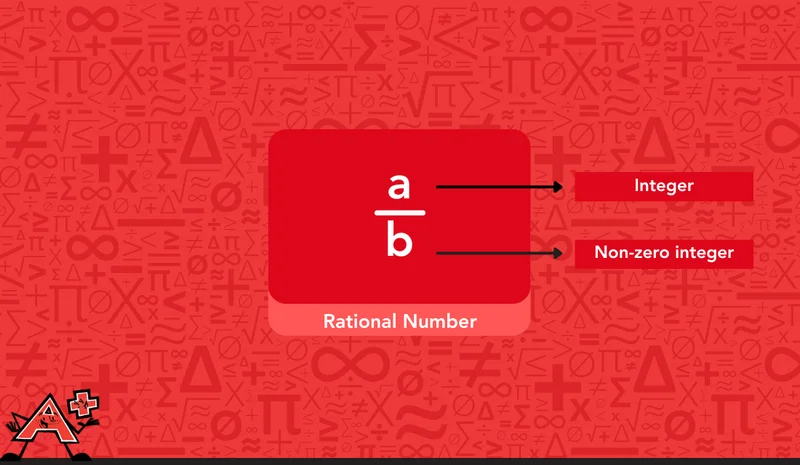
The denominator cannot be zero because division by zero is undefined in mathematics. Put simply, no number can be multiplied by zero to produce a nonzero result, so a fraction with zero in the denominator is not a valid number.
Three families of numbers all qualify as rational:
-
Integers (whole numbers and their negatives): 5, −3, or 0. Every integer can be written as a fraction over 1, like \(\Large\frac{5}{1}\), \(−\Large\frac{3}{1}\), and \(\Large\frac{0}{1}\)
-
Fractions: We write them in the form \(\Large\frac{a}{b}\), such as positive \(\Large\frac{3}{4}\) or negative \(−\Large\frac{2}{5}\).
-
Decimals: Some decimals stop at a specific digit, while others repeat a digit or pattern forever, such as 0.75 and 0.333...Both types can be written as fractions (0.75 = \(\Large\frac{3}{4}\) and 0.333... = \(\Large\frac{1}{3}\)).
Decimals deserve a closer look because they show up in two distinct patterns, so it's important to recognize how both can represent rational numbers.

Rational Numbers in Decimal Form
We can recognize rational numbers in decimal form by looking at how their digits continue after the decimal point. Depending on whether the digits stop or repeat, we call them terminating or repeating decimals.
Both types can be written as fractions, but we will use two different approaches while solving the examples. For terminating decimals, we will use place value and powers of 10. For repeating decimals, we will use a short algebraic method.
A. Terminating Decimals
A terminating decimal is a decimal that ends after a finite number of digits. Because it has an exact ending point, we can always write it as a fraction. We will do that by using place value and the corresponding power of 10 in the denominator.
Let’s look at two examples:
1. 0.75: We read 0.75 as 75 hundredths, which we write as \(\Large\frac{75}{100}\). Both the numerator and denominator are divisible by 25, so the fraction simplifies to \(\Large\frac{3}{4}\).
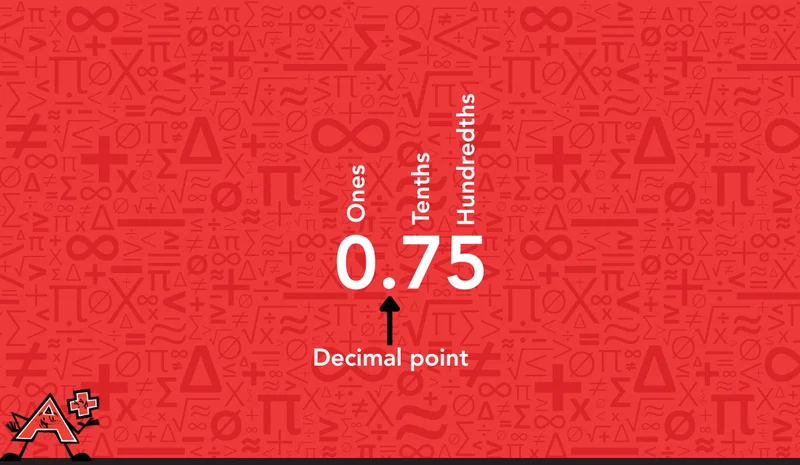
2. We read 0.4 as 4 tenths, which we write as \(\Large\frac{4}{10}\). Both numbers are divisible by 2, so the fraction simplifies to \(\Large\frac{2}{5}\).
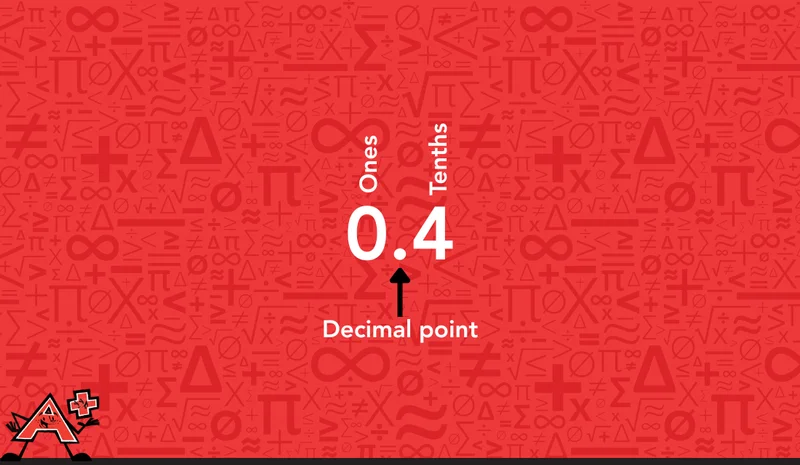
Because terminating decimals can be written as fractions, they are all rational numbers.
📕 You May Also Like: What Is a Terminating Decimal? A Complete Overview
B. Repeating Decimals
A repeating decimal is a decimal in which a digit or group of digits repeats forever. We can prove that they are rational numbers by using algebra to rewrite them as fractions.
Let’s work through the following example step by step.
We’ll convert 0.333… into a fraction.
-
Step 1: Let x = 0.333…
-
Step 2: Multiply both sides by 10 so the decimal point moves one place: 10x = 3.333…
-
Step 3: Subtract the first equation from the second: 10x - x = 3.333... - 0.333...
-
Step 4: The repeating .333... parts cancel each other out. On the left, 10x - x = 9x, while on the right, 3.333... - 0.333... = 3. This gives us 9x = 3.
-
Step 5: Since 9x means 9 times x, divide both sides by 9 to find the value of x: x = \(\Large\frac{3}{9}\)
-
Step 6: Simplify \(\Large\frac{3}{9}\) by dividing the numerator and denominator by 3: x = \(\Large\frac{1}{3}\)
Therefore, 0.333… = \(\Large\frac{1}{3}\).
📕 You May Also Like: How to Order Decimals from Least to Greatest: A Step-by-Step Method
Rational Numbers in Everyday Life
We use rational numbers to represent quantities and values in many everyday situations.
Here is a table of several examples with their fraction forms:
|
Everyday Situation
|
Number
|
Fraction Form
|
Why It Is Rational
|
|
Recipe measurements
|
\(\Large\frac{1}{3}\) cup
|
\(\Large\frac{1}{3}\)
|
Already written as a fraction.
|
|
Baseball batting average
|
0.666...
|
\(\Large\frac{2}{3}\)
|
Repeating decimal equals a fraction.
|
|
Store discount
|
25% off
|
\(\Large\frac{25}{100} = \Large\frac{1}{4}\)
|
Percentages are fractions over 100.
|
|
Temperature drop
|
−4°F
|
\(-\Large\frac{4}{1}\)
|
Negative integers are fractions over 1.
|
|
Test score
|
17 out of 20
|
\(\Large\frac{17}{20}\)
|
Already a ratio of two integers
|
*Note: While a 2-out-of-3 hitting rate equals the repeating decimal 0.666..., baseball stats round and display this as a three-digit decimal like .667 without a leading zero.
📕 You May Also Like: What Is a Rational Number? A Simple & Complete Guide
What Makes a Number Irrational
An irrational number is a number that cannot be written as a simple fraction, or ratio, of two integers. Instead, irrational numbers are expressed as non-terminating, non-repeating decimals, such as π ≈ 3.14159...
This is where many students may get confused. Both 0.333... (rational) and π (irrational) continue forever as decimals. The difference is that 0.333... repeats the digit 3 in a predictable pattern, while π (approximately 3.14159...) never repeats the same digit or group of digits in a pattern.
For that reason, π cannot be written as a fraction of two integers.
Let's look at a few more irrational numbers and see how they compare with rational numbers.
|
Number
|
Decimal Form
|
Terminates or Repeats?
|
Rational or Irrational?
|
|
0.125
|
0.125
|
Terminates
|
Rational
|
|
0.2727...
|
0.2727...
|
Repeats (digits 27)
|
Rational
|
|
−5
|
−5.000...
|
Terminates
|
Rational
|
|
π
|
3.14159...
|
Neither
|
Irrational
|
|
\(\sqrt{2}\)
|
1.41421...
|
Neither
|
Irrational
|
|
e
|
2.71828…
|
Neither
|
Irrational
|
As we can see, mathematics is full of surprising patterns that range from terminating decimals to the infinite mystery of π.
Numbers explain how our world is put together, and once we embark on the journey of understanding the predictability of rational numbers and the endless, non-repeating nature of irrational numbers, we begin to see the number system as a familiar map.
As part of that quest, we always welcome students to visit our Mathnasium center if they need more guidance or simply an encouraging environment to further explore how rich math truly is.
📕 You May Also Like: Is Pi a Rational or Irrational Number? A Step-By-Step Guide

At Mathnasium, we help students build a deeper understanding of math concepts through clear explanations, personalized instruction, and step-by-step problem solving.
How Mathnasium Helps Students Understand Any Math Concept
Mathnasium is a math-only learning center dedicated to helping K–12 students of all skill levels excel in math.
Whether students are building a solid mathematical foundation, preparing for more advanced math, or filling gaps in their understanding, we can support them.
Our proprietary teaching approach, the Mathnasium Method™, is designed around each student's needs and learning style to help them learn and master math. Our approach includes:
-
Assessment and Personalized Learning Plans: Each student begins their Mathnasium journey with a diagnostic assessment that identifies current skills, strengths, and gaps. From those findings, we build a personalized learning plan tailored to their goals, whether that means strengthening foundational math skills or developing fluency with concepts such as fractions, decimals, and rational numbers.
-
Teaching for Understanding: Our specially trained tutors use natural language and a mix of verbal, visual, mental, tactile, and written techniques so each concept lands before we move forward.
-
Problem-Solving and Critical Thinking: We give students time to work through problems independently. That productive struggle helps them learn to trust their own reasoning. When we do step in, we explain both the how and the why behind each answer, so students build problem-solving and critical thinking skills they can use in math and beyond.
-
An Engaging and Fun Learning Environment: Sessions include games, earned rewards, and consistent celebration of progress. Students build confidence alongside fluency, and many develop a more positive relationship with math over time.
The impact extends beyond the classroom:
-
94% of parents report an improvement in their child's math skills and understanding
-
93% of parents report their child's improved attitude toward math after attending Mathnasium
-
90% of students saw an improvement in their school grades
With over 1,100 learning centers across North America, there is likely a Mathnasium close to you.
Families throughout Viera and nearby communities, including Suntree, Melbourne, and Viera West, trust Mathnasium of Viera to help their children build lasting confidence in math.
If rational numbers or any other math concept is giving your child trouble, our team is ready to help.
📅 Schedule a Free Assessment at Mathnasium of Viera
Not near Viera?
📍 Find a Mathnasium Learning Center Near You


 (321) 242-6284