When Florida students return to school in August, one of the first math checkpoints they will meet is Progress Monitoring 1, part of the Florida Assessment of Student Thinking (FAST).
This early assessment helps teachers see what students remember from the previous year, which skills feel secure, and where support may be needed.
Because FAST Math PM1 comes early in the school year, your child will have limited classroom review time before the assessment, which makes summer a helpful time to ease your child back into math.
Today, we'll walk through what FAST measures by grade level and how your family can build low-pressure practice into the summer.

What FAST PM1 Looks Like
For learners in grades 3–8, FAST PM1 math usually happens during the first few weeks of the school year, according to Florida's statewide assessment schedule. Each district sets its exact testing dates.
For example, in the nearby Brevard County School District, where students begin the 2026–2027 school year on August 10, PM1 will likely fall within those first few weeks. However, we recommend confirming dates directly with your child's school or the Brevard Public Schools testing calendar.
Before you start planning summer practice, it helps to take a quick look at how FAST Math PM1 works:
-
Single session: Your child will take FAST Math PM1 in one session on a single day.
-
Standard time limits: Testing takes 80 minutes for grades 3–5 and 100 minutes for grades 6–8 (with extended time provided if needed).
-
Computer-adaptive format: Questions adjust in difficulty as your child works through the test, meaning every student sees a customized set of questions.
📕 You May Also Like: Florida B.E.S.T. Standards: A Guide for Parents
How to Help Your Student Keep the Skills Measured on FAST PM1 Fresh
To help you plan summer review for your learner, we created a table that shows what FAST Math focuses on by grade band, along with simple ways to keep those skills from fading over the summer. Think of this as a calm summer check-in rather than a full study plan.
Grades 3–5
In grades 3–5, your child will see FAST Math questions tied to number sense, operations, fractions, geometry, measurement, and word-problem reasoning. Here's how to fold review into a usual summer week:
|
Math Skill
|
Simple Ways to Practice
|
|
Addition and subtraction fluency
|
Ask your student to solve a few quick mental math problems during dinner, like “What is 8 + 7?” or “How many more to get to 20?”
|
|
Multiplication and division facts
|
Practice skip counting, times-table games, and quick fact drills in short bursts.
You can use flashcards, multiplication bingo, or ask questions like “What groups of 3 make 12?” and “If 12 cookies are shared by 4 people, how many does each person get?”
|
|
Fractions
|
Cut a pizza into 8 slices and ask how many slices make up a fourth, or split a candy bar three ways and figure out what's fair.
Divide a pan of brownies into tenths before cutting, then ask how many pieces are left after your child eats three.
|
|
Multi-step word problems
|
Focus on approach and reasoning.
Read a short problem together, underline the question, and talk through what it's asking before solving.
|
|
Basic geometry vocabulary
|
You can measure household items, compare lengths, or look for shapes around the house or in a park.
For families in Brevard County, that can be a walk around Viera Regional Park or Wickham Park, which works just as well as a living room.
|
Grades 5–8
Your fifth grader may benefit from both sets of ideas, since grade 5 often bridges elementary and middle school math. By grades 5–8, FAST Math begins to place more attention on the number system, ratios and proportional reasoning, expressions and equations, geometry, and data analysis and probability.
|
Math Skill
|
Simple Ways to Practice
|
|
Fractions, decimals, percent work
|
Check a sale sign that says '25% off' and have your child figure out the actual price of something at the store.
Pull up a sports stat, like a player's free-throw percentage, and ask what that means out of 100 attempts.
|
|
Ratios
|
Compare quantities in everyday groups, like “2 cups of rice for every 1 cup of beans” when cooking.
Or if you live in Brevard County, you can count red cars vs. blue cars on the drive to The Avenue Viera.
|
|
Solving equations
|
Try turning missing-number riddles into a game: “I'm thinking of a number. If I add 6, I get 14. What's my number?”
|
|
Interpreting graphs
|
Make a simple chart about family choices, such as favorite snacks or screen time, and discuss what the graph shows.
|
|
Geometry formulas
|
Measure a room, table, or rug at home, and figure out their area or perimeter together.
You can also take this practice outside. For example, at Viera Regional Park in Brevard County, have your child guess how many steps it'll take to circle the playground, then count their steps to check. Try it again around a nearby circular splash pad or planter to compare.
|
|
Multi-step problem solving
|
Plan a small budget together, like splitting $20 across snacks and a toy, working through each step out loud.
|

With a low-pressure steady review over the summer, your child can bring last year’s math skills back into focus and feel more prepared for FAST PM1.
📕 You May Also Like: How Much Math Kids Lose Over Summer + What to Do About It
How to Build FAST PM1 Readiness Without Cramming
For a baseline assessment like FAST PM1, your child does not need intense test prep. They benefit most from steady, light review of math concepts they learned last year, so those skills feel familiar again before school begins.
Take a look at these strategies to keep the summer math practice productive and stress-free:
-
Study solved problems together. Atkinson et al. suggests in their research (2000) that it can be useful to study solved examples before moving into independent practice. This kind of practice may look too easy at first, but that is part of why it works during summer break. Your child may be more willing to spend time on math when the practice feels light and manageable.
-
Let your child attempt an answer first, even if it's wrong. Research by Kapur (2014) found that this first attempt, even an incorrect one, can help students learn more deeply when discussion and guidance follow. With no grade attached, summer is a perfect time to try, miss, and try again.
-
Ask, "Why does that make sense?” According to Rittle-Johnson et al.’s study (2017), when students are asked to explain why an answer or strategy makes sense, it can support both procedural and conceptual learning.
-
Mix up problem types. Instead of running through 10 fraction problems in a row, alternate a fraction question with a ratio or equation question. Rohrer et al. argued in their work on interleaved math practice (2020) that this approach lets learners practice choosing the right strategy instead of repeating the same procedure automatically.
-
Spread practice across the summer. Short sessions spread over time support retention better than one concentrated push, as per the research by Rohrer & Taylor (2006).
-
Consider structured support for skills that still feel less secure. If your child gets stuck with multi-step word problems, ratios, or another specific concept, steady guided practice can help more than review at home. A tutor or structured program can focus on the exact skills your child needs, at a pace that fits them.
📕 You May Also Like: Summer Math Loss: Research Insights & Prevention Tips
FAQs About Math FAST PM1
Still have questions about FAST PM1? Here are the practical details Brevard County families ask us about most, from calculators to score reports.
1. Can my child improve or retake a PM1 score?
No. There is no retake for PM1 itself, but the score is used as a baseline. Teachers compare it with PM2 and PM3 later in the year to see how much progress your child makes and where support may be needed.
2. Where can Brevard parents see their child's PM1 results?
Brevard Public Schools shares FAST results through the Family Portal, accessible with a FOCUS parent account. If you haven't set up your FOCUS account yet, ask your child's school to help before results are released.
3. Does FAST PM1 affect my child's report card grade or promotion to the next grade?
No. PM1 is informational only and doesn't factor into report card grades. Only the year-end PM3 assessment is used for school accountability. When schools make promotion decisions, they look at a broader picture of your child’s performance.
4. What should we do if FAST PM1 shows my child has gaps to work on?
Think of PM1 as an early map of your child’s math needs. The assessment helps show where your child’s understanding stands at the start of the year, so any gaps it reveals give you useful direction for what to review next.
That information can help you decide whether your child needs a steadier practice routine at home, a conversation with their teacher, or more targeted support from a math tutor.
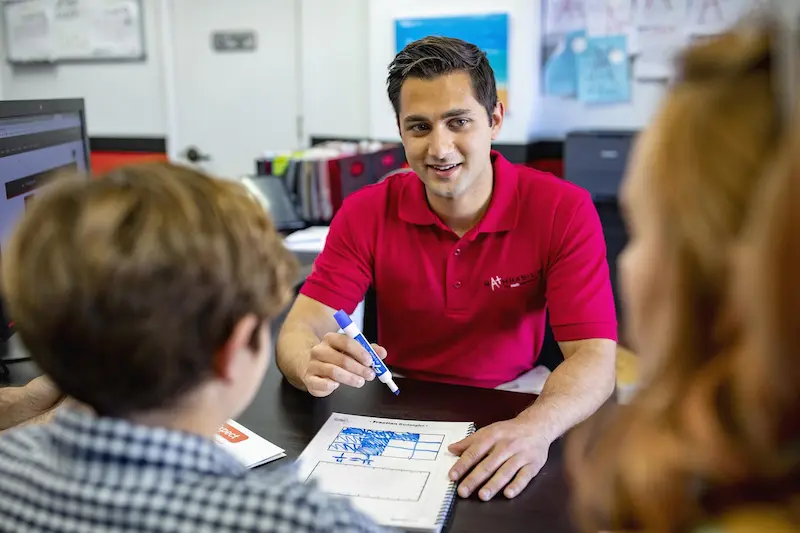
Mathnasium uses personalized learning plans and proven teaching techniques to help Brevard County students head into FAST PM1 prepared.
How Mathnasium Helps Students Keep Math Fresh Over the Summer
Mathnasium is a year-round math-only learning center dedicated to helping students of all skill levels, whether they need to catch up, keep up, or get ahead.
We offer both regular instruction and targeted math programs throughout the summer. Whether your child needs to keep skills fresh or prepare for fall tests like FAST PM1, summer sessions are a great way to build momentum for the year ahead.
Every program at Mathnasium is powered by the Mathnasium Method™, our proprietary teaching approach, designed around individual students’ needs and learning styles.
Here’s how it works.
Each student begins their Mathnasium journey with a diagnostic assessment, which helps us identify their current skills, knowledge gaps, and how they think about math.
Using these insights, we create a personalized summer learning plan focused on the skills the student needs most, whether that means rebuilding fluency, reviewing fractions, improving problem-solving habits, or preparing for the grade-level work ahead.
Our specially trained tutors follow the plan closely, delivering face-to-face instruction in a caring and supportive environment, both in-center and online. We teach through a mix of visual, verbal, tactile, written, and mental techniques so students can revisit important concepts in ways that feel clear and manageable.
During sessions, students get space to think through problems before we step in. Our tutors guide them to explain their reasoning, choose effective strategies, check their work, and connect new ideas to what they already know. This balance helps students build problem-solving skills, critical thinking, and greater independence in math.
Fun is a core part of our approach, too. We use game-based activities, rewards, and consistent encouragement to keep students engaged when school is out, because summer math should feel productive, not like punishment with pencils. Short, steady practice helps students return to school with skills that feel familiar instead of forgotten.
The results? True, measurable progress:
-
94% of parents report improvement in their child’s math skills and understanding
-
93% of parents report a more positive attitude toward math after attending Mathnasium
-
90% of students saw improvement in their school grades
With over 1,100 learning centers across North America, there is likely a Mathnasium close to you.
For families in the Suntree, Melbourne, and Viera West neighborhoods, Mathnasium of Viera brings that same approach close to home, with specially trained tutors who help students keep math fresh over the summer and return to school ready for the year ahead.
If your child could use steady summer math support before the new school year and FAST PM1, a free diagnostic assessment is a great place to start. Using the results, we create a personalized learning plan that helps your child strengthen the skills they need next.
📅 Schedule a Free Assessment at Mathnasium of Viera
Not located near Viera?
📍 Find a Mathnasium Learning Center Near You


 (321) 242-6284