When students first learn about circles, the problems usually go one way. They’re given the radius and asked to find the circumference or area. Later, the problems start going the other way. The circumference or the area is given, and the radius is what you need to find.
Working backward from a circle’s circumference or area is a skill we will use across geometry, science, and higher math. In this guide, our tutors will walk through these reverse problems step by step.

A Quick Review: Circle Parts
Before we solve reverse circle problems, let’s review the circle’s main components: radius, diameter, and π.
What Is a Radius?
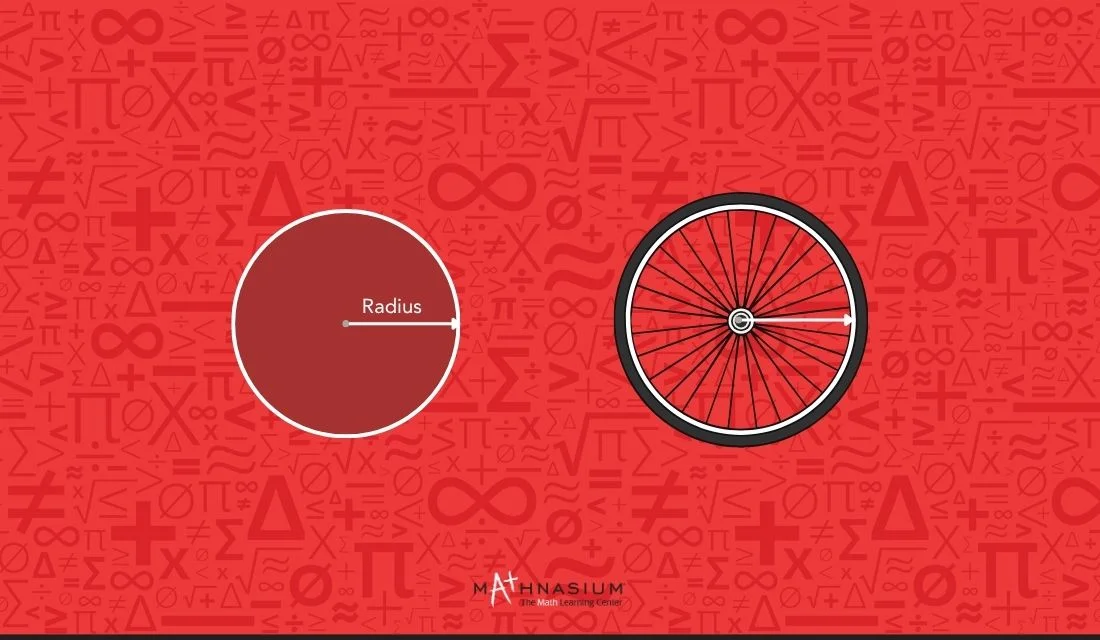
The radius of a circle is the distance from its center to any point on its edge. We write it as r. No matter where we are on the edge of a circle, that distance stays exactly the same.
We see the radius everywhere in real life. The spoke of a bicycle wheel, the minute hand of a clock, or a Ferris wheel spoke are all examples of a radius.
What’s a Diameter?
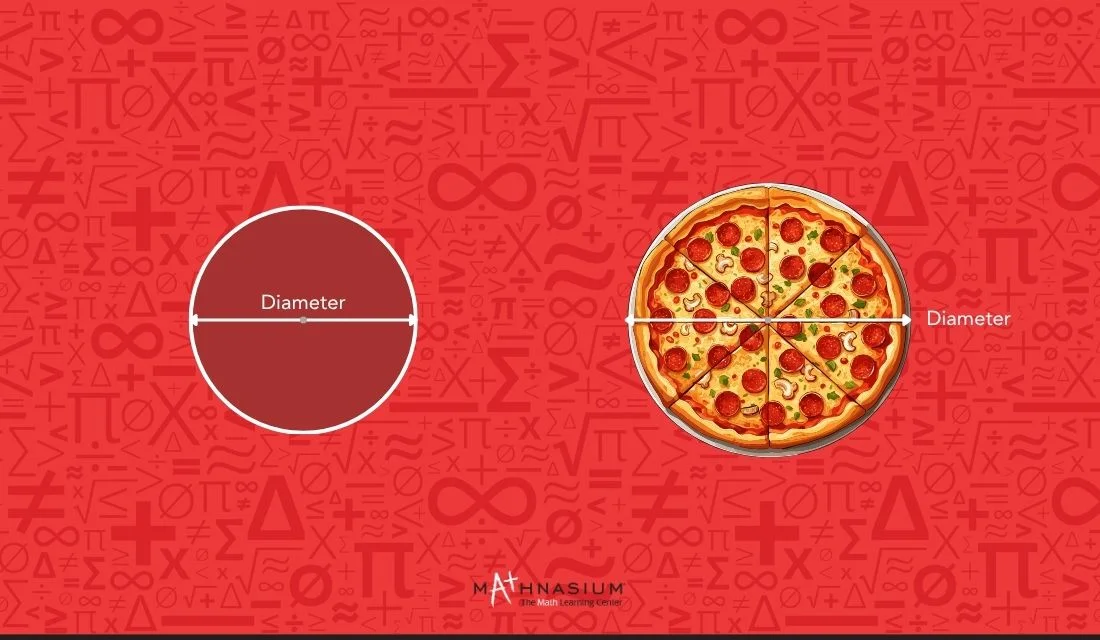
The diameter of a circle is the straight line that goes all the way across, from one side to the other, passing through the center. It is always exactly twice the radius, and we write it as d.
In a coin, a plate, or a circular pizza, the diameter is the straight line through the center that you can draw across any of them.
What’s π (pi)?
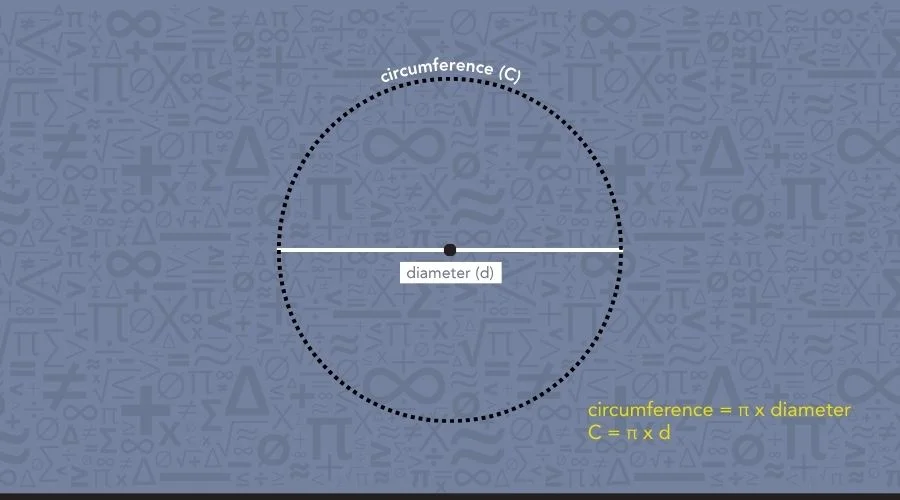
π (pi) is a fixed number, approximately equal to 3.14, that describes the relationship between the distance around the circle’s edge and its diameter. No matter the size of the circle, the distance around it is always π times the diameter.
We can see this for ourselves. Take any circular object, such as a pot lid, a frisbee, or a dartboard, and measure the distance around it with a string. Divide that length by the distance straight across the center. The result will always be approximately 3.14. That consistent relationship is what π captures.
📕 You May Also Like: 7 Amazing Facts About Pi Every Math Student Should Know
Circumference of a Circle: What It Is and How to Find It
The circumference of a circle is the total distance around its edge. We write it as C.
To find the circumference, we can think of it as the perimeter of a circle, the total distance around its edge. For a rectangle, the perimeter is always twice its length and width: P = 2(l + w). A circle works similarly. Its circumference, or the perimeter, is always π times its diameter.
So, to find the circumference of a circle, we multiply its diameter by π:
C = πd
If we know the radius instead, we use C = 2πr, because the diameter is always twice the radius.
How to Find the Radius From the Circumference
When we know the circumference and need the radius, we start from C = 2πr and work in reverse. We rearrange the formula so that r is on its own on one side of the equation. When a variable is on its own like that, we say it is isolated.
To isolate r, we need to identify the operation applied to the variable and reverse it:
-
Identify the operation applied to a variable. In C = 2πr, the radius is being multiplied by 2π. To get r on its own, we need to undo that multiplication.
-
Reverse the operation applied to the variable. Every operation has an opposite that undoes it. These opposites are called inverse operations. The inverse operation of multiplication is division. So we divide both sides of the equation by 2π to undo the multiplication. That gives us: r = C ÷ (2π).
Now, we’ll put this formula to work.
Calculating Radius From the Circumference of a Circle: Solved Example
A circular fountain in a town square has a circumference of 25.12 meters. A groundskeeper needs to know the radius to plan a path around it. What is the radius?
We know that C = 25.12 m and π is always approximately 3.14. To find the fountain’s radius, we can use the formula r = C ÷ (2π).
-
r ≈ 25.12 ÷ (2 × 3.14)
-
r ≈ 25.12 ÷ 6.28
-
r ≈ 4 meters
The fountain has a radius of 4 meters. The groundskeeper can now plan the path at the right distance from the edge.
What Is the Area of a Circle and How to Find It
The area of a circle is the amount of space the circle covers.
To find the area of a circle, we need to think differently than we do with other shapes, like rectangles. A rectangle has straight sides, so we can picture its area as neat rows of square units. A circle has a curved edge, so square units do not fit inside it perfectly, and we need another way to approach it.
Think of cutting a circle into many thin slices, like pizza slices. Each slice reaches from the center of the circle to the edge, so its height is the radius.
Now imagine rearranging those slices by turning every other slice upside down. As the slices get thinner and there are more of them, the new shape starts to look more like a rectangle.
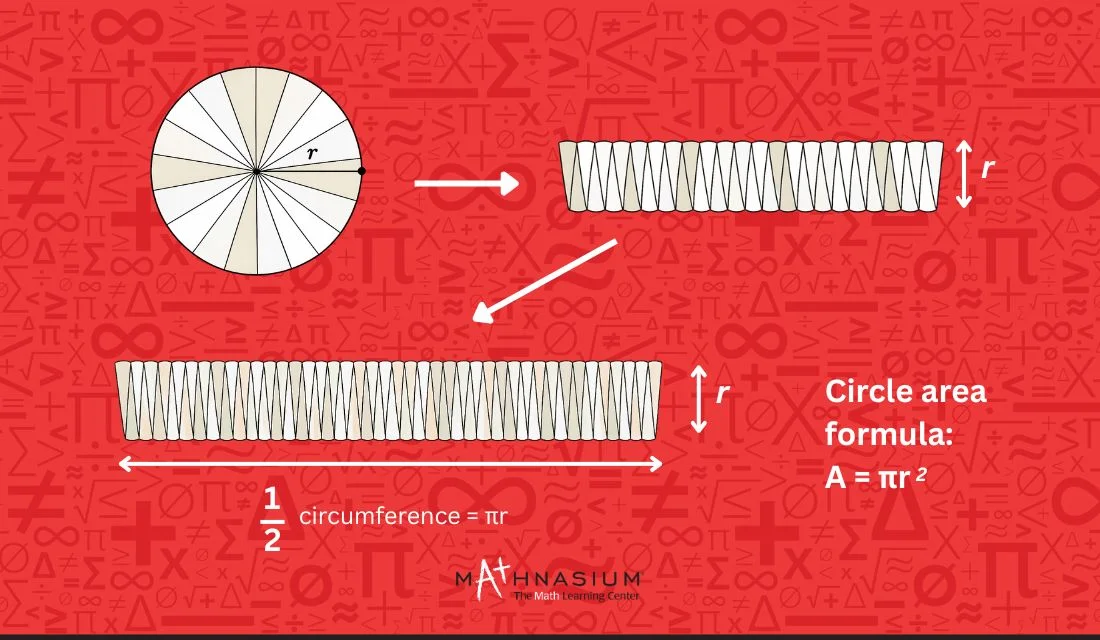
That rectangle has a height of r, the radius. Its width is half the distance around the circle, or half the circumference. Since the circumference is 2πr, half of it is πr. So the area becomes r × πr, which gives us πr². That is where the circle area formula comes from: A = πr².
📕 You May Also Like: What Is Area in Math? A Complete & Kid-Friendly Guide
How to Calculate the Radius From the Area
If the problem gives us the area of a circle and asks us to find the radius, we start from A = πr² and work in reverse. We rearrange the formula so that r is on its own on one side of the equation; in other words, we isolate r.
To do so, we need to undo the two operations applied to r, in reverse order. First, r is being squared, multiplied by itself. Then the result is multiplied by π. To isolate r, first, we undo the multiplication and then the squaring.
A. Multiplication is undone by division; these are inverse operations. So we divide both sides by π first, which gives us: r² = A ÷ π.
B. Now we need to undo the squaring. The inverse operation of squaring is taking the square root. The square root of a number is the value that, when multiplied by itself, gives that number. For example, the square root of 25 is 5, because 5 × 5 = 25. The square root of 49 is 7, because 7 × 7 = 49. So we take the square root of both sides. This turns r² = A ÷ π into: r = √(A ÷ π).
Pay close attention to the order of operations. Divide by π first, then take the square root. Taking the square root before dividing gives the wrong answer. Let’s try this formula in action.
Finding Radius From the Circle Area: Solved Example
A landscape designer is planning a circular garden with an area of 200.96 square feet. She needs to know the radius to order the right amount of edging material. What is the radius?
We have the area A = 200.96 ft², and know that π 3.14. We’ll use the formula: r = √(A ÷ π)
-
r ≈ √(200.96 ÷ 3.14)
-
r ≈ √64
-
r ≈ 8 feet
The garden has a radius of 8 feet.
📕 You May Also Like: Geometry Vocabulary: 59 Terms for Students in Grades 1-8
Common Mistakes to Avoid When Finding the Radius From Circumference or Area
Our tutors often see students make these mistakes when they work backward with circle formulas. Watch for them to catch errors before they affect the final answer.
-
Forgetting to take the square root. Students may correctly find r² from the area formula, then stop too soon and give r² as the answer. To find the radius, we still need to take the square root. That final step cannot be skipped.
-
Taking the square root too early, before dividing by π, changes the order of the steps and leads to the wrong answer. To solve correctly, divide by π first, then take the square root.
-
Confusing radius and diameter. Some learners may find r correctly, then double it when the problem only asks for the radius. Others may use the diameter in a formula instead of the radius. Before writing the final answer, always check which measurement the problem is asking for.
-
Rounding π too early. A child may use 3 instead of 3.14, which introduces an error that carries through the whole calculation. Use 3.14 or the π button on a calculator unless the problem specifies otherwise.
📕 You May Also Like: Geometry Prep: 10 Skills to Know Before 10th Grade
Your Turn! Try Finding the Radius from Circumference or Area
Here are two problems, one from circumference, one from area, to solve on your own. You can check your answers at the bottom of the page.
Problem 1: A circular track has a circumference of 94.2 meters. What is its radius?
Problem 2: A circular swimming pool has an area of 153.86 square meters. What is its radius?

Mathnasium's specially trained tutors guide students through the reverse circumference and area problems in a supportive, engaging environment.
How Mathnasium Can Help With Reverse Circumference and Area Problems (and Any Other Math Topic)
Mathnasium is the only math-only learning center helping K-12 students of all skill levels learn and master math.
We've worked with thousands of students and know how to explain any math topic, including finding the radius from circumference or area, in a way that makes the process clear and easy to follow.
To help students build a deep understanding of math concepts, we don’t rely on a one-size-fits-all curriculum but on our proprietary teaching approach, the Mathnasium Method™.
Each student starts with a diagnostic assessment that helps us identify their current skills, knowledge gaps, and learning goals. From there, we build a personalized learning plan tailored to their needs and pace.
Our specially trained tutors use natural language to phrase concepts and a combination of verbal, visual, mental, tactile, and written techniques to help students understand the math they are working with.
When students get stuck on a concept like the circumference or the circle area, we break it down into manageable steps and teach both the how and the why behind it.
Students gradually learn to do the same independently, walking out of our centers with the problem-solving skills and critical thinking tools they can use in math and beyond.
Fun is an important part of how we work. Sessions often include game-based and hands-on activities that keep students engaged and learning enjoyable. Students earn rewards along the way, and every bit of progress gets celebrated, so confidence grows alongside mastery.
Families see the difference:
-
94% of parents report an improvement in their child's math skills and understanding
-
93% of parents report their child's improved attitude toward math
-
90% of students saw an improvement in their school grades
With over 1,100 learning centers, Mathnasium brings top-rated math instruction close to your community.
Mathnasium of Windermere FL serves families in the Winter Garden and greater Orlando area, helping students build the kind of understanding that holds up in class, on tests, and in the math that comes next.
📅 Schedule a Free Assessment at Mathnasium of Windermere FL
Not near Windermere?
📍 Find a Mathnasium Learning Center Near You.
Pssst! Check Your Answers Here
If you worked through the practice problems, here are the answers:
Problem 1
A circular track has a circumference of 94.2 meters. What is its radius?
-
r = C ÷ (2π)
-
r = 94.2 ÷ (2 × 3.14)
-
r = 94.2 ÷ 6.28
-
r = 15 meters
Check: C = 2 × 3.14 × 15 = 94.2 ✓
Problem 2
A circular swimming pool has an area of 153.86 square meters. What is its radius?
-
r = √(A ÷ π)
-
r = √(153.86 ÷ 3.14)
-
r = √49
-
r = 7 meters
Check: A = 3.14 × 7² = 3.14 × 49 = 153.86 ✓
How did you do?


 (407) 243-6284