Do You Really Understand Compound Interest?
August 14 is National Financial Awareness Day, a perfect time to talk about one of the most powerful concepts in personal finance: compound interest.
At some point in high school, usually in Grade 10, 11, or 12, students learn about compound interest in math class. They memorize formulas, plug numbers into calculators, and get the “right” answer. But here’s the real question: Do they actually understand how it works?
If not, don’t worry, you’re about to. And once you do, you’ll see why compound interest is one of the most important (and surprisingly exciting!) concepts in personal finance.
What Is Compound Interest?
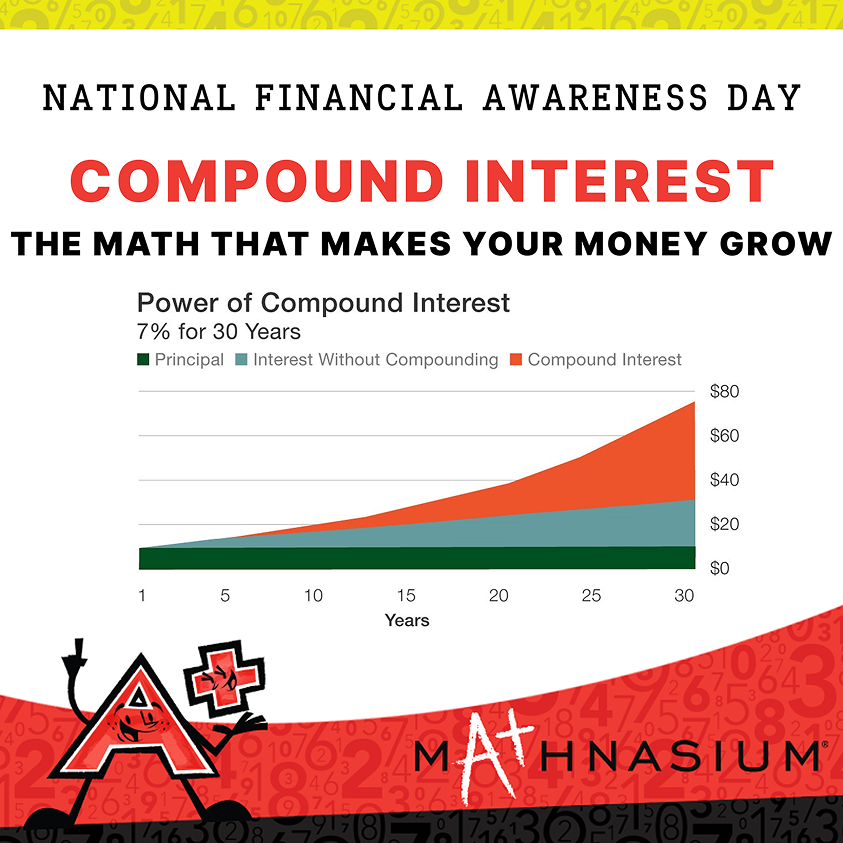
Compound interest is the process where your money earns interest, and then that interest starts earning interest too. Over time, this creates a snowball effect, your balance grows faster and faster, without you having to add more money.
The magic lies in the phrase “interest on interest.”
A Simple Example
Let’s say you put $100 in a savings account that earns 5% interest per year:
-
After 1 year: You earn $5 interest, so your total is $105.
-
After 2 years: You earn interest on $105, not just the original $100. That’s $5.25 in interest, for a total of $110.25.
-
After 10 years: Without adding another cent, your money grows to $162.89.
It doesn’t seem like much at first, but give it time, and the growth curve takes off.
The Power of Starting Early
Here’s where it gets exciting: the earlier you start saving or investing, the more compound interest works in your favor.
Imagine two friends, Alex and Sam:
Even though Alex only started 10 years earlier, by the time they’re both 60, Alex will have almost twice as much money as Sam, without putting in twice the effort. That’s the power of time and compounding.
The Formula Behind the Magic
The math for compound interest is:
A = P (1 + r/n)^(nt)
Where:
-
A = total amount after interest
-
P = principal (starting amount)
-
r = annual interest rate (in decimal form)
-
n = number of times interest is compounded per year
-
t = time in years
It’s a simple formula, but the real lesson isn’t in the equation; it’s in what it means for your money.
How It Applies to Real Life
Compound interest isn’t just for savings accounts. It plays a role in:
-
Investments like stocks, bonds, and retirement funds
-
Debt like credit cards (where interest works against you)
-
Education planning for RESP accounts
-
Long-term goals like buying a home or starting a business
Understanding how it works helps you make smarter financial decisions and avoid costly mistakes.
Takeaway for Students and Families
Whether you’re in high school math class or managing family finances, compound interest is one of the most important money concepts you’ll ever learn. National Financial Awareness Day is a great reminder to start thinking about your financial future, no matter your age.
Start small, start early, and be consistent; your future self will thank you.
From the classroom to real life, Mathnasium helps students truly understand the math that matters. If your child needs support with concepts like compound interest (and much more), contact us now and schedule a Free Assessment!


 (613) 680-6284
 (613) 983-1677