Imagine you’re at a concert or listening to your favorite soundtrack. Before long, your foot starts tapping to the beat. You may even know when the next strong beat is coming, even if you’ve never heard the song before.
How can you do that?
Your brain is picking up on a rhythm, a pattern that repeats over time. Math gives us a way to describe that rhythm, from how often the beat repeats to how much time passes between beats. As long as we can describe a pattern, we can also look at how it changes and use that information to predict what comes next.
Let’s find out what a pattern is, how to recognize the rule behind it, and how that rule helps us extend the pattern.

What Is a Pattern?
A pattern in math is a set of numbers, shapes, sounds, or objects that follows a rule. The rule tells us how the pattern repeats or changes from one part to the next.
When the items are arranged in a particular order, we can call them a sequence. Each item in the sequence is called a term.
Think about a traffic light. It follows the same order:
🔴 → 🟡 → 🟢 → 🔴 → 🟡 → 🟢 → 🔴…
Because the colors repeat in the same order, we can predict which color will come next.
The same idea works with numbers. The rule describes how we move from one term to the next.
Take this pattern:
1, 2, 4…
What should come next?
At first, we might think the answer is 8 because each number could be doubled:
1, 2, 4, 8…
But another rule could also fit. Add 1, then 2, then 3, and so on:
1, 2, 4, 7…
Both rules work for the first three terms, but they give us different next terms. That’s why a few terms may not always be enough to tell us the intended rule. The rule we choose needs to work consistently throughout the pattern.
Patterns also show up in many familiar situations:
|
Patterns in real life
|
Why it’s a pattern
|
|
Days of the week
|
The same seven days repeat in the same order.
|
|
Seasons of the year
|
Spring, summer, fall, and winter repeat in the same order each year.
|
|
A bus that comes every 15 minutes (8:00, 8:15, 8:30…)
|
Each arrival is 15 minutes later than the one before.
|
|
Saving $2 every week ($2, $4, $6…)
|
The total increases by $2 each week.
|
|
A rocket launch countdown (10, 9, 8…)
|
Each number is 1 less than the one before.
|
Patterns can work in different ways, depending on the rule they follow. Next, we’ll look more closely at some common types of patterns and learn what clues can help us recognize each one.

Types of Patterns
Most patterns we meet in math fall into three types:
-
Repeating patterns: The same group of items repeats in the same order.
-
Growing patterns: Each term gets larger.
-
Decreasing patterns: Each term gets smaller.
A. Repeating Patterns
In a repeating pattern, the same group of items comes back again and again, always in the same order.
In our traffic lights example, the colors keep repeating in the same sequence, so this is a repeating pattern:
🔴 → 🟡 → 🟢 → 🔴 → 🟡 → 🟢 → 🔴…
The smallest group that repeats is called the pattern unit. Here, the unit is 🔴, 🟡, 🟢.
For this pattern, 🔴🔺🔴🔺, the unit is 🔴🔺, not 🔴🔺🔴🔺, because the shorter group already repeats.
Patterns can look completely different and still share the same structure. Let’s compare these three:
-
🔴 🔺 🔴 🔺
-
A, B, A, B
-
clap, stomp, clap, stomp
The terms are different, but the pattern works the same way in each case: two items take turns and repeat in the same order.
We can describe this structure as an AB pattern.
When we recognize that different-looking patterns follow the same structure, we are generalizing. We’re looking past the individual colors, letters, or sounds and noticing the pattern they share.
|
Representation
|
Pattern
|
Rule
|
Structure
|
|
Shapes
|
🔴🔺🔴🔺🔴🔺
|
Alternate red circle and triangle
|
AB
|
|
Letters
|
A, B, A, B, A, B
|
Alternate A and B
|
AB
|
| Sounds/actions |
Clap, stomp, clap, stomp
|
Alternate clap and stomp
|
AB |
|
Numbers
|
2, 4, 2, 4, 2, 4
|
Alternate 2 and 4
|
AB
|
B. Growing Patterns
When each term in a pattern is greater than the one before, and the change follows the same rule each time, we call it a growing pattern.
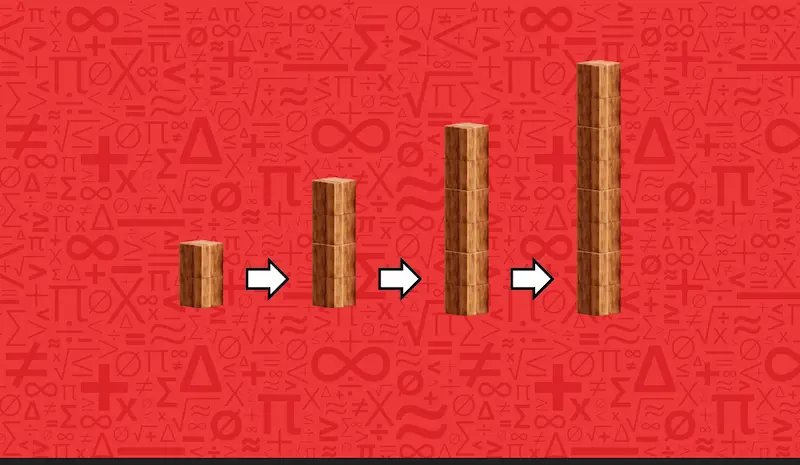
Imagine a row of block towers. The first tower has 2 blocks, the next has 4, then 6, then 8. Each new tower has 2 more blocks than the one before. That means the rule is: start at 2 and add 2 each time.
Growing patterns do not always increase by adding the same amount. They may also grow by multiplying.
Say you send a message to two friends. Then each of those two friends forwards it to two more, so 4 new people see it. If those 4 people each send it again, 8 new people see it next.
The number of people seeing the message follows this pattern:
1, 2, 4, 8…
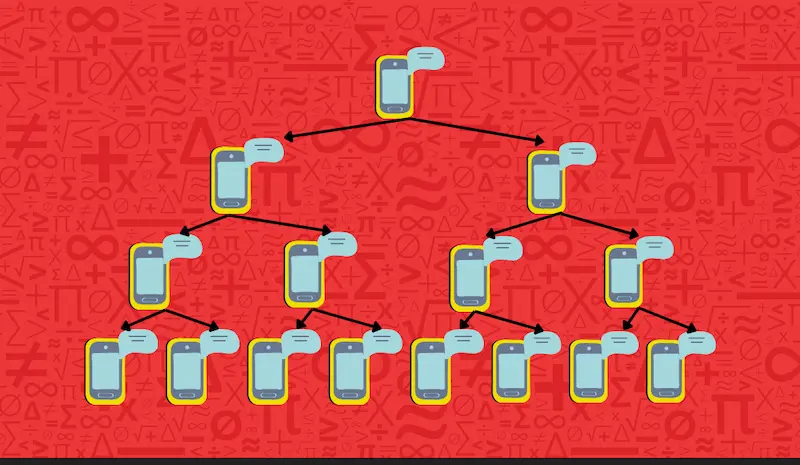
Each term is double the one before, so the rule is: start at 1 and multiply by 2 each time.
Growing patterns can share the same structure, too.
For example:
-
a row of block towers with 2, 4, 6, 8 blocks,
-
the amount you save growing by $2 each week
-
the number of socks in 1, 2, 3, and 4 pairs: 2, 4, 6, 8
The situations are different, but the pattern is the same each time: start at 2 and add 2 to get the next term.
|
Representation
|
Pattern
|
Rule
|
|
Block towers
|
2, 4, 6, 8 blocks
|
Start at 2, add 2
|
|
Money saved
|
$2, $4, $6, $8
|
Start at $2, add $2
|
|
Number of socks in pairs
|
2, 4, 6, 8 socks
|
Start at 2, add 2
|
C. Decreasing Patterns
A decreasing pattern is a pattern in which each term is smaller than the one before and the change follows the same rule each time.
Suppose we start with 20 stickers and give away 3 each day. The number of stickers left goes:
20, 17, 14, 11...
In this pattern, we follow the rule: start at 20 and subtract 3 each time.
If we cut a 64-inch ribbon in half again and again, the pieces measure 64, 32, 16, and 8 inches. Each step halves the length. The pattern still decreases because the values get smaller according to one consistent rule.
Let’s see whether these sequences follow the same structure:
-
Stickers left after giving away 3 each day: 20, 17, 14, 11...
-
Dollars left after spending $3 each day: 20, 17, 14, 11...
-
Pages left to read after finishing 3 pages each day: 20, 17, 14, 11...
In every case, we start at 20 and subtract 3 each time. Since the same rule works in all three situations, we can generalize and use it to describe the pattern they share.
|
Representation
|
Pattern
|
Rule
|
|
Stickers left
|
20, 17, 14, 11
|
Start at 20, subtract 3.
|
|
Numbers
|
20, 17, 14, 11
|
Start at 20, subtract 3.
|
|
Ounces of water left after each sip
|
20, 17, 14, 11 oz
|
Start at 20, subtract 3.
|
|
Pages left to read in a short chapter
|
20, 17, 14, 11 pages
|
Start at 20, subtract 3.
|
Quick Overview of Pattern Types
At Mathnasium, we find that comparing the three types side by side helps students sort new patterns quickly. Here’s a table to keep handy when you’re working on homework or preparing for a quiz:
|
Pattern
|
Type
|
What changes
|
Rule
|
Next term(s)
|
|
🔺🔵🔺🔵🔺🔵
|
Repeating
|
The unit 🔺🔵 repeats.
|
Repeat the two-shape unit.
|
🔺
|
|
5, 10, 15, 20
|
Growing
|
Each number is 5 more than the last.
|
Add 5.
|
25
|
|
81, 27, 9, 3
|
Decreasing
|
Each number is a third of the last.
|
Divide by 3.
|
1
|
📕 You May Also Like: What Are Growing & Shrinking Patterns? A Guide for Parents
How to Identify and Extend a Pattern
To identify a pattern, we can work through these steps:
-
Notice how the pattern is changing.
-
Compare terms that sit next to each other.
-
Describe the change as a rule.
-
Check the rule on every term we know.
We may also take one more step and extend the pattern by using the rule to find the next terms.
At Mathnasium, we like to work through new ideas with an example, so let’s walk through the steps using this pattern:
4, 7, 10, 13…
Step 1: Notice how the pattern is changing
First, we take a broad look at the pattern. The terms are numbers, and they get larger as we move from left to right. That tells us we’re likely working with a growing pattern.
Step 2: Compare terms that sit next to each other
Next, we look more closely at what changes from one term to the next. Because the numbers are increasing, we can start by checking whether the same amount is being added each time.
To check, we subtract each term from the one that comes after it:
-
7 − 4 = 3
-
10 − 7 = 3
-
13 − 10 = 3
Each difference is 3, so the pattern increases by 3 each time.
Step 3: Describe the change as a rule
Now we turn what we noticed into a clear rule:
Start at 4 and add 3 each time.
The starting value shows where the pattern begins, and “add 3” tells us how to move from one term to the next.
Step 4: Check the rule on every term we know
Before we extend the pattern, we check that our rule, “add 3 each time,” works for every term we already know:
-
4 + 3 = 7 ✓
-
7 + 3 = 10 ✓
-
10 + 3 = 13 ✓
Each calculation gives us the next term in the pattern, so the rule works all the way through. If a rule works for only some of the terms, we need to keep looking.
Step 5: Use the rule to find the next terms
Now we can continue the pattern by adding 3 each time:
-
13 + 3 = 16
-
16 + 3 = 19
-
19 + 3 = 22
So the next three terms are 16, 19, and 22.
📕 You May Also Like: Help Your Child Build Math Confidence Through Patterns
How Patterns Connect to Algebra
Patterns and algebra are closely connected. We often begin by noticing that something repeats or changes in a predictable way. Algebra gives us tools to describe that pattern more precisely and work with it in different forms.
We can represent the same pattern using:
-
tables to organize the terms or values in the pattern,
-
expressions to describe the rule behind the pattern,
-
functions to show how each input produces an output according to that rule,
-
graphs to show visually how the pattern changes.
📕 You May Also Like: How Playing with Patterns Boosts Your Child’s Math Skills
Your Turn: Spot the Pattern Yourself!
For each sequence below, decide whether it follows one rule all the way through. If it does, describe the rule and find the next term. If it doesn’t, identify where the pattern breaks. You can check your answers at the bottom of the page.
-
🔺🔵🔺🔵🔵🔺
-
3, 6, 12, 24
-
3, 6, 9, 13, 15
-
🍎🍎🍌🍎🍎🍌

Mathnasium tutors use different teaching techniques and hands-on activities to help students develop math skills such as pattern recognition.
How Mathnasium Helps Students Learn and Master Any Math Skill
Mathnasium is a math-only learning center dedicated to helping K–12 students of all skill levels excel in math.
We aim to build math skills students can carry from one topic to the next. With patterns, they learn to notice how quantities in a sequence relate, identify what changes, and explain the rule. That kind of reasoning supports number sense now and algebra later.
To build true math mastery, we use our proprietary teaching approach, called the Mathnasium Method™, designed to meet students where they are and guide them forward step by step.
Each student begins with a diagnostic assessment that helps us understand their current skill level, knowledge gaps, goals, and how they think and feel about math.
Using these insights, we create a personalized learning plan focused on the skills the student needs most, whether that means building number sense, practicing skip-counting, describing pattern rules, or preparing for sequences and early algebra.
Our specially trained tutors follow the plan closely and provide live, face-to-face instruction in a caring and fun group environment. They use mental, verbal, visual, tactile, and written techniques to help patterns make sense. Students might build repeating patterns with blocks, clap or tap a rhythm, compare number sequences, or explain a rule before writing it mathematically.
Students also get room to think through problems before tutors step in. Our tutors guide them to look for what changes, test whether a rule continues, explain their reasoning, and check whether the next term fits the pattern. This helps students build critical thinking, problem-solving skills, and greater independence in math.
Fun is a core part of the approach, too. We use hands-on and game-based activities, rewards, and consistent encouragement to keep students engaged as they spot, build, and extend patterns in different ways.
The impact is clear in our results:
-
94% of parents report an improvement in their child's math skills and understanding
-
93% of parents report their child's improved attitude toward math after attending Mathnasium
-
90% of students saw an improvement in their school grades
With over 1,200 learning centers across North America, there is likely a Mathnasium close to you.
For families in and near Richmond, TX, Mathnasium of Aliana brings that same approach close to home, with specially trained tutors who help students make sense of patterns, build number sense, and prepare for the algebra skills that grow from them.
If your child needs support with patterns or any other math topic, a free diagnostic assessment is a great place to start. Using what we learn, we create a personalized learning plan that helps your child master the skills they need next.
📅 Schedule a Free Assessment at Mathnasium of Aliana
Not near Richmond?
📍 Find a Mathnasium Learning Center Near You
Pssst!... Check Your Answers Here
Did you spot all the patterns? Here are the answers to the practice problems above:
-
Doesn’t follow one rule. The unit 🔺🔵 repeats twice, then the pattern breaks at the fifth shape. A triangle should come next, but we see a second circle instead.
-
Follows a rule. It’s a growing pattern: start at 3 and double each time. The next term is 48.
-
Doesn’t follow one rule. It starts by adding 3 (3, 6, 9), but 13 breaks the rule. It should be 12, and then 15 would follow.
-
Follows a rule. It’s a repeating pattern with the unit 🍎🍎🍌. The next three terms are 🍎🍎🍌.
Notice that sequences 2 and 3 both start with 3 and 6, yet they follow different rules. That’s why we check a rule on every term before we trust it.


 (713) 697-6284