At Mathnasium, we often call number lines one of the building blocks of deep math understanding because they give students a visual mental map of how numbers move, grow, and connect.
Kids typically meet their simplest version in kindergarten and continue using them throughout school.
Number lines stay relatively the same from one grade to the next. What changes is how much learners can do with it.
Today, seasoned Mathnasium tutors will show how number lines grow with your child, from early counting all the way to fractions and negative numbers, and why this one simple tool can support deeper understanding at every step.
First Off, What Is a Number Line?
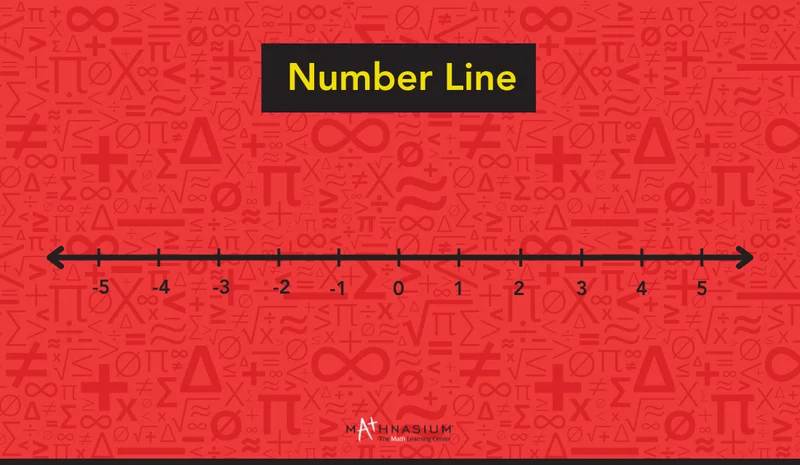
A number line is a simple visual that shows numbers in order, spaced evenly apart. It gives kids a way to see how numbers relate to each other.
Children build number sense this way, an intuitive feel for quantity that carries into every grade ahead.
📕 You May Also Like: How Number Lines Improve Math Understanding (Grades 1-5)
How K-8 Students Use Number Lines Throughout Their Math Journey
Students start with number lines that only handle whole numbers. Fractions, decimals, negative numbers, and inequalities join the line as they move up in grade.
Here's an overview of number line progression, based on Texas's TEKS math standards, which lay out the sequence in clear, grade-by-grade detail.
If you're in another state, the specific standard names and exact grade placement may differ slightly, but the sequence reflects a path shared across most US math curricula.
Kindergarten
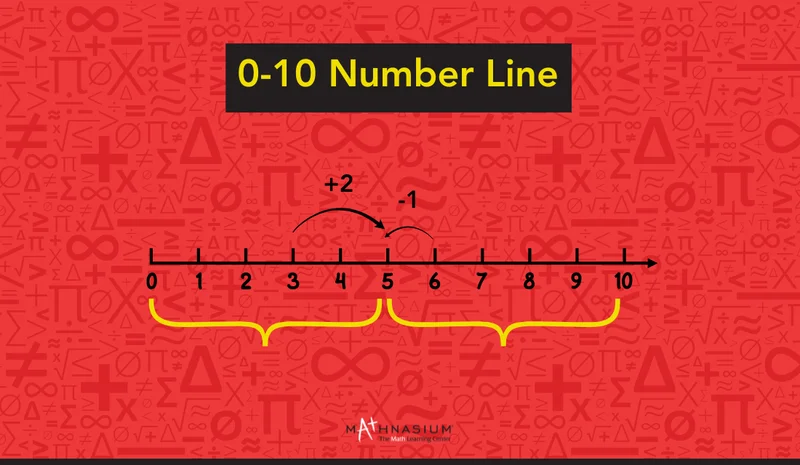
While in kindergarten, young learners place and compare small whole numbers, starting around 0 to 5 and moving up to 0 to 10. They make simple jumps along the line to add or subtract.
That means numbers stop being just labels here and start becoming positions. Left means less, right means more, and that idea is the core of early number sense.
On a 0 to 10 line, a kindergartener can see that 5 is two more than 3, one less than 6, and sits halfway between 0 and 10.
📕 You May Also Like: How to Use a Number Line With Positive & Negative Numbers
1st Grade
First graders take a big step from basic counting to ordering whole numbers all the way up to 120 on open number lines.
This is where place value and estimation start to make sense visually. Instead of just memorizing digits, first graders can look at 87 and instantly see that it belongs between 80 and 100, much closer to 90.
When they lay numbers out on a line, it helps them stop treating digits as isolated symbols and start understanding scale.
2nd Grade
In second grade, students learn to locate whole numbers between multiples of 10, 100, and 1,000. They use open number lines to add and subtract with bigger, more strategic jumps instead of counting one by one.
This builds rounding and estimation skills, and it introduces the idea of distance from zero, the same idea that turns into absolute value in 6th grade.
As an illustration, on a 0 to 1,000 line, a second grader can see that 457 falls between 400 and 500, closer to 500, so it's about 460. Rounding starts to feel natural instead of like a memorized rule.
📕 You May Also Like: How Estimation and Rounding Support Number Sense in Math
3rd Grade
By third grade, students start treating fractions, and soon decimals, as points and distances from zero on the number line. They also use that same line to model addition and subtraction.
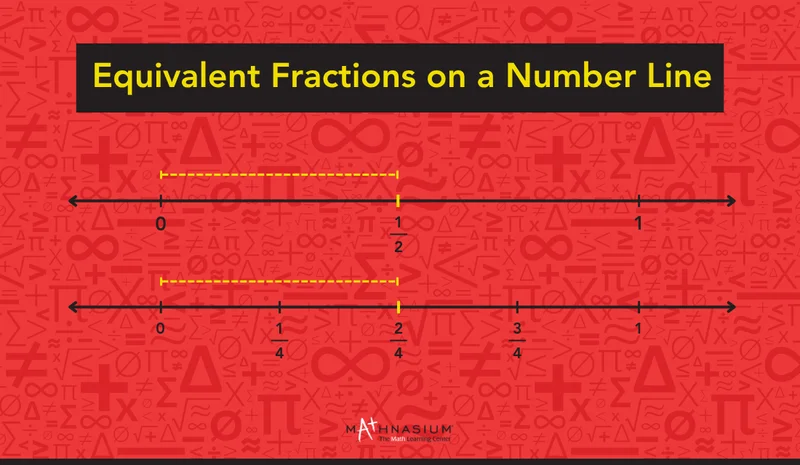
If a student in third grade sees a fraction as a point, that shows them that two fractions are equal if they land on the same spot. It also brings fractions and decimals into one number system instead of two separate topics.
On a line from 0 to 1, for example, learners can see that \(\Large\frac{1}{2}\) and \(\Large\frac{2}{4}\) land on the exact same point. That's proof they're equal, with no common denominator required.
4th Grade
At this stage, number lines turn into a lab for testing fractions and decimals side by side. Students match points on the line to specific values and use their positions to decide which numbers are larger and by how much.
When they compare numbers by position, they build a visual sense of which value is bigger and by how much, going beyond lining up digits or hunting for common denominators.
For example, fourth graders might see that 0.75 sits closer to 1 than 0.4 does. That makes the bigger decimal clear at a glance, no digit lineup required.
5th Grade
Students in fifth grade focus on ordering rational numbers, benchmark fractions, and percents on a number line. They model addition and subtraction of fractions with unlike denominators the same way.
They model fraction addition as combining lengths, instead of just manipulating numerators and denominators. This approach leads to fewer errors, and it helps them apply what they know to new problems more easily.
The fraction skills kids have at this stage tend to line up with how ready they feel for algebra years later.
Fifth graders can mark \(\Large\frac{1}{4}\) and \(\Large\frac{1}{3}\) on the same line to add them. The moment learners sees the gap between the two marks, their need for a common denominator becomes visual instead of abstract.
📕 You May Also Like: What Is a Rational Number? A Simple & Complete Guide
6th Grade
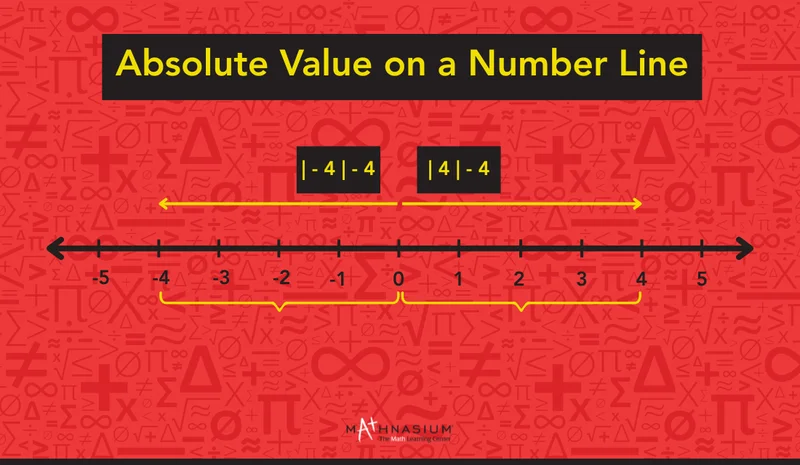
In the first year of middle school, students should be able to locate, compare, and order integers and rational numbers on a number line. They identify a number, its opposite, and its absolute value using that same line.
If negatives and positives are on one line, it helps students see that a negative number is a point left of zero, not some strange new category. Absolute value follows the same logic. It's how far a number sits from zero, a definition students reuse later in inequalities and functions.
For example, a sixth grader can see that -4 and 4 sit the same distance from 0, so both have an absolute value of 4. One point falls to the left of zero and the other to the right, but the distance matches.
7th Grade
Seventh grade asks students to model one-variable, two-step equations and inequalities. They represent whole solution sets on a number line.
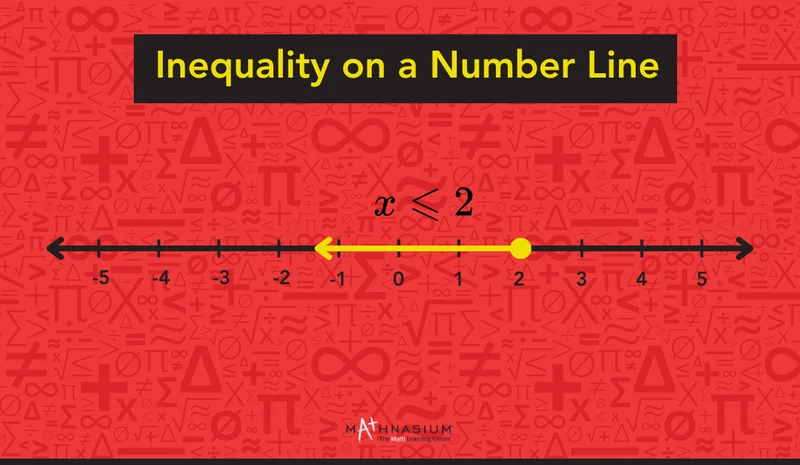
This is often the first time learners see a solution as "every number greater than" or "every number between," instead of one fixed value like x = 5. Graphing a solution set on a line makes the idea of infinite solutions concrete, which sets students up for algebra work on domains and constraints.
If seventh graders solve an inequality and land on x ≤ 2, they mark a filled circle at 2 and shade to the left. That shading shows every number that works, instead of just the number 2.
8th Grade
In eighth grade, students learn to approximate irrational numbers, like Pi (π) or a square root, and locate that approximation on a number line. They plot integers, rationals, and those approximations together on one line to compare their size.
When students put integers, fractions, decimals, and irrational approximations on the same line, they see that they all belong to one number system. That picture becomes the backbone of the real number line and the x-axis students rely on in high school algebra and graphing.
Eighth graders can see that \(\sqrt{5}\) falls between 2 and 3 on a number line, closer to 2. If they mark that point, it lets them compare it directly to a decimal like 2.1 or 2.5, instead of treating square roots and decimals as separate kinds of numbers.

Mathnasium tutors use number lines to turn abstract math into something students can see.
How Mathnasium Helps Students Understand and Enjoy Math
Mathnasium is a math-only learning center dedicated to helping K–12 students of all skill levels excel in math.
Number lines are one of the tools we use to make math clearer, from the first time a kindergartner circles a number on a line to the day an eighth grader compares a square root to a decimal.
They're one piece of the Mathnasium Method™, our proprietary approach to teaching math. We built it to help kids reach math mastery step by step, instead of memorizing rules.
Each student starts with a diagnostic assessment. It helps us understand their current skill level, their learning goals, and how they think and feel about math.
From there, we build a personalized learning plan around what we find. Our tutors combine mental, verbal, visual, tactile, and written techniques, and they adjust to how each child learns best.
We guide students through the how and why behind each concept so they develop flexible problem‑solving skills they can use long after a worksheet is finished.
Fun is a core part of the Mathnasium Method™. Our activities are often game-based and hands-on, keeping students engaged and enjoying the process. We celebrate every step of progress and use meaningful rewards, so confidence grows right alongside skill.
The results speak for themselves:
-
94% of parents report an improvement in their child's math skills and understanding.
-
93% of parents report their child's improved attitude toward math after attending Mathnasium.
-
90% of students saw an improvement in their school grades.
Mathnasium operates over 1,100 learning centers, bringing our top-rated math instruction close to your community.
For families based in or near Allen, TX, Mathnasium of Allen is a trusted local center with years of experience building confident math thinkers.
Our community recognizes our commitment to student success and has rewarded us with:
-
Over 100 five-star Google reviews reflect our parents' trust in proven results
-
Multiple Reader's Choice Awards from Living Magazine: Best Tutoring (2021–2025) and Best Early Education (2023, 2025)
-
Community Votes 2025 Best Tutor in Allen
-
Business Rate Best of 2025 Tutoring Service for Allen
Whether your child needs to catch up, keep up, or get ahead, our local team is ready to help.
📅 Schedule a Free Diagnostic Assessment at Mathnasium of Allen
Not near Allen?
📍 Find a Mathnasium Learning Center Near You


 (469) 361-2277
 (469) 361-2277