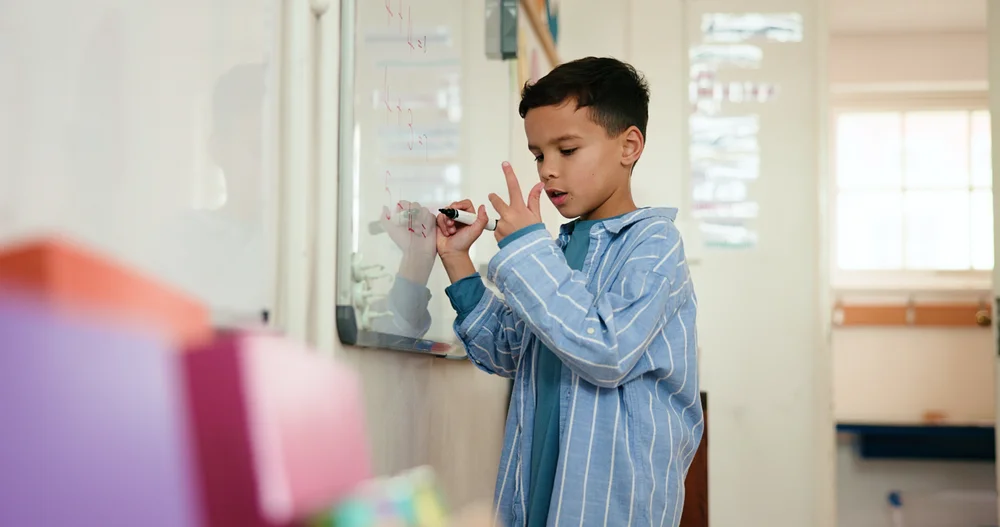
Finger counting in 3rd grade may seem like a harmless habit, but it's a clear signal. When a 3rd grader still relies on their fingers for basic addition, it usually means that number sense didn't develop the way it should have in the earlier grades.
Summer is a practical window to address this, and this guide shows parents exactly how.
From understanding what number sense is and what 3rd-grade benchmarks look like to specific activities that build it and signs that outside support is needed, Mathnasium's tutors walk you through it all.
What Finger Counting in 3rd Grade Tells You
By the end of 3rd grade, Common Core math standards expect children to work with numbers mentally: adding, subtracting, and comparing values without physical props.
So when a 9-year-old still reaches for their fingers on a simple addition problem, it's easy to read that as inattentiveness or a habit that just needs to be dropped.
In most cases, it isn't either of those things.
Finger counting at this age can be a sign that the mental scaffolding underneath the math didn't fully form. Our kids aren't being lazy. They're doing the only reliable thing they have available.
When number relationships aren't internalized, fingers are a perfectly logical solution. The problem isn't the fingers but what's missing without them.
This matters because the fix looks very different depending on how you frame it. Telling a child to stop using their fingers, without addressing why they need them, removes the workaround without replacing it with anything. That tends to increase errors, slow down work, and chip away at confidence.
In our tutors' experience, what's missing is usually number sense.
Before getting into what that means precisely, it helps to know that number sense develops in stages, and a gap at 3rd grade almost always traces back to something specific that didn't click in 1st or 2nd grade.
📕 You May Also Like: Skip Counting: The Bridge Between Counting and Multiplication
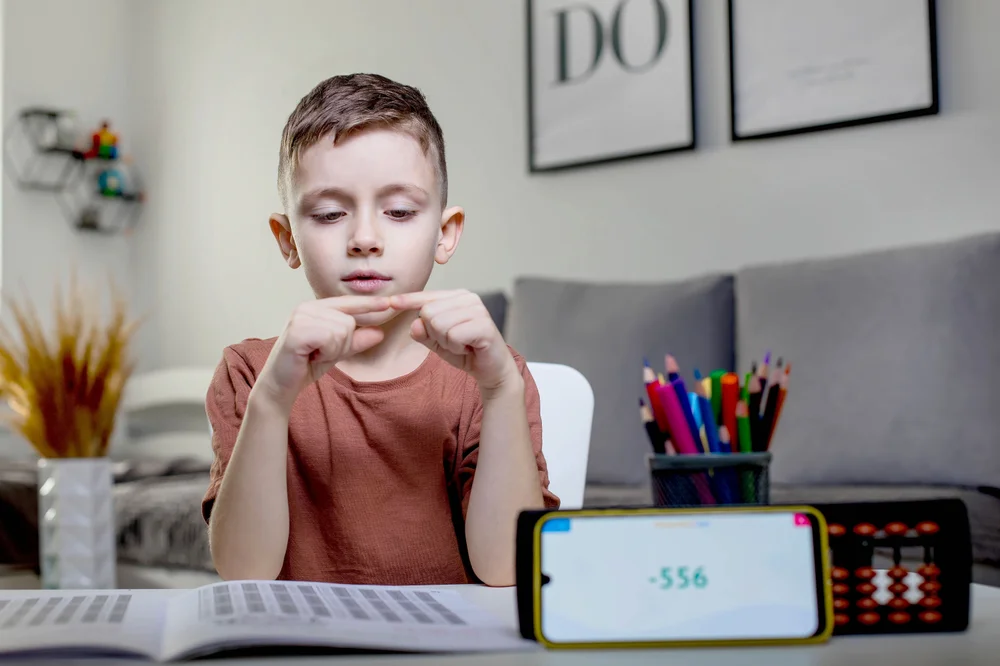
Finger counting at 9 is a signal worth paying attention to.
What Number Sense Is And Isn't
"Number sense" gets mentioned in conversations about early math, but it rarely gets defined in a way that's useful for parents. So here's a clear definition: number sense is the ability to understand numbers as quantities with relationships, not just symbols to manipulate by rule.
In practical terms, children with developed number sense know that 8 is close to 10, that 7 + 6 is the same as 7 + 3 + 3, and that if 5 × 4 = 20, then 5 × 5 must be 25. Beyond pure memorization, number sense requires understanding how numbers relate to each other.
Students without it see each problem as a standalone operation to execute. They may get the right answer, but only by following a procedure step by step. Remove the procedure, change the format slightly, or add one more step, and things fall apart.
To be perfectly clear, number sense is not:
-
Knowing math facts by heart. Memorization and understanding are different things, and one doesn't guarantee the other.
-
Being "good at math." That's an outcome, not a skill.
-
Something children either have or don't. It develops, and gaps in it can be addressed at any age.
The reason this distinction matters is that drilling facts without building the underlying understanding tends to produce fragile knowledge.
Our kids can repeat a procedure correctly in one context and completely lose it in another. That's not a memory problem. That's a classic example of a number sense problem. And this calls for a different kind of practice than most parents default to.
📕 You May Also Like: What Is Number Sense & Why It Matters in Early Math Education
Skills That Should Be in Place by 3rd Grade
By the end of 3rd grade, number sense shows up in specific, observable ways. Here's a practical reference for where kids should be at this stage.
1. Counting and Quantity
Children should be able to count forward and backward from any number. They should also recognize small quantities (up to 5) at a glance, instantly and without counting up.
2. Understanding Place Value
They should understand that 34 means 3 tens and 4 ones, and be able to use that understanding to add and subtract. Knowing what it means and working with it are two different things.
3. Number Relationships
Kids at this stage should have a feel for numbers relative to each other. Is 47 closer to 40 or 50? How far is 8 from 10? These are intuition questions, and the answers should come quickly.
4. Basic Fact Fluency
Addition and subtraction facts within 20 should be automatic. If your child is still working out 6 + 7 by counting up, that's the gap to close.
5. Early Multiplication Thinking
Third grade introduces multiplication. Children should begin to understand it as equal groups, instead of seeing it as just a new set of facts to memorize.
📕 You May Also Like: 6 Math Concepts to Master in 3rd Grade
Why Summer Is the Right Window
The school year moves fast. The class doesn’t wait for your child if it doesn't understand a concept. And several new topics have already been introduced before your student has an opportunity to catch up.
Summer removes that pressure entirely.
There's room to go back to the specific point where things stopped making sense and spend real time there, as there is no new curriculum to keep pace with. That's difficult to do in September, when 4th grade has already started, and the pace picks up again immediately.
Another benefit of summer is that it doesn't require a rigid schedule or hours of daily work. Fifteen to twenty minutes of focused, well-targeted practice several times a week is enough to maintain what's there and steadily build on it. The keyword is targeted. Generic grade-level practice covers a lot of ground but doesn’t necessarily address the specific skills that need attention.
That's what makes summer genuinely useful: there's time to be precise.
📕 You May Also Like: Is My 3rd Grader Really Ready for Multiplication?
4 Practical Ways to Build Number Sense at Home
Workbooks are the first thing we turn to. And rightfully so, as they have their place, but number sense builds faster through activities that require thinking about quantities. Here are four approaches organized by what they build.
1. Quantity and Mental Math
Card games are underestimated but very effective here. A simple game of War, where players compare and add card values, builds quantity recognition and mental addition without feeling like practice. Ask your child to add up a grocery receipt, estimate the total before the cashier does, or figure out how much change to expect.
2. Place Value
Play "closest to 100." Each player draws two number cards and decides which digit goes in the tens place and which in the ones. The goal is to get as close to 100 as possible without going over.
Simple, fast, and it builds place value thinking naturally.
3. Number Relationships
Use the drive to school, dinner, or any idle moment. "If we need 12 juice boxes and we have 7, how many more do we need?" These are the exact type of relational thinking that replaces finger counting with mental math.
4. Fact Fluency
Apps like Prodigy or Math Fact Fluency work well here, but so does a simple homemade game: write addition and subtraction facts on index cards, shuffle them, and see how many your child can answer correctly in two minutes. Track the score each time.
Your aim should be to make retrieval automatic so your child's focus is free for the harder parts of a problem.
📕 You May Also Like: 10 Fun Math Games to Play at Home with Your Child

What to Do When Home Practice Isn't Enough
Home practice works well for maintenance and for gaps that are relatively small. But some number sense gaps are specific enough, or deep enough, that a parent working with their child at the kitchen table isn't the most effective setup.
Here are a few signs that more structured support makes sense:
-
Your child understands something in the moment but can't apply it independently the next day.
-
The same type of mistake keeps showing up across different topics.
-
Math avoidance is growing. It shows up as a stomachache before homework or assignments finished suspiciously fast.
-
You're not sure exactly where the gap is, which makes it hard to know what to practice.
That last point is more common than parents expect. Number sense gaps aren't always obvious from a report card or a test score. Reasonable grades can mask a child who is relying on workarounds that will run out of road in 4th or 5th grade.
What structured support adds, that home practice usually can't, is precise identification of where the gap starts, alongside a plan built around that specific point.
At Mathnasium, that process begins with a diagnostic assessment designed to surface exactly where number sense broke down and why, so practice targets the right thing from day one.
📕 You May Also Like: The Unseen Benefits of Consistent Math Tutoring
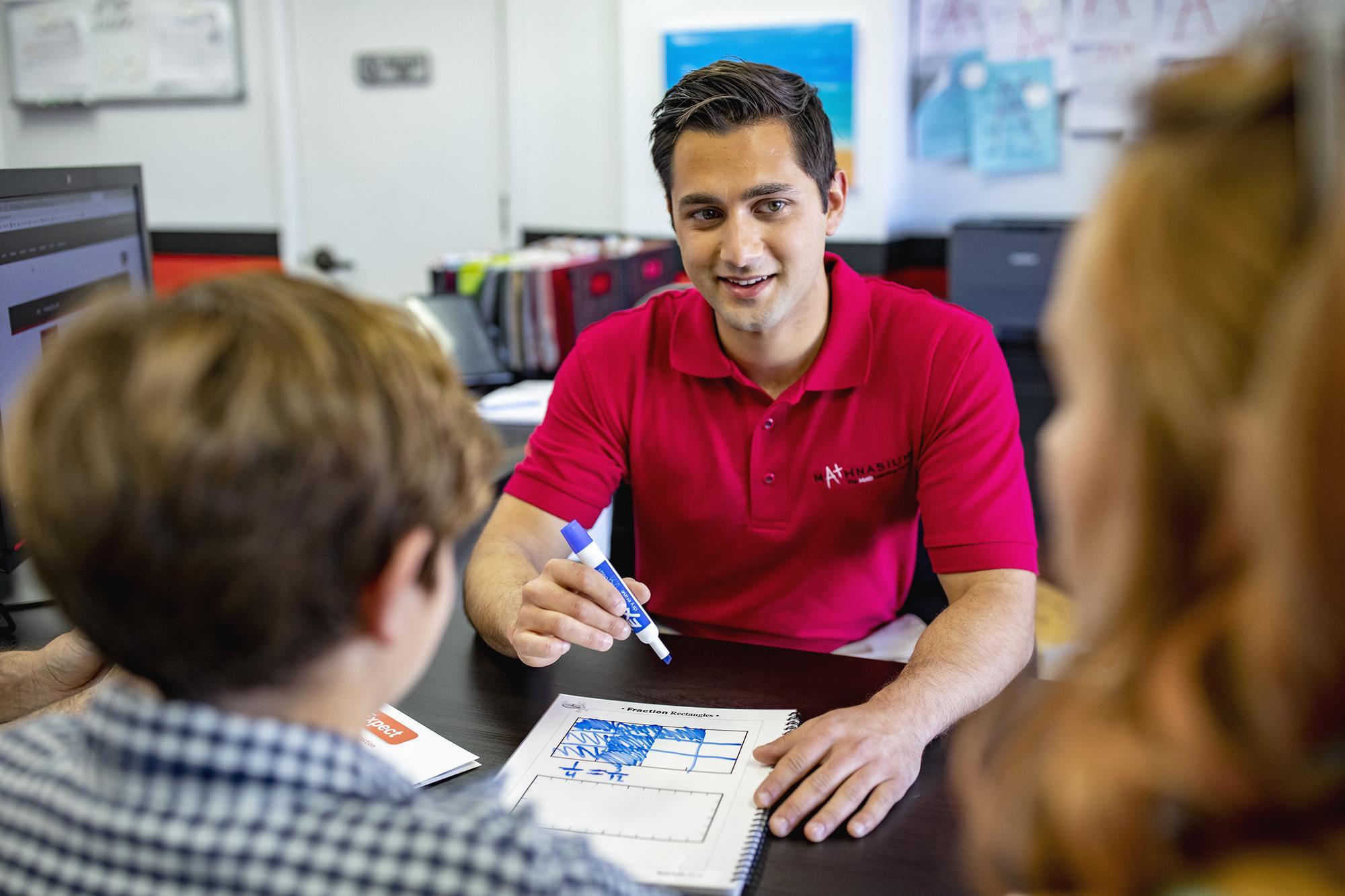
Mathnasium helps 3rd graders replace finger counting with solid and lasting number sense, one concept at a time.
How Mathnasium Helps 3rd-Graders Build Solid Math Foundations
Mathnasium is a math-only learning center empowering students of all skill levels to learn and master math.
We’ve worked with thousands of 3rd graders looking to catch up in math. Developing solid number sense is at the very focus of our work with them.
Most of our learning centers offer regular sessions in summer as well as dedicated summer learning programs. Whatever option suits your family, your child receives the same personalized learning experience driven by our proprietary teaching approach, the Mathnasium Method™.
Here’s how our approach works.
Each student begins with a diagnostic assessment that helps us pinpoint their current skills, knowledge gaps, and how they think about math in general. These insights inform a learning plan customized to their needs, which may be (re)building number sense or tackling more advanced concepts.
Once the plan is ready, our tutors follow it closely, delivering face-to-face math instruction in an environment that’s supportive and confidence-building.
Our tutors use natural language to phrase math concepts and rely on a combination of verbal, visual, mental, tactile, and written techniques to help students truly make sense of math and adapt to different learning styles.
If students get stuck, we break problems into manageable bits, teaching both the how and the why behind the answer. Working with our specially trained tutors, students gain the valuable critical thinking tools and problem-solving skills to use in math and beyond.
Fun is a core part of how we work. Sessions are often game-based, students earn rewards along the way, and every win gets celebrated. That consistent encouragement keeps students aware of their progress and growing in confidence with each session.
The results speak volumes:
-
94% of parents report an improvement in their child's math skills and understanding
-
93% of parents report their child's improved attitude toward math after attending Mathnasium
-
90% of students saw an improvement in their school grades
We operate over 1,100 learning centers across North America, bringing our proven approach close to your community.
Students based in or near Altadena, Los Angeles, are in good hands. Mathnasium of Altadena is a trusted local center with years of experience building confident math thinkers.
Whether your child needs to catch up, keep up, or get ahead, the team at Mathnasium of Altadena is ready to help.
📅 Schedule a Free Diagnostic Assessment at Mathnasium of Altadena
Not near Altadena?
📍 Find a Mathnasium Learning Center Near You


 (626) 254-6284
 (626) 669-4239