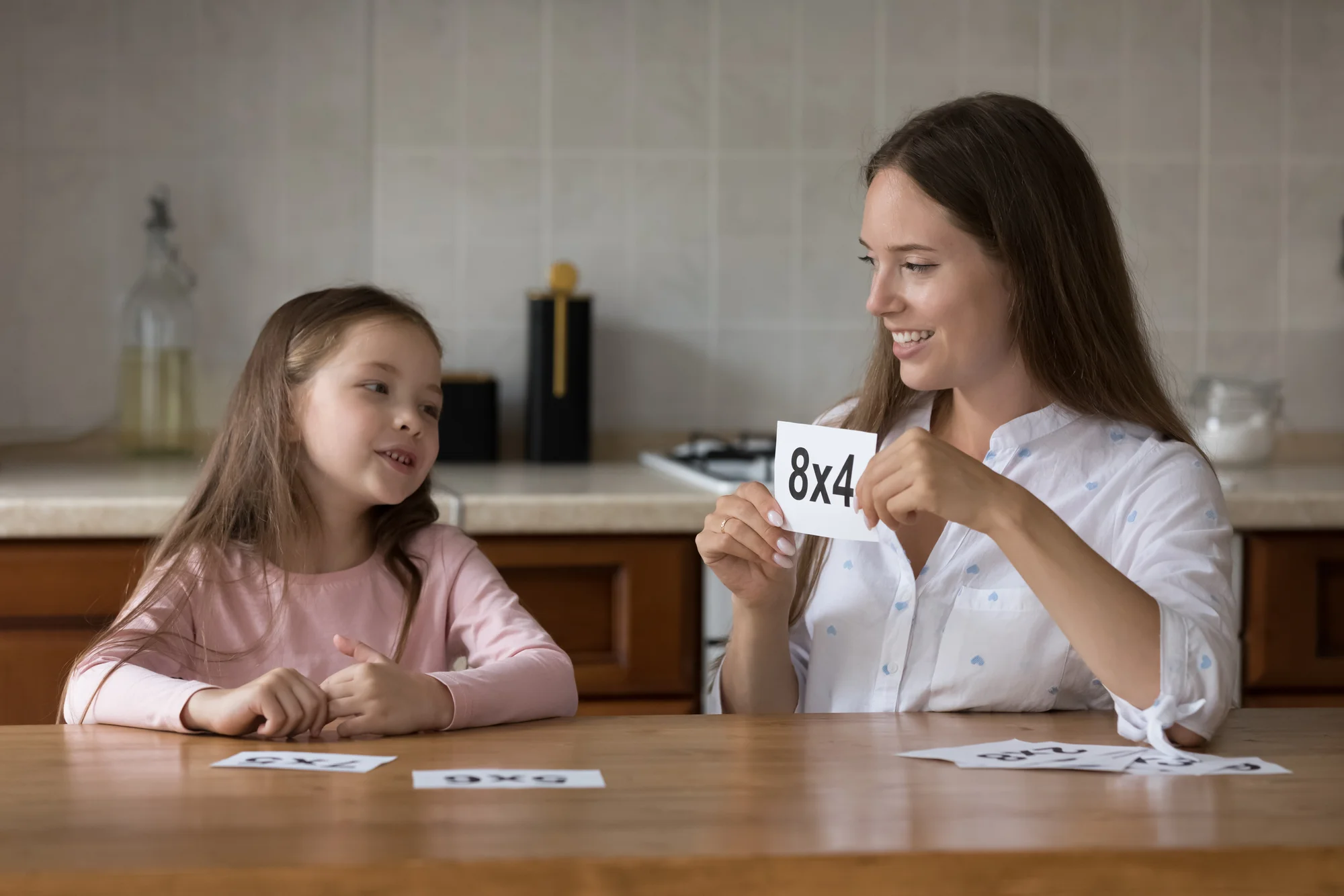
Third grade represents a big step forward in math learning.
Students move from basic operations into more complex territory with multiplication, division, and fractions. By understanding the 3rd-grade math standards and grade 3 math expectations, you can better gauge where your child stands.
Mathnasium tutors have prepared this comprehensive guide to help you figure out exactly what your third grader should know by the end of the year.
We'll walk you through each essential skill area with specific benchmarks you can use to gauge your child’s mastery, along with a short quiz designed to check their current skill level.
Essential Math Skills Every Third Grader Should Master
Third grade is the year math takes on more structure and depth. Students now tackle multiplication, fractions, and problem solving, building the foundation for all future math learning.
Most states align their elementary math standards with Common Core, a set of academic guidelines that outline what students should understand and be able to do at each grade level.
That means the third-grade benchmarks we’re outlining here reflect what students across the country are expected to master.
There may be slight timing differences, but in our experience, the core skills remain consistent.
1. Multiplication and Division Within 100
At this stage, students progress from basic arithmetic to fluently recalling multiplication and division facts. The real test is whether they understand what these operations mean, as opposed to just memorizing times tables.
By year's end, a third-grader should be able to:
-
Multiply and divide within 100 with accuracy and speed: This includes knowing multiplication facts through 10 × 10 and using them without relying on skip-counting or repeated addition.
-
Solve word problems involving multiplication and division: Students should identify the correct operation, set up the equation, and explain why their approach makes sense.
-
Explain the relationship between multiplication and division: If they know 3 × 4 = 12, they should recognize that 12 ÷ 3 = 4 and 12 ÷ 4 = 3. This inverse relationship becomes critical in later algebra work.
📕 You May Also Like: 7 Multiplication Games to Build Times Tables Fluency
2. Working with Numbers Up to 1,000
Place value understanding becomes much more sophisticated by the third grade. Students work confidently with three-digit numbers and start connecting multiplication skills to larger numbers.
In this stage of learning, students are expected to develop:
-
Accuracy with addition and subtraction within 1,000: Students add and subtract three-digit numbers accurately and explain how place value is aligned when solving.
-
An understanding of multiplication with multiples of 10: For example, 4 × 30 represents 4 groups of 3 tens, which results in 120.
-
The ability to use rounding to estimate answers: Students round numbers to the nearest ten or hundred and use estimates to evaluate whether an answer is reasonable.
-
A solid grasp of place value structure: A number like 562 represents 5 hundreds, 6 tens, and 2 ones, and that understanding guides how problems are solved.
📕 You May Also Like: How to Teach Place Value Using Base-10 Blocks
3. Understanding Fractions for the First Time
This is the year students discover that numbers exist between whole numbers. Fractions can feel abstract at first, so the focus is on helping them see fractions as real quantities on a number line.
Although fractions are still a new concept at this stage, third graders work toward:
-
Placement of fractions on a number line: Fractions represent real numbers between whole numbers, and students place them accurately on a number line.
-
Recognition of equivalent fractions: Different fractions can represent the same quantity. Students explain why \(\Large\frac{1}{2}\) is equal to \(\Large\frac{2}{4}\) and describe the reasoning behind that equivalence.
-
Comparison of fractions with matching numerators or denominators: Students determine which fraction is greater when either the numerators or denominators are the same and clearly explain their thinking.
-
An understanding of fractions as equal parts of a whole: A fraction such as \(\Large\frac{1}{3}\) represents one of three equal parts, not just one out of three pieces.
📕 You May Also Like: What Are Equivalent Fractions? A Kid-Friendly Guide
4. Understanding Area and Perimeter
Measurement skills become more precise this year, and students learn to distinguish between measuring around a shape versus measuring the space inside it.
In third grade, students are expected to demonstrate:
-
Precise measurement using rulers: Students use a ruler correctly and measure objects to the nearest quarter inch with accuracy.
-
A clear distinction between perimeter and area: Perimeter measures the distance around a shape, while area measures the space inside it. Students find both and explain the difference.
-
Finding area using unit squares and multiplication: Students determine area by counting square units or multiplying length by width when appropriate.
-
Comfort with basic metric measurements: Students use metric units such as liters, grams, and kilograms in real-world contexts.
📕 You May Also Like: Perimeter vs. Area: Why Kids Mix Them Up
5. Classifying Shapes by Their Attributes
Geometry lessons at this level focus on understanding how different shapes relate to each other. Students learn that shapes can belong to multiple categories at once, which is a more sophisticated way of thinking about geometry.
Students are expected to recognize:
-
How to identify and classify quadrilaterals: Squares, rectangles, rhombuses, and trapezoids are named based on their defining properties.
-
That shapes can belong to multiple categories: A square, for example, also qualifies as a rectangle and a rhombus because of its side lengths and angle structure.
-
Shared attributes between shapes: Features such as equal sides or right angles determine how a shape is classified.
-
How to partition shapes and express parts as fractions: Shapes are divided into equal parts, and each part is represented as a fraction of the whole.
📕 You May Also Like: Is Your Student Ready for Their Geometry Class? [+Quiz]
6. Solving Two-Step Word Problems
Word problems become more complex in third grade, and now require students to identify which operations to use and in what order. The goal is for them to break down problems logically and check their work.
Students are expected to reason through:
-
Two-step problems using all four operations: Students break problems into manageable parts, choose the correct operations in sequence, and explain how each step leads to the solution.
-
Writing equations with letters representing unknowns: Simple equations are written and solved to represent missing numbers in real-world contexts.
-
Estimating to check for reasonableness: Rounding and mental math are used to evaluate whether a final answer makes sense.
Assessment Quiz: Is Your Third Grader on Track?
This quiz covers the essential skills we've discussed. It's designed to give you a snapshot of your child's mastery of 3rd-grade math standards.
Your child should be able to complete most of these by the end of third grade.
But remember, every child grows at their own pace, so this is simply a helpful check-in, not a final verdict.
-
6 × 7 = ?
-
9 × 8 = ?
-
56 ÷ 7 = ?
-
378 + 465 = ?
-
902 - 547 = ?
-
Round 684 to the nearest hundred.
-
Which fraction is larger: \(\Large\frac{3}{4}\) or \(\Large\frac{3}{8}\)?
-
A rectangle has a length of 9 inches and a width of 4 inches. What is its area?
-
Maria has 35 pencils. She wants to put them into boxes with 5 pencils in each box. How many boxes does she need?
-
Jack bought 4 packs of stickers with 9 stickers in each pack. He gave 7 stickers to his sister. How many stickers does he have left?
If your child struggles with specific problem types (like all fraction questions or all word problems), focus practice there. The answer key below shows what they should understand.

Mathnasium tutors help third graders strengthen these essential skills so they can truly understand how math works.
How Mathnasium Helps Third Graders Build a Solid Math Foundation
Mathnasium is a math-only learning center, dedicated to helping students excel in any math skill or concept, including the foundational third-grade skills that set them up for success in all future math learning.
When students come to us struggling with third-grade concepts, we don't just hand them practice worksheets and hope for the best. Our proprietary approach, the Mathnasium Method™, works differently. It's personalized and designed to build a deep understanding of math.
To foster true mastery, our approach relies on:
-
Personalization on a granular level: Each student starts with a diagnostic assessment. This allows us to pinpoint their strengths, knowledge gaps, and how they approach math. From there, we create a learning plan customized to their needs, whether they're working to understand fractions, master multiplication facts, or build place value understanding.
-
Teaching for understanding: We explain math using clear, everyday language and support each concept with a blend of visual, verbal, written, mental, and hands-on techniques. This layered instruction helps students truly make sense of what they're learning.
-
Caring instruction: Our tutors are trained not just in math but also in how to connect with students. They know how to support a child who's feeling discouraged and how to challenge one who's ready for more advanced problem-solving.
-
Independent problem-solving and critical thinking: During instruction, we always set aside time for students to work through problems on their own. This gives them space to test their understanding and trust their own thinking. We guide them to see both the how and the why behind each concept. By understanding both, they develop critical thinking tools they can use in math and beyond.
-
Singular focus on math: Our program spans thousands of pages and has been continuously refined over the past 20 years. This singular focus on math allows us to take a deep dive into how students best absorb, learn, and retain mathematical concepts.
-
Empowering, fun learning environment: Our environment is designed to be both confidence-building and fun. Our materials are game-based, and we give students a chance to earn rewards to keep them motivated as they continue advancing to higher levels of achievement.
The results speak volumes:
-
94% of parents report an improvement in their child's math skills and understanding
-
93% of parents report an improved attitude towards math after attending Mathnasium
-
90% of students saw an improvement in their school grades
With over 1,100 Mathnasium centers nationwide, we’re proud to support communities with top-rated math tutoring.
For families in Denver, Mathnasium of Denver Highland is your trusted local learning center with years of experience in transforming how students think and feel about math.
Here’s what one Denver parent shared about their experience with Mathnasium:
Whether your student is looking to catch up, keep up, or get ahead on their math journey, we can help!
Ready to get started?
📅 Schedule a Free Diagnostic Assessment at Mathnasium of Denver Highland
Not near Denver?
📍 Find Mathnasium Learning Centers Near You
Psst! Check Your Answers Here
Here are the answers with brief explanations:
-
42
-
72
-
8 (How many groups of 7 fit into 56?)
-
843
-
355
-
700 (684 is closer to 700 than to 600)
-
\(\Large\frac{3}{4}\) is larger (Same numerator means compare denominators: smaller denominator = bigger pieces. 3 out of 4 pieces is more than 3 out of 8 pieces)
-
36 square inches (Area = length × width = 9 × 4)
-
7 boxes (35 ÷ 5 = 7)
-
29 stickers (First: 4 × 9 = 36. Then: 36 - 7 = 29)


 (720) 524-4763
 (720) 524-4763