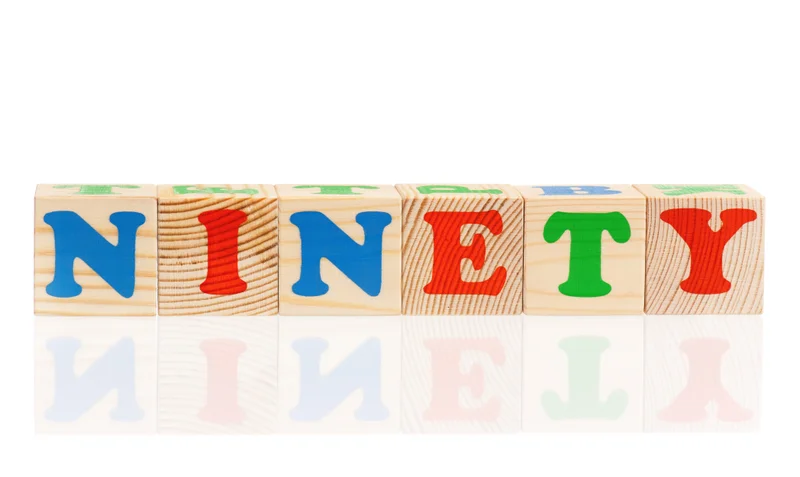
Numbers like 90, 50, 40, and 80 are easy to say out loud. But when we write them down, the spelling often doesn't match what we'd expect from the number we know.
Today, our Mathnasium tutors explain why these number spellings trip us up, provide the correct spellings, and share a few memory tricks so we never second-guess them again.

Correct Spellings and Memory Clues for 90, 80, 50, and Other Tricky Numbers
Use this table to check the correct spelling, spot the common mix-up, and remember the clue that makes each word easier to write.
|
Number
|
Correct Spelling
|
Common Misspelling
|
Memory Aid
|
|
90
|
ninety ✅
|
ninty ❌
|
Don't cut the line, keep the whole ninE!
|
|
19
|
nineteen ✅
|
ninteen ❌
|
|
80
|
eighty ✅
|
eightty, eigthy ❌
|
Eight shares its T when -TY or -TEEN comes through,
One T is enough, there is no need for two!
|
|
18
|
eighteen ✅
|
eightteen ❌
|
| 40 |
forty ✅
|
fourty ❌
|
Forty took a U-turn and lost its U,
So write F-O-R-T-Y, the spelling that’s true!
|
|
50
|
fifty ✅
|
fivety ❌
|
Five swaps its VE for an F, it's true,
There are two Fs in fifteen, and in fifty too!
|
|
15
|
fifteen ✅
|
fiveteen ❌
|
|
30
|
thirty ✅
|
thirdy, threety ❌
|
Three trades its REE for an I and an R,
THIR plus -TY, and thirty's not far!
THIR plus -TEEN, and you spell like a star!
|
|
13
|
thirteen ✅
|
threeteen ❌
|
Why do these numbers cause so many spelling mix-ups? Let’s look at what happens in each word.
📕 You May Also Like: How to Spell Numbers from 1 to 100 (+ Mistakes to Avoid)
What Makes 90, 80, 50, and Others Tricky to Spell
Some tens words follow a pattern we can hear clearly. Six becomes sixty, and seven becomes seventy. The starting number, six or seven, is clear, and we just add the “-ty.”
Other tens words change shape before “-ty” is added. That is where the spelling can get confusing. Four becomes forty, five becomes fifty, eight becomes eighty, and three becomes thirty.
Then we have 90. This one looks like it might change too, but it actually keeps the “e” from nine. That is why “ninty” is such a common mistake. We may expect the “e” to disappear, but in ninety, it stays.
Each of the other four tens words follows its own twist:
-
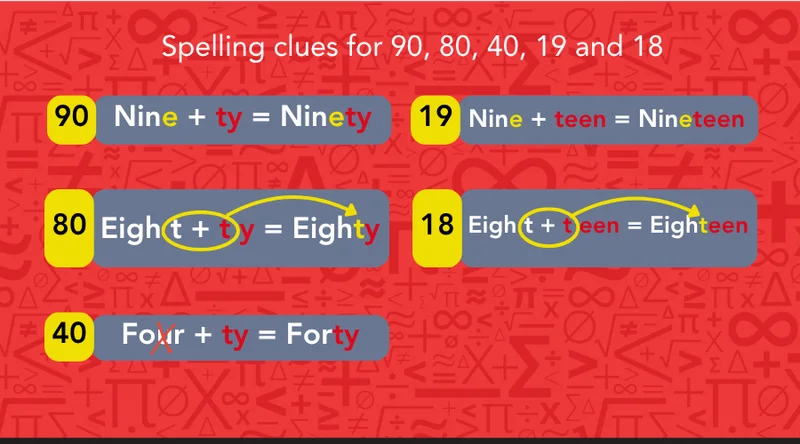
80: Eight already ends in "t". When we add "y", that same "t" becomes the "t" in eighty, so the word only needs one letter "t".
-
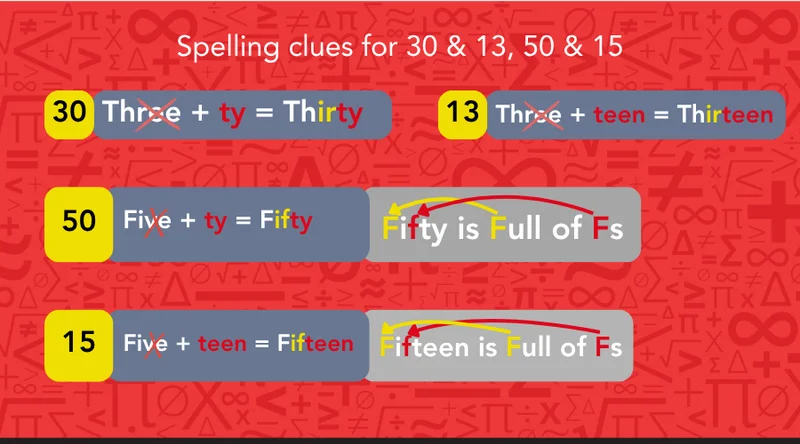
50: Before we add “-ty” to write fifty, we need to change the word “five” a bit: the "v" becomes "f", and the silent "e" drops away. That gives us "fif-", which turns into fifty when "-ty" is added.
-
40: Four has a "u" right in the middle, so "fourty" can look reasonable at first. But the correct spelling is "forty." The word keeps the sound of four, drops the "u," and then adds "-ty."
-
30: Thirty follows a pattern similar to fifty. The word three changes shape before we add "-ty": three becomes "thir-", then "-ty" gives us "thirty."
We’ll see two of these spelling shifts again in the teen numbers, so keep “fif-” and “thir-” in mind as we look at the numbers 11-19 next.
📕 You May Also Like: 8 Fun Math Games That Build Real Skills for Elementary Kids
How to Spell Numbers from 11 to 19
The numbers 11 through 19 follow their own pattern, separate from tens words. We need to add “-teen” to the base number, for example six + teen gives us sixteen or seven + teen gives us seventeen.
But 13 and 15 change shape first, just like 30 and 50 do:
-
Three becomes “thir-,” then we add “-teen” to get thirteen.
-
Five becomes “fif-,” then we add “-teen” to get fifteen.
That is why thirteen and fifteen can be harder to spell. Their base words change before the ending is added.
To spell 18 and 19, we can use the same clues that helped us with 80 and 90:
-
Eighteen works like eighty. “Eight” already ends with “t” and “teen” starts with “t,” so we only write one “t”: “eighteen,” not “eightteen.”
-
Nineteen works like ninety. The silent “e” in “nine” does not drop or merge. It stays in the word, so we write “nineteen,” not “ninteen.”
Eleven and twelve work differently. They do not follow an obvious pattern, so we usually learn them as special spellings to remember.
📕 You May Also Like: Common Place Value Misconceptions in Elementary Math
A Picture Clue for Spelling Tricky Numbers
To make the spelling patterns for tricky numbers easier to spot, let’s look at the spelling changes side by side. Here's a quick visual breakdown of 90, 80, 40, 19, and 18:
See how the swaps behind 30 and 13, and 50 and 15, play out below, plus a shortcut to help 50 and 15 stick.
📕 You May Also Like: How to Teach Math to Visual Learners
Put Your Number Spelling into Practice!
Now it's your turn to spot and fix a few tricky spellings. You can check your answers at the bottom of the page.
-
Circle the correctly spelled number: forty / fourty
-
Circle the correctly spelled number: ninty / ninety
-
Write the number word for 68.
-
Write the number word for 84.
-
Spot the mistake: “I have fivety-two dollars.”
FAQ About Spelling Numbers
Here are some of the most common questions students ask us at Mathnasium of Beach Blvd about spelling numbers.
1. Do two-digit numbers need a hyphen?
Yes. Any compound number from 21 to 99 that isn't a round number, meaning it has both a tens word and a ones word, needs a hyphen between them. That's why “one hundred forty-two” has a hyphen between “forty” and “two,” but a round number like “one hundred forty” doesn't need one anywhere.
2. What's the difference between “-teen” and “-ty” endings?
They sound similar, but they mean a completely different relationship to ten:
-
“-Teen” numbers (like thirteen or fifteen) mean “ten more than,” so thirteen is 3 + 10.
-
“-Ty” numbers (like thirty or fifty) mean “groups of ten,” so fifty is 5 × 10.

At Mathnasium, students learn to approach new math concepts with curiosity, confidence, and a deeper understanding of how ideas connect.
How Mathnasium Helps Students Build Confidence With Any Math Concept
Mathnasium is a math-only learning center empowering students of all skill levels to excel in math.
To help students build a deep understanding of any math concept, we use a proprietary teaching approach called the Mathnasium Method™.
Here’s how it works.
Each student begins with a diagnostic assessment. This relaxed interaction helps us understand what they know, how they think, and where they are ready to grow next. From there, we create a personalized learning plan focused on the skills the student needs most.
Our specially trained tutors explain math in clear, everyday language, using visual, verbal, tactile, and written techniques to help students make sense of numbers in a clear and engaging way. Many of our activities are hands-on or game-based, especially for our younger learners, who pick up patterns best through play rather than repetition. Tutors might turn a tricky spelling into a quick game or a silly rhyme, using reward systems and consistent encouragement to keep students engaged and having fun.
The impact is clear in the results:
-
94% of parents report an improvement in their child's math skills and understanding
-
93% of parents report their child's improved attitude toward math after attending Mathnasium
-
90% of students saw an improvement in their school grades
With over 1,100 learning centers across North America, there is likely a Mathnasium close to you
For PreK-12 students in and near Jacksonville, FL, Mathnasium of Beach Blvd offers hands-on support with number sense and any other math topic standing in the way of math confidence.
Whether your child is looking to catch up, keep up, or get ahead in math, we can support them. Schedule a free diagnostic assessment, and we'll use it to understand exactly where they are and build a personalized plan from there.
📅 Schedule a Free Assessment at Mathnasium of Beach Blvd
Not near Beach Blvd?
📍 Find a Mathnasium Learning Center Near You
Pssst! Check Your Answers Here
Ready to see how you did? Here are the answers to the practice problems above.
-
Forty is the correct spelling.
-
Ninety is the correct spelling.
-
68 is written as sixty-eight.
-
84 is written as eighty-four.
-
The mistake is “fivety-two.” The correct spelling is “fifty-two.”


 (904) 619-1048