More often than expected, we see the wrong answer on a PEMDAS problem even after the concept seems clear to students. The mnemonic is easy to learn. The rules behind it require a little more effort.
Mathnasium tutors developed this guide, covering what each part of PEMDAS means, where errors tend to creep in, and how to fix them.

What Does PEMDAS Stand For?
PEMDAS is a mnemonic that tells us the correct order to solve operations in a multi-step math problem. Each letter stands for a different operation, and before we can use the rule correctly, we need to know exactly what each one means.
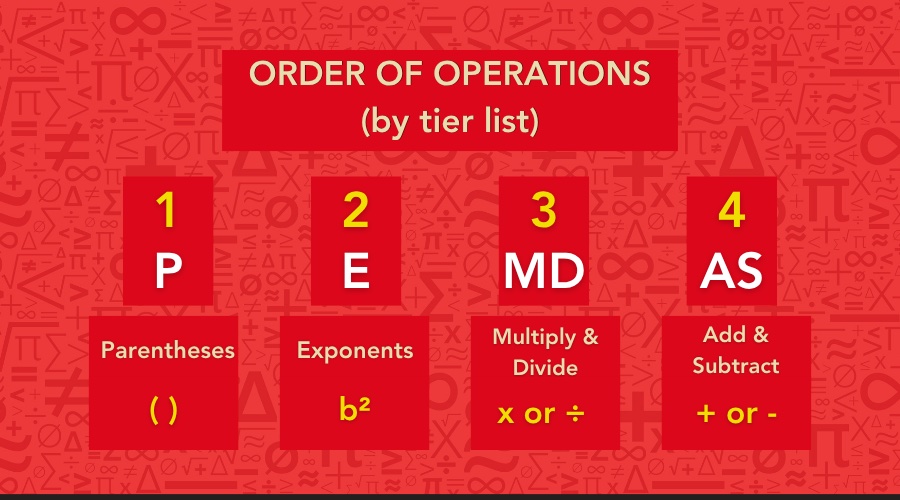
1. P: Parentheses
We always solve what is inside parentheses first, no matter what else is in the problem. Why? Because they are the highest authority in a math problem. They define which numbers belong together before the rest of the operations take place.
2. E: Exponents
Next, we handle any exponents. Exponents come after parentheses but before multiplication because they represent repeated multiplication, which is a more compressed, higher-level operation than a single multiply or add. So 5² means 5 × 5 = 25, not 5 × 2 = 10. That's a common mix-up, so keep it in mind.
3. M and D: Multiplication and Division
Multiplication and division come before addition and subtraction because they do more to a number. Multiplying or dividing changes a quantity far more than adding or subtracting one unit at a time.
And unlike exponents, multiplication and division share equal priority, so the M coming before the D in the acronym doesn't mean multiplication goes first. This is one of the most common PEMDAS mistakes we see.
We work through them together, moving left to right across the problem. Whichever one we meet first, we solve first.
4. A and S: Addition and Subtraction
Addition and subtraction come last because they make the smallest change to a number; we're simply combining or taking away one amount at a time.
Like multiplication and division, they share equal priority, so we solve them left to right, not in the order the letters appear in the acronym.
Students who miss this often get the right operations but the wrong answer.
📕 You May Also Like: What Is an Exponent? A Complete, Beginner-Friendly Guide
The Most Common PEMDAS Mistakes and How To Fix Them
These are the patterns we see most regularly in our sessions.
1. The Acronym Isn’t a Strict Sequence
Many assume multiplication comes before division, and addition comes before subtraction, simply because of the letter order.
We work through examples together until the left-to-right rule clicks. When we see a multi-step problem worked through in one pass without written steps, errors follow.
A common error looks like this:
Problem: 12 ÷ 4 × 3
If we go by letter order and multiply first, we’ll get the wrong answer, like so:
4 × 3 = 12 → 12 ÷ 12 = 1
The correct process in this case is: 12 ÷ 4 = 3 → 3 × 3 = 9
2. PEMDAS Inside Parentheses
Parentheses often get ignored the moment they are identified. We walk back through the problem together: the order of operations still applies inside the brackets, and every operation inside needs to be resolved in the correct order before moving outward.
Take this problem: 3 × (2 + 4 × 5)
Addition before multiplication inside the parentheses gives the wrong answer, like here:
2 + 4 = 6 → 6 × 5 = 30 → 3 × 30 = 90
The process we need to follow is: 4 × 5 = 20 → 2 + 20 = 22 → 3 × 22 = 66
3. The One-Pass Mistake
When we solve a multi-step problem in one pass without writing down each step, it's easy to apply operations out of order without realizing it.
Let's look at this example: 5 + 3² × 2 − 4
The mistake we usually see is skipping steps and solving left to right, like so:
5 + 3² = 8 → 8 × 2 = 16 → 16 − 4 = 12
Here, the student added 5 and 3² before handling the exponent, then multiplied, all in one pass, out of order.
What we recommend is one operation per line:
-
3² = 9 → rewrite: 5 + 9 × 2 − 4
-
9 × 2 = 18 → rewrite: 5 + 18 − 4
-
5 + 18 = 23 → rewrite: 23 − 4
-
Our answer is 19.
Writing each step on a new line makes it easy to see exactly where the order was followed, and where it wasn't.
📕 You May Also Like: How to Use Math Anchor Charts to Support Learning at Home
How to Work Through a PEMDAS Problem Without Making Mistakes
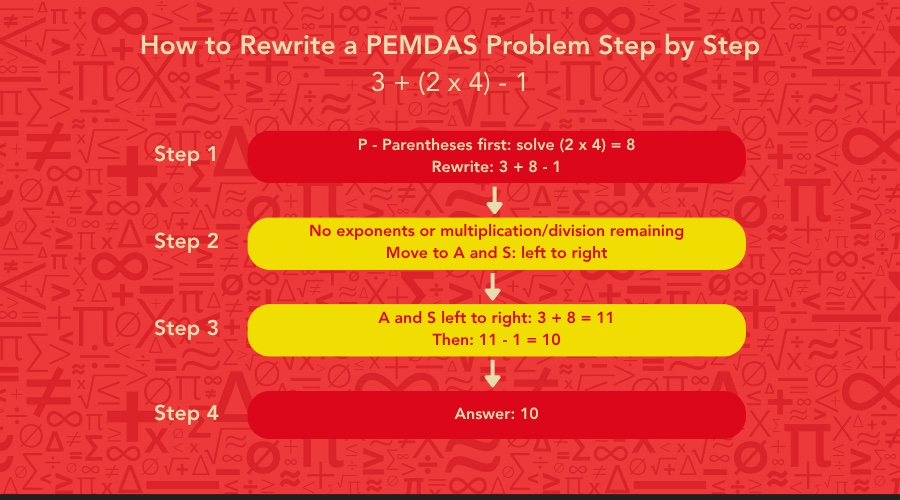
The most reliable way to avoid errors on a multi-step problem is to rewrite it at each step, and solve one operation at a time on a new line. This helps us prevent skipped steps and wrong answers.
Here is how our tutors walk through it:
-
Read the whole problem first. Before touching anything, we identify every operation present.
-
Label each operation. We note what is there: parentheses, exponents, multiplication, division, addition, subtraction.
-
Rewrite the problem step by step. Each operation gets its own line and we never combine steps.
-
Never skip a step. Problems that are worked through in one pass usually have the wrong answer.
Once it becomes a habit, it takes far less effort than going back to fix mistakes.
📕 You May Also Like: How to Break Down Any Math Problem Into Steps
Solved PEMDAS Examples
Let’s work through three PEMDAS examples that put the method into practice. Each one is solved line by line, and we will follow the same rewrite approach we covered above.
Example 1: Basic Order
Problem: 2 + (3 × 4) − 5
Step 1: Solve inside the parentheses first.
3 × 4 = 12
Rewrite: 2 + 12 − 5
Step 2: A and S (work left to right).
2 + 12 = 14
14 − 5 = 9
Answer: 9
Example 2: The Left-to-Right Rule in Action
Problem: 12 ÷ 4 × 3
There are no parentheses or exponents here, so we move straight to M and D, and work left to right.
Step 1: M and D.
12 ÷ 4 = 3
3 × 3 = 9
Answer: 9
Frequently Asked Questions About PEMDAS
Our tutors have prepared a list of questions we hear most often from parents and students working through order of operations for the first time.
1. My child's teacher uses GEMS instead of PEMDAS. Is that different?
GEMS stands for Grouping symbols, Exponents, Multiplication/Division, and Subtraction/Addition. The mathematical rule behind it is identical to PEMDAS, just presented through a newer acronym.
The difference in the name is intentional: GEMS reminds us that parentheses are not the only grouping symbols, and that multiplication/division and addition/subtraction each share equal priority.
2. How can I test if my child understands the left-to-right rule?
A classic problem like 6 ÷ 2(1 + 2) is a reliable way to check. We need to solve the parentheses first to get 6 ÷ 2 × 3, then work left to right: 6 ÷ 2 = 3, then 3 × 3 = 9. An answer of 1 means the left-to-right rule has not fully clicked yet.
3. Is PEMDAS the only way to remember the order of operations?
BODMAS and BIDMAS are common alternatives used in the UK and other countries. The order of operations itself is universal; the acronym is simply a memory tool, and different regions have developed their own versions of it.

Our tutors help students look past the letters of PEMDAS to truly understand the logic, order, and priority behind every mathematical operation.
How Mathnasium Helps Students Master the Order of Operations (And Any Math Topic)
Mathnasium is a math-only learning center where students of all skill levels build the confidence and knowledge they need to succeed in math.
Whether students need help rebuilding foundational arithmetic skills, mastering specific topics like order of operations, or looking for a challenge above their curriculum, we offer a personalized path forward tailored to their specific needs.
That personalized path is powered by the Mathnasium Method™, our proprietary teaching approach.
Our approach begins with a diagnostic assessment. It is a relaxed interaction with your students that gives us a precise picture of their current skills as well as knowledge gaps. Using these insights, we create a personalized learning plan to put them on the best path to math mastery.
From there, our specially trained tutors deliver face-to-face instruction built around each student's specific plan. Sessions are structured, supportive, and paced to match how each student learns.
We use natural language to phrase concepts and draw on a mix of verbal, visual, mental, tactile, and written techniques so students truly understand the math they’re learning.
If a concept is challenging, we break it down into manageable steps and teach both the how and why behind it. In time, students gain their own problem-solving skills and critical thinking tools to use in math and beyond.
At Mathnasium, we make sure that learning is enjoyable. Game-based activities and a reward system keep sessions engaging, and we mark every step forward, because momentum in math builds on itself.
The results families see are measurable:
-
94% of parents report an improvement in their child's math skills and understanding
-
93% of parents report an improved attitude toward math after attending Mathnasium
-
90% of students saw an improvement in their school grades
With over 1,100 learning centers across North America, Mathnasium brings our proven approach close to you.
For families in and around Beach Blvd, FL, Mathnasium of Beach Blvd is a local center where students get the focused, personalized support they need to move forward in math with confidence.
Whether your child needs to catch up, keep up, or get ahead, our team is ready to help.
📅 Schedule a Free Diagnostic Assessment at Mathnasium of Beach Blvd
Not near Beach Blvd?
📍 Find a Mathnasium Learning Center Near You


 (904) 619-1048