Your student typically gets fluent with fractions and decimals in 5th grade. Then, 6th grade is where percents join the picture. This is also when the curriculum moves to converting between these forms. As students tell us, this is where they often stumble, especially if they're called on in front of the class, or even worse, working under the time pressure of a test.
That’s why today, our tutors are walking through how percents, decimals, and fractions convert into one another. By the end, we’ll show how to switch between them using the conversion triangle.

What Are Fractions, Decimals, and Percents
Each of these three forms expresses a value in a different way. Here is what each one means:
-
Fractions: a part of a whole expressed as a numerator over a denominator. If 3 pizza slices out of 8 are eaten, that is \(\Large\frac{3}{8}\) of the pizza.
-
Decimals: a part of a whole written using place value. If we are participating in a race and complete 0.75 of it, we’ve covered three quarters of the distance.
-
Percents: a part of a whole calculated out of 100. A 25% discount means we save $25 on every $100 spent.
All three forms can describe the same value. The conversion triangle shows how to move between them.

Where We See Fractions, Decimals, and Percents in Real Life
These three forms show up constantly outside the classroom, often without being labeled as math. Relatable examples help us see why fluency matters in everyday life.
-
Basketball & Sports Stats: If a player hits 3 out of 4 free throws, they made \(\Large\frac{3}{4}\) of their shots. Their official stat line shows that fraction as a decimal (0.75) or as a shooting accuracy rate of 75%.
-
Money and savings. A savings account earning 2.5% interest states the return rate as a percent. We need to convert that value to a decimal before we can calculate earnings over time.
-
Maps and scale. A map key might show that \(\Large\frac{1}{4}\) inch represents one mile. Converting that to a decimal makes route planning much simpler.
-
Weather and probability. A weather forecast showing a 0.3 probability of rain uses a decimal. If we convert that to 30% it’ll be easier to compare with the forecast in other cities.
How to Convert Between Percents, Decimals, and Fractions
Each of the three forms connects to the other two through a direct conversion path. We’ll map out all six paths below.
Starting from a Fraction
When we start with a fraction, we're working with two numbers: the top number (numerator) divided by the bottom number (denominator).
Path 1: Fraction to Decimal
When we convert a fraction to a decimal, all we need to do is divide the numerator by the denominator.
Say we want to convert \(\Large\frac{3}{4}\) to a decimal.
We simply divide: 3 ÷ 4 = 0.75
So there we have it, \(\Large\frac{3}{4}\) is 0.75. Easy as that.
Path 2: Converting a Fraction to a Percent
If we want to convert a fraction to a percent, we need to:
-
Convert to a decimal first
-
Then multiply by 100
Let’s check if this works and convert \(\Large\frac{2}{5}\) to a percent.
So, remembering the steps, we:
-
Convert to a decimal by dividing 2 by 5: 2 ÷ 5 = 0.4
-
Now, we multiply what we got by 100: 0.4 × 100 = 40
So, our result is 40%.
📕 You May Also Like: How to Turn a Fraction Into a Percent: A Kid Friendly Guide
Starting from a Decimal
Decimals use place value, which makes both conversion paths pretty straightforward.
Path 1: Decimal to Percent
To convert a decimal to a percent, we just need to multiply it by 100 (or move the decimal point two places to the right) and add the percent sign.
Let’s try it together and convert 0.35 to a percent.
Multiply the decimal by 100: 0.35 × 100 = 35
That’s our result: 35%. Easy, right?
Path 2: Decimal to Fraction
When we need to convert a decimal to a fraction, we follow two steps:
-
Place the decimal digits over the correct place value denominator (10, 100, 1000)
-
If possible, simplify the fraction
Now let’s follow these exact steps and convert 0.6 to a fraction:
-
We only have one decimal digit, so we need to place it over 10: \(\Large\frac{6}{10}\)
-
Both numbers can be divided by 2: \(\Large\frac{6÷2}{10÷2}\). Our simplified fraction is \(\Large\frac{3}{5}\)
So, our final result is \(\Large\frac{3}{5}\).
Starting from a Percent
A percent is already telling us a value out of 100, which is the key to both conversion paths.
Path 1: Percent to Decimal
We can complete this conversion pretty easily, we just need to divide the percent by 100 or move the decimal point two places to the left.
To see this in action, we’ll convert 45% to a decimal.
We just divide 45 by 100: 45 ÷ 100 = 0.45.
And that’s our decimal, 0.45.
Path 2: Percent to Fraction
If we want to rewrite a percent as a fraction, we follow two steps:
-
Place the percent number over 100. The percent acts as our fraction’s numerator, and 100 is the denominator
-
Check if we can simplify the fraction further
Following these steps, we’ll convert 80% to a fraction.
-
Write 80 over 100: \(\Large\frac{80}{100}\)
-
Divide both the numerator and the denominator by 20 to get \(\Large\frac{4}{5}\)
Because we can’t simplify the fraction any further, \(\Large\frac{4}{5}\) is our result.
📕 You May Also Like: How to Move the Decimal Point: A Place-Value Explanation
How the Conversion Triangle Connects These Three Forms
Now that we’ve walked through all six conversion paths, here’s an easy way to see them together at once.
The conversion triangle is a visual tool that maps how percents, decimals, and fractions connect to one another.
Each corner of the triangle holds one of the three forms, and each side shows the operation needed to move between the two connected corners.
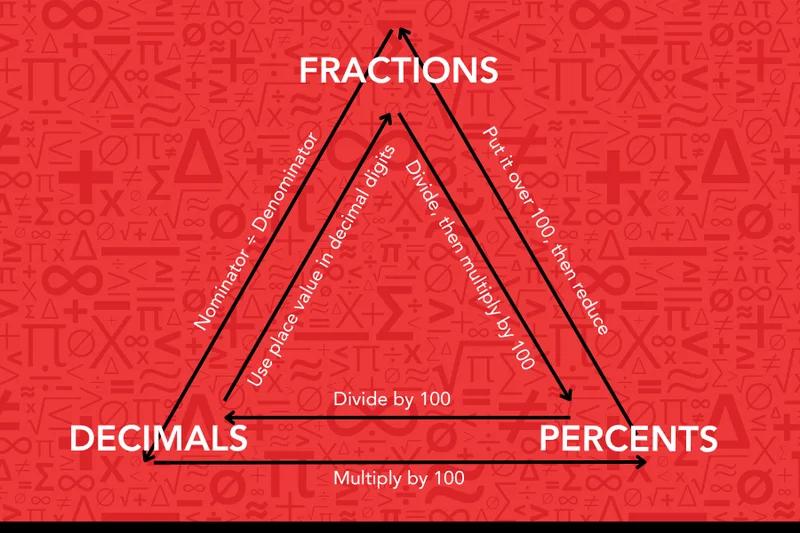
Once we truly understand the conversion triangle and can see it in our mind, we can move through problems easily.
Where Students Most Commonly Get Stuck With Conversion Problems
These are the patterns we see most often when students work through conversion problems.
1. Forgetting to simplify
Many students write the fraction correctly but stop before simplifying. \(\Large\frac{80}{100}\) is not wrong, but \(\Large\frac{4}{5}\) is the complete answer. We remind students to always check whether the numerator and denominator share a common factor before moving on.
📕 You May Also Like: How to Reduce Fractions: A Kid-Friendly Guide
2. Multiplying instead of dividing when converting a percent to a decimal
The operation flips depending on which direction you’re converting, and that catches students off guard. When we convert a percent to a decimal, we divide by 100, which gives us a value that represents a whole unit, not hundreds. On the other hand, when we convert a decimal to a percent, we multiply by 100 instead, which shows how many parts exist out of 100.
3. Treating repeating decimals as errors
When students divide 1 by 3 and get 0.333..., many assume they have made a mistake. We reassure them that repeating decimals are valid results and that \(\Large\frac{1}{3}\) and \(\Large\frac{2}{3}\) are the most common ones they will encounter at this level.
We explain that 10 can’t divide evenly into 3 equal whole parts, and the infinite 3s show us that the fraction lives between standard decimal place values. In those cases, we can simply round the decimal.
📕 You May Also Like: How to Round Decimals: Nearest Tenth, Hundredth, and Thousandth
4. Choosing the wrong denominator for a decimal to fraction conversion
If we are converting 0.25 and write it as \(\Large\frac{25}{10}\) instead of \(\Large\frac{25}{100}\), we will get the wrong simplified fraction. The denominator depends on the number of decimal places, and checking that first prevents the error. Two decimal places mean hundredths (\(\Large\frac{25}{100}\)), while one decimal place means tenths (\(\Large\frac{25}{10}\)).

Mathnasium tutors use personalized learning plans and proven teaching techniques to help students master any math concept.
How Mathnasium Helps Students Master Any Math Concept
Mathnasium is a math-only learning center with over 1,100 locations across North America, helping K-12 students catch up, keep up, and get ahead in math.
Whether students are looking to rebuild foundational knowledge of fractions, decimals, and percents, improve their fluency, or take on challenges above their school level, we can support them.
At Mathnasium, we personalize each student’s learning experience. We do that through the Mathnasium Method™, our proprietary teaching approach designed around each student’s individual needs and learning style.
Our approach includes:
-
Assessment and Personalized Learning Plans: Each student begins their Mathnasium journey with a diagnostic assessment that helps us figure out their current skills, strengths, and knowledge gaps. We use that information to build a personalized learning plan that follows their goals, whether they are looking to close foundational gaps, better understand their current curriculum, or move to more advanced coursework.
-
Teaching for Understanding: Our specially trained tutors use natural language and a mix of verbal, visual, mental, tactile, and written techniques, and always make sure each concept lands before we move forward.
-
Problem-Solving and Critical Thinking: We give students time to work through problems independently. When we do step in, we explain both the how and the why behind each answer. This helps students build problem-solving and critical thinking skills that come in handy in math, and beyond.
-
An Engaging and Fun Learning Environment: All our sessions include games and earned rewards. We constantly celebrate progress so students can build confidence alongside fluency.
Parents consistently report meaningful progress:
-
94% of parents report an improvement in their child's math skills and understanding
-
93% of parents report their child's improved attitude toward math after attending Mathnasium
-
90% of students saw an improvement in their school grades
For families in Cape Coral and the surrounding Southwest Florida area, Mathnasium of Cape Coral brings that same approach to the local community. Our tutors work with students at every level, whether they are building fluency with fractions for the first time, preparing for a test, or working ahead of their grade level. We meet each student where they are and build from there.
📅 Schedule a Free Assessment at Mathnasium of Cape Coral
Not near Cape Coral?
📍 Find a Mathnasium Learning Center Near You


 (239) 540-6284