Perfect squares show up in math class long before most students realize how useful they actually are.
They meet them first as simple multiplication facts. Then, once algebra enters the picture, those same familiar numbers resurface in a new form, helping students solve square roots, expand binomials, and factor trinomials.
The moment students learn to recognize perfect squares on sight, a lot of algebra gets easier. At Mathnasium of Cherry Hills, we like to introduce this concept early and keep building on it as coursework gets more advanced.
Today, our seasoned Mathnasium tutors explain what perfect squares are and give you 3 ways to use perfect squares in algebra, from solving square roots to binomials and trinomials.

What Is a Perfect Square?
A perfect square is a term multiplied by itself. Some examples of perfect squares are:
-
5²
-
x²
-
a²b²
-
(xy)²
-
(x+1)²
Let's break down what each one means:
-
5² means 5 times 5 or ‘’5 squared’’. It equals 25, and makes 25 a perfect square.
-
x² means x times x or ‘’x squared’’.
-
a²b² means (ab)(ab), which equals a × a × b × b or a2b2.
-
(xy)² means (xy)(xy), the entire quantity xy multiplied by itself.
-
(x+1)² means (x+1)(x+1), the entire expression multiplied by itself.
Notice that perfect squares aren't limited just to plain numbers. Single variables, combinations of variables, or entire expressions in parentheses can all be perfect squares, as long as they are multiplied by themselves.
The moment students can spot this pattern, they can put it to work in a few different ways:
-
Recognizing a perfect square makes square roots easier to simplify.
-
Recognizing a perfect square helps us expand a squared binomial without multiplying it out term by term.
-
Recognizing a perfect square helps us work backward from a trinomial to figure out the binomial it came from.
📕 You May Also Like: What Does “Squared” Mean in Math? Explain It to a 10-Year-Old
1. How Recognizing Perfect Squares Helps Solve Square Roots
Perfect squares help us solve square roots in two ways. Sometimes they make a square root instantly simple, like \(\sqrt{25}\). Other times, they help us break a harder-looking number, like \(\sqrt{50}\), into simpler pieces so we can still use a perfect square.
The approach is very simple. We look at a square root and first ask, "Is this already a perfect square?" Then:
-
If it is, we know the answer right away.
-
If it isn't, we look for a perfect square hiding inside.
Example 1: A Simple Square Root
Let’s start with \(\sqrt{25}\). Just by looking at the number 25, we know it is a perfect square because 5 × 5= 25. That means the square root of 25 is just 5.
By recognizing the perfect square, we solved the square root of 25 in a single step.
Example 2: A Square Root That Needs Splitting
Now let’s look at \(\sqrt{50}\). 50 is not a perfect square, but we can still use perfect squares to help. The steps are:
Step 1: Split
First, we split 50 into two numbers, where one is a perfect square. Let’s go through perfect squares one by one (like 4, 9, 16, 25, or 36) and ask ourselves:
-
Does 4 go into 50 evenly? No.
-
Does 9 go into 50 evenly? No.
-
Does 16 go into 50 evenly? No.
-
Does 25 go into 50 evenly? Yes! 25 × 2 = 50
So, our number is 25, and to get to 50, we need to multiply it by 2.
Step 2: Rewrite
Then, we rewrite the square root using that split.
\(\sqrt{50}\) = \(\sqrt{25 × 2}\)
Step 3: Move the Square Root Out of the Square Root
Next, we take the square root (5) of the perfect square (25) and place it outside of the square root. \(\sqrt{50}\) = \(\sqrt{25 × 2}\) while keeping 2 inside.
Step 4: Keep the Non-Square Root Inside the Square Root
We keep the other part (2) outside the square root. The multiplication is still there. It’s just between 5 and \(\sqrt{2}\).
Now, we are dealing with:
\(\sqrt{50}\) = 5\(\sqrt{2}\)
Even though 50 is not a perfect square, spotting 25 inside it lets us turn \(\sqrt{50}\) into a much simpler expression \(\sqrt{50}\) = 5\(\sqrt{2}\).
2. Expanding Perfect-Square Binomials
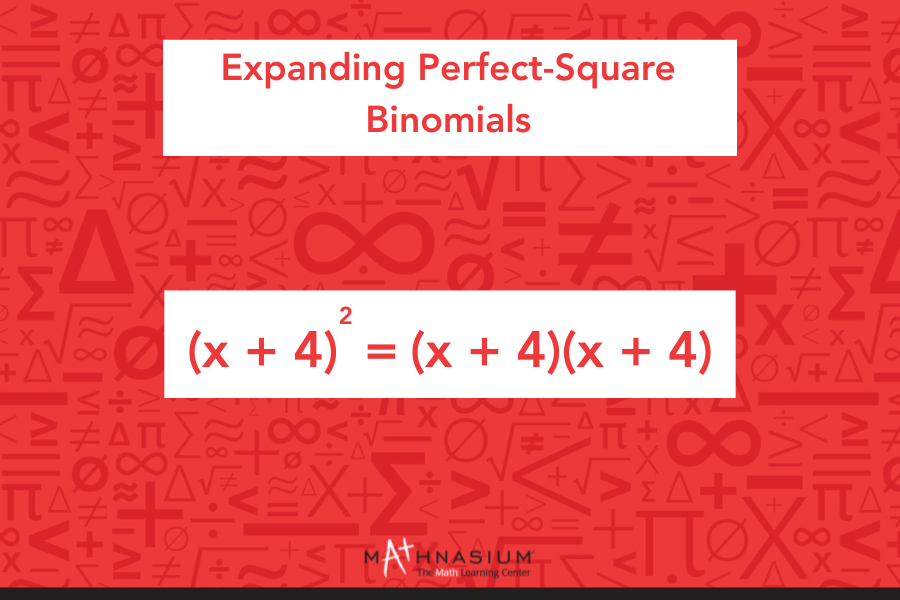
In case you’ve forgotten, a perfect-square binomial is a binomial that is squared, like (x + 4)².
Before we start expanding, we recognize that (x + 4)² is just (x + 4) multiplied by itself. Let’s look at the entire process step by step.
Step 1: Write the Binomial Multiplied by Itself
(x + 4)²=(x + 4)(x + 4)
Step 2: Multiply Every Binomial Term
Then, we multiply every term in the first binomial (x + 4) by every term in the second (x + 4).
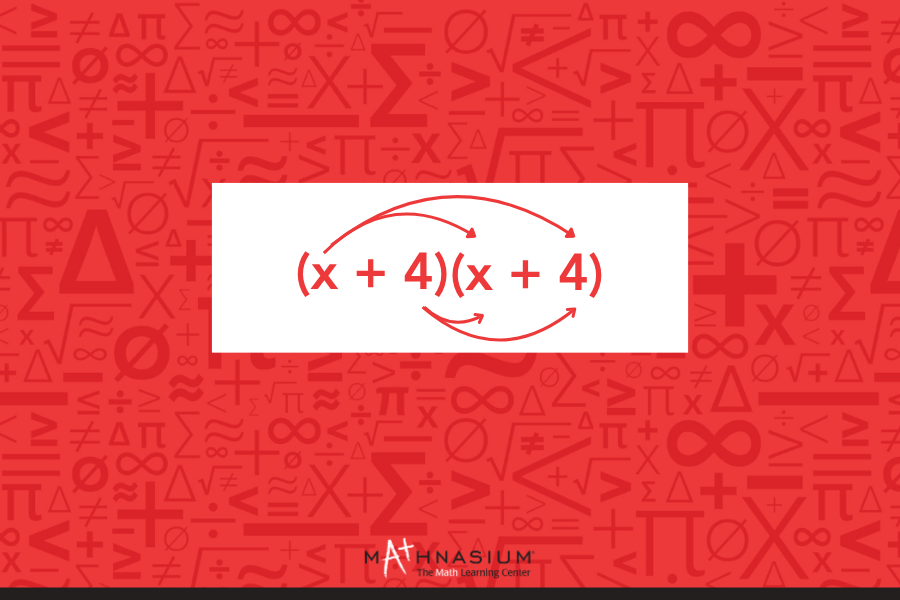
By multiplying, we now have:
(x + 4)(x + 4) = x² + 4x + 4x + 16
This is the same process some students know as the FOIL method (First, Outer, Inner, Last):
-
First: 𝑥 × 𝑥 = x2
-
Outer: 𝑥 × 4 = 4𝑥
-
Inner: 𝑥 × 4 = 4𝑥
-
Last: 4 × 4 = 16
Step 3: Group Like Terms
After multiplying, we have four terms:
(x + 4)(x + 4) = x² + 4x + 4x + 16
Now, we check if we have any like terms. The only like terms are 4x and 4x, so we add them to get 8x, and we're finally left with:
4x + 4x = 8x
By replacing those two middle terms with 8x, we get our final expanded expression:
(x + 4)² = x² + 8x + 16
As a result of expanding a perfect square binomial, we always get a three-term expression (perfect-square trinomial) with the exact same structure.
-
First term: The square of the first term (x times x equals x²)
-
Last term: The square of the second term (4 times 4 equals 16)
-
Middle term: Double the product of the two terms (2 times x times 4 equals 8x)
📕 You May Also Like: What Is the FOIL Method in Math? A Kid-Friendly Guide
3. Factoring Perfect-Square Trinomials (Going Backward)
To factor perfect-square trinomials like x² + 6x + 9, we work backward and find the binomial we squared to create it.
Three features help us confirm a trinomial came from squaring a binomial:
-
The first term should be a square.
-
The last term should also be a square.
-
The middle term should be twice the product of the square roots of the first and last terms.
If all three parts match, we can rewrite the trinomial as a squared binomial. Let’s factor x² + 6x + 9 and see what binomial is hiding.
Step 1: Check the First and Last Term
The first term, x², comes from x times x. The last term, 9, comes from 3 times 3. That gives us x and 3 as the two square roots we'll work with.
Step 2: Check the middle term
First, we multiply x by 3, which gives us 3x. Then, we double that product, which gives us 6x. That matches the middle term in the original expression.
Step 3: Rewrite as a binomial squared
Since all three parts match, we can rewrite the trinomial as a binomial squared:
x² + 6x + 9 = (x + 3)²
This time, we moved in the opposite direction. We started with the trinomial and traced it back to the binomial that created it.
 Mathnasium tutors use personalized learning plans and proven teaching techniques to help students learn and master algebra.
How Mathnasium Helps Students Master Algebra (And Any Other Math Concept)
Mathnasium is a math-only learning center dedicated to helping K-12 students of all skill levels learn and master math.
From strengthening foundational skills and mastering daily algebra topics to taking on advanced problem-solving, we customize our support to meet your student right where they are.
Instead of relying on a one-size-fits-all program for algebra, we use a proprietary teaching approach called the Mathnasium Method™, designed around individual students' needs and learning styles.
Each student begins their Mathnasium journey with a diagnostic assessment that helps us identify their current skill level, learning goals, and learning style.
From there, we build a personalized learning plan tailored to their needs and pace.
Our specially trained tutors use natural language and a combination of verbal, visual, mental, tactile, and written techniques to help students truly understand the math they are working with.
We show students shortcuts like recognizing and using perfect squares, so algebra feels less like memorizing steps and more like spotting patterns they already know. With that groundwork in place, students build toward real algebra mastery, one concept at a time.
When they’re stuck on a concept, we break it down into manageable parts and show them both the how and the why behind the answer. Gradually, students build their own problem-solving skills and critical thinking tools.
Fun is an important part of how we work. Sessions often include game-based and hands-on activities that keep students engaged, and every bit of progress gets celebrated, so confidence grows alongside mastery.
The results speak for themselves:
-
94% of parents report an improvement in their child's math skills and understanding
-
93% of parents report their child's improved attitude toward math after attending Mathnasium
-
90% of students saw an improvement in their school grades
With a network of more than 1,100 centers, Mathnasium brings top-rated instruction close to your home.
For families located in or near Denver, CO, Mathnasium of Cherry Hills is a trusted local center with years of experience building confident math thinkers.
With over 100 five-star Google reviews, our community recognizes our dedication to students’ success.
Here's what one parent had to share about our center.

Whether your child needs to catch up, keep up, or get ahead in math, we are happy to help.
📅 Schedule a Free Diagnostic Assessment at Mathnasium of Cherry Hills
Not near Cherry Hills?
📍 Find a Mathnasium Learning Center Near You


 (720) 474-1878
 (720) 474-1878