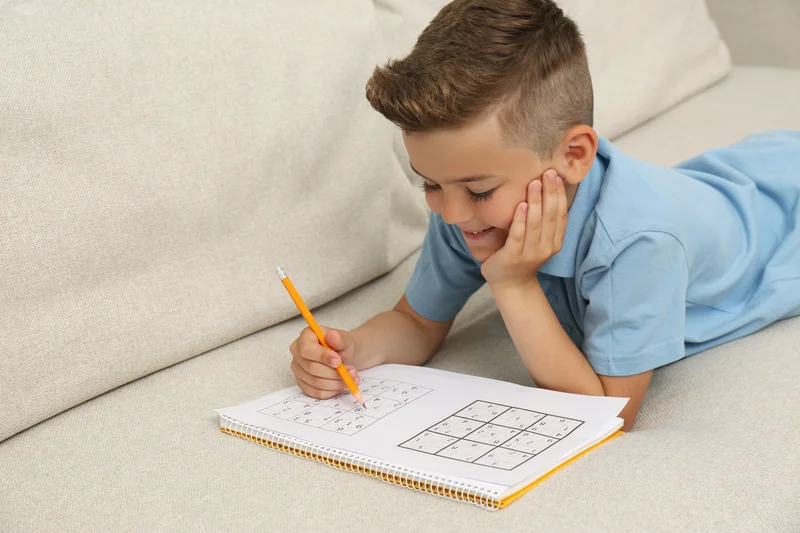
If there is one insight we could share from working with students across grade levels, it is that some of the most effective math practice does not look like math at all. It looks like play.
First graders sort three clues to find a hidden red ball and never think about a math worksheet. Ninth-grade students work through a coin puzzle on a balance scale and build the same systematic reasoning that geometry proofs and algebra problems demand.
Neither group raises a hand nor opens a textbook. Both walk away sharper. Logic puzzles do this kind of work in the background, and they ask almost nothing of parents.
We are Mathnasium of Clear Lake, and today, we’ll show you a set of logic puzzles for students, organized by grade band, so any parent can sit down with their child tonight and start building the mathematical thinking that carries a child through algebra and geometry.
What Is a Logic Puzzle?
Logic puzzles ask your child to find an answer through reasoning alone, without any calculation. Each clue rules something out until one solution remains.
Logic puzzles come in a few common forms:
-
Grid puzzles: your student gets a set of clues and matches people, objects, or traits by testing each option against every rule
-
Sudoku: a grid asks your child to fill in numbers or symbols so that none repeat in a row, column, or block
-
Lateral thinking puzzles: working backward from a strange scenario, the solver questions their first assumption and rebuilds the situation piece by piece
Each type asks your student to think in a different way, and together they cover most of the reasoning each student will use in algebra, geometry, and beyond.
📕 You May Also Like: Algebraic Reasoning: What It Is and How to Develop It
How Logic Puzzles Build Mathematical Thinking
Logic puzzles build mathematical reasoning in kids through four skills that reappear across grade bands and show up again in algebra and geometry.
-
Deductive reasoning: each clue narrows the field, and your young learner practices the same if-this-then-that thinking they'll use to solve for an unknown in an equation
-
Pattern recognition: your student starts to notice how pieces relate to each other, a habit that pays off later when they work with shapes, angles, and spatial relationships in geometry
-
Eliminating possibilities: instead of guessing at an answer, your child rules out what can't be true until only one option remains, which mirrors how they'll narrow down solutions in a system of equations
-
Persistence and error-checking: your student tries an answer, hits a contradiction, and starts again without losing confidence, building the resilience math problems demand at every level
In a 2022 study, Weng Ting-Sheng found that a puzzle-type logical thinking game for sixth graders was associated with improved problem-solving ability and logical thinking.
The puzzles we prepared for you are built on that same principle. They are familiar enough to pick up in minutes, engaging enough to keep your child asking for an additional round.
📕 You May Also Like: How to Nurture Algebraic Thinking in Elementary School
12 Logic Puzzles for Students, Grade by Grade
Each logic puzzle below is easy to pick up, light on prep, and matched to a stage of thinking your child is building at school right now. We organized them by grade band, so you always know which one fits where your student is today.
1. Grades K-2
At this age, your child is just starting to reason through clues instead of guessing. The three puzzles below build that skill through matching, placement, and simple elimination games.
A. Who Has the Red Ball?
Gather three people and one red ball, or just use the written clues on paper. One statement is true, and your child needs to figure out which one by testing each possibility.
-
Person A says, "Person B has the red ball."
-
Person B says, "I do not have the red ball."
-
Person C says, "Person A has the red ball."
Player tests each option in turns. If the first person has the ball, does that match the rule that only one statement is true? If not, they move to the next option.
This is where learners first actually practice with if-this-then-that thinking, the same reasoning they'll use to solve for an unknown the moment they start learning equations.
B. Fill the Shapes
Line up a row of empty shape outlines and hand your child a matching set of shape cards.
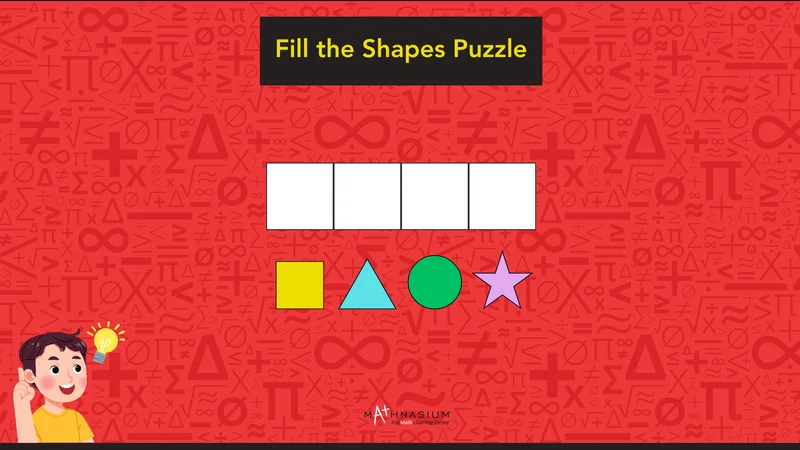
A few simple rules decide where each one goes, like:
By placing each shape, the solver checks it against every rule until the row works.
The payoff shows up later. This early comfort with patterns and placement carries directly into geometry as soon as your student starts working with shapes on a coordinate grid.
C. 4x4 Shape Sudoku
A tiny 4x4 grid asks your child to place symbols like squares, triangles, stars, and circles so none repeat in a row or column.
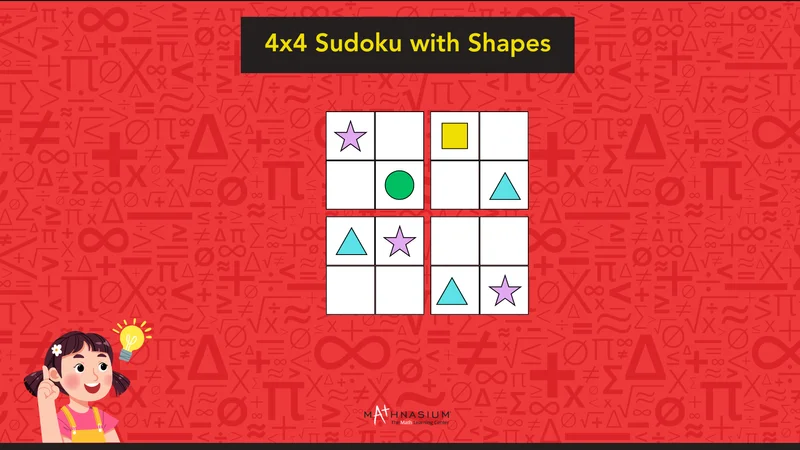
Your child checks what's already placed and rules out anything that creates a repeat.
Systematic elimination like this becomes a habit your student leans on later with multiplication tables and logical proofs.
📕 You May Also Like: Help Your Child Memorize Multiplication Tables in 3 Steps
2. Grades 3-5
Your child starts building longer chains of reasoning at this stage, holding multiple clues in mind at once. The three puzzles below sharpen that skill through ordering, spatial rules, and structured elimination.
A. Seating Order Puzzle
Four family members sit in a row, and a set of clues decides where each one goes. One family member isn't at either end, another sits directly to the right of a third, and a fourth takes the far left seat.
Your child draws four empty spots and places each name by testing it against every clue until one arrangement satisfies them all.
This mirrors algebraic substitution directly. Each clue narrows down possible values, the same way an equation narrows down possible values for an unknown.
B. Color-the-Boxes Grid Puzzle
A 3x3 grid comes with a few rules:
-
No two red boxes can touch side-by-side or top-to-bottom.
-
The center box must be blue.
-
The top row holds exactly two blue boxes.
Your student colors the grid one box at a time, checking each choice against all three rules before moving on.
This builds spatial reasoning and counting under constraints, both of which resurface later in area, perimeter, and any problem involving multiple conditions at once.

Even a few minutes with this puzzle can sharpen your child's spatial reasoning, a skill that carries directly into geometry.
C. Mini Logic Grid (Who Owns Which Pet?)
Three kids, Liam, Mia, and Noah, each own one of three pets: a cat, a fish, or a dog. Your child's job is to figure out who owns what using only these clues:
-
Liam does not have the cat.
-
Mia's pet is not the fish.
-
The dog owner is older than the cat owner, and Noah is the youngest.
To get started, draw a simple grid with the kids' names down the side and the pets across the top. For each pair, write ‘’Yes’’ if it's still possible or ‘’No’’ if a clue rules it out. Apply one clue at a time. Each ‘’No’’ eliminates a combination until only one match remains for each child.
The thinking your child does here maps directly onto what solving systems of equations requires. They work through combinations, rule out what cannot be true, and arrive at the only answer that fits.
3. Grades 6-8
Your student starts doing puzzles with several conditions layered together at this stage, holding cases in mind and testing them one by one. The three puzzles below build that skill through arrangement, truth-testing, and algebraic structure.
A. Five-Color Row Puzzle
Draw five boxes in a row on a piece of paper and label them 1 to 5. Each box gets one color (red, blue, green, yellow, or purple). The rules decide which color goes where:
Your child starts by placing what they know for certain. As blue must go in either box 1 or box 5, they try both and see which one survives the other rules.
From there, green must have yellow on one side and purple on the other, which means those three always travel together. Place that block and see where it fits.
The moment your learner has placed the fixed pieces, only one arrangement satisfies every rule at once.
That process of placing fixed pieces first and letting the rest resolve is exactly how students approach multi-step algebra problems.
B. Truth-Teller and Liar Puzzle
Two people stand in front of your child. One always tells the truth, and one always lies. The speaker says, "At least one of us is a liar."
Your student tests both cases. If the speaker tells the truth, the statement holds and points to the other person as the liar. If the speaker lies, the statement falls apart and creates a contradiction.
This builds case analysis, a skill that shows up again in algebra when checking a solution and in geometry when a proof needs to rule out every possible case.
C. Bus Stop Line-Up Puzzle
Four friends, Alex, Bella, Chris, and Dana, are waiting in a line at the bus stop, one behind the other. The goal is to figure out who stands where using only a few simple rules.
The clues might look like this:
-
Alex is not at either end of the line.
-
Bella stands directly in front of Chris.
-
Dana is at the front of the line.
Ask your student to draw four boxes in a row to stand for the line, then write the friends’ names in the boxes.
Then, they test each arrangement against all three rules. If Bella isn’t directly in front of Chris or Alex ends up at an end, that arrangement is out. They keep trying and ruling out impossible line-ups until they find one that satisfies every clue at once.
Even though this looks like a simple bus stop story, your child is practicing the same “try a case, check it against all conditions, and rule it out if it breaks a rule” thinking they’ll use later when solving systems of equations or building a proof in geometry.
D. Number Grid Puzzle
Draw a 4×4 grid and fill in a few numbers, like:
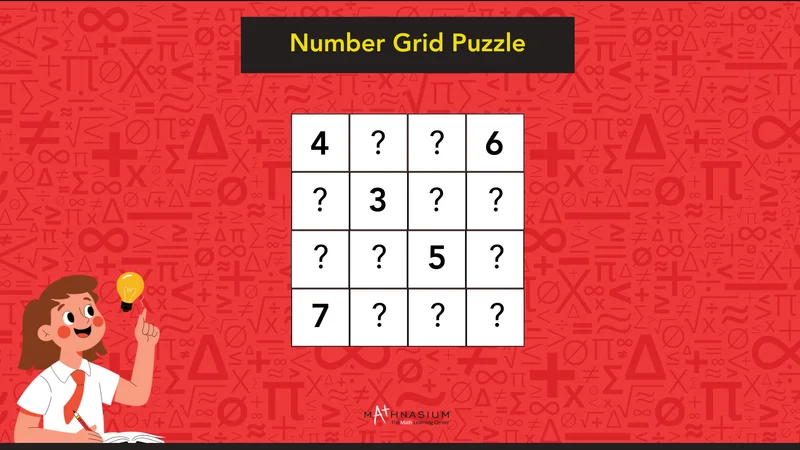
Tell your student: “Each row and each column must add up to 20.”
They use addition and subtraction to choose numbers for the blanks, but every choice has to work in both its row and its column. If a number fixes one row but breaks a column total, they erase it and try a different value that keeps everything balanced.
This keeps the arithmetic simple while asking for multi‑condition reasoning, which fits what students are building in middle‑school pre‑algebra and algebra.
4. Grades 9-12
Your student handles multiple layers of logic at once by this stage, testing entire scenarios rather than single clues. The three puzzles below build that skill through role assignment, layered constraints, and strategic planning.
A. Knights-and-Knaves-Style Puzzle
Three people stand in front of your child. One always tells the truth, one always lies, and one sometimes lies. For example:
-
Person 1 says, "The second is a liar."
-
Person 2 says, "The third tells the truth."
-
Person 3 says, "Both the first and the second are liars."
To find out who is who, your high schooler tests each possible assignment of roles, checking whether every statement holds under that assignment, until only one consistent solution remains.
This mirrors the formal logic used in proofs and conditional statements and reflects the same structure underlying if–then–else logic in computer science.
B. Balance Scale Coin Puzzle
This one is a thought experiment. Your high schooler doesn't need a real scale or actual coins, just a pencil and paper.
Ask them to picture 12 identical coins on a table, one of them fake and slightly lighter than the rest. They have an imaginary two-pan balance scale, and their job is to find the fake coin using as few weighings as possible.
The strategy is divide and conquer:
-
First Weighing: Split the 12 coins into three groups of four, then weigh two groups against each other. If the scale tips, the fake coin is in the lighter group. If it balances, the fake coin is in the unweighed group.
-
Second & Third Weighings: Now down to four coins, split them into two groups of two to weigh. Take the lighter pair and weigh one coin against the other to find the fake!
This builds the same decision-tree thinking behind computer programming, solving algebraic inequalities, and constructing geometric proofs.

Mathnasium's specially trained tutors use games, puzzles, hands-on activities, and personalized learning plans to build math confidence, session by session.
How We Make Math Learning Fun at Mathnasium
Mathnasium is a math-only learning center dedicated to empowering students of all skill levels to learn and master math.
At our centers, students engage with math in a fun, low-pressure environment where our caring, specially trained tutors use a variety of techniques to teach in a way that makes sense to them.
That principle sits at the heart of our broader approach to math learning, the Mathnasium Method™.
Designed to unlock each student's true math potential, our approach relies on:
-
Personalized learning plans: Each student begins with a diagnostic assessment that identifies their skill level, knowledge gaps, and how they approach math. From there, our tutors follow a personalized learning plan built around what the student needs.
-
Teaching for understanding: Our tutors explain math in clear, everyday language and use visual, verbal, written, mental, tactile, and hands-on techniques so students develop a deep understanding of math concepts.
-
Independent problem-solving: Each session gives students time to reason through a problem on their own first, building the same deductive thinking a logic puzzle demands.
-
Math-only focus: We are dedicated to math and math only. This singular focus allows us to go deeper into how students best learn, absorb, and retain math skills.
-
A confidence-building, fun learning environment: We often hear students say our sessions don't feel like lessons at all. That's by design. Our approach includes game-based activities and plenty of encouragement to keep students motivated and moving forward.
The results speak for themselves:
-
94% of parents report an improvement in their child's math skills and understanding
-
93% of parents report their child's improved attitude toward math after attending Mathnasium
-
90% of students saw an improvement in their school grades
We operate over 1,100 learning centers and bring our proven approach close to your home.
For families in and around Clear Lake, Mathnasium of Clear Lake is a trusted local center with years of experience helping students connect math to the world around them.
If you would like to see your child approach math with curiosity and confidence, schedule a free diagnostic assessment with us, and we will build a personalized learning plan around what matters to them.
📅 Schedule a Free Diagnostic Assessment at Mathnasium of Clear Lake
Not near Clear Lake?
📍 Find a Mathnasium Learning Center Near You


 (281) 465-4990