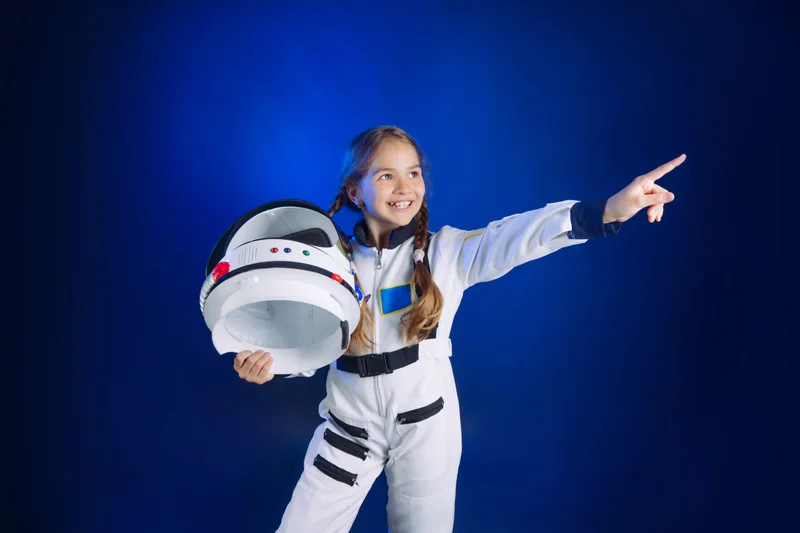
Space exploration runs on the same math your child is doing right now: fractions, rates, measurement, and scale. You do not need to live near a space center to make that connection tangible.
For our neighbors in Houston, there is an extra layer. Johnson Space Center is a short drive away, and the math your child does at home is the same math running its missions.
Today, Mathnasium tutors share four simple activities that turn everyday math into something kids can see, touch, and care about, right at home.
How Math Comes Alive Through Real-World Connections
Children understand math faster when they can connect it to something they already find interesting, and that is what we see in our sessions every day. Concepts that feel abstract on a worksheet start to make sense the moment a child sees them doing something real.
Curiosity leads kids to learn more deeply and stay engaged longer, especially when they're encouraged to explore and ask questions.
Fractions show up in fuel calculations. Rates and ratios appear in orbital mechanics. Measurement and scale are built into every mission blueprint.
Your child just needs to see that the math on their homework page is the same math that puts people in space.
You do not need a science background to make this work. Curiosity is enough, and Houston gives families a uniquely inspiring place to start.
📕 You May Also Like: How NASA Uses Math Every Day
4 Easy Ways to Bring Space Math Home
Parents can turn space exploration into hands-on math practice without any special equipment, a science background, or hours of preparation. Each activity takes a familiar math concept and ties it to something NASA engineers and scientists actually do.
1. Build a Scale Model of a Rocket
Look up the height of the Saturn V rocket together (it stands 363 feet tall). Pick a scale with your child, like 1 inch for every 10 feet, and ask them to calculate how tall the rocket would be at that scale.
Then, build it using a strip of paper, a ruler, and tape, marking off the major sections: the engines, the fuel tank, and the crew capsule.
The build covers scale, ratio, multiplication, and unit conversion, all in one afternoon. It also mirrors something NASA engineers actually do, which is scale models are used throughout spacecraft design and testing because every proportion has to be exact, or the full-size spacecraft does not behave the way the model predicts.
📕 You May Also Like: Measurement Conversions: A Kid-Friendly Guide
2. Track the International Space Station
Go to NASA's free "Spot the Station" tool and find the next time the ISS will pass over Houston. Before it flies over, use the altitude and orbit data on the site to estimate how fast the station is traveling.
NASA also publishes the ISS speed directly (17,500 miles per hour), so your child can work backward and figure out how far it travels in one minute, ten minutes, or in the time it takes to eat dinner.
Kids feel speed, distance, and time become real the moment they watch a dot cross the sky and know exactly how fast it is moving. Flight controllers at Johnson Space Center track the ISS around the clock using exactly this kind of calculation, adjusting the station's orbit when needed.
📕 You May Also Like: How Estimation and Rounding Support Number Sense in Math
3. Build a Mars Trip Budget
Print or draw a simple supply list together: food, water, fuel, and equipment. Tell your child the crew has six astronauts and the trip takes about eight months each way.
Ask them to figure out how much of each supply the crew needs, how to divide the weight limit fairly, and what gets cut if the budget runs short.
Multiplication, division, estimation, and large numbers all come up naturally as your child works through the problem. Every NASA mission runs on a budget and a weight limit, and engineers spend years doing exactly this kind of calculation before a spacecraft ever leaves the ground.
📕 You May Also Like: The Grocery Store Budget Challenge for Kids
4. Count Down in Multiple Units
Find an upcoming rocket launch (NASA and SpaceX both publish schedules online) and note how many days away it is. Ask your child to convert that into hours, then minutes, then seconds. For an extra challenge, ask them how many times the Earth will rotate before the rocket launches.
The countdown format makes multiplication and unit conversion feel urgent rather than routine. Launch countdowns at JSC are precision-timed to the second, and a single miscalculation can delay a mission by days.
NASA STEM Engagement also offers free activities and videos organized by grade level, so parents can keep the momentum going between sessions.

A rocket launch gives children a reason to care about every calculation, because at JSC, the countdown is never just a number.
Why Do Houston Families Have a Unique Advantage?
For our neighbors in Houston, that real-world connection has a name and an address. Space exploration, and the work happening every day at Johnson Space Center, uses many of the same math ideas your child is learning in elementary and middle school.
If you are a short drive from Johnson Space Center, your child can connect the math they practice at home to the people, missions, and spacecraft behind space exploration.
Space Center Houston
Space Center Houston is the official visitor center for NASA's Johnson Space Center, and it runs several programs designed specifically for families and young learners.
-
Homeschool Day events bring students into the center for structured, curriculum-aligned activities.
-
Overnight experiences let kids sleep under a shuttle and wake up inside a working space facility.
-
Astronaut appearances and mission briefings bring the human side of spaceflight close enough to ask questions.
If you are planning a family visit, you can check Space Center Houston’s current programs and admission options here, since offerings can vary throughout the year.
How to Get the Most Out of a Visit
A trip to Space Center Houston works best with a little preparation. Before you go, give your child a simple mission, such as find a distance, a speed, and a weight from the exhibits. From there, ask them to compare the size of different spacecraft or estimate how long a mission lasted.
Ask your child to compare the size of different spacecraft or estimate how long a mission lasted. The exhibits are full of real data, and your child just needs a reason to look for it.
Houston families do not need to create a connection between math and the world around us. The connection is already there, about 25 miles southeast of downtown.

At Mathnasium, we build math thinkers by meeting students where their curiosity already lives and showing them what math can do from there.
How Mathnasium Helps Students Grow as Math Thinkers
Mathnasium is a math-only learning center dedicated to helping K-12 students learn and master math at every level.
Students come to us with all kinds of starting points. Whether they need to catch up, keep up, or get ahead, we work on something bigger alongside their immediate needs, which is transforming how they think and feel about math so they grow into flexible, confident math thinkers.
That work is guided by the Mathnasium Method™, our proprietary teaching approach designed around each student's individual needs and learning style.
Enrollment begins with a diagnostic assessment that gives us a clear picture of their current skills, knowledge gaps, and how they naturally think about math. From those insights, we build a personalized learning plan tailored to their needs and goals.
Our specially trained tutors follow that plan closely, delivering face-to-face instruction in a supportive and fun setting. We use plain, everyday language to explain math and draw on a mix of verbal, visual, mental, tactile, and written techniques, so students can approach each concept in the way that makes most sense to them.
We place special focus on problem-solving and critical thinking. Students learn to break challenges into manageable steps and reason through the how and the why behind each concept, building independent mathematical thinking that serves them well beyond the classroom.
Fun is built into the approach, too. Game-based activities, earned rewards, and consistent celebration of progress keep students engaged and enjoying the process. Confidence grows with each session.
The results speak for themselves:
-
94% of parents report an improvement in their child's math skills and understanding
-
93% of parents report their child's improved attitude toward math after attending Mathnasium
-
90% of students saw an improvement in their school grades
We operate over 1,100 learning centers and bring our proven approach close to your home.
For families in and around Clear Lake, Mathnasium of Clear Lake is a trusted local center with years of experience helping students connect math to the world around them.
If you would like to see your child approach math with curiosity and confidence, schedule a free diagnostic assessment with us, and we will build a personalized learning plan around what matters to them.
📅 Schedule a Free Diagnostic Assessment at Mathnasium of Clear Lake
Not near Clear Lake?
📍 Find a Mathnasium Learning Center Near You


 (281) 465-4990