When you hear the word sequence, you might think of things happening in a certain order, like steps in a routine or scenes in a movie. Instructions that only make sense when followed one by one. A sequence is all about what comes next.
Math uses sequences, too. Instead of actions or events, math sequences involve numbers arranged in a specific order and guided by a pattern. Some patterns change quickly, while others move forward in a steady, predictable rhythm. One such pattern is called an arithmetic sequence.
Today, Mathnasium instructors explain what an arithmetic sequence is in math, how to find any term in the sequence, and how it compares to other types of number patterns you’ll see in class.
You’ll also get a chance to practice and explore common questions, so you can build a clear, well-rounded understanding of the concept.

What Do We Mean by Arithmetic Sequences?
An arithmetic sequence is a sequence of numbers where we either add or subtract the same value to get from one number to the next. The value that is added or subtracted each time is called the common difference.
So, what is arithmetic about it?
It’s the fact that we use basic math—adding or subtracting the same number again and again—to go from one number to the next. That’s why it’s called an arithmetic sequence. The name tells us how the pattern works.
Think of it like saving the same amount of money each week. The total changes every time, but it always changes by the same amount.
Let’s see how this works with numbers.
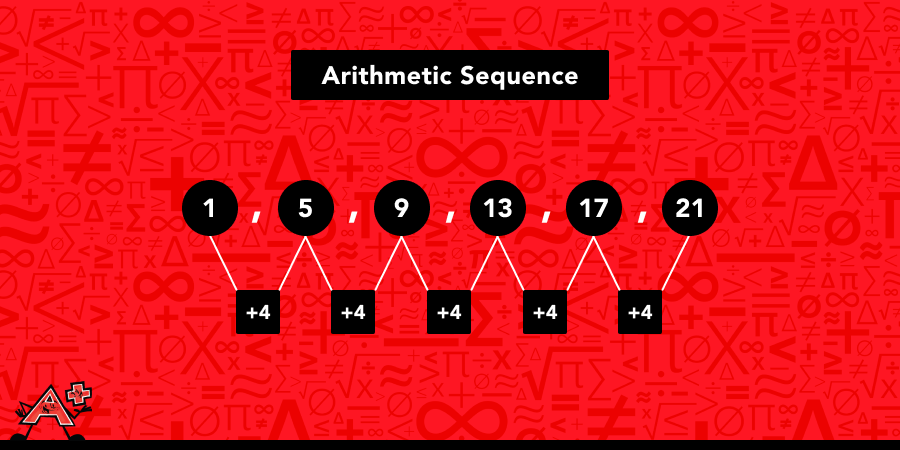
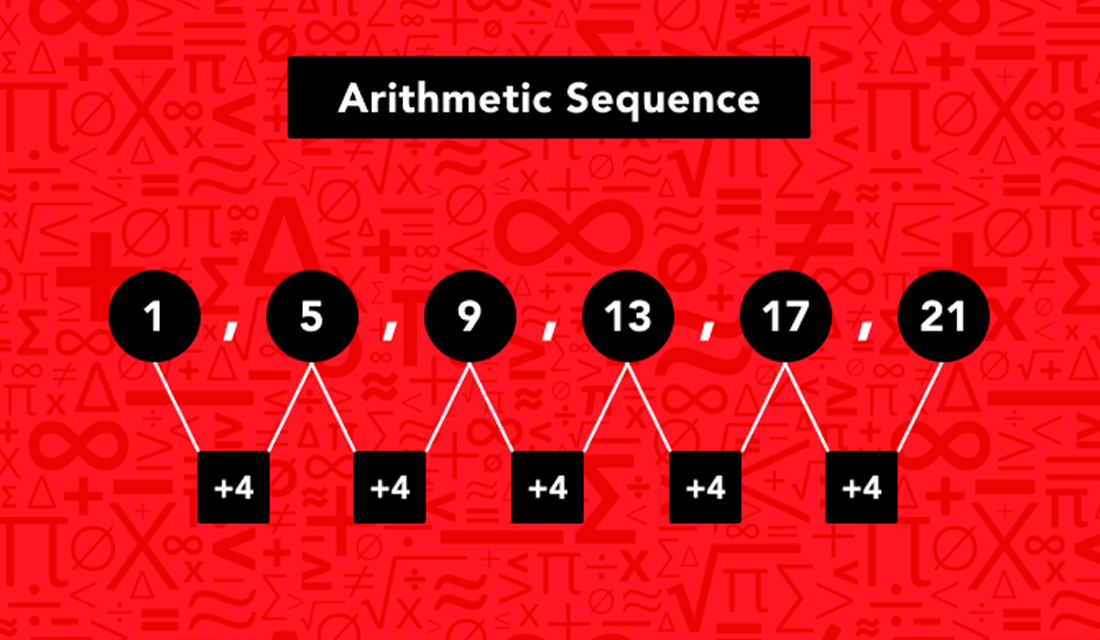
Notice that we add +4 each time. That means the common difference is +4.
This can also work with subtraction, like so:
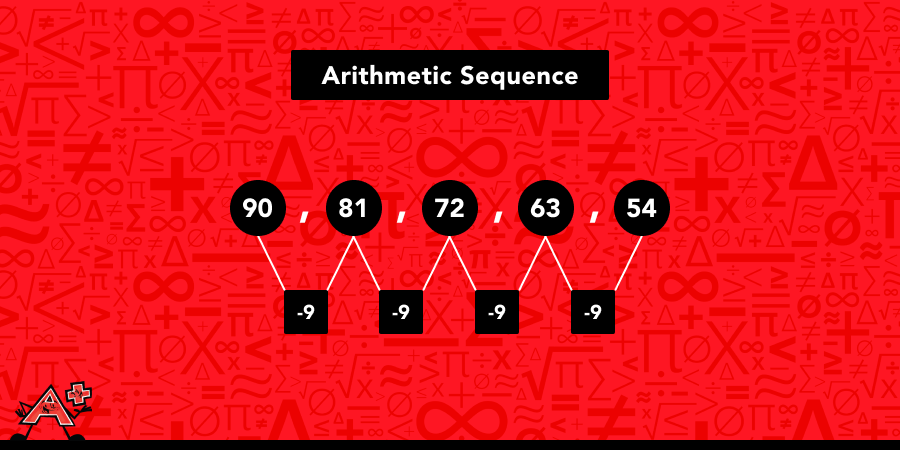
This time, the sequence decreases by 9 each step, so the common difference is −9.
And what is not an arithmetic sequence?
For instance:
-
1, 3, 9, 27, 81, 243, … is not an arithmetic sequence because the numbers change by multiplying by 3, not by adding or subtracting the same value each time.
-
1, 4, 9, 16, 25, 36, … is also not an arithmetic sequence because a different number is added at each step.
📕 You May Also Like: How to Use T-Charts to Solve (and Graph) Linear Equations
How Do We Find Any Term in the Arithmetic Sequence?
Arithmetic sequences change in a predictable way, which means we can list the numbers one by one to find a specific term.
That approach works fine when the sequence is short. But what if we wanted to find something like the 1,000th term? Writing out every number before it would take us forever.
Fortunately, arithmetic sequences come with a helpful shortcut. Once we know the first term and the common difference, we can find any term in the sequence, no matter how far along it is.
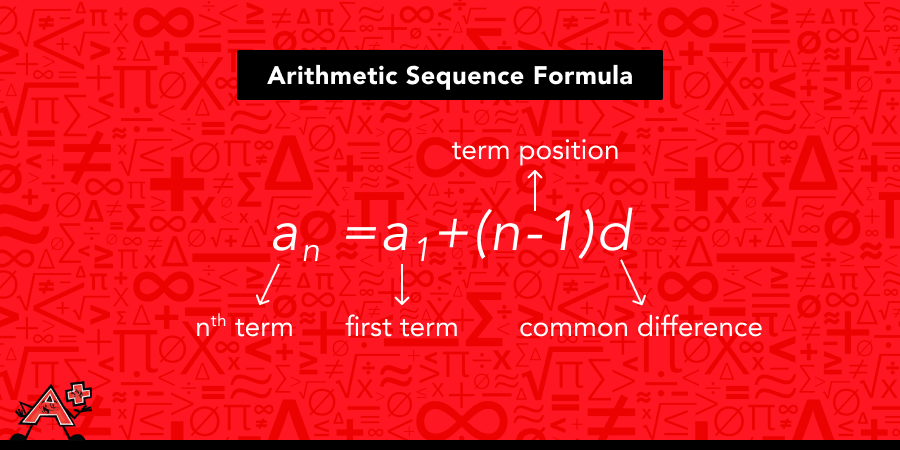
The formula we can use is:
\(a_{n} = a_{1} + (n - 1)d\)
Here’s what each part stands for:
-
an is the value of the nth term in the sequence
-
a1 is the first term of the sequence
-
n tells us which term we want to find
-
d is the common difference
Let’s test it out.
Suppose we want to find the nth term of the arithmetic sequence 5, 8, 11, 14, …
Before we use the formula, let’s first identify what we already know about this sequence.
The first term is 5, and the common difference is 3. That means a = 5 and d = 3.
Now we substitute these values into the formula:
\(a_{n} = 5 + (n - 1)3\)
Next, we simplify:
\(a_{n} = 5 + 3n - 3\)
\(a_{n} = 3n + 2\)
We can check our work by plugging in the first few values of n and seeing if they match the numbers in the sequence.
-
1st term: \(n = 1 \rightarrow a_{(1)} = 3(1) + 2 = 3 + 2 = 5\)
-
2nd term: \(n = 2 \rightarrow a_{(2)} = 3(2) + 2 = 6 + 2 = 8\)
-
3rd term: \(n = 3 \rightarrow a_{(3)} = 3(3) + 2 = 9 + 2 = 11\)
-
3rd term: \(n = 3 \rightarrow a_{(3)} = 3(3) + 2 = 9 + 2 = 11\)
The values we get match the original sequence, so we know our formula works.
Now we can use it to find any term in the sequence. For example, to find the 100th term:
\(a_{100} = 3(100) + 2 = 302\)
That saved us quite a bit of time, didn’t it?
Arithmetic vs. Geometric Sequence: What Is the Difference?
Arithmetic and geometric sequences are often mentioned together in math class, which is why they’re easy to mix up. Both are sequences, both follow a pattern, and both show up again and again in middle and high school math.
However, the key difference between them is how the numbers change from one term to the next.
-
Arithmetic sequences change by adding or subtracting the same number each time. That number is called the common difference.
-
Geometric sequences change by multiplying or dividing by the same number each time. That number is called the common ratio.
For example, we can determine that:
-
2, 5, 8, 11, … is an arithmetic sequence because the same number, +3, is added each time.
-
2, 6, 18, 54, … is a geometric sequence because each term is found by multiplying by 3.
Another helpful way to see the difference between arithmetic and geometric sequences is by graphing the terms.
First, let’s graph an arithmetic sequence 1, 3, 5, 7, 9… Here, the x-values represent the position of each term in the sequence (1st term, 2nd term, 3rd term, etc.). The y-values represent the actual value of each term.
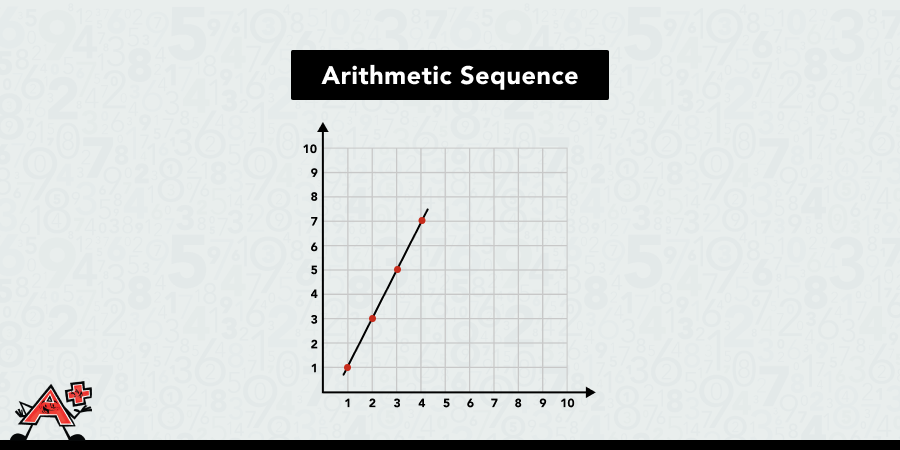
Each term increases by the same amount, so when we plot the points, they line up in a straight line. That straight-line shape shows us that the sequence is changing at a steady, constant rate.
Now let’s graph a geometric sequence, such as 3, 6, 12, 24, 48…. Just like before, the x-values represent the position of each term in the sequence, and the y-values represent the value of each term.
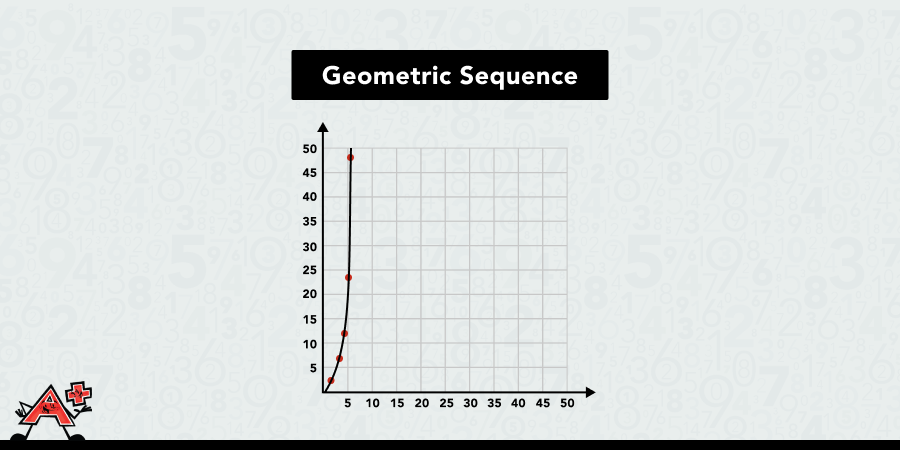
Since each term is multiplied by the same number, the points curve upward instead of forming a straight line. This upward curve shows that the values are increasing faster and faster as the sequence continues.
📕 You May Also Like: What Is A Slope In Math? A Complete, Kid-Friendly Guide
Practice Time: See How Well You Know Arithmetic Sequences
Great job following along so far. Now it’s time to practice what you’ve learned about arithmetic sequences.
When you’re done, check how you did at the bottom of the guide.
Task 1
Determine if the sequence is arithmetic or not. If it is, write the common difference.
a) 3, 8, 13, 18, 23, 28, …
b) 100, 90, 70, 40, 0, …
c) 21, 15, 9, 3, -3, -9, …
Task 2
Determine the 10th term of the sequence.
a) 3, 5, 7, …
b) 18, 14, 10, …
c) 2, 9, 16, …
Task 3
Determine the nth term of the arithmetic sequence.
2, 7, 12, 17, 22, 27, …
Task 4
Determine whether each sequence is arithmetic or geometric.
-
If it is arithmetic, find the common difference.
-
If it is geometric, find the common ratio.
a) 4, 7, 10, 13, …
b) 20, 16, 12, 8, …
c) 3, 6, 12, 24, …
📕 You May Also Like: Is Your Student Ready for Their Algebra Class? [+Quiz]
FAQs About Arithmetic Sequences
Our students often enjoy working with arithmetic sequences because the patterns are clear and predictable. Still, learning about them can raise a few questions along the way.
To help, we’ve gathered some of the most common questions we hear at Mathnasium and provided simple answers to clear up any confusion.
1) When do students begin learning about arithmetic sequences in school?
Students typically begin learning about arithmetic sequences in middle school, often around 6th or 7th grade, when they start working more closely with patterns, expressions, and early algebra concepts.
Arithmetic sequences may also appear again in later grades, where students explore them in more depth, connect them to graphs, and use them to understand linear relationships.
Because these ideas build over time, it’s normal for students to revisit arithmetic sequences more than once as their math skills grow.
2) Can arithmetic sequences have zero in them?
Yes, arithmetic sequences can absolutely include zero.
An arithmetic sequence is defined by adding or subtracting the same amount each time. As long as that pattern stays consistent, zero can be one of the terms.
For example:
−6, −3, 0, 3, 6, …
In this sequence, each term increases by 3, so it is arithmetic, and 0 is simply one value in the pattern.
Zero can appear at the beginning, in the middle, or anywhere in an arithmetic sequence. What matters is not the size of the numbers, but that the change between them stays the same.
3) Can an arithmetic sequence have fractions or decimals?
Yes, an arithmetic sequence can definitely include fractions or decimals.
As long as the sequence adds or subtracts the same amount each time, it is still arithmetic, even if the numbers are not whole numbers.
For example, this is an arithmetic sequence with fractions:
\(\Large\frac{1}{2}, 1, \Large\frac{3}{2}, 2, \Large\frac{5}{2}, ...\)
Each term increases by \(\Large\frac{1}{2}\).
This is an arithmetic sequence with decimals:
0.5, 1.0, 1.5, 2.0, 2.5, …
Each term increases by 0.5.
What matters is not whether the numbers are whole, fractional, or decimal, but that the change between consecutive terms stays the same.
4) Are arithmetic sequences the same as arithmetic series?
No, they are not the same.
An arithmetic sequence is a list of numbers that follows a pattern, where each term changes by the same amount. When you work with sequences, you’re usually focused on identifying the pattern or finding specific terms.
An arithmetic series, on the other hand, is what you get when you add all the terms of an arithmetic sequence together.
Students are typically introduced to arithmetic sequences first, often in middle school or early algebra. Arithmetic series are usually taught later, once students are comfortable with sequences and begin learning how to find sums efficiently in more advanced math classes.

Mathnasium is a math-only learning center where students can build a deep understanding of any math concept, including arithmetic sequences.
Master Arithmetic Sequences with Top-Rated Mathnasium Tutors
Mathnasium is a math-only learning center dedicated to helping K–12 students of all skill levels learn and master math.
Over the years, we’ve worked with middle school and early high school students who are learning algebra and exploring number patterns, where arithmetic sequences often play an important role. For many students, mastering arithmetic sequences is an important step toward truly understanding how algebra works and how numbers relate to one another.
No matter your student’s goals in math, we help them develop a deep understanding of math concepts, whether they’re working on sequences, linear relationships, or preparing for more advanced topics.
To build that understanding, we use the Mathnasium Method™, our proprietary teaching approach designed to help each student unlock their full math potential.
Each Mathnasium journey begins with a diagnostic assessment, which helps us pinpoint what your student already knows and where they could use extra support. Using these insights, we create a personalized learning plan that puts your student on their best path forward.
With that plan in place, our instructors follow it closely, providing face-to-face instruction in a caring and fun environment. During sessions, we use a thoughtful balance of Socratic questioning and direct teaching, along with mental, visual, verbal, tactile, and written techniques, so students can truly make sense of what they’re learning.
When students feel stuck, we break concepts into manageable steps and explain both the how and the why behind each solution. The goal is to help students build strong problem-solving skills and critical thinking they can use in math and beyond.
Our sessions often include game-based activities and meaningful rewards, helping students stay motivated and enjoy the learning process.
And the results speak for themselves:
-
94% of parents report an improvement in their child's math skills and understanding
-
93% of parents report an improved attitude towards math after attending Mathnasium
-
90% of students saw an improvement in their school grades
Whether your student is looking to catch up, keep up, or get ahead in math, your local Mathnasium center can help. Get started by scheduling a diagnostic assessment, and together we’ll create a personalized plan for math mastery.
Pssst! Check Your Answers Here
If you’ve given our exercises a try, check your answers below.
Task 1
a) 3, 8, 13, 18, 23, 28, …
This sequence is arithmetic. Each term increases by 5, so the common difference is +5.
b) 100, 90, 70, 40, 0, …
This sequence is not arithmetic.
The differences between terms are −10, −20, −30, −40, which are not the same.
c) 21, 15, 9, 3, −3, −9, …
This sequence is arithmetic. Each term decreases by 6, so the common difference is −6.
Task 2
a) 3, 5, 7, …
This arithmetic sequence increases by 2 each time. Starting at 3 and adding 2 repeatedly, the 10th term is 21.
b) 18, 14, 10, …
This arithmetic sequence decreases by 4 each time. Starting at 18 and subtracting 4 repeatedly, the 10th term is −18.
c) 2, 9, 16, …
This is an arithmetic sequence that increases by 7 each time. Starting at 2 and adding 7 repeatedly, the 10th term is 65.
Task 3
Determine the nth term of the arithmetic sequence:
2, 7, 12, 17, 22, 27, …
First, identify what we know:
To find the nth term, start with the first term and add 5 for each step after it. That means we add 5 a total of (n − 1) times:
\(a_{n} = 2 + 5(n - 1)\)
\(a_{n} = 2 + 5n - 5\)
\(a_{n} = 5n - 3\)
So, the nth term of the sequence is:
\(5n − 3\)
Task 4
a) 4, 7, 10, 13, …
This sequence is arithmetic. Each term increases by 3, so the common difference is +3.
b) 20, 16, 12, 8, …
This sequence is arithmetic. Each term decreases by 4, so the common difference is −4.
c) 3, 6, 12, 24, …
This sequence is geometric. Each term is multiplied by 2, so the common ratio is 2.


 (832) 299-5217