From measuring ingredients in the kitchen to sharing food with friends, we use mixed numbers to describe amounts that are more than a whole. Every mixed number has two parts, a whole number and a fraction, so there is more to keep track of than in a regular addition problem.
Mixed number addition relies directly on the foundational concepts you already know about whole numbers and fractions.
Today, our Mathnasium tutors will show how to add mixed numbers with like and unlike denominators, explain why the math works, and point out the mistakes to watch for.

What Is a Mixed Number?
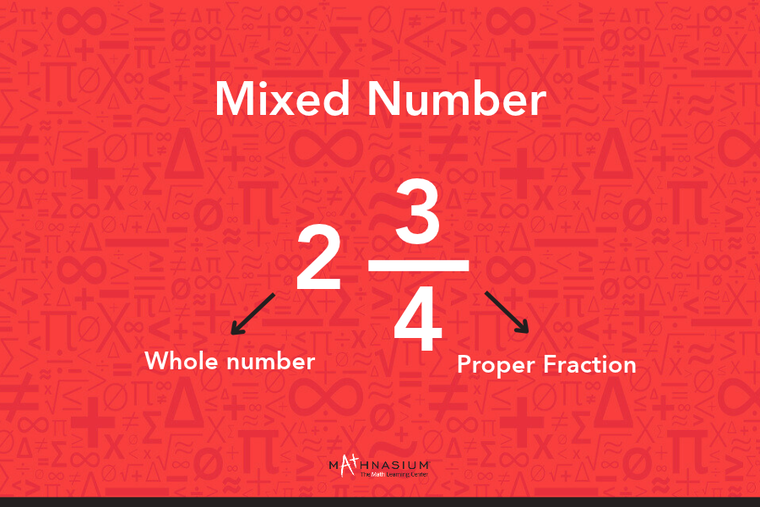
A mixed number is a number made of a whole number and a proper fraction written together.
Imagine we order 3 identical pizzas and cut the third one into 4 equal slices. If we eat 1 of those slices, we are left with 2 whole pizzas and 3 out of 4 slices of the third pizza.
To count how much pizza is left, we can write the amount as a mixed number, like this:
2\(\Large\frac{3}{4}\)
Here, the 2 whole pizzas give us the whole number part, and the \(\Large\frac{3}{4}\) gives us the proper fraction part.
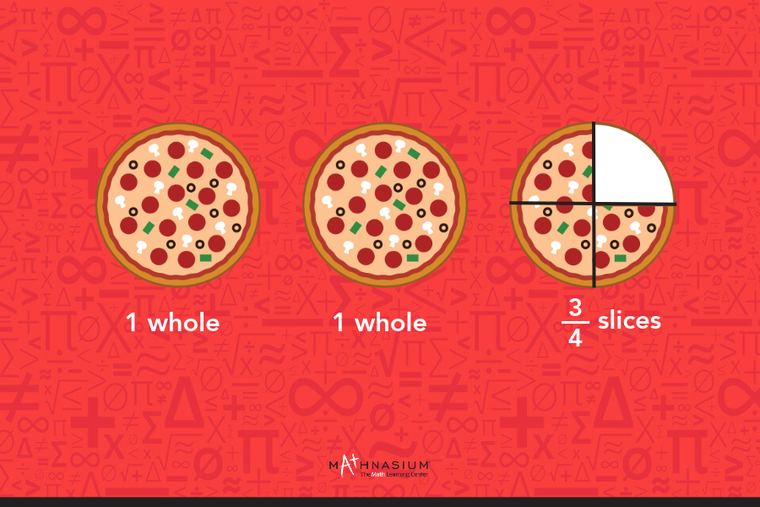
Together, they represent a single total amount. That is why it is called a mixed number, because we "mix" a whole number and a proper fraction together into one value.
But what if the fraction part is bigger than 1 whole?
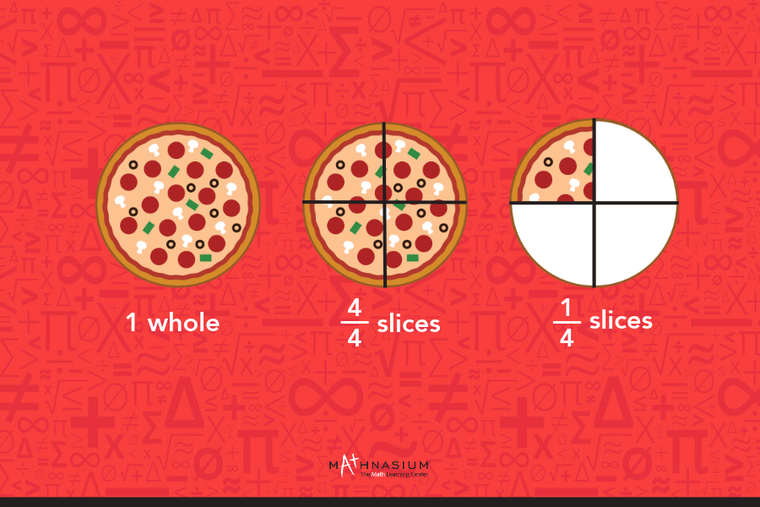
Let’s pick up where we left off. We had 2 whole pizzas and 3 slices of the third pizza. Now we eat 2 more slices from that third pizza, which leaves 1 slice. Then we cut our second pizza into 4 equal slices.
We now have 1 whole pizza, plus 4 slices from the second pizza and 1 slice from the third, which makes 5 slices in all.
We could write this amount as 1\(\Large\frac{5}{4}\).
At first glance, 1\(\Large\frac{5}{4}\) looks like a mixed number, but it isn’t.
The fraction \(\Large\frac{5}{4}\) is an improper fraction, which means its top number is greater than its bottom number. A mixed number needs a proper fraction, so 1\(\Large\frac{5}{4}\) is not a mixed number yet.
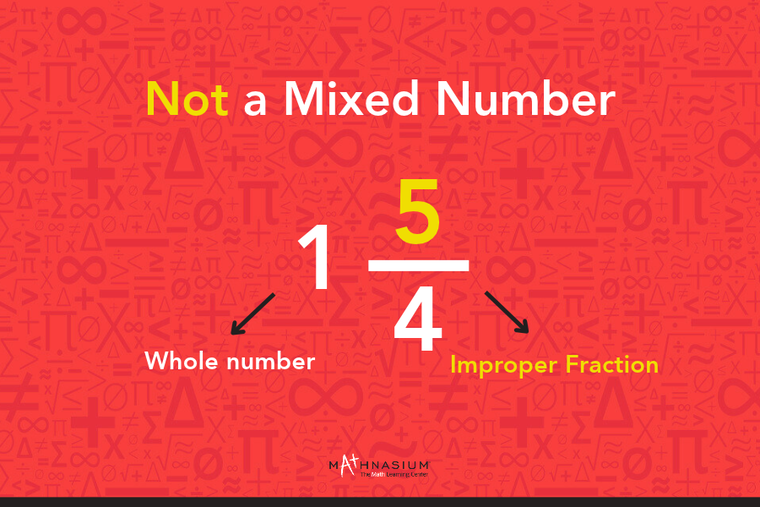
To turn it into one, we need to regroup.
Regrouping means pulling the whole pizzas out of the improper fraction and adding them to the whole number. Of our 5 slices, 4 already make a whole pizza, and 1 slice is left over:
\(\Large\frac{5}{4}\) = \(\Large\frac{4}{4}\) + \(\Large\frac{1}{4}\) = 1\(\Large\frac{1}{4}\)
Then we add that extra whole pizza to the 1 we already had:
1 + 1\(\Large\frac{1}{4}\) = 2\(\Large\frac{1}{4}\)
Now the fraction part, \(\Large\frac{1}{4}\), is a proper fraction, so we have a mixed number.
📕 You May Also Like: A Simple Guide to Mixed Numbers and Improper Fractions
How to Add Mixed Numbers
To add mixed numbers, we always look at the denominators first. Remember that the denominator tells us how many equal parts a whole is cut into. Since we can only add pieces that are the exact same size, we can run into two different situations:
-
When the denominators are the same: That means we can jump right in and add them together.
-
When the denominators are different: We first rewrite them as equivalent fractions with a common denominator, and then we can add.
Once the denominators match, the steps are the same in both cases:
-
First, we add the whole numbers separately.
-
Then, we add the fractions together.
-
We combine the two sums.
-
And at last, we regroup or simplify (sometimes both) the fraction part if needed.
Let’s jump right in!
A. How to Add Mixed Numbers with Like Denominators
When both fractions have the same denominator, their pieces are the same size, so we can count them together, just like 1 apple and 2 apples make 3 apples.
In the same way, 1 fifth and 2 fifths make 3 fifths. Since the pieces are still fifths, the denominator stays 5.
Let’s see how that happens by finding the sum of 2\(\Large\frac{3}{5}\) + 1\(\Large\frac{4}{5}\).
Step 1: Add the whole numbers
In 2\(\Large\frac{3}{5}\) + 1\(\Large\frac{4}{5}\), the whole numbers are 2 and 1 so we add them together.
2 + 1 = 3
Step 2: Add the fractions
Both fractions are made of fifths, so we count the fifths and keep the denominator the same. We add the numerators, 3 and 4, to get 7 fifths.
\(\Large\frac{3}{5}\) + \(\Large\frac{4}{5}\) = \(\Large\frac{7}{5}\)
Step 3: Combine the whole number and the fraction
Now we bring the two sums back together.
3 + \(\Large\frac{7}{5}\) = 3\(\Large\frac{7}{5}\)
The amount is now back in one piece, but the fraction part, \(\Large\frac{7}{5}\), is an improper fraction, so 3\(\Large\frac{7}{5}\) is not a finished mixed number yet.
Step 4: Regroup and simplify if needed
To regroup, we pull the extra whole out of the fraction. We know that 5 fifths make 1 whole, so we can split 7 fifths into 5 fifths and 2 fifths:
\(\Large\frac{7}{5}\) = \(\Large\frac{5}{5}\) + \(\Large\frac{2}{5}\) = 1\(\Large\frac{2}{5}\)
The fraction part holds 1 whole and \(\Large\frac{2}{5}\) left over. We add that extra whole to the 3 we already have:
3 + 1\(\Large\frac{2}{5}\) = 4\(\Large\frac{2}{5}\)
Last, we check whether the fraction can be simplified. The numbers 2 and 5 share no common factor besides 1, so \(\Large\frac{2}{5}\) is already in simplest form, and we’re done.
📕 You May Also Like: How to Subtract Mixed Numbers When You Need to Borrow
B. How to Add Mixed Numbers with Unlike Denominators
To add mixed numbers with unlike denominators, we first rewrite the fractions so they share a common denominator, and then we follow the same steps we used for like denominators.
We need that extra step because fractions with different denominators are made of equal parts of different sizes.
Halves and thirds can’t be counted together, just like 1 apple and 1 orange don’t make 2 apples. But if we rewrite both fractions using equal parts of the same size, we can count them together again.
Let’s see how this works with 1\(\Large\frac{1}{3}\) + 2\(\Large\frac{1}{6}\).
Step 1: Find the common denominator
Both denominators of \(\Large\frac{1}{3}\) and \(\Large\frac{1}{6}\) need to divide evenly.
We can look for it by listing a few multiples for each number:
-
Multiples of 3: 3, 6, 9, 12…
-
Multiples of 6: 6, 12, 18, 24…
The smallest number that appears on both lists is 6. That makes 6 the least common denominator.
Since \(\Large\frac{1}{6}\) already has 6 as its denominator, we only need to convert \(\Large\frac{1}{3}\).
To get our new fraction, we multiply both the numerator and denominator by 2, because 3 × 2 gives us our common denominator of 6.
\(\Large\frac{1 × 2}{3 × 2}\) = \(\Large\frac{2}{6}\)
Now we can rewrite our problem:
1\(\Large\frac{2}{6}\) + 2\(\Large\frac{1}{6}\)
Step 2: Add the whole numbers
Now we can take our whole number parts and add them together.
1 + 2 = 3
Step 3: Add the fractions
We count the sixths and keep the denominator the same.
\(\Large\frac{2}{6}\) + \(\Large\frac{1}{6}\) = \(\Large\frac{3}{6}\)
Step 4: Combine the whole number and the fraction
Now we can bring our sums back together.
3 + \(\Large\frac{3}{6}\) = 3\(\Large\frac{3}{6}\)
Step 5: Regroup and simplify if needed
Last, we check whether we need to regroup or simplify.
The fraction \(\Large\frac{3}{6}\) is a proper fraction, so we don’t need to regroup. But we can still simplify it.
The numbers 3 and 6 share a common factor of 3, so we can divide the top and the bottom part of the fraction by 3:
\(\Large\frac{3 ÷ 3}{6 ÷ 3}\) = \(\Large\frac{2}{3}\)
That gives us 3\(\Large\frac{1}{2}\).

Common Mistakes to Avoid When Adding Mixed Numbers
In our work with students, we’ve noticed a few common mistakes that come up when adding mixed numbers. Many of them are the same mistakes we see when adding fractions, because every mixed number has a fraction part, and the fraction rules still apply to that part.
Let’s take a look at the table to see what to watch for.
| Common mistake |
Example |
How we avoid it |
| Adding the denominators together |
\(\Large\frac{3}{8}\) + \(\Large\frac{2}{8}\) = \(\Large\frac{5}{16}\) |
We never add the denominators. The denominator tells us how many equal parts make a whole, and adding fractions only changes how many of those parts we have. We keep the denominator the same:
\(\Large\frac{3}{8}\) + \(\Large\frac{2}{8}\) = \(\Large\frac{5}{8}\) |
| Adding fractions with unlike denominators right away |
\(\Large\frac{1}{8}\) + \(\Large\frac{1}{2}\) = \(\Large\frac{2}{10}\) |
Eighths and halves are equal parts of different sizes, so we can't count them together. We find a common denominator first, then add:
\(\Large\frac{1}{8}\) + \(\Large\frac{4}{8}\) = \(\Large\frac{5}{8}\) |
| Changing the denominator but not the numerator |
\(\Large\frac{1}{2}\) + \(\Large\frac{1}{5}\) = \(\Large\frac{2}{10}\)
\(\Large\frac{1}{10}\) + \(\Large\frac{1}{10}\) = \(\Large\frac{2}{10}\) |
Whatever we multiply the bottom by, we multiply the top by as well. This keeps the fraction equivalent:
\(\Large\frac{1 × 5}{2 × 5}\) = \(\Large\frac{5}{10}\) and \(\Large\frac{1 × 2}{5 × 2}\) = \(\Large\frac{2}{10}\) |
| Leaving an improper fraction next to the whole number |
6\(\Large\frac{9}{8}\) |
A mixed number needs a proper fraction, so we regroup. Since \(\Large\frac{9}{8}\) = 1\(\Large\frac{1}{8}\), we add that 1 whole to the 6 and get:
7\(\Large\frac{1}{8}\) |
| Regrouping but forgetting to add the extra whole |
2\(\Large\frac{11}{10}\) becomes 2\(\Large\frac{1}{10}\) |
After we pull 1 whole out of 11/10, we add it to the whole number we already have:
2 + 1\(\Large\frac{1}{10}\) = 3\(\Large\frac{1}{10}\) |
📕 You May Also Like: A Beginner-Friendly Guide to Adding and Subtracting Fractions
Your Turn: Can You Add Mixed Numbers with Like and Unlike Denominators?
Our Mathnasium tutors put together 4 problems that cover everything we did today. For each one, add the mixed numbers and write the answer as a mixed number in simplest form.
-
3\(\Large\frac{2}{9}\) + 4\(\Large\frac{5}{9}\)
-
5\(\Large\frac{7}{10}\) + 2\(\Large\frac{6}{10}\)
-
4\(\Large\frac{3}{10}\) + 1\(\Large\frac{1}{5}\)
-
2\(\Large\frac{5}{6}\) + 3\(\Large\frac{3}{4}\)
Check your answers at the bottom of the guide.
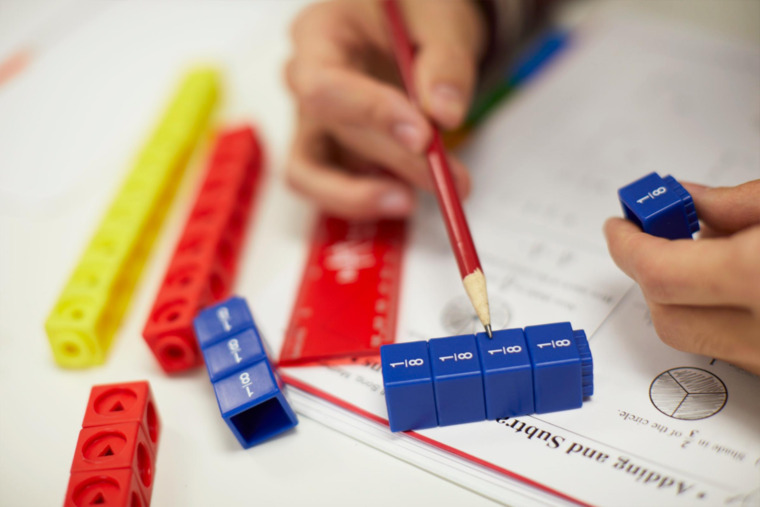 Mathnasium uses personalized learning plans and hands-on teaching techniques to help students make sense of fractions, mixed numbers included.
How Mathnasium Helps Students Master Any Math Concept
Mathnasium is a math-only learning center empowering students of all skill levels to learn and master math.
Students come to us at different points in their math journey. Some need help with foundational skills like equivalent fractions and common denominators. Others are ready to move on to multiplying and dividing mixed numbers. Wherever your child is, we build the path forward from that exact point.
At the core of how we do that is the Mathnasium Method™, our proprietary teaching approach.
It starts with a diagnostic assessment, a relaxed interaction that gives us a clear picture of your child’s strengths and knowledge gaps. From there, we build a personalized learning plan tailored to their needs and goals.
With the plan in place, our specially trained tutors deliver face-to-face instruction in a supportive and fun environment. We use everyday language and a mix of verbal, visual, mental, tactile, and written techniques so concepts land in a way that makes sense to your child.
When something feels confusing, we break it down into smaller steps and explain both the how and the why. In time, students build the problem-solving skills and critical thinking tools they can use in math and beyond.
Fun is a core part of how we work. Our activities are often game-based and hands-on, and students earn rewards along the way. We track their progress and celebrate every win, big or small, so confidence grows with every session.
The results speak for themselves:
-
94% of parents report an improvement in their child’s math skills and understanding
-
93% of parents report an improved attitude toward math after attending Mathnasium
-
90% of students saw an improvement in their school grades
With over 1,200 learning centers across North America, there is likely a Mathnasium close to you.
For families in and near Phoenix, AZ, Mathnasium of Desert Ridge is a trusted local center with years of experience helping students build confident, independent math thinkers.
Whether your child needs to catch up, keep up, or get ahead, our local team is happy to help!
📅 Schedule a Free Diagnostic Assessment at Mathnasium of Desert Ridge
Not near Desert Ridge?
📍 Find a Mathnasium Learning Center Near You
Pssst! Check Your Answers Here
Here are the answers. How did you do?
-
7\(\Large\frac{7}{9}\)
-
8\(\Large\frac{3}{10}\)
-
5\(\Large\frac{1}{2}\)
-
6\(\Large\frac{7}{12}\)


 (602) 374-3445
 (833) 369-4077