At Mathnasium, we see adding and subtracting fractions as one of the core fraction skills students begin developing in upper elementary school. The skill appears later in work with mixed numbers, measurements, rational numbers, and algebraic expressions or equations that include fractional values.
Outside the classroom, we use it when we combine measurements, adjust recipes, or add and subtract portions of time or distance. The process can feel straightforward when the denominators match, but once the denominators are different, we need a few extra steps to make the fractions work together.
Today, our seasoned tutors will walk you through what a fraction is and how to add and subtract fractions with both like and unlike denominators.

Let’s Review First: What Is a Fraction?
A fraction is a way of showing how many equal parts of a whole we have. We write it with two numbers, one above the other.
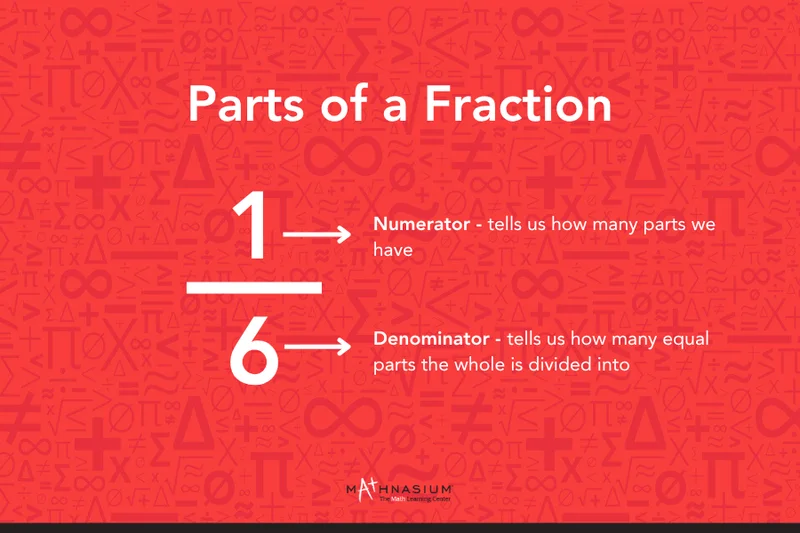
Imagine we cut a pizza into 8 equal slices and have 5 slices left. If we want to describe how much pizza we have as a fraction, 8 becomes the denominator because the whole pizza was divided into 8 equal parts. We use 5 as the numerator because we have 5 of those 8 parts.
Our fraction is \(\Large\frac{5}{8}\).
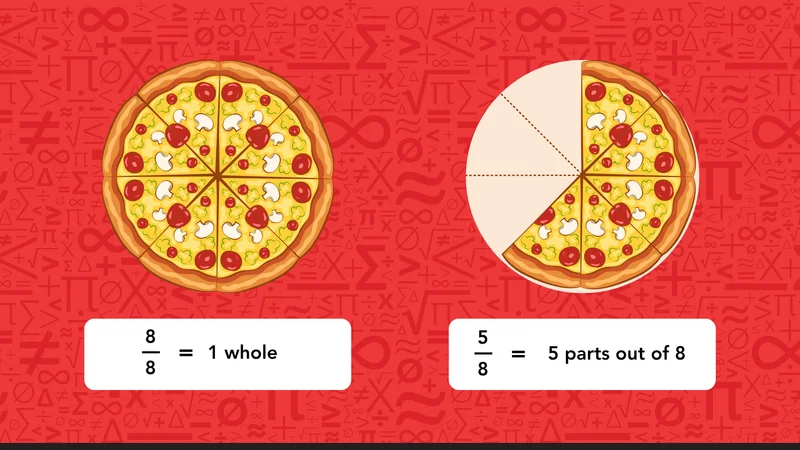
We already know how a fraction can describe how much pizza we have. Next, we will see how we can add fractions when we put equal parts together and subtract fractions when we take some of those parts away.

How to Add and Subtract Fractions With Like Denominators
To add or subtract fractions with like denominators, we add or subtract the numerators and keep the denominator the same.
Here is how it works.
We started with \(\Large\frac{5}{8}\) of a pizza. Say your friend ate 2 of those remaining slices, which we can write as \(\Large\frac{2}{8}\). As every slice is already the same size, we don’t need to change the denominator. We just subtract 2 from the 5 eighths we have:
\(\Large\frac{5}{8}\) − \(\Large\frac{2}{8}\) = \(\Large\frac{3}{8}\).
The same idea works for addition. Suppose we have \(\Large\frac{3}{8}\) of a pizza and add \(\Large\frac{4}{8}\) more. Since all the pieces are still eighths, we add the numerators and keep the denominator:
\(\Large\frac{3}{8}\) + \(\Large\frac{4}{8}\) = \(\Large\frac{7}{8}\).
Let’s put this into practice and calculate:
\(\Large\frac{7}{10}\) - \(\Large\frac{2}{10}\).
Step 1: Add or subtract the numerators
In our example, both fractions already share the same denominator, 10. That means we can go straight to subtracting the numerators:
\(\Large\frac{7}{10}\) - \(\Large\frac{2}{10}\) = \(\Large\frac{5}{10}\).
So, we get \(\Large\frac{5}{10}\).
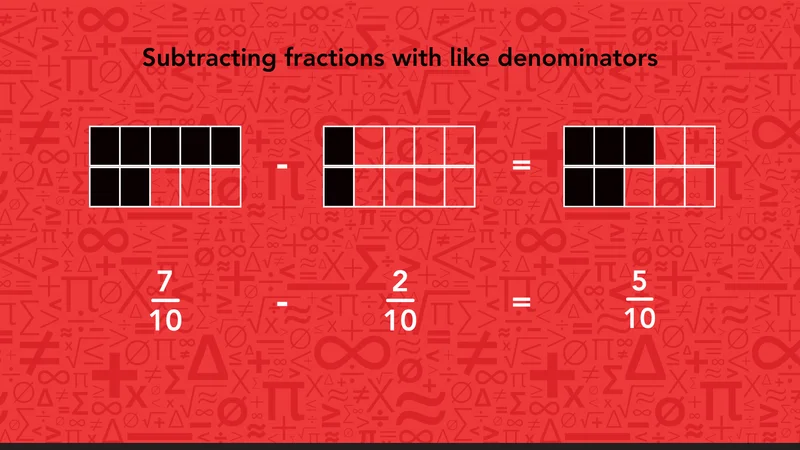
During sessions, our tutors often use visual tools to help students connect the numbers in a problem to what they represent. Here, the model below divides each fraction into 10 equal parts, so we can compare the shaded sections and see why \(\Large\frac{7}{10}\) - \(\Large\frac{2}{10}\) = \(\Large\frac{5}{10}\).
Step 2: Simplify if needed
Our answer, \(\Large\frac{5}{10}\), isn’t in its simplest form yet, because 5 and 10 share a common factor. Both numbers can be divided by 5:
That leaves us with:
\(\Large\frac{5}{10}\) = \(\Large\frac{1}{2}\).
But what do we do if the parts we’re adding or subtracting aren’t the same size to begin with? We’ll find out next.
📕 You May Also Like: How to Reduce Fractions - A Kid-Friendly Guide
How to Add and Subtract Fractions With Unlike Denominators
To add or subtract fractions with unlike denominators, we first rewrite them with a common denominator. When the denominators match, we can add or subtract the numerators.
Why can’t we add the numerators right away when the denominators are different? Let’s see.
Suppose you spend \(\Large\frac{1}{2}\) hour on math homework and another \(\Large\frac{1}{3}\) hour reading. How much time do you spend altogether?
The denominators, 2 and 3, tell us that the hour has been divided into different-sized parts: halves and thirds. Before we can add those fractions, we need to rewrite them so they have the same denominator and represent the same-sized parts. We call that shared number a common denominator.
To find a common denominator for \(\Large\frac{1}{2}\) and \(\Large\frac{1}{3}\), we look for a number that both 2 and 3 divide into evenly. The smallest one is 6, so we can rewrite both fractions in sixths without changing the fractions’ value.
-
Take \(\Large\frac{1}{2}\). What do we multiply 2 by to get 6? The answer is 3. To keep the fraction equivalent, we multiply the numerator by the same number: (\(\Large\frac{1}{2}\)) × 3 = \(\Large\frac{3}{6}\).
-
For \(\Large\frac{1}{3}\), what do we multiply 3 by to get 6? The answer is 2, so we multiply both the numerator and denominator by 2: (\(\Large\frac{1}{3}\)) × 2 = \(\Large\frac{2}{6}\).
We have \(\Large\frac{3}{6}\) and \(\Large\frac{2}{6}\). The fractions still represent the same amounts as \(\Large\frac{1}{2}\) and \(\Large\frac{1}{3}\), but now they are written in equal-sized parts and we can add the numerators:
\(\Large\frac{3}{6}\) + \(\Large\frac{2}{6}\) = \(\Large\frac{5}{6}\).
So altogether, you spend \(\Large\frac{5}{6}\) of an hour on homework and reading.
Now, we’ll work through the steps with this subtraction example:
\(\Large\frac{8}{9}\) − \(\Large\frac{2}{6}\).
Step 1: Find a common denominator
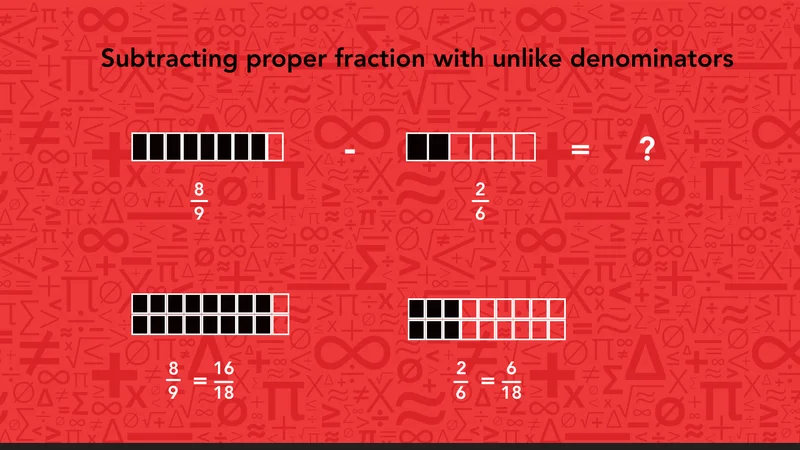
Before we can subtract, we need both fractions to describe the same size pieces. We look for a number that both denominators, 9 and 6, divide into evenly. The smallest number that works is 18, so 18 will be our common denominator.
Step 2: Rewrite each fraction with the common denominator
Next, we rewrite each fraction so it has a denominator of 18 without changing its value.
-
For \(\Large\frac{8}{9}\), we multiply the numerator and the denominator by 2: (\(\Large\frac{8}{9}\)) × 2 = \(\Large\frac{16}{18}\).
-
For \(\Large\frac{2}{6}\), we multiply both the numerator and denominator by 3: (\(\Large\frac{2}{6}\)) × 3 = \(\Large\frac{6}{18}\).
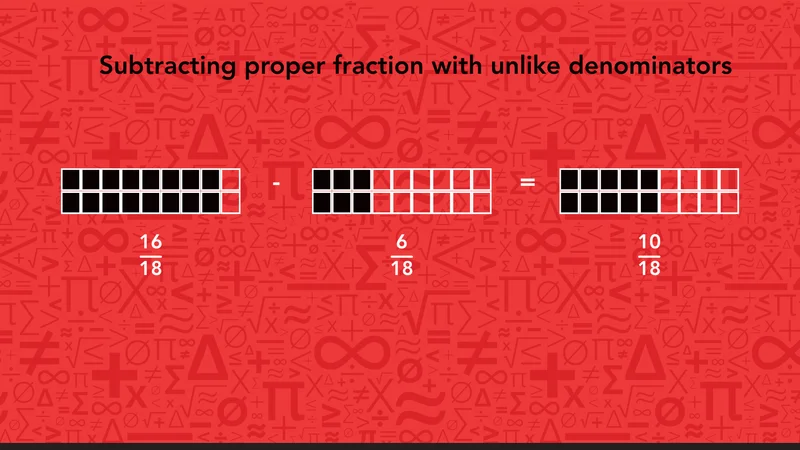
Picture two bars of the same length, one divided into 9 equal parts and the other into 6. Once we rewrite both fractions in eighteenth-sized parts, we can compare them piece by piece.
📕 You May Also Like: Equivalent Fractions Explained: A Kid-Friendly Guide
Step 3: Add or subtract the numerators
Now that both fractions share the same denominator, we can subtract the numerators:
\(\Large\frac{16}{18}\) - \(\Large\frac{6}{18}\) = \(\Large\frac{10}{18}\).
Our new fraction is \(\Large\frac{10}{18}\).
Step 4: Simplify if needed
The fraction \(\Large\frac{10}{18}\) can be simplified because both 10 and 18 are divisible by 2. So we divide the numerator and denominator by 2:
(\(\Large\frac{10}{18}\)) ÷ 2 = \(\Large\frac{5}{9}\).
This gives us our final answer: \(\Large\frac{5}{9}\).
📕 You May Also Like: 9 Ways Analog Clocks Teach Both Time and Fractions
Quick Reference: Addition and Subtraction of Fractions With Like & Unlike Denominators
Before a quiz or homework assignment, you can use this quick reference from our tutors to review the steps for adding and subtracting fractions with like and unlike denominators.
|
Like denominators
|
Unlike denominators
|
-
Add or subtract the numerators.
-
Keep the denominator the same.
-
Simplify if needed.
|
-
Find a common denominator.
-
Rewrite each fraction using the common denominator.
-
Add or subtract the numerators.
-
Simplify if needed.
|
Try Adding and Subtracting Fractions Yourself!
Now it’s your turn. Solve each problem below and simplify your answer if needed. You can check your answers at the bottom of the page.
-
\(\Large\frac{5}{12}\) + \(\Large\frac{3}{12}\).
-
\(\Large\frac{7}{9}\) − \(\Large\frac{4}{9}\).
-
\(\Large\frac{1}{4}\) + \(\Large\frac{1}{6}\).
-
\(\Large\frac{7}{10}\) − \(\Large\frac{1}{5}\).
📕 You May Also Like: Types of Fractions—A Comprehensive, Beginner-Friendly Guide

Mathnasium is a math-only learning center dedicated to helping K–12 students of all skill levels excel in math.
How Mathnasium Helps Students Make Sense of Fractions (and Any Other Math Topic)
Mathnasium is a math-only learning center dedicated to helping K–12 students of all skill levels excel in math.
We help students see the idea behind math concepts, such as fractions, so the methods truly make sense instead of feeling like isolated rules.
To support that understanding, we use the Mathnasium Method™, our proprietary teaching approach, to meet students where they are and guide them forward step by step.
Each student begins with a diagnostic assessment that helps us understand their current skill level, knowledge gaps, goals, and how they think and feel about math.
Using these insights, we build a personalized learning plan focused on the skills the student needs most, whether that means understanding fraction magnitude, finding equivalent fractions, adding and subtracting fractions, or preparing for more advanced work with ratios, percentages, and algebra.
Our specially trained tutors follow that plan closely and provide live, face-to-face instruction in a caring and fun group environment. They use mental, verbal, visual, tactile, and written techniques to help students compare fractions, work with area models, find common denominators, and explain why each step makes sense.
Students also get room to think through problems before tutors step in. Our tutors guide them through the reasoning rather than simply giving the correct answers. This helps students build critical thinking, problem-solving skills, and greater independence with fractions and later math.
Fun is part of the approach, too. We use hands-on and game-based activities, rewards, and consistent encouragement to keep students engaged as they work with fractions and related number concepts.
The results? True, measurable progress:
-
94% of parents report an improvement in their child's math skills and understanding
-
93% of parents report their child's improved attitude toward math after attending Mathnasium
-
90% of students saw an improvement in their school grades
With over 1,100 learning centers across North America, there is likely a Mathnasium close to you.
For families in and near Ramsey, New Jersey, Mathnasium of Ramsey brings that same approach close to home, with specially trained tutors who help students make sense of fractions, number relationships, and the math concepts that build from them.
If your child needs to catch up, keep up or is ready to get ahead, a free diagnostic assessment is a great place to start. Using what we learn, we create a personalized learning plan focused on the skills they need next.
📅 Schedule a Free Assessment at Mathnasium of Ramsey
Not near Ramsey?
📍 Find a Mathnasium Learning Center Near You
Pssst…! Check Your Answers Here
Ready to see how you did? Here are the answers to the practice problems above.
-
\(\Large\frac{5}{12}\) + \(\Large\frac{3}{12}\) = \(\Large\frac{2}{3}\). As both fractions already share a denominator of 12, we add the numerators: \(\Large\frac{5}{12}\) + \(\Large\frac{3}{12}\) = \(\Large\frac{8}{12}\). Then, we simplify the fraction by dividing both the numerator and the denominator by 4 and get \(\Large\frac{2}{3}\).
-
\(\Large\frac{7}{9}\) − \(\Large\frac{4}{9}\) = \(\Large\frac{1}{3}\). Both fractions share a denominator of 9, so we can subtract the numerators: \(\Large\frac{7}{9}\) − \(\Large\frac{4}{9}\) = \(\Large\frac{3}{9}\). By dividing both the numerator and denominator by 3, we can simplify the fraction to \(\Large\frac{1}{3}\).
-
\(\Large\frac{1}{4}\) + \(\Large\frac{1}{6}\) = \(\Large\frac{5}{12}\). Since the denominators don’t match, we find a common denominator. The smallest number both 4 and 6 divide into evenly is 12. That makes \(\Large\frac{1}{4}\) into \(\Large\frac{3}{12}\), and \(\Large\frac{1}{6}\) into \(\Large\frac{2}{12}\). Now we can add the fractions \(\Large\frac{3}{12}\) + \(\Large\frac{2}{12}\) = \(\Large\frac{5}{12}\). 5 and 12 have no common factors other than 1, so the fraction is already in simplest form.
-
\(\Large\frac{7}{10}\) − \(\Large\frac{1}{5}\) = \(\Large\frac{1}{2}\). Because \(\Large\frac{7}{10}\) and \(\Large\frac{1}{5}\) count different-sized parts, we first rewrite them with the same denominator. The smallest number both 10 and 5 divide into evenly is 10. We rewrite both fractions using the common denominator of 10: \(\Large\frac{7}{10}\) stays the same, \(\Large\frac{1}{5}\) = \(\Large\frac{2}{10}\). Next, we subtract: \(\Large\frac{7}{10}\) − \(\Large\frac{2}{10}\) = \(\Large\frac{5}{10}\). Both 5 and 10 are divisible by 5, so we can simplify: (\(\Large\frac{5}{10}\)) ÷ 5 = \(\Large\frac{1}{2}\).


 (201) 891-6284