Geometric proofs ask students to show, step by step, why a statement about a shape must be true. The last line is a statement instead of a number, and every step needs a reason.
So, for students who are encountering them for the first time, geometric proofs may feel like a new kind of math. It takes time to adjust to it, but once it clicks, many of our students even begin to enjoy it.
Today, we invite you to learn geometric proofs with us. Let’s explore how proofs work and walk through two beginner-friendly examples.

What Is a Geometric Proof?
A geometric proof is a step-by-step argument that shows why a statement about a figure is always true, using only facts we already know.
Why do we need one?
Picture two angles that look exactly alike. We could measure them with a protractor, but that only tells us about one drawing, and drawings can be off by a degree or two. Mathematicians want to know the angles match in every figure built the same way, and a proof gives them that certainty.
That's also why we never trust how a diagram looks. Two segments can appear equal and still differ in length, for instance.
In a proof, we only use what the problem tells us or what we can back up with a reason.
Given and Prove
Every proof starts with two pieces of information:
For example:
Statements and Reasons
Most beginner proofs are written as a two-column proof. Statements, the facts we write down, go on the left, and reasons, which is how we know each fact is true, go on the right.
| Statements |
Reasons |
|
1. M is the midpoint of AB̅
|
1. Given
|
|
2. AM̅ ≅ MB̅
|
2. Definition of midpoint
|
That's a complete proof. It starts from the Given, ends at the Prove, and backs up every step along the way.
Equal or Congruent?
Proofs use two symbols, equal and congruent, that are easy to mix up. This is why we usually ask our students to pause here for a moment and focus on distinguishing between them.
-
We use = for measurements, like AM = MB or m∠1 = m∠2. Here, “m” stands for "measure."
-
We use ≅ for the figures themselves, like AM̅ ≅ MB̅ or ∠1 ≅ ∠2.
In other words, = compares numbers, and ≅ compares shapes.
📕 You May Also Like: Who Was Euclid? The Ancient Mind Behind Modern Geometry
What Reasons Can You Use in a Geometry Proof?
Every reason in a geometry proof comes from the given information, a definition, a postulate, a theorem, or a property of equality or congruence.
Reasons are what make a proof trustworthy. Each one points back to something mathematicians have already agreed is true, so no step depends on how a figure looks.
Here's how the main types of reasons differ:
-
A definition tells us exactly what a term means.
-
A postulate is a basic fact we accept without proof, like the idea that two angles forming a straight line add up to 180°.
-
A theorem is a statement someone has already proven. Once a theorem is proven, we can use it as a reason in any proof that follows.
-
Properties of equality and congruence work the same way they do in algebra. For example, the substitution property lets us replace a value with one that's equal to it.
Most beginner proofs use only a handful of reasons. These are the ones that appear in the examples below:
| Reason |
Type |
In Other Words |
|
Definition of midpoint
|
Definition
|
A midpoint splits a segment into two congruent parts.
|
|
Definition of supplementary angles
|
Definition
|
Supplementary angles add up to 180°.
|
|
Definition of congruent angles
|
Definition
|
Angles with equal measures are congruent.
|
|
Linear Pair Postulate
|
Postulate
|
Two angles that form a straight line are supplementary.
|
|
SAS (Side-Angle-Side)
|
Postulate
|
If two sides and the angle between them match, the triangles are congruent.
|
|
Vertical Angles Theorem
|
Theorem
|
When two lines cross, the angles across from each other are congruent.
|
|
Substitution Property
|
Property
|
We can swap a value for anything equal to it.
|
|
Subtraction Property of Equality
|
Property
|
We can subtract the same amount from both sides of an equation.
|
Textbooks sometimes word these reasons a little differently, so students should use the names their teacher uses in class.
📕 You May Also Like: A Student-Friendly Guide to Math Properties
How to Write a Geometry Proof, Step by Step
To write a geometry proof, we start with the facts we’re given, explain in our own words why the statement is true, and then turn that explanation into numbered statements and reasons.
The explanation comes first for a reason. When we jump straight into the two-column table, we are likely to end up guessing at the next statement. Once we can say why something is true, the proof becomes a matter of writing it down in order.
-
Read the Given and Prove. Identify where the proof starts and where it needs to end.
-
Mark the diagram. Add tick marks to congruent segments and arcs to congruent angles, but only for facts the Given states. A diagram can show which points lie on the same line and which angles sit next to each other. It can’t show sizes.
-
Explain it in your own words. Talk through why the Prove statement makes sense, as if explaining it to a friend.
-
Work backward from the Prove. Ask what would need to be true right before the last line, then what would need to be true before that, until you reach the Given.
-
Write the proof and check it. Start with the Given, give every statement a reason, and make sure the last line matches the Prove exactly.

Geometry Proof Examples
Let’s see some examples of the full process, from talking through the idea to writing the finished proof. Here, it is important to note that the second example builds on the first, so review them in sequence.
Example 1: Proving Vertical Angles Are Congruent
Given: ∠1 and ∠2 form a linear pair; ∠2 and ∠3 form a linear pair
Prove: ∠1 ≅ ∠3
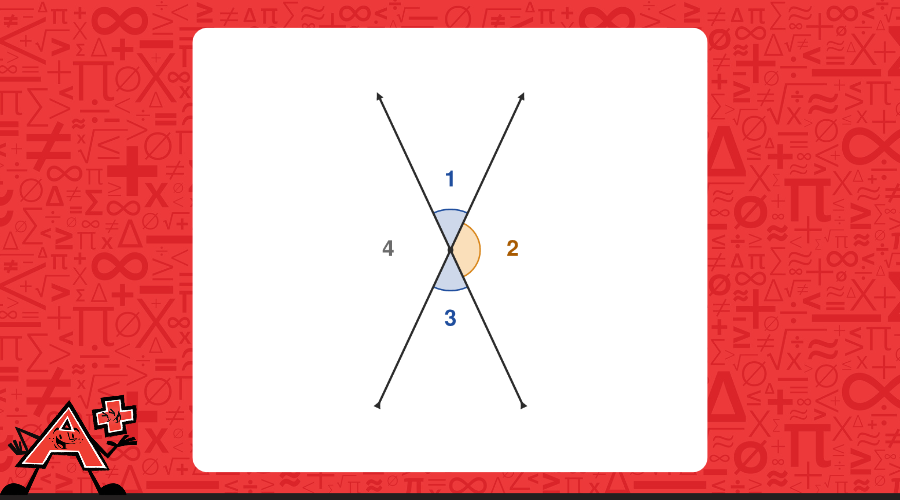
Let’s talk it through.
Both ∠1 and ∠3 sit next to ∠2 along a straight line, and a straight line measures 180°. So ∠1 is whatever is left when we take ∠2 away from 180°, and so is ∠3. If ∠2 measured 130°, both ∠1 and ∠3 would measure 50°. The same leftover means the same size, whatever ∠2 measures.
Now we can write that reasoning as a proof.
| Statements |
Reasons |
| 1. ∠1 and ∠2 form a linear pair; ∠2 and ∠3 form a linear pair |
1. Given |
| 2. ∠1 and ∠2 are supplementary; ∠2 and ∠3 are supplementary |
2. Linear Pair Postulate |
| 3. m∠1 + m∠2 = 180°; m∠2 + m∠3 = 180° |
3. Definition of supplementary angles |
| 4. m∠1 + m∠2 = m∠2 + m∠3 |
4. Substitution Property |
| 5. m∠1 = m∠3 |
5. Subtraction Property of Equality |
| 6. ∠1 ≅ ∠3 |
6. Definition of congruent angles |
In step 3, we switch from angles to their measures so we can use algebra.
Steps 4 and 5 are the same “leftover” idea from our talk-through, written as equations. It’s tempting to jump from step 2 straight to step 5, but remember, every move needs its own reason, even the ones that feel obvious.
Notice that the proof doesn’t stop at m∠1 = m∠3. The Prove asks for ∠1 ≅ ∠3, so step 6 switches back from measures to the angles themselves.
We’ve now proven the Vertical Angles Theorem, and we can use it as a reason in any future proof.
Example 2: Proving Triangles Congruent With SAS
Given: B is the midpoint of AE̅ and of CD̅
Prove: △ABC ≅ △EBD
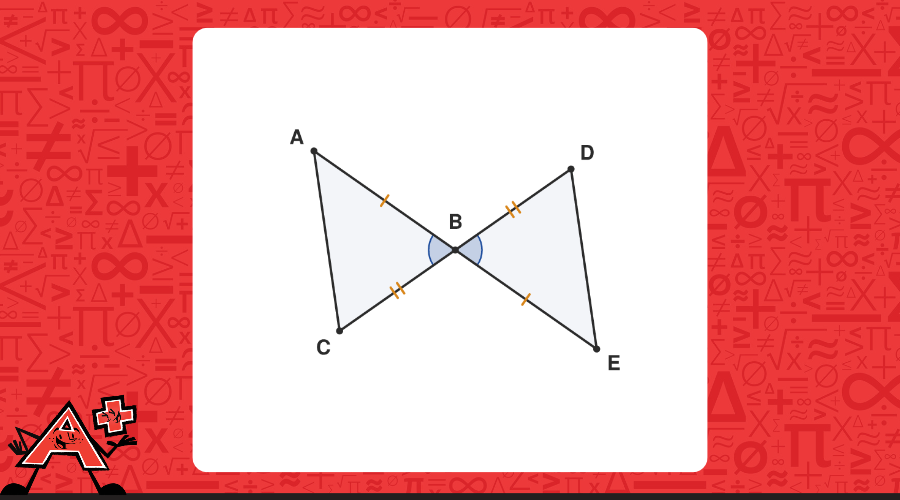
The Given mentions a midpoint twice, so we get two pairs of matching sides. AB and EB are the two halves of AE, and CB and DB are the two halves of CD.
Because AE̅ and CD̅ are straight line segments that intersect at B, ∠ABC and ∠EBD form a pair of vertical angles, which we just proved are congruent. Two sides and the angle between them match, so the triangles are congruent by SAS.
| Statements |
Reasons |
|
1. B is the midpoint of AE̅
|
1. Given
|
|
2. AB̅ ≅ EB̅
|
2. Definition of midpoint
|
|
3. B is the midpoint of CD̅
|
3. Given
|
|
4. CB̅ ≅ DB̅
|
4. Definition of midpoint
|
|
5. ∠ABC ≅ ∠EBD
|
5. Vertical Angles Theorem
|
|
6. △ABC ≅ △EBD
|
6. SAS
|
Why each step comes next?
The angles at B look equal in the diagram, but that’s not a reason we can use. The Vertical Angles Theorem from Example 1 is what proves they’re congruent. SAS also requires the angle to sit between the two sides, and ∠ABC does, since it’s formed by sides AB and BC.
The order of the letters matters, too. Writing △ABC ≅ △EBD tells us A matches E, B matches B, and C matches D.
📕 You May Also Like: What Are Similar Figures and How to Identify Them?
Your Turn: Practice Writing a Geometric Proof
Ready to try one on your own?
Your task is to fill in the missing reasons in the table below, then check your answers at the bottom of the page.
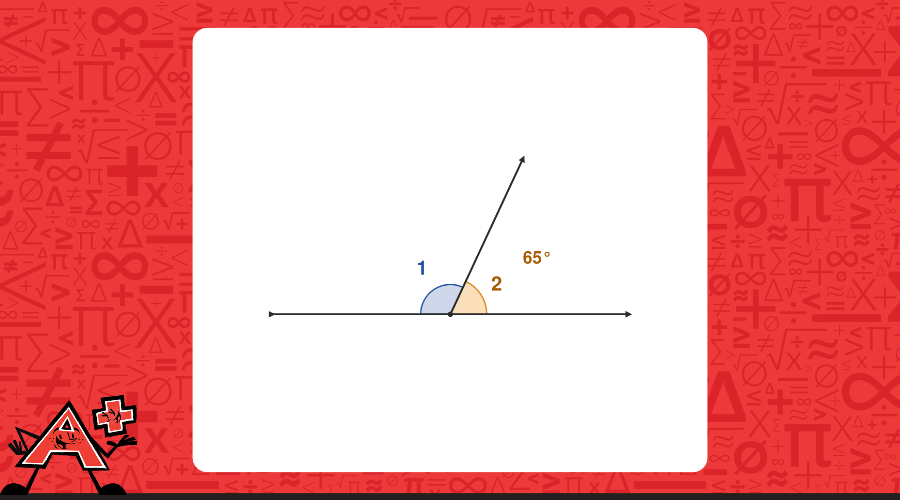
Given: ∠1 and ∠2 form a linear pair; m∠2 = 65°
Prove: m∠1 = 115°
| Statements |
Reasons |
| 1. ∠1 and ∠2 form a linear pair |
1. ______ |
| 2. ∠1 and ∠2 are supplementary |
2. ______ |
| 3. m∠1 + m∠2 = 180° |
3. ______ |
| 4. m∠2 = 65° |
4. Given |
| 5. m∠1 + 65° = 180° |
5. ______ |
| 6. m∠1 = 115° |
6. ______ |
FAQs About Geometric Proofs
Here are the questions our tutors hear most often from students working through their first proofs.
1. What are the three types of geometric proofs?
The three types are two-column proofs, paragraph proofs, and flowchart proofs. They all use the same logic in a different layout. For example, here’s Example 1 as a paragraph proof:
Since ∠1 and ∠2 form a linear pair, they’re supplementary, so m∠1 + m∠2 = 180°. In the same way, m∠2 + m∠3 = 180°. By substitution, m∠1 + m∠2 = m∠2 + m∠3, and subtracting m∠2 from both sides gives m∠1 = m∠3. Therefore, ∠1 ≅ ∠3.
A flowchart proof places each statement in a box, connects the boxes with arrows, and writes the reason beneath each box.
2. Do I need to memorize every theorem to write proofs?
No, most proofs in a unit draw on the same small set of reasons, so keeping a reasons list nearby works well while you learn. When you get stuck, go back to the Prove and ask what would need to be true right before it.
3. Can parents help with geometry proofs without remembering geometry?
Yes! Parents don’t need to know the theorems to help. Asking “How do you know that’s true?” or “What does the Given tell you?” encourages students to explain their thinking out loud, which is often where the next step appears.
 Mathnasium’s specially trained tutors help students explain their thinking before they write it down, so every proof makes sense step by step.
How Mathnasium Helps Students Master Geometric Proofs (and Any Math Concept)
Mathnasium is a math-only learning center that helps K–12 students of all skill levels learn and master math, from early number sense to geometry and beyond.
Every student starts with a diagnostic assessment that helps us understand their current skill level, learning goals, and how they learn best. Using these insights, we build a personalized learning plan that meets each student where they are.
Our specially trained tutors follow that plan and provide face-to-face instruction in a caring and fun group environment, both in-center and online. They teach with the Mathnasium Method™, our proprietary teaching approach that combines mental, verbal, visual, tactile, and written techniques so math makes sense.
With proofs, our tutors start with the why. Students explain in their own words why a statement is true before they write any statements or reasons, so the finished proof becomes a record of their own thinking.
Every session also includes time for homework help after students finish their learning plan topics, so they head back to class ready for the next proof.
The results speak for themselves:
-
94% of parents report an improvement in their child’s math skills and understanding.
-
93% of parents report their child’s improved attitude toward math after attending Mathnasium.
-
90% of students saw an improvement in their school grades.
Mathnasium operates over 1,100 learning centers nationwide, bringing our approach close to your community.
For families in Farmington, Kaysville, Fruit Heights, and Centerville, UT, Mathnasium of Farmington is a trusted local center with specially trained geometry tutors. Whether your student needs to catch up, keep up, or get ahead, our team is ready to help.
📅 Schedule a Free Assessment at Mathnasium of Farmington
Not near Farmington?
📍 Find a Mathnasium Learning Center Near You
Pssst! Check Your Answers Here
If you tried the practice proof, here are the missing reasons:
-
Given
-
Linear Pair Postulate
-
Definition of supplementary angles
-
Substitution Property
-
Subtraction Property of Equality
How did you do?


 (801) 928-7671
 (801) 928-7671