Although similar figures usually appear formally in middle school, the idea carries much further. You’ll use the same thinking in more advanced topics such as trigonometry, functions and graphs, and later calculus.
Outside the classroom, similarity shows up in scale drawings, maps, architecture, graphic design, and video games, where objects may be resized while keeping the same proportions.
Today, our tutors will break down what makes shapes similar and how to tell that two shapes are similar.

What Are Similar Figures?
Similar figures are shapes that have the same form or structure, but not necessarily the same size. Their corresponding angles are equal, and their corresponding side lengths are proportional.
We can think of one figure as a scaled version of the other.
We use the symbol ~ to show that two figures are similar.
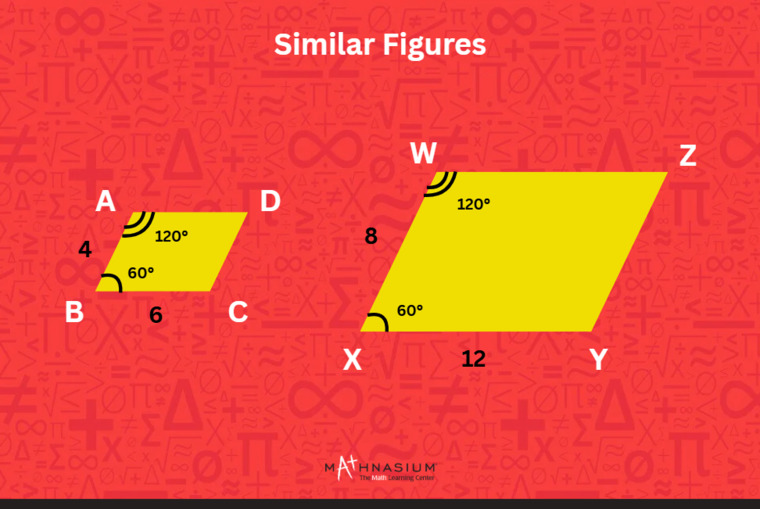
Take these two similar parallelograms, ABCD ~ WXYZ:
-
Parallelogram ABCD has sides of AB = 4 and BC = 6, with angles ∠B = ∠D = 60° and ∠A = ∠C = 120°.
-
Parallelogram WXYZ has sides of WX = 8 and XY = 12, with the two angles, ∠X = ∠Z = 60° and ∠W = ∠Y = 120°.
Let’s see which of their sides are corresponding,
Corresponding parts of the shapes have the same position in each figure if we look at the two shapes facing the same way.
In our example, the side AB of parallelogram ABCD corresponds with the side WX of parallelogram WXYZ, and the side BC corresponds with the side XY.
Now, we’ll divide the sides of parallelogram WXYZ by the matching sides in parallelogram ABCD:
-
WX ÷ AB = 8 ÷ 4 = 2
-
XY ÷ BC = 12 ÷ 6 = 2
Because opposite sides of a parallelogram are equal, we know CD = AB and AD = BC.
We can say the same about the second parallelogram, where YZ = WX and WZ = XY. So when we compare AB with WX and BC with XY, we're checking one side from each pair of equal sides.
By checking one side from each pair of equal opposite sides, we safely confirm that all four sides are proportional.
Both pairs give us the same ratio, 2. This tells us that each side in WXYZ is twice the length of its corresponding side in ABCD.
We call this ratio the scale factor. It tells us how much larger or smaller one figure is compared with the other. So the scale factor from ABCD to WXYZ is 2.
When we write ABCD ~ WXYZ, the order of the letters tells us which angles correspond:
-
∠A and ∠W correspond and both measure 120°
-
∠C and ∠Y correspond and both measure 120°
-
∠B and ∠X correspond and both measure 60°
-
∠D and ∠Z correspond and both measure 60°
That order also tells us which sides to compare, such as AB with WX and BC with XY.

How to Tell If Two Shapes Are Similar?
To tell whether two shapes are similar, we check two things:
-
Are all corresponding side lengths proportional?
-
Are all corresponding angles equal?
At Mathnasium, we like to explain abstract concepts, like similar shapes, through examples. So, let’s work through one step by step and find out whether trapezoids PQRS and TUVW are similar.
-
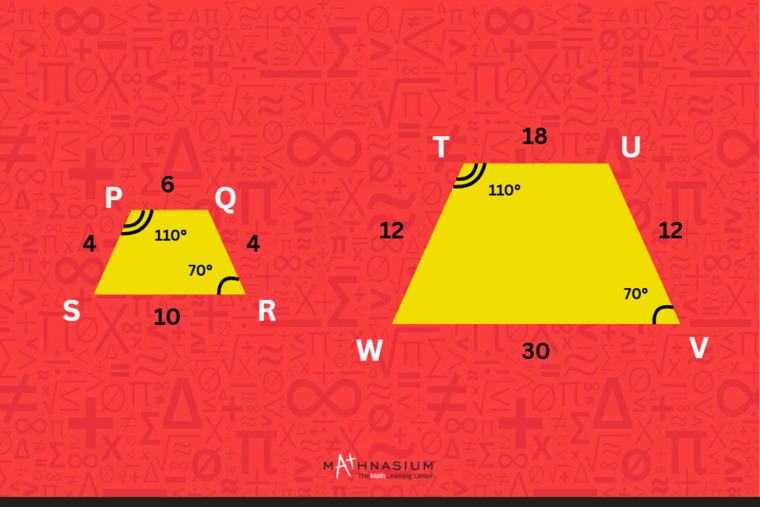
Trapezoid PQRS has sides PQ = 6, QR = 4, RS = 10, SP = 4, with angles ∠R = 70° and ∠P = 110°.
-
Trapezoid TUVW has sides TU = 18, UV = 12, VW = 30, WT = 12, with the angles ∠V = 70° and ∠T = 110°.
Step 1: Match the corresponding parts
We match each vertex to its corresponding partner:
That tells us which angles and sides to compare.
Step 2: Check the corresponding angles
We need to confirm that all corresponding angles are equal. In our trapezoids, we know that ∠R = 70°, ∠P = 110°, ∠V = 70° and ∠T = 110°.
-
∠P and ∠T correspond, and both measure 110°.
-
∠R and ∠V correspond, and both measure 70°.
We still need to find ∠S, ∠Q, ∠U, and ∠W. Because PQ ∥ RS, the angles along each leg of trapezoid PQRS are supplementary, which means they add up to 180°:
∠S = 180° − 110° = 70°
∠Q = 180° − 70° = 110°
The same idea works for trapezoid TUVW. Because TU ∥ VW, the angles along each leg are supplementary, so each pair adds to 180°:
∠W = 180° − 110° = 70°
∠U = 180° − 70° = 110°
So all four pairs of corresponding angles are equal:
∠P = ∠T = 110°
∠Q = ∠U = 110°
∠R = ∠V = 70°
∠S = ∠W = 70°
📕 You May Also Like: How to Measure Angles with a Protractor: A Complete Guide
Step 3: Check the corresponding side ratios
Next, we divide each side in TUVW by its corresponding side in PQRS:
-
TU ÷ PQ = 18 ÷ 6 = 3
-
UV ÷ QR = 12 ÷ 4 = 3
-
VW ÷ RS = 30 ÷ 10 = 3
-
WT ÷ SP = 12 ÷ 4 = 3
Every pair gives us the same ratio of 3.
The corresponding angles are equal, and all corresponding sides have the same ratio. So:
PQRS ∼ TUVW
The scale factor from PQRS to TUVW is 3.
📕 You May Also Like: What Is Congruent in Geometry? A Complete Overview
Common Mistakes to Avoid With Similar Shapes
We may see figures that look similar at first glance, but once we compare their corresponding sides and angles, the match may not hold up. Here are a few places where it’s easy to get tripped up:
A. Don’t trust the picture alone. What looks similar on the page may not be similar in practice. We should check the given angle measures and side lengths instead of relying on the picture alone.
B. Matching angles do not always mean the shapes are similar.
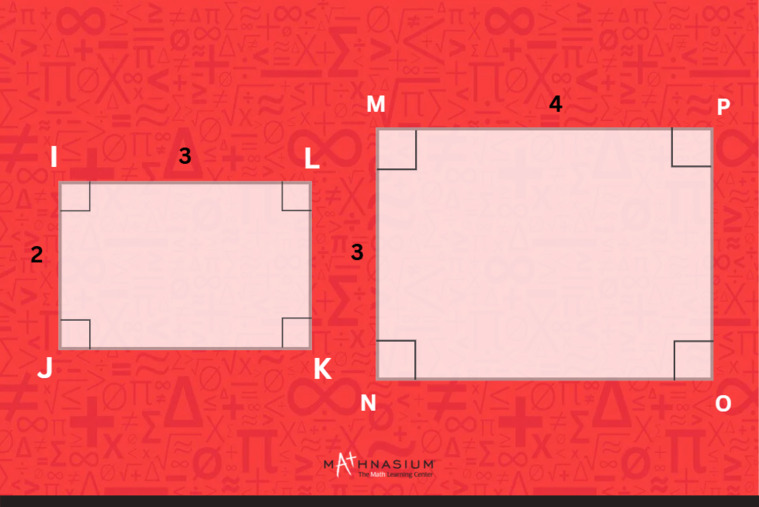
Take rectangles. A 2 × 3 rectangle and a 3 × 4 rectangle both have four 90° angles, but their side ratios are different, so the rectangles are not similar.
C. A rotated or flipped shape can still be similar.
One figure may be turned, flipped, or placed differently on the page, but that does not change its shape. We need to match each side and angle with its corresponding part before deciding whether the figures are similar or not.
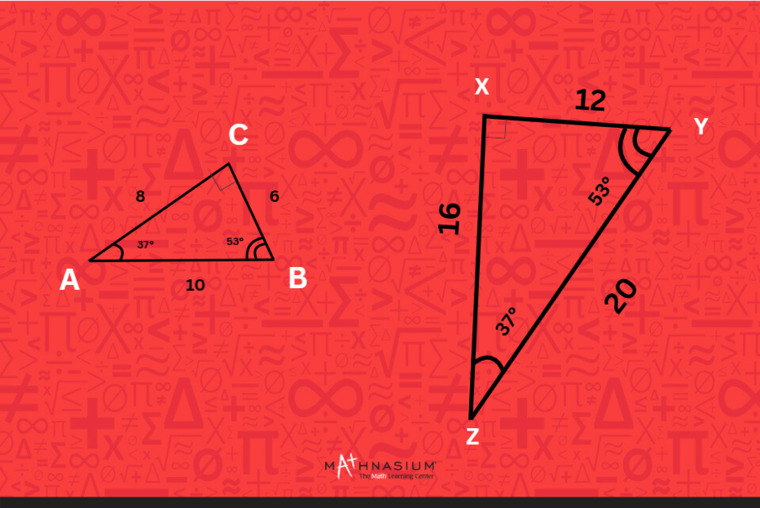
For example, triangle ABC has angles 37°, 53°, 80° and sides AB = 10, BC = 6, CA = 8. Triangle ZYX is drawn rotated and flipped on the page, with angles 37°, 53°, 80° and sides YZ = 20, XY = 12, ZX = 16.
Matching shortest to shortest and longest to longest shows us that ΔABC~ΔZYX with a scale factor of 2. This makes them similar despite the different orientation on the page.
📕 You May Also Like: How to Turn Math Mistakes into Learning Tools at Home
Try Telling if Two Shapes Are Similar Yourself!
For each pair of shapes below, decide whether they’re similar or not. You can check your answers at the bottom of the page.
Task 1
Triangle DEF has angles 50°, 58°, 72° and sides DE = 8, EF = 9, FD = 10. Triangle GHI has angles 50°, 58°, 72° and sides GH = 16, HI = 18, IG = 20.
Task 2
Rectangle JKLM has sides JK = 4, KL = 6. Rectangle NOPQ has sides NO = 6, OP = 9.
Task 3
Triangle EFG has angles 37°, 53°, 90° and sides EF = 3, FG = 4, GE = 5. Triangle HIJ has angles 23°, 67°, 90° and sides HI = 5, IJ = 12, JH = 13.
 Mathnasium is a math-only learning center dedicated to helping K–12 students of all skill levels excel in math.
How Mathnasium Helps Students Master Similarity (and Any Other Math Topic)
Mathnasium is a math-only learning center dedicated to helping K–12 students of all skill levels excel in math.
Whether students need support mastering foundational geometry topics like angles and side relationships, specific skills like identifying similar shapes, or more advanced concepts like scale factor and proportional reasoning, we can support them.
We personalize each student's learning experience through the Mathnasium Method™, our proprietary approach to math instruction.
Here’s how it works in practice.
Each student begins with a diagnostic assessment that helps us understand which skills are secure, which need more support, and how the learner thinks and feels about math.
Using these insights, we create a personalized learning plan focused on the skills the student needs most, whether that means reinforcing ratio and proportion skills, comparing corresponding sides and angles, or preparing for more advanced geometry.
Our specially trained tutors follow the plan closely and provide live, face-to-face instruction in a caring and fun group environment. They use mental, verbal, visual, tactile, and written techniques to help students make sense of abstract math concepts, like similar shapes.
Students also get room to think through problems before tutors step in. This helps students build problem-solving skills, critical thinking, and greater independence in geometry.
Fun is an important part of the approach, too. We use game-based activities, rewards, and consistent encouragement to help students stay engaged as they compare shapes, spot relationships, and work through geometry challenges.
Families see the difference:
-
94% of parents report an improvement in their child's math skills and understanding
-
93% of parents report their child's improved attitude toward math after attending Mathnasium
-
90% of students saw an improvement in their school grades
With over 1,100 learning centers across North America, there is likely a Mathnasium close to you.
For families in and near Farmington, Mathnasium of Farmington brings that same approach close to home, with specially trained tutors who help students make sense of similar figures and the geometry skills that build from them.
Whether your child needs to reinforce geometry foundations, keep up with current coursework, or get ahead, a free diagnostic assessment is a great place to start. Using what we learn, we create a personalized learning plan that helps your child build the skills they need next.
📅 Schedule a Free Assessment at Mathnasium of Farmington
Not near Farmington?
📍 Find a Mathnasium Learning Center Near You
Pssst! Check Your Answers Here
Ready to see how you did? Here are the answers to the practice problems above:
Task 1
Similar — both triangles share the same three angles (50°, 58°, 72°), and every side scales by the same factor of 2: GH ÷ DE = 16 ÷ 8 = 2, HI ÷ EF = 18 ÷ 9 = 2, and IG ÷ FD = 20 ÷ 10 = 2.
Task 2
Similar — both are rectangles, so all angles are 90° by definition. By matching the vertices in order (JKLM ~ NOPQ), the corresponding sides scale evenly: NO ÷ JK = 6 ÷ 4 = 1.5, OP ÷ KL = 9 ÷ 6 = 1.5.
Task 3
Not similar — although both are right triangles (90°), the acute angles do not match (37°/53° vs. 23°/67°), and the side ratios are not equal (5 ÷ 3 ~ 1.67 vs. 12 ÷ 4 = 3).


 (801) 928-7671
 (801) 928-7671