You just finished a long multiplication problem. The answer looks right, but to be sure, you'd have to do the whole thing over again.
What if you didn't have to?
A mathematician from a century ago could check that answer in about five seconds with no calculator, no redoing the math. Just a quick trick using the digits themselves. Before calculators existed, this method was standard training for anyone who worked with numbers regularly.
Today, most students never hear about it.
It's called casting out nines, and Mathnasium tutors sometimes share it as a puzzle-like shortcut for checking work. In this guide, we'll pull back the curtain on what it is, where it came from, and how to use it to check answers across all four operations.

What Is Casting Out Nines?
Casting out nines is a way to check an arithmetic answer using the digits of the numbers themselves instead of repeating the whole calculation.
There's no better way to see this than through an example. Say we want to check whether we added correctly:
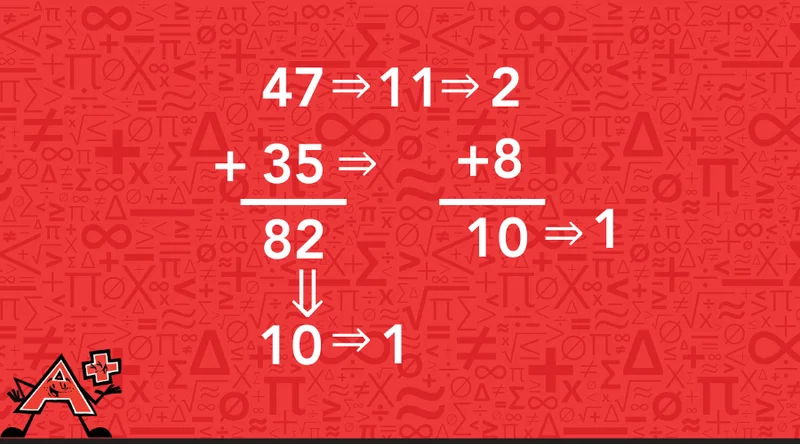
47 + 35 = 82
We follow three simple steps.
Step 1: Add the digits of each number down to a single digit.
Step 2: Add those results and reduce again.
2 + 8 = 10, and 1 + 0 = 1
Step 3: Do the same with the answer, then compare.
For 82: 8 + 2 = 10, and 1 + 0 = 1
The 1 we got from the two addends matches the 1 from the answer, so this problem passes the casting out nines check.
Mathematicians call this "keep adding digits until you get one" process finding the digital root. We'll use that term from here on. The trick works for all four basic operations: addition, subtraction, multiplication, and division.
Why Do We Call It "Casting Out Nines"?
If you look back at the first example, you probably didn't spot any 9s at all. So, why do we call this method casting out nines?
The name comes from a shortcut we're allowed to use: whenever we see a 9 in a number, or a group of digits that adds up to 9, we can skip it entirely. Those digits don't affect the digital root, so ignoring them saves time.
Let's watch it in action. Here's a sum we already know how to check:
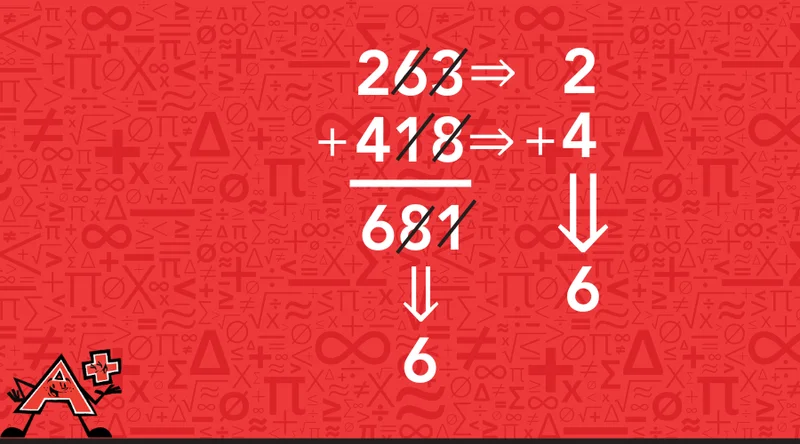
263 + 418 = 681
Step 1: Find the digital root of each number, but cast out any 9s you spot.
-
263 → Notice that 6 + 3 = 9, so we cast those out and keep 2.
-
418 → Notice that 1 + 8 = 9, so we cast those numbers out and keep 4.
-
681 → Notice that 8 + 1 = 9, so we cast both 1 and 8, and keep 6.
Step 2: Add the digital roots of the two addends.
2 + 4 = 6
Step 3: Compare to the digital root of the answer.
Both sides give 6, and the check passes. And we got there faster by casting out the 9-pairs instead of adding every digit.
That's where the name comes from. We literally cast out the nines.
Casting out nines has been around for over 800 years. The method was first described by the Indian mathematician Bhaskara II around 1150 CE in his book Līlāvatī, and it was introduced to Europe by Leonardo Fibonacci in 1202.
How Casting Out Nines Works in Addition
Casting out nines fits most naturally with addition, as we simply combine the digital roots of the numbers we add and check whether they match the digital root of the sum.
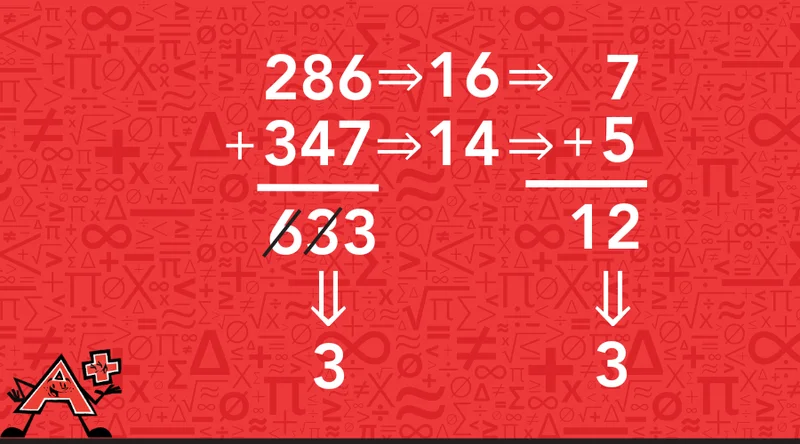
Let's see how this works with: 286 + 347 = 633
Step 1: Find the digital root of each number.
-
286 → 2 + 8 + 6 = 16 → 1 + 6 = 7
-
347 → 3 + 4 + 7 = 14 → 1 + 4 = 5
-
633 → Notice that 6+3 =9, so after casting 6 and 3, we only have 3 left.
Step 2: Add the digital roots of the two addends.
7 + 5 = 12 → 1 + 2 = 3
Step 3: Compare to the digital root of the answer.
Both sides give 3, so this addition passes the casting out nines check.
How Casting Out Nines Works in Subtraction
For subtraction, the check works a little differently. Instead of adding the digital roots of both numbers, we subtract them, and if that gives us a negative number, we add 9 to keep it positive.
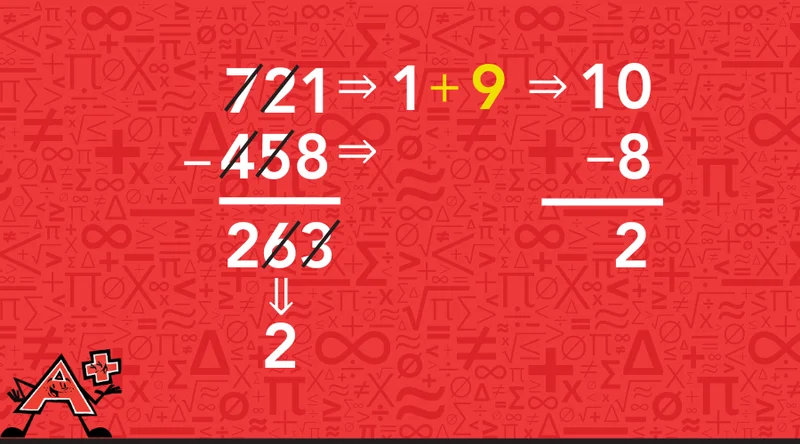
Let's check: 721 − 458 = 263
Step 1: Find the digital root of each number.
-
721 → Remove 7 + 2 =9 , and only 1 remains.
-
458 → Remove 4 + 5 =9 as well, and 8 remains.
-
263 → Remove 6 + 3 = 9, and only number 2 remains.
Step 2: Subtract the digital root of the number being subtracted (subtrahend) from the digital root of the starting number (minuend).
If the result is negative, add 9 to bring it back to a positive digit.
In our problem, 1 − 8 would be negative, so we add 9 first: 1+9=10, and 10−8=2. That way, we keep the numbers positive.
Step 3: Compare to the digital root of the answer.
Both sides give 2, so this subtraction passes the casting out nines check.
📕 You May Also Like: Why Subtracting Negative Numbers Is Hard (And How to Help)
How Casting Out Nines Works in Multiplication
For multiplication, the process mirrors addition as we reduce each factor to a single digit, multiply those digits, and compare them to the digital root of the product.
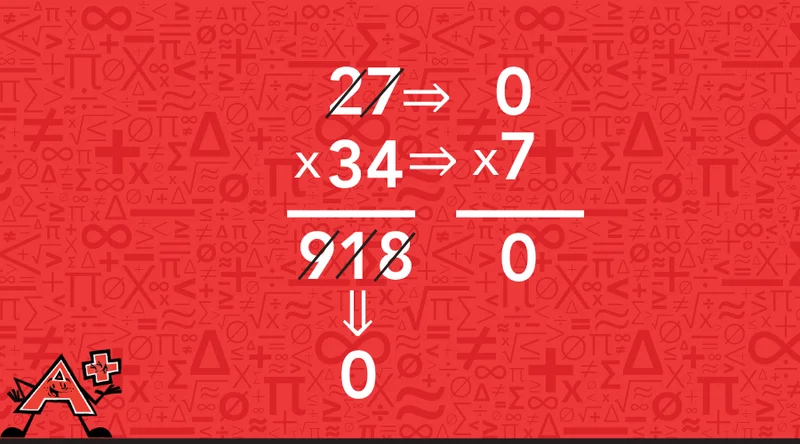
Let's work out this one: 27 × 34 = 918
Step 1: Find the digital root of each number.
-
27 → Remove 2 + 7 = 9, and only 0 remains (we treat a total of 9 as 0).
-
34 → 3 + 4 = 7
-
918 → Remove 9, and then 1 + 8 = 9, so we remove those as well, and only 0 remains.
Step 2: Multiply the digital roots of the two factors.
0 × 7 = 0
Step 3: Compare to the digital root of the answer.
Both sides give 0, so this multiplication passes the casting out nines check.
📕 You May Also Like: Why Kids Struggle With Multi-Digit Multiplication + Tips
How Casting Out Nines Works in Division
For division, think of it as reverse multiplication: the divisor times the quotient should give you back the dividend. The check works the same way.
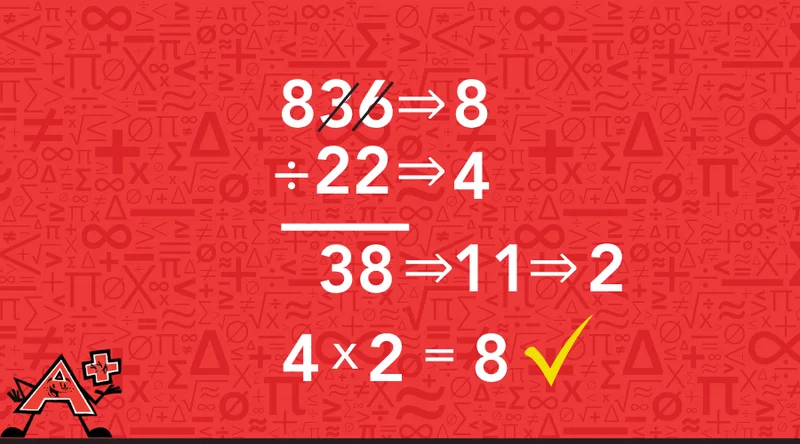
Let's try this with 836 ÷ 22 = 38
Step 1: Find the digital root of each number.
Step 2: Multiply the digital roots of the divisor and the quotient.
4 × 2 = 8
Step 3: Compare to the digital root of the dividend.
Both sides give 8, so this division passes the casting out nines check.
📕 You May Also Like: 3 Ways to Help Your Child Finally Understand Division
Your Turn! Check Your Knowledge of Casting Out Nines
Ready to practice what we’ve covered? Check if these calculations are correct by using the Casting Out Nines method, and check your answers at the bottom of the guide.
-
286 + 347 = 633
-
23 × 35 = 805
-
501 − 215 = 286
-
273 ÷ 13 = 21
FAQs About Casting Out Nines
We put together answers to some of the questions we hear most often from students regarding the Casting Out Nines method.
1. Why does this method only work with nines and not other numbers?
Casting out nines works because of how our number system is built. We use ten digits, 0 through 9, to write every number, which is why it is called base-10.
In this system, every number can be broken down into a multiple of 9 plus a remainder. That remainder is the digital root.
Take 25 as an example. We can write it as (2 × 9) + 7. The digital root is 7 (2 + 5). The multiple of 9 disappears, and only the remainder survives.
Let's try 143. We can write it as (15 × 9) + 8. The digital root is 8 (1 + 4 + 3). Again, the multiple of 9 drops out, and only the remainder is left.
2. Can we use casting out nines to check answers with decimals or fractions?
Casting out nines works with whole numbers only. The method relies on digit sums, and once decimals or fractions enter the picture, the digit positions no longer behave the same way.
3. If the digital roots match, do I still need to recheck my calculation?
Casting out nines tells us our answer is likely correct, but it does not guarantee it. The method catches most arithmetic errors quickly, but it can miss certain mistakes.
Here is an example. Let's say we multiply 46 and 23 and get 1,067 instead of the correct answer 1,058.
Step 1: Find the digital root of each number.
Step 2: Multiply the digital roots of the two factors.
1 × 5 = 5
Step 3: Compare to the digital root of the answer.
As both give 5, casting out nines passes the check, even though the answer is wrong.
Think of it as a first filter, not a final verdict. If the digital roots don't match, you know for certain there's an error. If they do match, it's a strong signal your work is correct, but a full check is still the safest way to be sure.
4. Does casting out nines work with more than two numbers?
Yes. The method works the same way regardless of how many numbers we’re adding or multiplying. We find the digital root of each number, apply the operation to all of them, and compare the result to the digital root of the answer.
For example, let's check: 124 + 233 + 315 = 672
Step 1: Find the digital root of each number.
-
124 → 1 + 2 + 4 = 7
-
233 → 2 + 3 + 3 = 8
-
315 → 3 + 1 + 5 = 9 → cast it out, leaving 0
-
672 → 6 + 7 + 2 → cast out 7 and 2, leaving only 6
Step 2: Add the digital roots of all three addends.
7 + 8 + 0 = 15 → 1 + 5 = 6
Step 3: Compare to the digital root of the answer.
Both sides give 6, so this addition passes the casting out nines check.
For subtraction and division, the method works best with two numbers, as the relationship between the numbers becomes harder to track when more are involved.

Mathnasium tutors use tricks like casting out nines to spark curiosity and then build a deeper understanding behind them.
How Mathnasium Helps Students Understand and Enjoy Arithmetic
Mathnasium is a math-only learning center dedicated to empowering students of all skill levels to learn and master math.
Casting out nines is exactly the kind of mathematical thinking we love at Mathnasium. It goes beyond just a trick. It is a window into how numbers actually behave.
That same curiosity about how numbers work is what our proprietary teaching approach, the Mathnasium Method™, is built to nurture. It helps students experience math logically, step by step, so understanding grows from the ground up.
To foster true mastery and enjoyment of math, our approach relies on:
-
Personalization on a granular level: Each student begins with a diagnostic assessment that identifies their strengths, knowledge gaps, and goals. From those insights, we create a personalized learning plan that meets each student exactly where they are and builds arithmetic skills in a clear, logical sequence.
-
Teaching for understanding: We explain math using clear, everyday language, helping students grasp not just what to do, but why it works. Casting out nines is a perfect example. The trick is fun, but the insight is what it reveals about how numbers behave.
-
Caring guidance: Our specially trained tutors know how to encourage a learner who feels stuck and how to challenge one who is ready for more, keeping each student motivated and engaged.
-
Independent problem-solving and critical thinking: During sessions, we set aside time for students to work through problems on their own, building confidence in their reasoning and helping them verify their own thinking.
-
Singular focus on math: Mathnasium is math-only, and our program spans thousands of pages, refined over more than 20 years. This focused approach allows us to take a deep dive into how students best learn, retain, and enjoy math at every level.
-
Empowering, fun learning environment: Our centers are designed to make math engaging. Sessions often include interactive and game-based materials, because when learning feels fun, students are more curious, confident, and willing to keep going.
The results speak for themselves:
-
94% of parents report improvement in their child's math skills and understanding
-
93% of parents report an improved attitude toward math after attending Mathnasium
-
90% of students saw improvement in their school grades
With over 1,100 learning centers, there is likely a Mathnasium close to you.
Families across Great Neck and nearby areas trust Mathnasium of Great Neck to help their children become confident mathematical thinkers.
Whether your child is looking to catch up, keep up, or get ahead, our team is ready to assist!
📅 Schedule a Free Assessment at Mathnasium of Great Neck
Not near Great Neck?
📍 Find a Mathnasium Learning Center Near You
Pssst! Check Your Answers Here
If you worked through the practice problems, here are the answers:
1. 286 + 347 = 633
-
286 → 2 + 8 + 6 = 16 → 1 + 6 = 7
-
347 → 3 + 4 + 7 = 14 → 1 + 4 = 5
-
633 → We spot 6 + 3 = 9 and cast them out, which leaves 3 only.
We add the digital roots: 7 + 5 = 12 → 1 + 2 = 3. That matches the digital root of 633 (3), so the calculation is correct.
2. 23 × 35 = 805
We multiply the digital roots: 5 × 8 = 40 → 4 + 0 = 4. That matches the digital root of 805 (4), so the calculation is correct.
3. 501 − 215 = 286
We subtract the digital roots: 6 − 8 would be negative, so we add 9: 6 + 9 = 15, and 15 − 8 = 7. That matches the digital root of 286 (7), so the calculation is correct.
4. 273 ÷ 13 = 21
We multiply the digital roots of the divisor and the quotient: 4 × 3 = 12 → 1 + 2 = 3. That matches the digital root of 273 (3), so the calculation is correct.
How did you do?


 (516) 550-9031