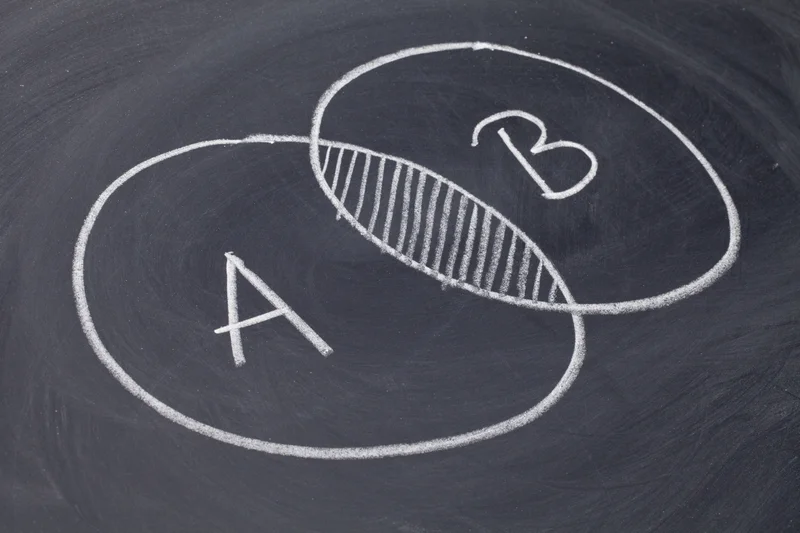
Students first meet the Venn diagram in elementary school as a way to show how two or more groups relate to each other, using circles.
When the circles overlap, it means some items belong to both groups at the same time. Common questions ask how many items fall into that overlap. For example, if some students in a class play soccer and some play basketball, how many play both?
Today, we'll find out how to solve this type of Venn diagram problem, finding the overlap between two groups, in two ways: first using the diagram itself, and then using a formula.
How to Read a Venn Diagram With Overlaps
To read a Venn diagram with overlaps, look at each section of the circles. The overlapping area shows the items that belong to both groups, while the non-overlapping parts show items that belong to only one group.
At Mathnasium, we like explaining abstract concepts like Venn diagrams through examples. Let’s picture a class survey about pets as a Venn diagram.
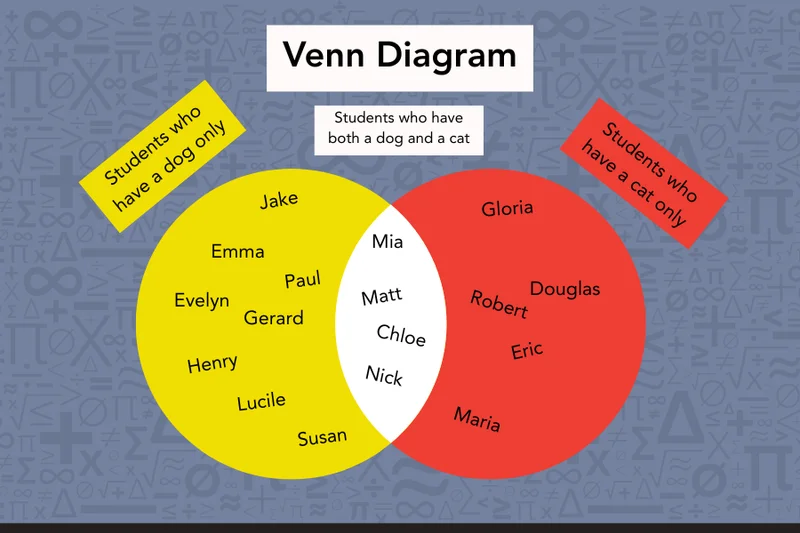
Some students have a dog, some have a cat, and some have both. On the diagram, we would see:
-
The left section: students who have a dog only
-
The right section: students who have a cat only
-
The overlap in the middle: students who have both a dog and a cat
Every student in the class fits into one of these three sections, and each student belongs in exactly one section. Classmates with both a dog and a cat belong in the overlap. The “dog only” section is for classmates with a dog and no cat.
The overlap shows the shared part of the diagram. When we work with numbers, that section helps us avoid counting the same item twice
📕 You May Also Like: 5 Practical Ways to Use Diagrams and Drawings for Math Problems
Finding the Missing Overlap With a Diagram (Solved Example)
Let’s see how we can use a Venn diagram to find the missing overlap, when a problem gives us the total number of items and both group totals.
A bakery display has 30 cupcakes. 20 cupcakes have chocolate frosting. 15 cupcakes have sprinkles. Every cupcake has chocolate frosting, sprinkles, or both. How many cupcakes have both chocolate frosting and sprinkles?
Step 1: Add the Two Full Groups
First, we add the cupcakes with chocolate frosting and the cupcakes with sprinkles:
20 + 15 = 35
But the display has only 30 cupcakes. Our count is 5 too high.
Step 2: Use the Extra Count to Find the Overlap
The total number is too big because the cupcakes with both chocolate frosting and sprinkles were counted twice: once in the chocolate-frosting group and once in the sprinkles group. So the extra 5 belongs in the overlap:
35 − 30 = 5
That means 5 cupcakes have both chocolate frosting and sprinkles.
Step 3: Fill in the “Only” Sections
Now that we know the overlap, we can find each “only” section. The chocolate-frosting group has 20 cupcakes total, and 5 of them also have sprinkles:
20 − 5 = 15
So, 15 cupcakes have chocolate frosting only. The sprinkles group has 15 cupcakes total, and 5 of them also have chocolate frosting:
15 − 5 = 10
So, 10 cupcakes have sprinkles only.
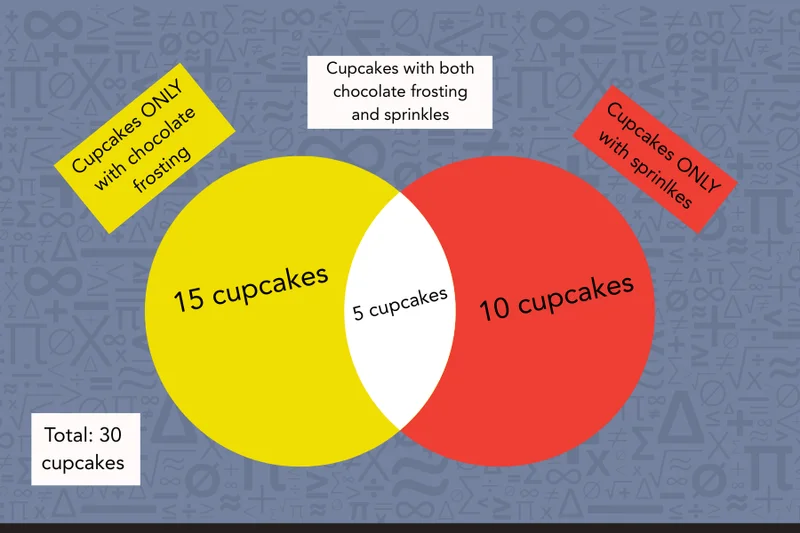
Now every cupcake is counted once: 15 cupcakes with chocolate frosting only, 10 with sprinkles only, and 5 with both.
📕 You May Also Like: How to Use Model Drawing for Word Problems (+Examples)
How to Count Overlapping Sets With a Formula
To count overlapping sets without drawing the full Venn diagram, we add both group totals, then subtract the overlap once. This keeps us from counting the same item twice:
Total = Group A + Group B − Both
Or we can write it with more formal notation. We use n to stand for the number of items in a group, so n(A) is the number of items in group A, and n(B) is the number of items in group B.
-
To write the total of two groups, we use the symbol ∪, which stands for union.
-
To write the number of items that fall into both groups, we use the symbol ∩, which stands for intersection, the overlap in the Venn diagram.
Using this notation, we can write the formula this way:
n(A ∪ B) = n(A) + n(B) − n(A ∩ B)
Let's see how it works through an example. Say a shelf has 23 books. Of those books, 17 are science books, and 8 are books about animals. Some books fit both groups, such as a science book about animal behavior.
If we add the two groups right away, we get:
17 + 8 = 25
But there are only 23 books on the shelf. The extra 2 comes from the overlap: the books that are both science books and books about animals. Those books were counted once in the science group and once in the animal-books group.
That is why we add both groups first, then subtract the overlap once. This is called the inclusion-exclusion principle, we include both group totals, then exclude the extra count from the overlap.
The 2 books are both science books and animal books. If 2 books are both, then:
17 − 2 = 15 science books only
8 − 2 = 6 animal books only
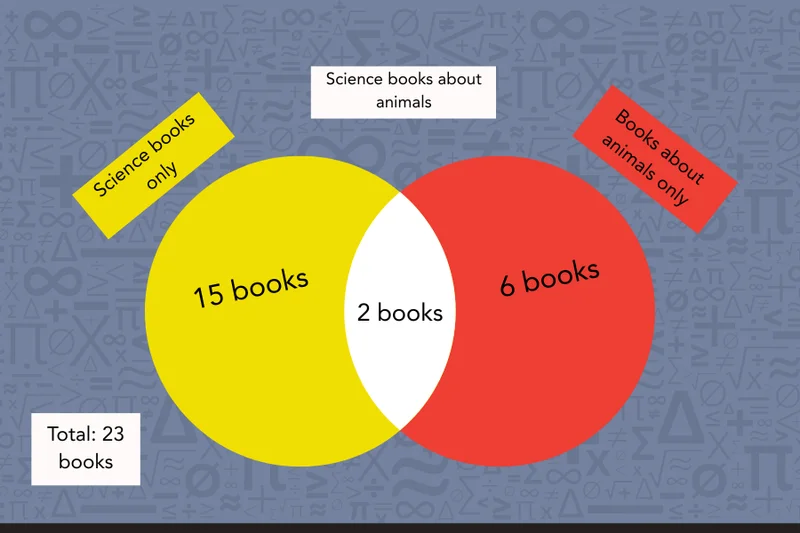
Each part of the formula matches the diagram. n(A) and n(B) are the full circles. n (A ∩ B) is the overlap in the middle. When we subtract it once it brings the count back to the actual total, so every book is counted one time.
📕 You May Also Like: 7 Tips to Help Your Child Memorize Math Formulas
Using the Formula to Find the Overlapping Set (Solved Example)
Now, we’ll put the formula to work to find the overlapping set.
Imagine you have 18 students, 12 students play guitar, 10 students play piano. Every student plays guitar, piano, or both. How many students play both instruments? Here's how we solve it.
For this problem, the two groups are guitar players and piano players, so we plug in what we know: n(A ∪ B) = 18 students total, n(A) = 12 guitar players, and n(B) = 10 piano players. n(A ∩ B) is students who play both.
18 = 12 + 10 − n(A ∩ B)
18 = 22 − n(A ∩ B)
To find n(A ∩ B), we solve the equation the same way we would with any variable.
18 = 22 − n(A ∩ B)
We add n(A ∩ B) to both sides, so it's no longer negative:
18 + n(A ∩ B) = 22
Then we subtract 18 from both sides to isolate n(A ∩ B):
n(A ∩ B) = 22 − 18
n(A ∩ B) = 4
So, n(A ∩ B) = 4. That means 4 students play both instruments. We can check the answer by thinking through the sections of the Venn diagram. If 4 students play both instruments, then:
12 − 4 = 8 guitar only
10 − 4 = 6 piano only
Now we add each section once:
8 + 6 + 4 = 18
The total matches, so the overlap is correct.
📕 You May Also Like: 7 Common Mistakes Students Make in Math Word Problems
Your Turn! Find the Overlap Yourself
Try solving these two challenges on your own and check your answers at the bottom of the page. Use whichever method feels right, drawing the diagram or applying the formula.
Challenge 1: In a class of 25 students, 14 play soccer and 15 play basketball. Every student plays at least one of the two sports. How many students play both?
Challenge 2: A survey of 40 kids at a summer camp found that 22 like swimming and 19 like hiking. Every kid likes swimming, hiking, or both. How many kids like both activities?
Once you’re done, check your answers at the bottom of the guide.
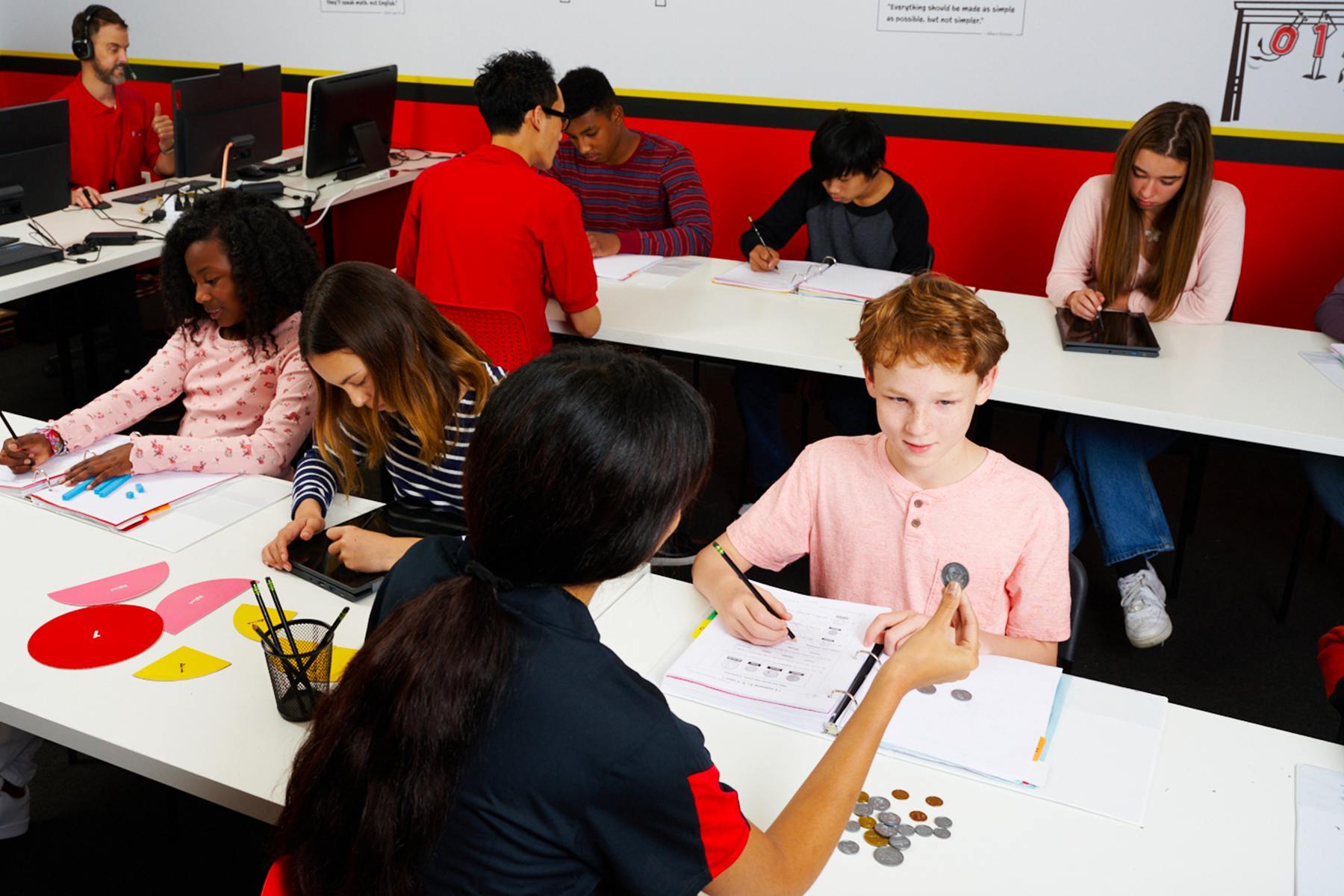
Mathnasium tutors use personalized learning plans and interactive teaching techniques to help students understand how Venn diagrams organize overlapping sets and make word problems easier to solve.
How Mathnasium Helps Students With Venn Diagram Problems (and Any Other Math Topic)
Mathnasium is a math-only learning center dedicated to helping K–12 students of all skill levels excel in math.
We work with students to build a solid understanding of math concepts, like Venn diagrams and overlapping sets, instead of just memorizing formulas.
Our specially trained tutors use a proprietary teaching approach, the Mathnasium Method™, to meet students where they are and guide them toward math mastery, step by step.
Each student begins their Mathnasium journey with a diagnostic assessment, which lets us identify their current skills, knowledge gaps, and how they think about math, including the logic, number sense, and problem-solving skills behind topics like Venn diagrams.
Using these insights, we create a personalized learning plan focused on the skills the student needs most. Our tutors follow the plan closely, delivering face-to-face instruction in a supportive environment, both in-center and online. They use a mix of verbal, visual, written, tactile, and mental techniques so each concept lands clearly.
During sessions, students learn to connect visual models to formulas, explain why each step works, and apply the same reasoning to new problems. This helps them build problem-solving skills and critical thinking they can use across math topics.
Fun is a core part of our approach, too. We use game-based activities, let students earn rewards, and celebrate their progress together, so learning stays enjoyable and confidence grows with every session.
Families see the difference:
-
94% of parents report improvement in their child’s math skills and understanding
-
93% of parents report a more positive attitude toward math after attending Mathnasium
-
90% of students saw improvement in their school grades
With over 1,100 learning centers across North America, there is likely a Mathnasium close to you.
For families in and near Great Neck, Mathnasium of Great Neck brings that same approach close to home.
If Venn diagrams or any other math concept feels shaky, a free diagnostic assessment is the right place to start.
📅 Schedule a Free Assessment at Mathnasium of Great Neck
Not near Great Neck?
📍 Find a Mathnasium Learning Center Near You
Pssst! Check Your Answers Here
Here are the worked solutions to the practice problems above.
Challenge 1
We’ll use the formula: n(A ∪ B) = n(A) + n(B) − n(A ∩ B). For this problem, the two groups are soccer players and basketball players: n(A ∪ B) = 25 students total, n(A) = 14 soccer players, and n(B) = 15 basketball players. n(A ∩ B) is students who play both.
25 = 14 + 15 − n(A ∩ B)
25 = 29 − n(A ∩ B)
To find n(A ∩ B), we solve the equation the same way we would with any variable.
25 = 29 − n(A ∩ B)
We add n(A ∩ B) to both sides, so it's no longer negative:
25 + n(A ∩ B) = 29
Then we subtract 25 from both sides to isolate n(A ∩ B):
n(A ∩ B) = 29 − 25
n(A ∩ B) = 4
So, n(A ∩ B) = 4. That means 4 students play both soccer and basketball. We can check the answer by thinking through the sections of the Venn diagram. If 4 students play both sports, then:
14 − 4 = 10 soccer only
15 − 4 = 11 basketball only
Now we add each section once:
10 + 11 + 4 = 25
The total matches, so the overlap is correct. ✓
Challenge 2
We’ll use the formula: n(A ∪ B) = n(A) + n(B) − n(A ∩ B). For this problem, the two groups are kids who like swimming and kids who like hiking: n(A ∪ B) = 40 kids total, n(A) = 22 who like swimming, and n(B) = 19 who like hiking. n(A ∩ B) is kids who like both.
40 = 22 + 19 − n(A ∩ B)
40 = 41 − n(A ∩ B)
To find n(A ∩ B), we solve the equation the same way we would with any variable.
40 = 41 − n(A ∩ B)
We add n(A ∩ B) to both sides, so it's no longer negative:
40 + n(A ∩ B) = 41
Then we subtract 40 from both sides to isolate n(A ∩ B):
n(A ∩ B) = 41 − 40
n(A ∩ B) = 1
So, n(A ∩ B) = 1. That means 1 kid likes both swimming and hiking. We can check the answer by thinking through the sections of the Venn diagram. If 1 kid likes both activities, then:
22 − 1 = 21 kids like swimming only
19 − 1 = 18 kids like hiking only
Now we add each section once:
21 + 18 + 1 = 40
The total matches, so the overlap is correct. ✓


 (516) 550-9031