How do architects figure out how tall a building will be from a small drawing on paper? They rely on proportions to keep lengths and dimensions in scale.
But when a proportion includes an unknown value or larger numbers, the calculations can start to feel messy. That’s where cross-multiplication comes in. It gives us a fast way to turn two equal ratios into an equation we can solve.
Let’s see how this shortcut works step by step, and look at the mistakes to watch for along the way.

Quick Review: What Is a Proportion?
A proportion is an equation that shows two ratios describe the same relationship between quantities.
Here’s how it works:
Suppose a recipe uses 2 cups of flour for 12 cookies. If we want to make 18 cookies, how many cups of flour will we need?
We already know one flour-to-cookie ratio: 2 cups for 12 cookies. For 18 cookies, the amount of flour is unknown, so we can call it x.
As we want the recipe to keep the same balance of flour to cookies, the new ratio has to be equivalent to the original one. That gives us:
\(\Large\frac{2}{12} = \Large\frac{x}{18}\).
Both ratios compare the same quantities in the same order: cups of flour to number of cookies. That’s the core idea behind a proportion. We set two ratios equal because they describe the same relationship at different sizes.
We can use proportions any time we scale quantities while keeping the relationship between them the same. Here are a few more places you might see them:
|
Real-Life Example
|
What the Proportion Compares
|
|
Map scale
|
Inches on the map to miles in real life.
|
|
Scale model rocket
|
Inches on the model rocket compared with feet on the real rocket.
|
|
Currency exchange
|
One currency’s value to another’s.
|

How to Solve Proportions With Cross-Multiplication
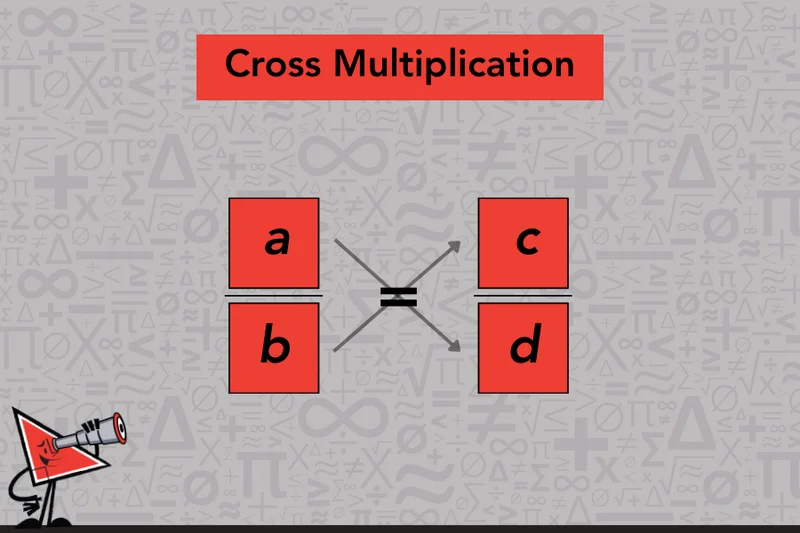
To solve a proportion using cross-multiplication, we work through these steps:
Let’s apply these steps to the proportion: \(\Large\frac{2}{12} = \Large\frac{x}{18}\):
Without cross-multiplication, we could clear both denominators by multiplying both sides by 12 × 18:
12 × 18 × (\(\Large\frac{2}{12}\)) = 12 × 18 × (\(\Large\frac{x}{18}\))
The denominators cancel out, and we get:
2 × 18 = 12x
After clearing the fractions, each numerator ended up paired with the denominator diagonally across from it:
-
The numerator of the first ratio, 2, pairs with the denominator of the second ratio, 18.
-
The denominator of the first ratio, 12, pairs with the numerator of the second ratio, x.
Because of this crossing pattern, we call this method cross-multiplication. Instead of writing out all the denominator-canceling steps every time, we multiply diagonally across the equal sign.
Now, we’ll put the method to use. Imagine a game gives you 5 bonus coins for every 3 challenges you complete. If you complete 12 challenges and the rate stays the same, how many bonus coins will you earn?
Step 1: Set up the proportion
We start by translating the word problem into a proportion. To do that, we need to:
-
Identify what the problem compares. Here, we’re comparing completed challenges to bonus coins.
-
Write the ratio we already know. The problem tells us that 3 completed challenges earn 5 bonus coins, so our first ratio is: \(\Large\frac{3}{5}\).
-
Write the second ratio. We know there are 12 completed challenges, but we still need to find the number of bonus coins. We can let x stand for that unknown amount, and our second ratio will look like this: \(\Large\frac{12}{x}\).
-
Set the ratios equal. Both ratios compare challenges to coins, so we can write: \(\Large\frac{3}{5} = \Large\frac{12}{x}\).
Our proportion is \(\Large\frac{3}{5} = \Large\frac{12}{x}\).
📕 You May Also Like: 6 Ways to Help Your Child Understand Proportionality
Step 2: Cross-multiply and set the products equal
Now that our proportion is set up, we multiply diagonally across the equal sign:
That gives us:
3x = 5 × 12
3x = 60
Step 3: Solve the equation
To isolate x, we divide both sides by 3:
3x ÷ 3 = 60 ÷ 3
x = 20.
So, after completing 12 challenges, you’ll earn 20 bonus coins.
📕 You May Also Like: How to Cross Multiply Fractions and Proportions
What to Watch For When Solving Proportions With Cross-Multiplication
At Mathnasium, we noticed that students tend to make the same few errors when they first start using cross-multiplication. To help you catch them early, our tutors put together a quick overview.
A. Mixing up the order of the ratios
Keep the quantities in the same order on both sides. Suppose you’re making a fruit punch with 4 cups of juice for every 3 cups of sparkling water, and you want to know how much juice you need for 12 cups of sparkling water.
When setting up the proportion, you may accidentally reverse the second ratio and write:
\(\Large\frac{3}{4} = \Large\frac{x}{12}\).
But now the order has changed. In the first ratio, the numerator represents sparkling water, and the denominator represents juice. In the second ratio, x represents juice and 12 represents sparkling water, so the quantities are in the opposite order.
To keep the ratios consistent, we need:
\(\Large\frac{3}{4} = \Large\frac{12}{x}\).
That way, sparkling water stays on top and juice stays on the bottom in both ratios.
Before you write the proportion, we recommend labeling what each number represents to keep the quantities in the same order on both sides.
B. Multiplying straight across instead of diagonally
With cross-multiplication, we multiply diagonally, then set the two products equal. Take this proportion:
\(\Large\frac{2}{3} = \Large\frac{x}{9}\)
2 × 9 = 3 × x
18 = 3x.
Straight-across multiplication, such as 2 × 3 and x × 9, gives us the wrong pair of products.
C. Treating a proportion like an addition pattern
In a proportion, both quantities change by the same factor rather than by the same added amount. Say we’re working on this proportion:
\(\Large\frac{2}{5} = \Large\frac{6}{15}\).
You might notice that 2 becomes 6 by adding 4 and think the same rule should apply to the denominator. That would mean adding 4 to 5 as well:
But the denominator should be 15, not 9. Instead, look for the same multiplication factor in both quantities:
That tells us the two ratios are proportional.
📕 You May Also Like: How to Solve Proportions: Four Methods and When to Use Each
Try Cross-Multiplying Yourself!
Practice setting up a proportion and solving it with cross-multiplication on your own. You can check your answers at the bottom of the page.
Problem 1
A photocopier enlarges a 4-inch by 6-inch photo so that the 4-inch side becomes 10 inches. What does the 6-inch side become?
Problem 2
Mia runs 3 miles in 24 minutes. At the same pace, how long will it take her to run 8 miles?
📕 You May Also Like: 5 Ways Math Practice Impacts Brain Development + Benefits

At Mathnasium, we use personalized learning plans and proven teaching techniques to help students master any math skill or topic, proportions included.
How Mathnasium Helps Students With Proportions (and Any Other Math Topic)
Mathnasium is a math-only learning center dedicated to helping K–12 students of all skill levels excel in math.
Whether a student is learning to recognize equivalent ratios, solve a missing-value proportion, or use cross-multiplication efficiently, our specially trained algebra tutors help them understand why the method works instead of treating it as a shortcut to memorize.
To support that understanding, we use the Mathnasium Method™, our proprietary teaching approach, to meet students where they are and guide them forward step by step.
Each student begins with a diagnostic assessment that helps us understand their current skill level, knowledge gaps, goals, and how they think and feel about math. For proportions, that may include looking at how comfortably they work with fractions, ratios, equivalent values, and equations.
Using these insights, we build a personalized learning plan focused on the skills the student needs most, whether that means reinforcing ratio reasoning, solving proportions, understanding cross-multiplication, or preparing for later work with rates, percentages, and algebra.
Our tutors follow that plan closely and provide live, face-to-face instruction in a caring and fun group environment. They use mental, verbal, visual, tactile, and written techniques to help students compare ratios, connect equivalent fractions, explain each step of a proportion, and see why cross-multiplication produces an equivalent equation.
Students also get room to think through problems before tutors step in. Our tutors guide them to explain their reasoning, check whether two ratios are equivalent, and decide whether their answer makes sense in context. This helps students build critical thinking, problem-solving skills, and greater independence in math.
Fun is part of the approach, too. We use game-based activities, rewards, and consistent encouragement to keep students engaged as they work with ratios, proportions, and related math concepts.
The results speak for themselves:
-
94% of parents report an improvement in their child's math skills and understanding
-
93% of parents report their child's improved attitude toward math after attending Mathnasium
-
90% of students saw an improvement in their school grades
With over 1,100 learning centers across North America, there is likely a Mathnasium close to you.
For families in and near Orlando, Florida, Mathnasium of Lake Nona brings that same approach close to home, with specially trained tutors who help students make sense of ratios, proportions, and the algebraic reasoning that builds from them.
If your child gets stuck with proportions, cross-multiplication, or any other math concept, a free diagnostic assessment is a great place to start. Using what we learn, we create a personalized learning plan focused on the skills they need next.
📅 Schedule a Free Assessment at Mathnasium of Lake Nona
Not near Lake Nona?
📍 Find a Mathnasium Learning Center Near You
Pssst…! Check Your Answers Here
How did cross-multiplication go? Here are the answers to the practice problems above.
Problem 1
The 6-inch side becomes 15 inches.
We compare inches on the original photo to inches after enlarging: \(\Large\frac{4}{6} = \Large\frac{10}{x}\). Cross-multiplication gives us: 4x = 6 × 10 = 60. We divide both sides by 4 and get: x = 15.
Problem 2
It will take Mia 64 minutes.
We compare miles to minutes: \(\Large\frac{3}{24} = \Large\frac{8}{x}\). After cross-multiplying, we get: 3x = 24 × 8 = 192. Then, we divide both sides by 3, which leaves us: x = 64.


 (407) 243-6284