Advanced math concepts like derivatives can feel confusing at first because students may learn how to calculate them before they understand what they mean.
In our tutoring work at Mathnasium, we often see learners use the power rule correctly and get every answer right, but then go blank when they need to use the idea in an unfamiliar problem.
We believe lasting fluency with rules and formulas grows from understanding the idea behind the concept. When students understand what a derivative represents first, the rules that come later become easier to remember, explain, and use.
That is why, before we touch a single rule, we're going to build a true sense of what a derivative is, using graphs to see what's happening at a single point.

What Is a Derivative?
A derivative is a tool that measures how fast something is changing at one exact moment.
Think about a car's speedometer. Speed tells us how quickly the car's position is changing over time.
When the speedometer reads 60 mph, it is showing the car's speed at that exact moment. It tells us how fast the car is moving right now.
Derivatives can give us “right now” information about any changing amount, such as distance, temperature, or population. They tell us how fast that amount is changing at one specific instant.
📕 You May Also Like: 5 Math Skills to Use for Learning Limits (Prep for Calculus)
A Derivative As the Slope of a Curve
We can think of a derivative visually as the slope of a curve at a single point on a graph.
Let’s start with something we already know: the slope of a straight line. No matter where we measure it, a straight line has the same slope all the way across. Its steepness does not change.
But how do we describe a curve’s steepness? It can get steeper, flatter, or change direction as we move along it. Because of this, a curve does not have one single slope for the whole graph. Instead, we need a way to find the slope at one specific point.
We can do that with a derivative. Here is the idea:
-
We choose two points on the curve that are very close together and find the slope between them. Then we imagine moving those points closer and closer together.
-
As the space between them gets smaller, the slope between them gets closer to the slope of the curve at that single point. The straight line that matches the curve’s steepness at that point is called the tangent line. The derivative is the slope of that tangent line.
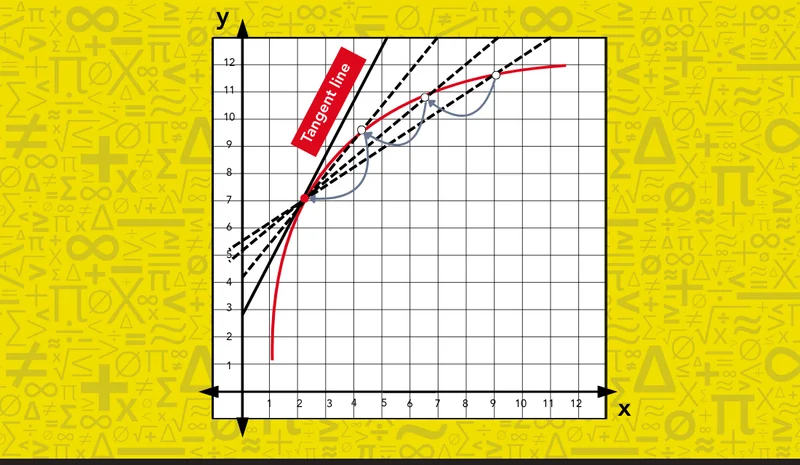
Now we know that a derivative gives us the slope at one exact point. But a curve does not always have the same steepness everywhere, so the derivative can change from one point to the next. Let’s see how that works in an example.
Imagine a curve that is steep near the start and gradually flattens out later on.
-
Near the steep part, point A, the derivative gives us a large positive number because the curve is climbing quickly.
-
Near the flatter part, point B, the derivative gives us a small positive number, close to zero, because the curve is barely climbing at all.
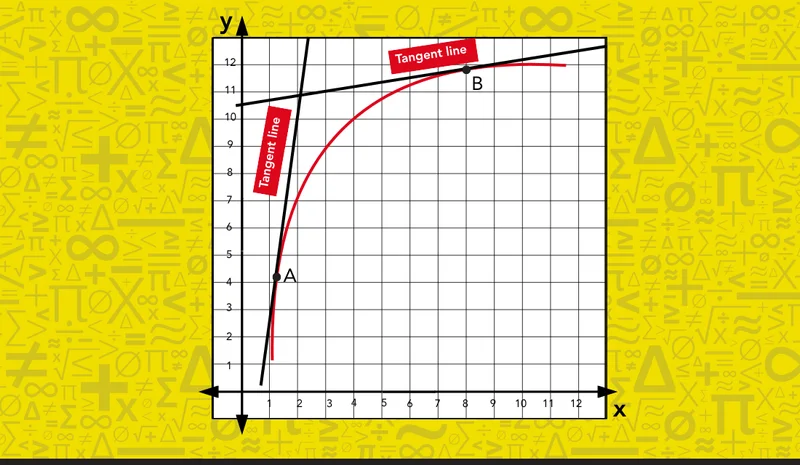
It is the same curve, but the slope changes depending on exactly where we are. That changing slope is what the derivative captures at each point.
📕 You May Also Like: How to Find the Slope of a Line—A Kid-Friendly Guide
How to Write a Derivative
Derivatives are usually written as f′(x). It is a formal notation for the idea we've already covered:
-
the rate of change,
-
the slope at a point.
f′(x), read as “f prime of x,” simply means “the derivative of the function f.”
Here's how that notation might look in practice. Say a function f(x) describes your distance from home after x minutes of driving.
If f′(10) = 2, that tells you that at exactly 10 minutes, you're covering 2 miles for every minute that passes, in other words, your speed at that instant is 2 miles per minute:
-
The "10" tells us when we're checking (10 minutes in),
-
The "2" tells us the rate at that exact moment.
📕 You May Also Like: Functions vs. Equations: What Is the Difference?
Reading a Derivative on a Graph
Derivatives show up anywhere a quantity is changing, and we want to know how fast. Here are a few examples:
Example 1: Elevation of a Hiking Trail
Picture a graph that shows the elevation of a hiking trail as you move along it, distance on the x-axis, elevation on the y-axis.
The red curve climbs steadily for the first mile or so, peaks around the 0.8-mile mark at roughly 1,100 feet, then heads back downhill toward the end of the trail.
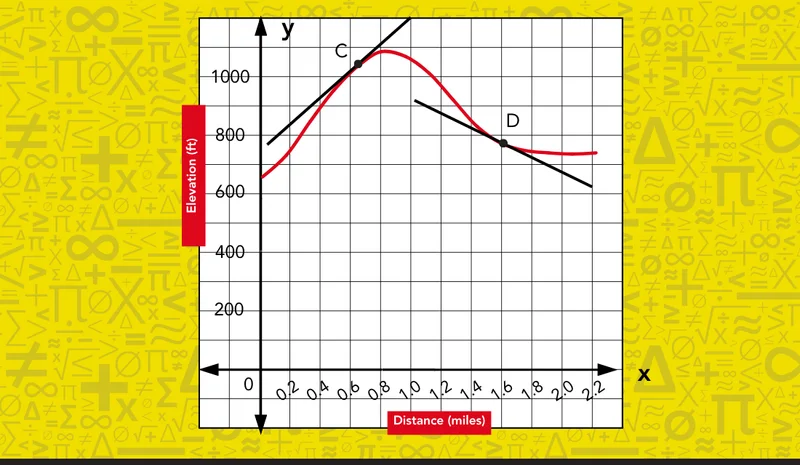
Look at the two points marked on the curve.
-
At the point C, just before the summit, the tangent line tilts upward. The derivative there is positive. That means you are still climbing.
-
At the point D, farther down the descent, the tangent line tilts steeply downward. The derivative there is negative. That tells us your elevation is decreasing, and because the line is steep, you are losing elevation quickly.
So the derivative tells us two things at once:
If we kept checking points all the way to the very top, we would eventually find a flat tangent line with a slope of 0. That marks the exact moment when you are no longer climbing and have not yet started descending. In other words, you are right at the peak.
📕 You May Also Like: What Is a Negative Slope? A Step-By-Step Guide
Example 2: A Runner's Pace
Imagine you are running a 5K and checking your GPS watch as you go. Your pace keeps updating because your speed changes throughout the race. We can build a graph of your distance traveled over time, with distance on the y-axis and minutes on the x-axis.
The graph might start steep, flatten out during a harder middle stretch, then get steeper again near the finish.
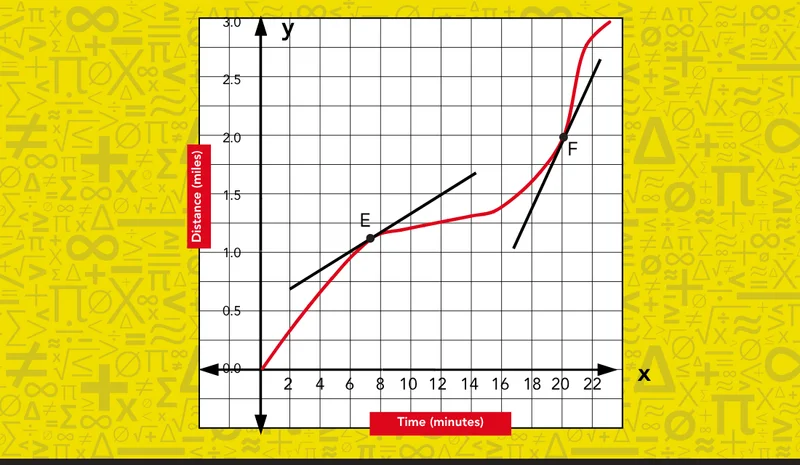
Now we’ll look at the two points marked on the curve.
-
At the point E, around the 8-minute mark, you have covered about 1.15 miles. The tangent line there tilts upward at a moderate angle, showing your speed at that exact instant, right before the hill slows you down.
-
At the point F, around the 20-minute mark, you have covered about 2 miles. The tangent line there tilts upward more steeply. That steeper slope tells us you are covering distance faster at that exact moment than you were at the first point, even though your overall pace since the start looks slower, since the hill in between dragged your average down. This is your final push, so your GPS watch would show a faster speed, or a lower minutes-per-mile pace, than it did earlier.
Unlike the hiking trail, both tangent lines here point upward. That's because this graph plots distance covered against time, and distance covered can only grow or stay flat as time passes. Even if you stopped completely to tie your shoe, your total distance wouldn't go down, it would just pause.
So the slope of this curve is always positive or zero, never negative. That's different from elevation, which can go up when you climb and down when you descend.
📕 You May Also Like: A Parent's Guide to How Math Builds K-12

At Mathnasium, tutors help students make sense of advanced concepts such as derivatives by connecting graphs, rates of change, and real-life examples in clear, student-friendly ways.
How Mathnasium Helps Students Build True Understanding of Advanced Math Topics (and Beyond)
Mathnasium is a math-only learning center that helps K–12 students of all skill levels with math, whether they need to catch up, keep up, or get ahead.
We work with students to build a solid understanding of math concepts, including advanced topics like derivatives, so that notation and formulas feel less like symbols to memorize and more like tools they can comfortably use.
To support that understanding, we use the Mathnasium Method™, our proprietary teaching approach, to meet students where they are and guide them toward math mastery, step by step.
Here is how it works:
-
Each Mathnasium student begins with a diagnostic assessment. It helps us identify their current skills, learning gaps, and how they think about math overall.
-
Using these insights, we create a personalized learning plan focused on the skills the student needs most, whether that means building algebra foundations or intuition around rates of change, reviewing functions and graphs, or getting support with derivatives and related concepts.
-
Our specially trained tutors follow the plan closely, delivering face-to-face instruction in a caring and supportive group environment, both in-center and online. We teach through a mix of visual, verbal, written, tactile, and mental techniques so abstract ideas like derivatives feel clear.
-
We also give students room to think through unfamiliar problems before stepping in. They guide students to look for structure, explain their reasoning, check whether their answers make sense, and connect new ideas to the skills they already know. This balance helps students build problem-solving skills, critical thinking, and greater independence in advanced math.
-
Fun is a core part of our approach, too. For older students, that often means engaging challenges, meaningful progress, encouragement, and rewards that help keep motivation steady even when the math becomes demanding.
The results speak for themselves:
-
94% of parents report improvement in their child’s math skills and understanding
-
93% of parents report a more positive attitude toward math after attending Mathnasium
-
90% of students saw improvement in their school grades
With over 1,100 learning centers across North America, there is likely a Mathnasium close to you.
Mathnasium of Lake Nona brings that same approach close to families Lake Nona, FL, and the surrounding communities.
If derivatives, other advanced courses, or the skills beneath them feel shaky, a free diagnostic assessment is a great place to start. From there, we’ll create a personalized learning plan that helps your child master the skills they need next.
📅 Schedule a Free Assessment at Mathnasium of Lake Nona
Not near Lake Nona?
📍 Find a Mathnasium Learning Center Near You


 (407) 243-6284