Math is a ladder where every concept your child learns is a rung, and every rung depends on the ones below it.
If your child truly understands fractions in 5th grade, they're already building the foundation for algebra. If they reach algebra with shaky fraction knowledge, they'll feel like they've hit a wall, even if they can't explain why.
Let's take a tour of that ladder from bottom to top, looking at how math builds from kindergarten through high school, what matters at each stage, and what to watch for as your child climbs. Understanding the structure helps you support them with confidence.

Kindergarten Through Grade 2 — Number Sense and the Building Blocks of Arithmetic
Before children can add, subtract, or do anything else with numbers, they need to understand what numbers are. That's the work of the early grades, and it's more sophisticated than it looks.
In kindergarten through 2nd grade, our young learners are building what educators call number sense, an intuitive feel for how numbers relate to each other, how quantities can be broken apart and put back together, and how our base-ten system works.
When taught properly, at this stage, they're learning to count with meaning rather than just reciting a sequence. They're exploring shapes, comparing lengths, and beginning to add and subtract, first with objects, then with numbers alone.
These early concepts are easy to underestimate. We know that developing number sense in the early grades is one of the most reliable predictors of math success later on (Source: ten Braak et al.).
What "on track" looks like at this stage has little to do with speed or memorization. We need to prioritize understanding.
A 2nd grader who can tell you that 47 is made up of 4 tens and 7 ones, and who can reason about whether an answer makes sense, is doing exactly the right kind of math work, even if they're still counting on their fingers sometimes.
📕 You May Also Like: 7 Tips to Help Your Child Build Number Sense
Grades 3 Through 5 — Multiplication, Fractions, and the Most Critical Years
If there is one stretch of the math ladder that deserves your full attention (and, ideally, professional support), it's this one.
Third through 5th grade is where math makes its first significant leap, moving from the familiar world of counting and adding to the more demanding terrain of multiplication, division, and fractions.
Multiplication and division arrive in 3rd grade, and with them comes a shift in thinking. Your child is moving beyond simply combining quantities towards reasoning about equal groups, arrays, and the relationship between operations.
Fluency matters here, but again, so does understanding. This is when memorization without understanding backfires, as students are almost guaranteed to struggle once those multiplication facts need to be applied in new ways.
Then come fractions, and this is where the ladder gets its most consequential rungs.
In an article published in Psychological Science, Siegler et al. (2012) found that 5th graders' fraction knowledge is a powerful long-term predictor of high school math achievement, even after controlling for IQ, reading, working memory, and family background.
The difficulty is that fractions require a real conceptual shift. A fraction isn't a pair of whole numbers stacked on top of each other; it's a single value that lives on the number line. Kids who don't make that shift tend to apply rules they don't fully understand, leading to consistent errors down the road.
Tools like fraction models, area models, and number lines may look unfamiliar if you learned math differently, but they're specifically designed to build conceptual understanding before procedures are introduced.
By 5th grade, your child is also working with decimals, connecting them to fraction knowledge, and tackling multi-step word problems that require careful reasoning about which operation applies and why.
📕 You May Also Like: How to Help Your Child Make Sense of Wholes and Fractions
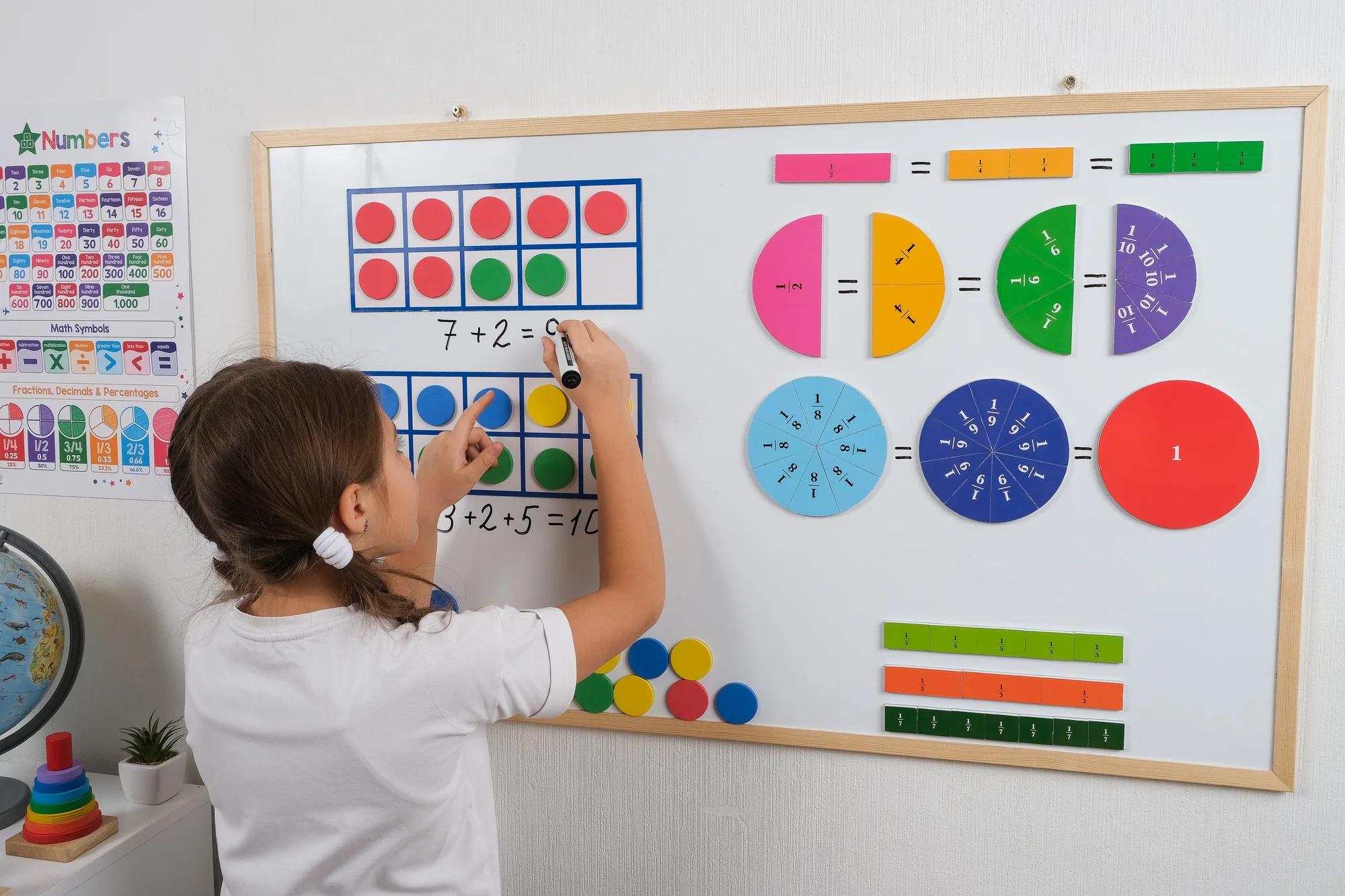
A study found that 5th graders' fraction knowledge is a powerful predictor of high school math achievement
Grades 6 Through 8 — The Bridge to Abstract Thinking
Middle school is where the math ladder starts to feel steeper, and where we see kids who got by just fine in elementary school suddenly find themselves struggling to keep up.
It's not that the work got harder for no reason. Middle school math is the bridge between the concrete arithmetic your child has been building for years and the abstract reasoning that high school math demands. The shift is real, and it's intentional.
In 6th grade, students move into ratios and proportional reasoning, learning to compare quantities and think in terms of relationships rather than fixed values. This is also when negative numbers, variables, and expressions make their first real appearance, and for many students, that's the moment math starts to feel like a foreign language.
7th and 8th grade deepen that work considerably. Your child will encounter linear equations, functions, and the foundational ideas of geometry, including angle relationships, transformations, and the Pythagorean theorem. Statistics and probability also enter the picture, asking students to interpret data and reason about uncertainty.
The National Mathematics Advisory Panel (2008) identified proficiency in rational numbers and algebra as the critical gateway to higher math. Put simply, a student who reaches high school without a solid grasp of proportional reasoning and pre-algebra is starting at a disadvantage, regardless of how capable they are.
This is a natural moment to think about where your middle schooler stands.
-
Are they catching up after a gap formed in elementary school?
-
Keeping up but feeling the pressure of a faster pace?
-
Or ready to get ahead and explore more challenging material?
Each situation calls for a different kind of support, but all three are workable with the right approach.
📕 You May Also Like: Why Your Straight-A Student Suddenly Can't Do 6th Grade Math
Grades 9 Through 12 — From Algebra to Calculus and Everything Between
High school math can look different from one student to the next, and that's by design.
The typical progression moves through Algebra 1 (for students who haven't completed it in 8th grade), Geometry, Algebra 2, and Precalculus. From there, some students go on to Calculus or Statistics, while others consolidate their skills and focus on applied math coursework. Both paths can represent a successful math journey, and neither says anything definitive about a student's ability or potential.
What high school does add, quite visibly, is stakes.
The SAT® and ACT® both include substantial math sections that draw directly on algebra, geometry, and data analysis skills. A student with gaps from earlier grades will feel that pressure acutely because those tests are measuring the rungs of the ladder they've already climbed (or, perhaps, skipped over).
Algebra 2 and Precalculus are worth a particular mention. These courses ask students to hold multiple abstract ideas in mind at once, work fluently with functions, and apply reasoning across unfamiliar problem types.
For students who have solid foundations, these courses feel challenging but manageable. For those carrying unresolved gaps, they can feel overwhelming in a way that's hard to recover from mid-year.
Here, we need to take a quick pause to emphasize that it is never too late to address gaps from earlier on the ladder! It just takes more deliberate work, but the rungs can still be rebuilt.
📕 You May Also Like: Preparing for High School Math: A Roadmap for Success
Signs Your Child May Have a Gap on the Ladder
Parents often sense something is off before they can name it. A child who used to feel fine about math starts avoiding homework, or grades that held steady begin to slip as topics become more abstract.
A few things worth paying attention to:
-
Homework that takes significantly longer than it should.
-
Growing anxiety or frustration around math that goes beyond a hard week.
-
A concept your child understood last year that seems to have stopped making sense.
-
A pattern of making the same kinds of errors rather than new ones.
It helps to remember that none of these signs point to a child's intelligence or potential. They point to a gap somewhere on the ladder, a rung that wasn't fully secured before the next one was added. That's a structural problem, and structural problems have structural solutions.
Research summarized by the American Psychological Association links math anxiety in children to a mix of factors, including unaddressed skill gaps and declining confidence. Catching the signs early and responding calmly makes an enormous difference.
Noticed the Signs? Here's What to Do
Start by getting specific.
Rather than "my child is struggling with math," try to identify the concept where things seem to break down. Ask your child's teacher where the gaps appear to be forming. If possible, have their skills assessed by someone who can look at them systematically rather than just by grade level.
Your nearest Mathnasium Learning Center can provide the skills assessment, and most will do it for free. If you are in or near Memphis, we welcome you for a free assessment at Mathnasium of Memphis East!
Going back to identifying signs, once you know where they stand, the goal is to go back to where the understanding stopped and rebuild from that point forward.

How Mathnasium Helps Students Climb the Ladder with Confidence
At Mathnasium, we think about math exactly the way this article does: as a structure where every concept connects to what came before it.
Every student who walks through our doors begins with a diagnostic assessment designed to identify not just their grade level, but the specific rungs of the ladder they're standing on firmly and the ones that need reinforcement.
From there, we build a personalized learning plan that targets those gaps directly, introducing new concepts gradually and only once the foundations are genuinely in place.
Our specially trained tutors work with students of all skill levels in a caring and fun group environment, whether they're catching up, keeping up, or getting ahead. Instruction is face-to-face, live, and responsive to how each child is thinking in real time.
And the results speak for themselves:
-
94% of parents report an improvement in their child's math skills and understanding
-
93% of parents report their child's improved attitude toward math after attending Mathnasium
-
90% of students saw an improvement in their school grades
With over 1,100 learning centers across the country, trusted local support is closer than you might think.
For families based in or near Memphis, Mathnasium of Memphis East is a trusted local center with years of experience transforming not only math skills, but also how students think and feel about the subject.
Whether your student is looking to catch up, keep up, or get ahead on their math journey, we can help!
Ready to get started?
📅 Schedule a Free Diagnostic Assessment at Mathnasium of Memphis East!
Not located near Memphis?
📍 Find Mathnasium Learning Centers Near You.


 (901) 343-0348
 (901) 666-9962