It's back-to-school season in our hometown of Mankato. With the new school year come fresh routines and new academic expectations.
When it comes to math, those expectations are set by Minnesota's Academic Standards. These standards outline what students should master at each grade level, while local teachers turn those benchmarks into daily lessons, practice, problem-solving, and evaluation.
The more you're familiar with what your child is working toward, the easier the start of the year can be for your student.
Today, we'll break down what K–8 math looks like at the start of the year and how Mankato families can reinforce learning at home. We’ll also cover how to spot early warning signs and know when extra support may help.

What Minnesota’s Math Standards Mean for Mankato Classrooms
The Minnesota Department of Education Math Standards emphasize more than getting the correct answer. Students are expected to develop conceptual understanding, communicate their reasoning, recognize patterns, and apply mathematics to unfamiliar situations.
As a result, classroom work often includes visual models like number lines or tape diagrams, group discussion, and questions that ask students to justify their methods. This approach helps students build flexible problem-solving skills alongside basic calculation.
For Mankato families, this shift shows up most clearly once state testing enters the picture. The same reasoning skills students practice in class are exactly what standardized testing is designed to measure.
The MCAs, or Minnesota Comprehensive Assessments, add another layer of context for Mankato classrooms. State math testing begins in grade 3 and continues through grade 8, with assessment tasks aligned to grade-level expectations.
Teachers still focus on teaching the core curriculum rather than simply “teaching to the test”. However, MCA-style reasoning reflects the deeper, conceptual understanding students are expected to build throughout the entire school year.
Since new concepts stack on prior learning, early fall is the right window to work on foundational skills. If your learner tackles small gaps early, they can maintain steady progress throughout the year.
📕 You May Also Like: How to Reignite a Love of Math After a Tough School Year
What to Expect at Each Grade in the First Weeks of School in Mankato
September in Mankato Area Public Schools (ISD 77) is about shaking off summer rust and settling back into a math routine. Once that foundation feels solid, teachers introduce new units with more confidence all around.
Kindergarten: Building Early Math Confidence
When children step into kindergarten classes this month, the focus turns straight to making numbers feel tangible. Teachers spend these early weeks connecting numbers to things kids can touch and count.
-
Counting sets of objects up to 10
-
Matching written numbers to the correct amount
-
Using blocks, counters, and dot cards to build number sense
If you want to support their early number sense at home, our tutors recommend giving them a small handful of household items—like buttons or toy blocks—and asking them to arrange them into groups of five.
Have them touch each item as they count aloud. If they can point to each object once without skipping or double-counting, they are building a great foundation for early number sense.
Grade 1: Moving Beyond Counting One by One
First grade builds on that foundation by asking kids to work with numbers in groups instead of counting each one individually.
-
Addition and subtraction within 10
-
Number talks that show more than one way to reach an answer
-
Early grouping strategies like making 5 or making 10
If you see your kid counting on their fingers right now, that is completely normal and expected at this stage.
To support them in reaching the next milestone, moving away from counting one by one and toward quick mental groupings, we suggest playing a quick game we call Secret Amount.
Give your child a handful of up to 10 small items (like coins or cereal pieces), let them hide a few under their hand, and ask them to figure out how many are left based on what they can see.
The more your child practices this short mental jump, the less they rely on finger-counting. At the same time, they'll begin visualizing numbers in groups.
📕 You May Also Like: Finger Counting: A Great Tool or a Hindering Habit?
Grade 2: Making Sense of Tens and Ones
Second grade introduces place value in a bigger way, with two-digit numbers taking center stage in September.
-
Two-digit place value: tens and ones
-
Base-ten blocks and visual charts
-
Groundwork for larger addition and subtraction
Now, to complement what they learn at school, you can try a quick sketch-and-build routine.
Ask your child to draw a two-digit number like 45 using simple lines for tens (ten-sticks) and dots for ones, and then have them explain what each part represents out loud.
As they move back and forth between a visual sketch and the written number, it will help anchor true place-value understanding before tackling larger equations.
📕 You May Also Like: How to Teach Place Value Using Base-10 Blocks
Grade 3: A First Look at Multiplication
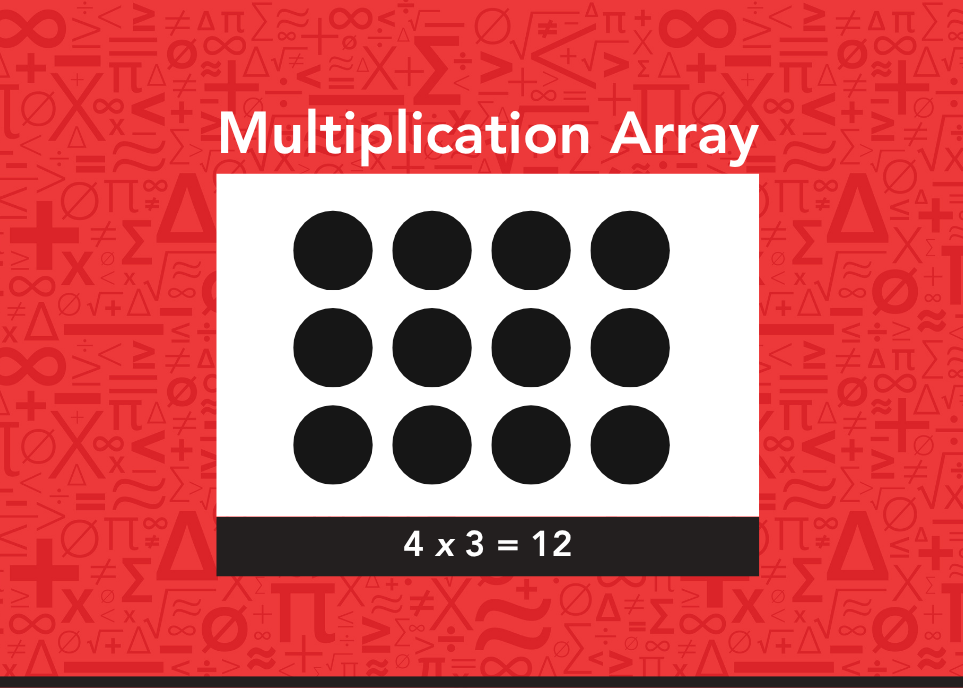
Third grade is where multiplication shows up for the first time, introduced through pictures before it ever becomes an equation.
-
Equal-group drawings and array grids
-
Early multiplication concepts
-
Multi-digit addition story problems
If you're looking for an efficient way to make the transition to multiplication smooth, here's something we like to do during sessions.
Draw a quick grid of dots on a piece of paper, say, 3 rows of 4 dots, and ask your child to circle the rows or columns before writing out a repeated addition sentence like 3 + 3 + 3 + 3.
Connecting those structured dot arrays to numerical sentences helps build a concrete bridge to equations long before formal memorization kicks in.
Grade 4: Fluency Meets Bigger Numbers
Fourth grade leans on multiplication facts kids already know, then asks them to apply that knowledge to bigger numbers.
-
Single-digit multiplication facts, 0 through 10
-
Building speed and accuracy with fact recall
-
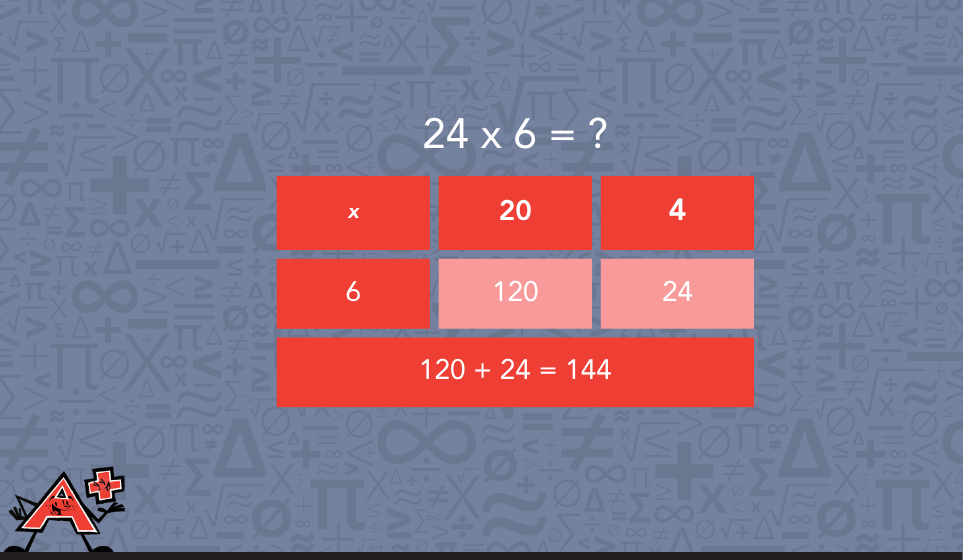
Visual area models for multi-digit multiplication
Try an area-model fact routine at home. Choose a larger multiplication problem and help your child break one factor into tens and ones.
For 24 × 6, they can use the facts 20 × 6 and 4 × 6, then add 120 + 24 to find 144. Ask your child to explain how the smaller facts connect to the larger product. This builds fact fluency, place-value understanding, and confidence with multi-digit multiplication.
Grade 5: Decimals and Multi-Step Thinking
Fifth grade brings decimals into the picture, along with problems that take more than one step to solve.
-
Place value with decimals
-
Place value with large whole numbers
-
Multi-step problem solving
To put this into practice, try a "Dollar-and-Cents Match" activity. Write decimals like 3.45, 7.08, and 12.60 on cards. Ask your child to read each as money and compare pairs like 7.08 and 7.80.
This targets common misconceptions, such as assuming 7.08 is greater because 80 is larger than 8,and builds secure decimal place-value intuition.
📕 You May Also Like: Equivalent Fractions Explained: A Kid-Friendly Guide
Grade 6: Ratios Take Center Stage (Prairie Winds & Dakota Meadows)
Middle school changes the setting and the math. At Prairie Winds and Dakota Meadows, September centers on ratio reasoning.
As your child explores ratios in school, you can help them build a concrete visual bridge by sketching a simple tape diagram together. Give them a straightforward comparison, like mixing 2 parts blue paint to 3 parts yellow, and have them draw equal boxes to represent the relationship before finding larger totals.
Grade 7: Negative Numbers Enter the Picture
Seventh grade adds negative numbers to the mix, and with them, a whole new set of rules to track.
To support this learning at home, try activities like:
-
Track temperature changes: Ask your child to find the change from −3° to 4°, using a number line if helpful.
-
Play a points game: Start at 0, draw cards with values such as +6, –4, or +2.5, and add each value to a running total.
-
Compare signed numbers: Write pairs such as -\(\Large\frac{1}{2}\) and −0.75, then ask which is greater and how a number line proves it.
Grade 8: Straight Into Algebra
Eighth grade wastes no time. September opens directly with linear equations and the algebra skills that build toward high school.
To show them both the how and the why behind how equations work, you can write an equation such as 3x + 4 = 19. Draw a line down the middle of a sheet of paper, with one side for each side of the equation. Ask your child to record the same operation on both sides:
-
Subtract 4 from both sides: 3x = 15
-
Divide both sides by 3: x = 5
-
Finish by having your child check the answer in the original equation: 3(5) + 4 = 19
Community & Public Math Resources in Greater Mankato
If you're looking for additional resources to support math practice, our local community offers several helpful options, such as:
-
Blue Earth County Library System (Youth Services Division): The Mankato library, located at 100 E. Main Street, offers free Wi-Fi, public library services, and a helpful starting point for families looking for children’s books, educational materials, and digital-learning access. Ask Youth Services staff about currently available math-themed materials and activities.
-
Mankato Area Public Schools (ISD 77) Community Education: Community Education offers youth enrichment opportunities for school-age students. Its GRASP Math program is a self-paced, at-home summer correspondence program for students completing grades K–8; it is designed to reinforce math skills from the grade just completed.
-
Twin Cities PBS and PBS LearningMedia: Families can access free videos, activities, lesson plans, and interactive learning resources. Search by grade level and math topic, then review the listed standards alignment to find materials that fit what a child is learning in school.
📕 You May Also Like: Creating a Math-Friendly Homework Environment at Home
When to Consider Structured Support
The first few weeks of school can set the tone for the entire year.
If despite your home support, you notice signs of struggle like homework frustration, fading confidence, or lingering gaps with foundational concepts from the previous grade, you may want to consider getting structured support for your student.
This means your child would work with a trained tutor who can focus on finding the specific place where understanding breaks down and offer support that adapts to your child and goes beyond quick fixes.
For local families, Mathnasium of Mankato offers exactly this kind of structured support. Our tutoring support starts with a diagnostic assessment that pinpoints a student's exact skill level and knowledge gaps. From there, we build a customized learning plan designed to fill in those foundational holes and rebuild confidence in the classroom.
📕 You May Also Like: The Pre-Algebra Readiness Checklist: 9 Skills Your Child Needs Before Starting
How Mathnasium of Mankato Supports Students Throughout the School Year
Mathnasium of Mankato is a math-only learning center and part of a network of over 1,100 learning centers.
We serve students across the Greater Mankato area. Some need help getting the school year off to a good start. Others are working to keep up with curriculum demands or looking to get ahead through advanced enrichment.
Instead of one-size-fits-all support, we personalize each student's learning experience through the Mathnasium Method™, our proprietary teaching approach.
Here's how it works:
Each student begins their time at Mathnasium with a diagnostic assessment. This relaxed interaction gives us clear insight into their current skills and learning gaps. Using these insights, we create a learning plan tailored specifically to their needs.
With the plan in place, our specially trained tutors follow it closely and teach math for true understanding. We use a mix of verbal, visual, mental, tactile, and written techniques, and we make sure each concept lands before we move on.
When students get stuck, we break the problem down into manageable bits and teach both the how and the why behind the answer. Along the way, students build problem-solving skills and reasoning tools they'll use in math and beyond.
We build motivation directly into the learning process. By using game-based activities, reward incentives, and milestone celebrations, we help students develop a positive mindset toward math and take pride in their progress.
The results speak for themselves:
-
94% of parents report an improvement in their child's math skills and understanding
-
93% of parents report an improved attitude toward math after attending Mathnasium
-
90% of students saw an improvement in their school grades
Whether your student is looking to catch up, keep up, or get ahead in their math class, our local team is happy to help!
Ready to get started?
📅 Schedule Free Consultation at Mathnasium of Mankato
Not near Mankato?
📍 Find a Mathnasium Learning Center Near You


 (507) 345-3276
 (507) 382-5802