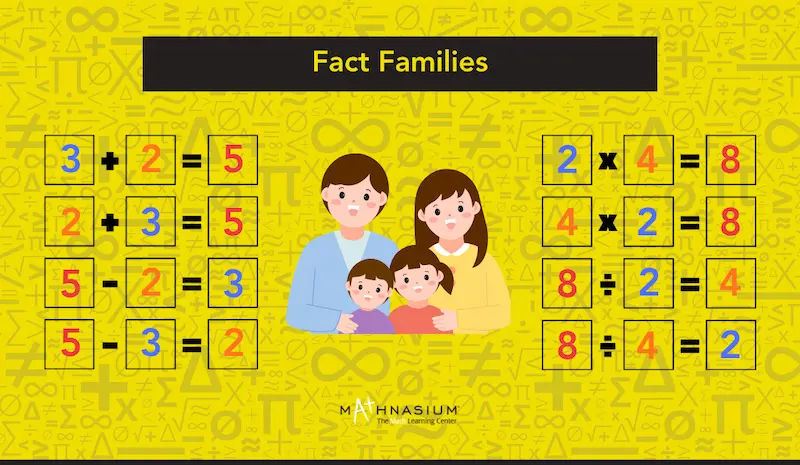
Confidence with math begins with a clear view of how numbers interact. When your child sees how numbers work together, isolated equations turn into connected patterns that feel far easier to solve.
A fact family is a simple, visual way to help children see the relationships between numbers and how the operations work together.
Today, our Mathnasium tutors will explain how fact families work, how fact families can build early math understanding, and how to practice them at home with fact triangles.

What Is a Fact Family in Math?
A fact family is a group of three numbers that are mathematically related to one another. These numbers work together to form a set of basic arithmetic operations.
In elementary mathematics, there are two main types of fact families:
An addition and subtraction family shows how two smaller numbers combine to form a larger sum, which in turn can be broken back down.
For example, using the numbers 3, 5, and 8, we get 4 math sentences or equations that look like this:
-
3 + 5 = 8
-
5 + 3 = 8
-
8 - 3 = 5
-
8 - 5 = 3
A multiplication and division family operates on the same principle, showing us how two factors multiply to create a product, and how that product can be divided back into the original factors.
For example, if we use the numbers 4, 6, and 24, we’ll also get 4 math sentences:
-
4 × 6 = 24
-
6 × 4 = 24
-
24 ÷ 4 = 6
-
24 ÷ 6 = 4
Both types demonstrate the relationship of inverse operations, proving that if we know one math fact, we can easily figure out the rest of the facts in that specific group.
Let's examine how both families work, including fact families with duplicate numbers.
1. How the Addition and Subtraction Fact Family Works
An addition and subtraction fact family uses three numbers to show how they relate to each other when we add and subtract.
Let’s look at one with the numbers 4, 5, and 9 by using a fact triangle.
A fact triangle is a visual tool that helps us see the connection (or inverse relationship) between operations and numbers.
Out of our three numbers, each one has a name and a place in the triangle:
-
The two smaller numbers, 4 and 5, go in the bottom corners. We call them the parts (also called addends).
-
The largest number, 9, goes in the top corner. We call it the whole (also called the sum or total).
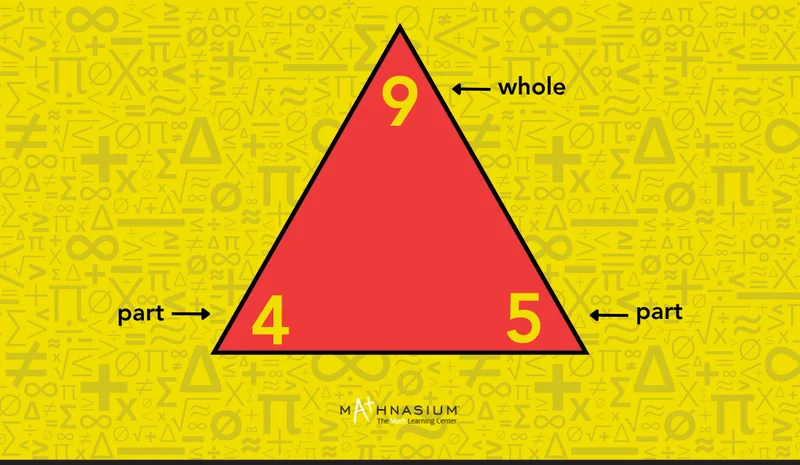
Any three numbers cannot form a fact family. The two parts must add up to the whole.
For example, 4, 5, and 10 do not work, because 4 + 5 = 9, not 10.
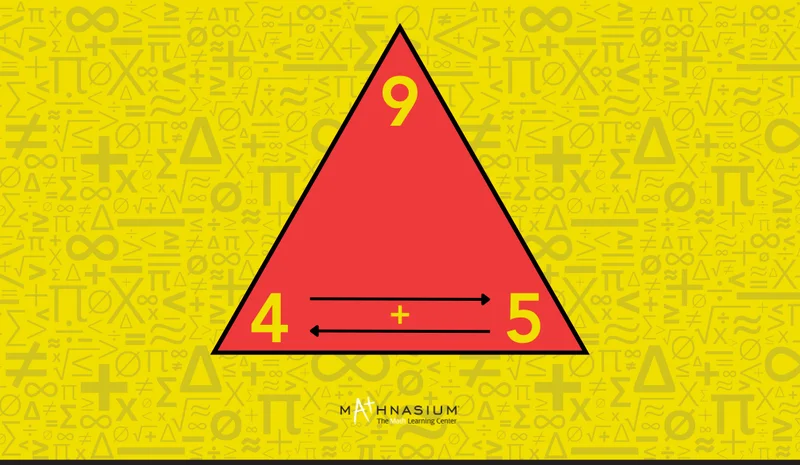
With the triangle ready, we can write our facts.
First, we can add our parts together in both directions to get the whole:
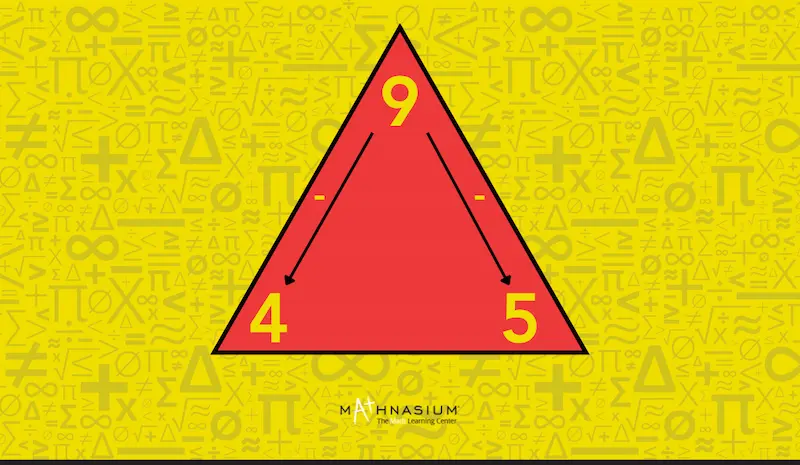
Next, we start with the whole and take away one part each time. What is left is the other part:
Now we have four facts, and all four use only 4, 5, and 9. This shows us how addition and subtraction act as inverse operations, each one perfectly undoing what the other just did.
📕 You May Also Like: What Are Inverse Operations? A Complete Overview
2. How the Multiplication and Division Fact Family Works
A multiplication and division fact family uses three numbers to show how they relate to each other when we multiply and divide.
We can see one with the numbers 3, 4, and 12 by also using a fact triangle.
Our three numbers go in the same places in the triangle as before, but they have different names:
-
The two smaller numbers, 3 and 4, go in the bottom corners. We call them the factors.
-
The largest number, 12, goes in the top corner. We call it the product.
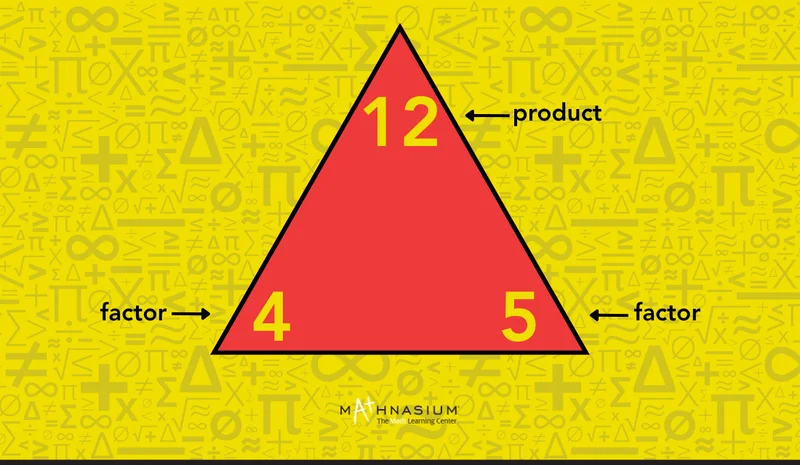
Just like with an addition and subtraction fact family, we cannot use three random numbers. The two factors must multiply to give the product.
For instance, the numbers 3, 4, and 14 won't work because 3 × 4 = 12, not 14.
With our factors and product in place on the triangle, we can write our facts.
First, we multiply our factors together in both directions to get the product:
As with addition, the order of the factors does not change the product.
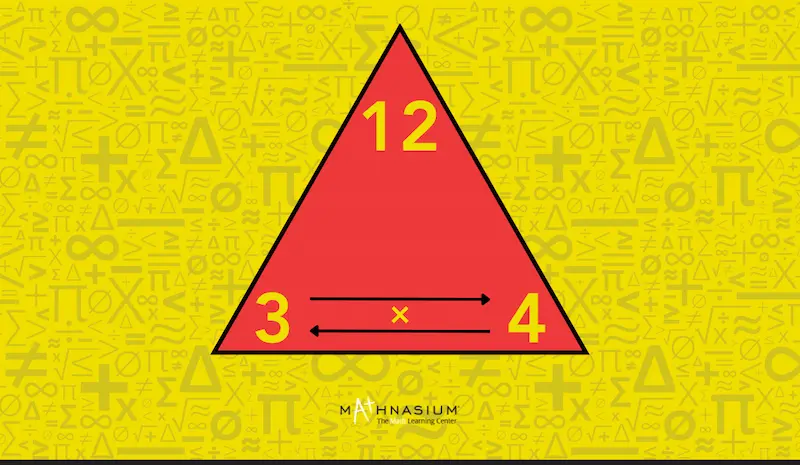
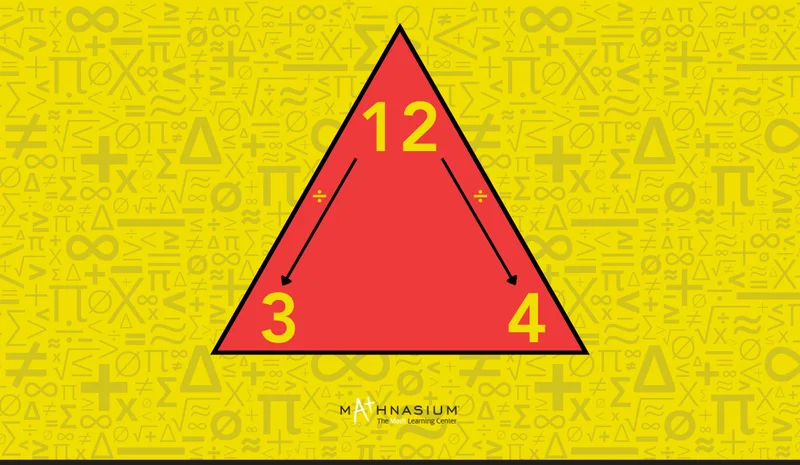
Next, we reverse the process with division. We start with the product at the top and split it into equal groups, using one factor each time:
📕 You May Also Like: 3 Ways to Help Your Child Finally Understand Division
3. How Fact Families with Duplicate Numbers Work
When two of our three numbers are the same, we get only two facts instead of four in a fact family.
We can see this with numbers like 4, 4, and 8.
The order of the parts changes nothing, because both parts are 4. So we get only one addition fact. The subtraction side works the same way. We take one part away from the whole and get only one subtraction fact:
Multiplication and division work in the same way. The numbers like 5, 5, and 25 give us only two facts, one multiplication and one division:
Now we come to one very special set of numbers: 2, 2, and 4.
These three numbers work for addition and subtraction, and they also work for multiplication and division. That gives us four different math sentences:
-
2 + 2 = 4
-
4 − 2 = 2
-
2 × 2 = 4
-
4 ÷ 2 = 2

How Do Fact Families Help Kids Understand Math Better?
Fact families help your child understand math by showing how the four operations connect. Instead of memorizing isolated equations, they can learn that every fact belongs to a small group of numbers that work together. That connection can give them a flexible way to think about numbers, and it makes new facts easier to learn.
Here are some ways fact families can support your child as they work with numbers:
-
Inverse operations: Addition and subtraction undo each other, and so do multiplication and division. The fact 2 + 3 = 5 also tells your child that 5 − 3 = 2.
-
The commutative property (turn-around rule): Your child can learn that addition and multiplication are flexible, because swapping the numbers does not change the total (2 + 3 = 3 + 2 and 3 × 4 = 4 × 3).
-
Less memorization: Your child can learn that one relationship instead of four separate facts. One known fact gives them the other three, so a long list of facts becomes a smaller, connected web.
-
Builds mental math and number sense: If your child forgets what 12 ÷ 3 equals, they can use the multiplication fact 3 × 4 = 12 to find the answer. Instead of getting stuck when one fact slips their mind, they can use a connected fact to figure it out.
-
Prepares them for pre-algebra: A fact triangle, with the biggest number at the top and the two smaller numbers at the bottom, shows your child that numbers have structure. That structure can prepare them for missing-number problems and early algebra, such as 3 + x = 5.
📕 You May Also Like: How Number Sense Shapes Your Child's Problem-Solving Skills
How to Practice Fact Families at Home with Fact Triangles
You can practice fact families at home with a piece of paper and a pen with your child. Pick two numbers together and write all four facts that belong to the family.
Here is how to do it together.
Draw a large triangle on the paper and let your child help. Choose two small numbers, such as 5 and 8, and write them in the two bottom corners.
Then, ask: “What do 5 and 8 give us if we add them together?” The answer, 13, goes in the top corner.
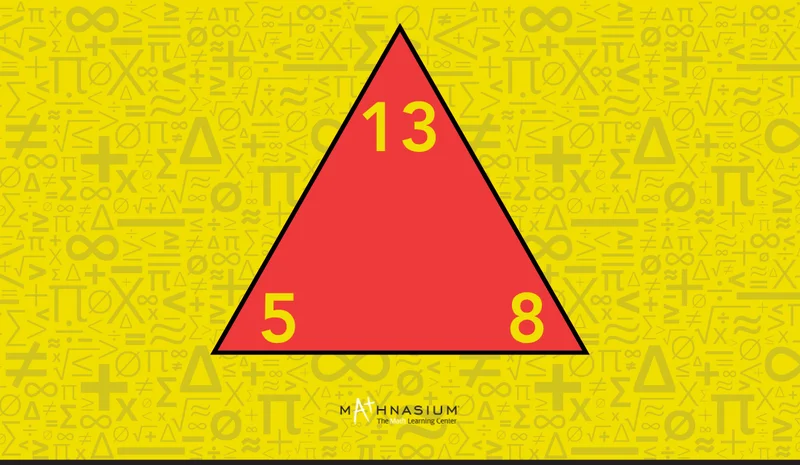
To make practice more engaging, we can draw a square right under the triangle. The triangle becomes the roof of a house, and the square is where the family lives. Now, all of your math facts can live together inside the house!
Add the first math fact, 5 + 8 = 13, inside the house like this.
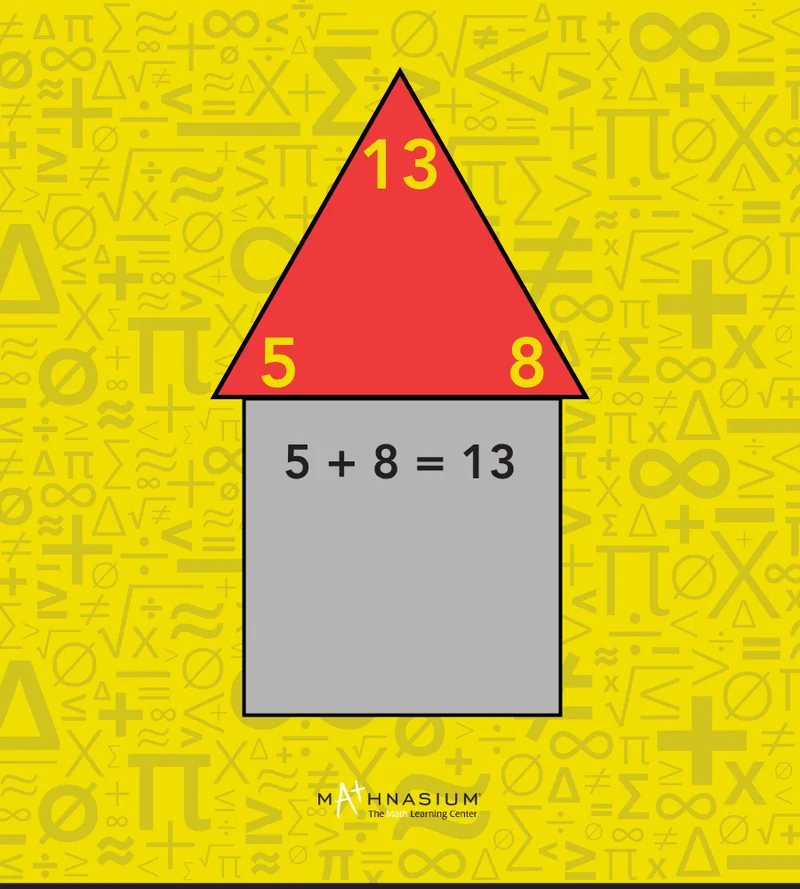
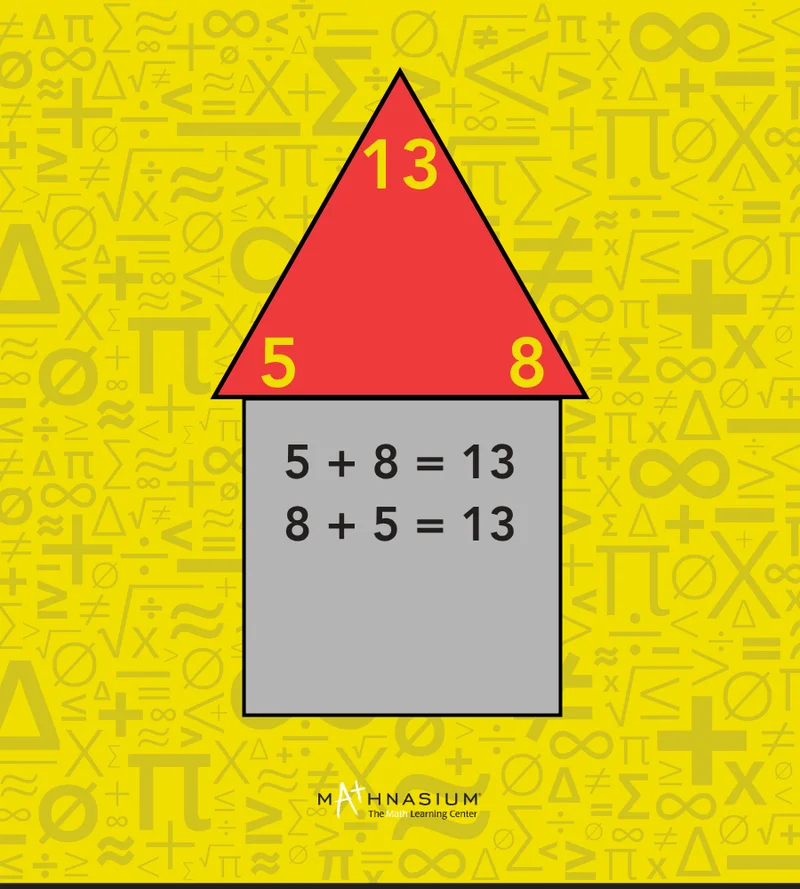
Then ask what happens if we switch the order of the two numbers. The sentence 8 + 5 = 13 shows that the answer stays the same.
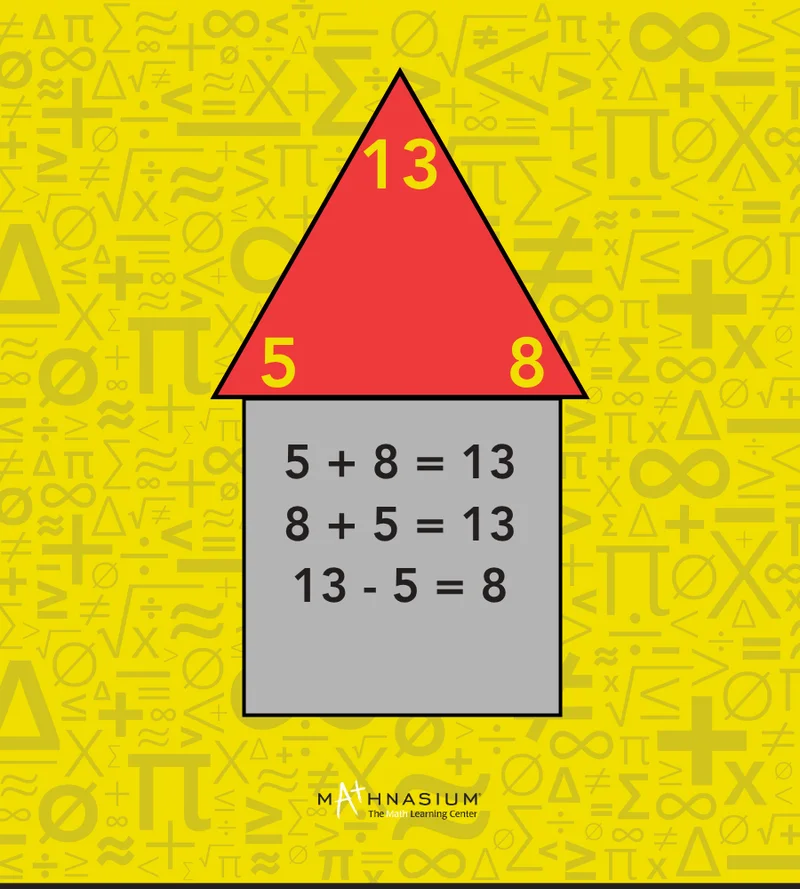
Next, place a finger over the 8 and ask, “What do we get if we start with 13 and take away 5?” The answer gives us 13 − 5 = 8.
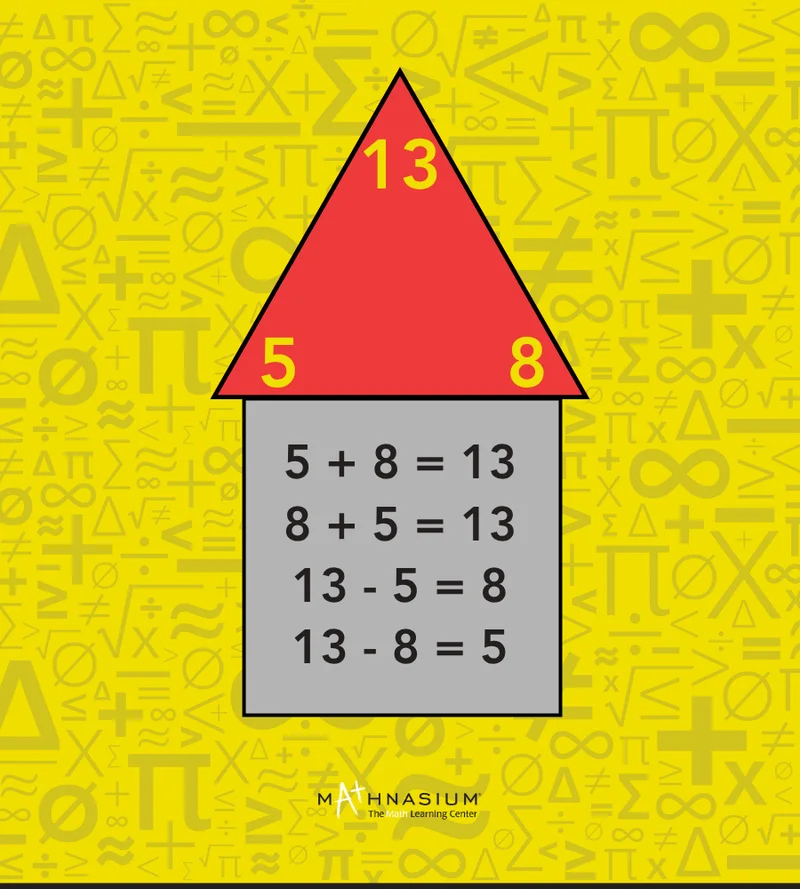
Cover the 5 and ask the same question about 13 and 8 to find 13 − 8 = 5.
The same steps work for multiplication and division fact families. Pick two numbers, such as 6 and 7, and write them in the bottom corners.
Ask what the two numbers give us when we multiply them, and write the product, 42, in the top corner. Both multiplication facts go in the house, and covering one number at a time reveals the two division facts.
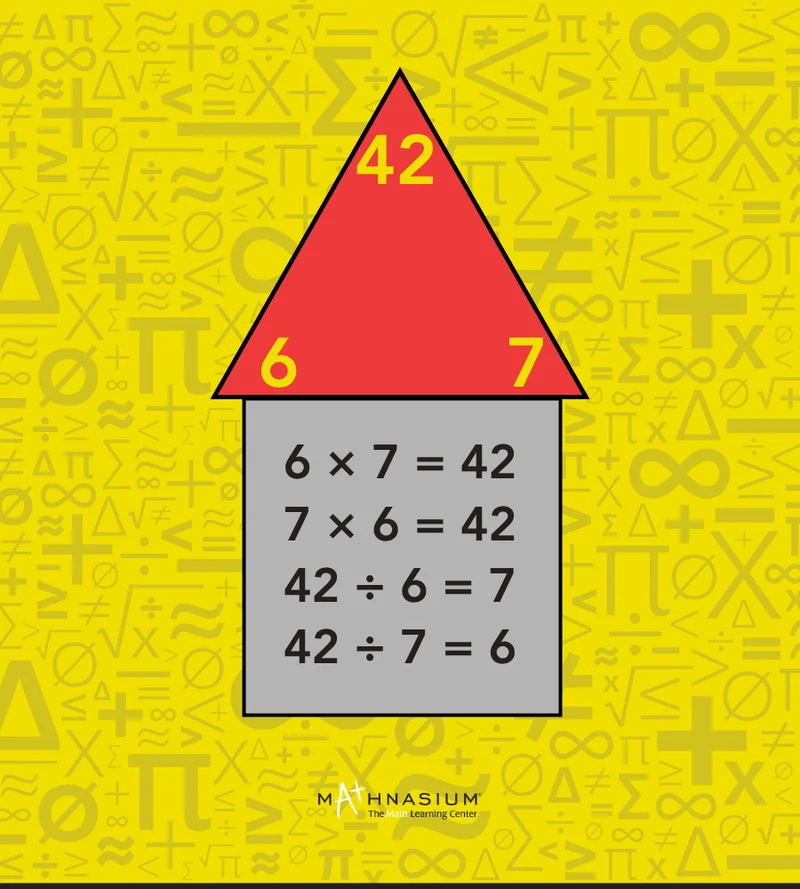
To keep practice playful, our Mathnasium tutors suggest letting dice or number cards pick the two numbers. Your child can roll two dice or draw two cards, and every new pair starts a new fact family house.

Mathnasium tutors use personalized visual tools and hands-on techniques to help students build number sense and confidence with math facts.
How Mathnasium Helps Young Learners Build Number Sense and Operation Fluency
Mathnasium is a math-only learning center empowering students of all skill levels to learn and master math.
Whether a student is building number sense with early addition facts or growing into multiplication and division, we teach for lasting understanding of how the operations connect.
We do that through the Mathnasium Method™, our proprietary teaching approach designed around how each student learns best.
Here is how it works in practice:
-
Diagnostic assessment and personalized learning plan: Each student begins with a diagnostic assessment, a relaxed interaction that shows us strengths and knowledge gaps. From there, we build a personalized learning plan tailored to each student’s needs and goals.
-
Teaching for understanding: Our specially trained tutors follow that plan closely and teach math face-to-face in a supportive environment. We use plain, everyday language and a mix of verbal, visual, mental, tactile, and written techniques, so a concept like the fact triangle makes sense from several angles.
-
Problem-solving and critical thinking: Our tutors break challenging concepts into manageable parts and teach both the how and the why behind the answer. Over time, students build problem-solving skills and critical thinking tools they can use in math and in life.
-
A fun learning environment: Our activities are game-based and hands-on, and students earn rewards along the way. We track progress and celebrate every win, so confidence grows with every session. Students also develop a more positive relationship with math.
Families see measurable results:
-
94% of parents report an improvement in their child’s math skills and understanding
-
93% of parents report an improved attitude toward math after attending Mathnasium
-
90% of students saw an improvement in their school grades
With over 1,200 learning centers across North America, there is likely a Mathnasium near you.
For families in and around Mankato, MN, Mathnasium of Mankato is a trusted local center that builds confident math thinkers. Whether a student needs to catch up, keep up, or get ahead, our team is happy to help.
Ready to start?
📅 Schedule a Free Diagnostic Assessment at Mathnasium of Mankato
Not near Mankato?
📍 Find a Mathnasium Learning Center Near You


 (507) 345-3276
 (507) 382-5802