Learning standards across the U.S., including Virginia's Standards of Learning for Mathematics, introduce multiplication formally in Grade 3.
From that point forward, how a child understands and relates to multiplication shapes their performance across fractions, ratios, algebra, and beyond.
Our instructors consistently find that conceptual understanding of multiplication and fact fluency go hand in hand. Children who build both from the start tend to handle harder math with far more confidence than those who rely on memorization alone.
This difference is not always visible in 3rd grade but becomes apparent later on their math journey.
We put together eight practical tips to build your child's multiplication understanding and fact fluency from the ground up.

1. Make Sure They Understand What Multiplication Is First
Before any facts or tables, at Mathnasium, we start by showing our students what multiplication stands for. We would advise you to do the same.
Multiplication simply means combining equal groups to find a total, which is exactly what addition does. That is why we say multiplication is repeated addition.
To make that notion land, try explaining it with a few examples:
-
4 × 3 means four equal groups of three: 3 + 3 + 3 + 3 = 12
-
5 × 6 means five equal groups of six: 6 + 6 + 6 + 6 + 6 = 30
-
7 × 0 means seven equal groups of nothing: still nothing
If your child understands this connection, that is a stable foundation to build on.
📕 You May Also Like: How Math Concepts Reappear in New Forms Each Year
2. Introduce Multiplication Through Arrays and Visual Models
As conceptual understanding forms, support it with visuals.
A recently published educational study suggests that visual representations in mathematics can support understanding, reduce cognitive load, and improve problem-solving performance.
For multiplication purposes, we recommend a combination of:
-
Arrays: This is a rectangular arrangement of rows and columns. A 5 × 3 array of dots makes 15 visible as a structure and reveals immediately why 5 groups of 3 and 3 groups of 5 produce the same total.
-
Number lines: Draw three equal jumps of six on a number line and your child can see 3×6 building up step by step, landing on 18.
-
Bar models: Draw a bar divided into equal sections, each labeled with the same number. For 4×5, that means four sections, each holding five. Your child can count what is inside and connect it to the multiplication sentence before writing it symbolically.
 Arrays like this one make the structure of multiplication visible before a single fact is memorized
📕 You May Also Like: How to Teach Math to Visual Learners with Pictures & Manipulatives
3. Start With Confidence-Building Facts
Not all multiplication facts are equally approachable. In other words, the order in which your child meets them is important.
We recommend beginning with the 0s, 1s, 2s, 5s, 10s, and 11s as it builds the momentum your child needs to tackle harder facts with confidence.
Each of these groups follows a pattern clear enough to work out rather than memorize:
-
0s: Any number times 0 is always 0
-
1s: Any number times 1 is always itself
-
2s: These are doubles, familiar territory from addition
-
5s: The answer always ends in 0 or 5
-
10s: Just add a zero
-
11s: Up to 9×11, the digit simply repeats
By the time these feel comfortable, you’ve already covered a large portion of the multiplication table before encountering anything that requires deeper reasoning.
📕 You May Also Like: How to Break Down Any Math Problem Into Steps
4. Use the Commutative Property to Cut the Work Nearly in Half
The full 12 × 12 multiplication table contains 144 facts. That number alone can feel overwhelming to your learner if they’re just starting out. It is at this moment that you should remind them that every fact has a twin.
This is the commutative property at work: in multiplication, the order of the factors does not change the product.
-
Knowing 3 × 8 = 24 means automatically knowing 8 × 3 = 24
-
Knowing 6 × 9 = 54 means automatically knowing 9 × 6 = 54
-
And so on, all the way through the table
Once you account for all those turn-around pairs alongside the 12 square numbers like 3 × 3 or 7 × 7, the number of unique facts your child actually needs to learn drops from 144 to 78. That’s fewer than half.
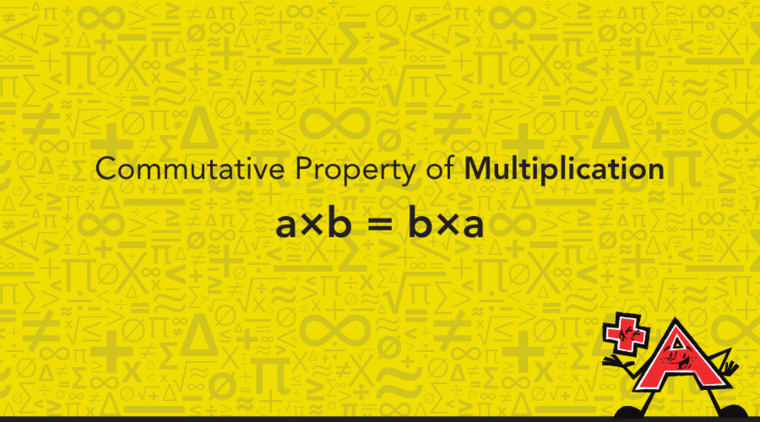 Order doesn't change the product, and that cuts the facts your child needs to learn nearly in half.
5. Step to Unknown Facts One Group at a Time
With a reliable core of known facts, those facts become stepping stones. Our instructors use this approach regularly because it changes how students relate to facts they have not yet memorized.
If they know one fact confidently, they can reach the fact next to it by adding or subtracting a single group:
-
Know 8 × 5 = 40? Add one more group of 8 to reach 8 × 6: 40 + 8 = 48
-
Know 10 × 7 = 70? Subtract one group of 7 to reach 9 × 7: 70 −7 = 63
-
Know 6 × 4 = 24? Add one more group of 6 to reach 6 × 5: 24 + 6 = 30
This way, an unmemorized fact stops being a dead end and becomes a solvable problem.
It reminds your young learner that there’s always a way forward, even when memory fails. With time, that sense of having a reliable route through any fact builds a kind of confidence that rote memorization rarely produces.
📕 You May Also Like: Critical Thinking vs. Memorizing: What Really Builds Math Skills?
6. Spot the Patterns That Connect Multiplication Facts
Teach your student that multiplication facts are not isolated. They are connected by relationships that run across entire fact families.
What do we mean by this? We’ll give you a few telling examples:
-
×4 facts are always double the ×2 facts: 4 × 7 is just 2 × 7 doubled, 14 + 14 = 28
-
×6 facts are the ×5 facts plus one group: 6 × 8 is 5 × 8 plus one more 8, 40 + 8 = 48
-
×9 facts are the ×10 facts minus one group: 9 × 6 is 10 × 6 minus one 6, 60 − 6 = 54
-
×12 facts are the ×10 facts plus the ×2 facts: 12 × 7 is 70 + 14 = 84
This is another proof that memorizing every fact by heart is simply not necessary. The more such patterns your child has in place, the more they can derive harder facts from easier ones they already know.
📕 You May Also Like: 4 Related Fact Strategies to Help Build Your Child’s Math Flexibility
7. Change It Up with Missing Factor Problems
Missing factor problems take a familiar multiplication fact and turn it into a question. Instead of asking, "What is 6 × 7?" flip it: "6 times what number gives you 42?"
We introduce these at our centers because they ask students to think about multiplication as a relationship between numbers. That understanding pays off in prealgebra, where missing factor thinking is exactly what equation solving demands.
Sit down with your child and work through a few together. Start simple and build up:
-
5 × __ = 35
-
__ × 8 = 48
-
9 × __ = 63
-
__ × 7 = 56
-
4 × __ = 36
-
__ × 6 = 54
Notice how your child approaches these. The ones they solve quickly point to facts already automatic. The ones they hesitate on reveal exactly where to focus next.
8. Use the Distributive Property to Break Hard Facts Apart
Some facts resist every other strategy. The 6s, 7s, and 8s are where most students hit a wall, and the distributive property gives them a reliable way through.
The principle is straightforward: split one factor into two smaller parts, multiply each separately, then combine the results. Every step uses arithmetic your child already knows.
-
7 × 8: Split 8 into 5 + 3. Now multiply each part separately. 7 × 5 = 35, and 7 × 3 = 21. Add them together: 35 + 21 = 56
-
6 × 7: Split 7 into 5 + 2. 6 × 5 = 30, and 6 × 2 = 12. Add them together: 30 + 12 = 42
-
8 × 6: Split 6 into 5 + 1. 8 × 5 = 40, and 8 × 1 = 8. Add them together: 40 + 8 = 48
The first few times, it takes effort. As they work through the same fact repeatedly, the path becomes automatic.
 At Mathnasium, personalized learning plans and proven teaching techniques help every student build a multiplication foundation that holds up as math gets harder.
How Mathnasium Helps Students Build Solid Math Foundations
Mathnasium is a math-only learning center dedicated to helping K-12 students of all skill levels learn and master math.
Multiplication is one of the most foundational skills in math and one of the most frequent points of focus for our instructors.
To help students build a solid and lasting foundation, we rely not on a one-size-fits-all curriculum but on the Mathnasium Method™, a proprietary teaching approach designed around each student's individual learning needs and style.
It begins with a diagnostic assessment, a relaxed interaction where we uncover your child's strengths and knowledge gaps. From those insights, we build a personalized learning plan tailored to their needs, whether that means building conceptual understanding of multiplication from the ground up or strengthening fact fluency for a student who has the concept but needs more practice.
Our specially trained instructors follow that plan closely, teaching math face-to-face in a supportive and fun setting. We use plain, everyday language to explain concepts and draw on a mix of verbal, visual, mental, tactile, and written techniques so the math truly lands.
When students get stuck, we give them space to work through it on their own first, guiding them to trust their own thinking. When we step in, we break the concept down and show both the how and the why behind the answer. Over time, students develop the problem-solving skills and critical thinking tools they carry into math and beyond.
Fun is a major part of how we work. Sessions are often game-based, students earn rewards along the way, and every bit of progress gets celebrated. That keeps learning engaging, enjoyable, and students aware of how far they have come.
Results are real and measurable:
-
94% of parents report an improvement in their child's math skills and understanding
-
93% of parents report their child's improved attitude toward math after attending Mathnasium
-
90% of students saw an improvement in their school grades
We operate over 1,100 centers, bringing our top-rated approach close to your community.
If you're based in or near Mechanicsville, VA, Mathnasium of Mechanicsville is a trusted local resource with years of experience helping students transform not only their skills but also how they think and feel about math.
Whether your child needs to catch up, keep up, or get ahead, our team is happy to help.
📅 Schedule a Free Assessment at Mathnasium of Mechanicsville
Not near Mechanicsville?
📍 Find a Mathnasium Learning Center Near You


 (804) 559-0550