One-step equations are where formal algebraic reasoning truly begins. Here, a variable stands in for an unknown number, and we use a single inverse operation to reveal its value.
These simple equations set us up for the two-step and multi-step problems ahead. No matter how many steps we take, our goal is always to keep both sides balanced as we isolate the variable.
That's why today, our tutors put this guide together to explain what an algebraic equation is, what makes it "one-step," and how to solve one using addition, subtraction, multiplication, or division.

What Is an Algebraic Equation?
An algebraic equation is a math sentence that says two expressions are equal. It always has an equal sign and at least one side that hides a number we don't know yet.
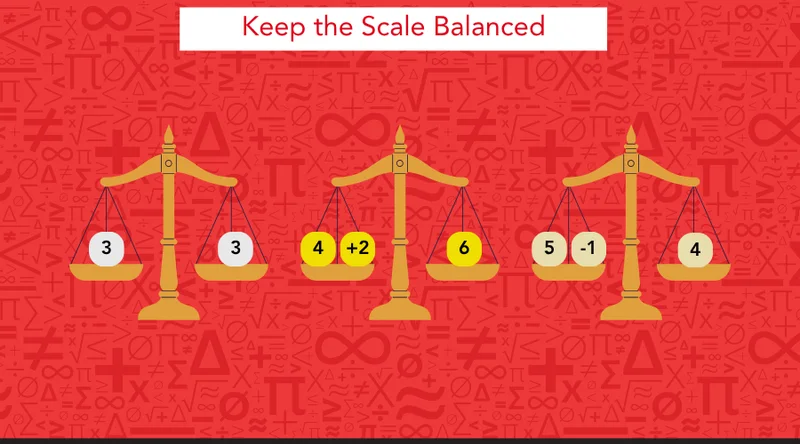
Before we go further, let's remind ourselves what a basic equation looks like through a few examples:
-
3 = 3
-
4 + 2 = 6
-
5 - 1 = 4
Notice what all of these have in common?
They are all telling us the same thing—that the values on both sides are equal.
At Mathnasium, we like to picture an equation like a balanced scale. Both sides have to weigh the same amount, or the scale tips!
So, where does the "algebraic" part come in?
The big difference here is that an algebraic equation introduces a variable, which is a hidden number we still need to find. While we can use any symbol for a variable, we usually reach for x.
Let's see what that looks like:
x + 3 = 8
We can read this as: "What number, plus 3, gives us 8?"
We need to find the value of x to keep our scale balanced, since the whole goal is to figure out what number makes both sides the same.

What Is a One-Step Equation?
A one-step equation is an algebraic equation we can solve using a single operation.
We already know that an algebraic equation hides a variable somewhere in it, a number we still need to find. In a one-step equation, only one operation stands between us and that number.
The operation is what decides which of the four shapes a one-step equation takes.
|
Operation
|
What Happens to the Variable
|
Example
|
|
Addition
|
We add a number to the variable.
|
x + 3 = 8
|
|
Subtraction
|
We take a number away from the variable.
|
x − 5 = 2
|
|
Multiplication
|
We multiply the variable by a number.
|
4x = 20
|
|
Division
|
We divide the variable by a number.
|
\(\Large\frac{x}{6}\) = 3
|
📕 You May Also Like: Expression vs. Equation Explained: A Student-Friendly Guide
How to Solve One-Step Equations
We solve one-step equations using an inverse operation, the opposite math action that undoes whatever is attached to the variable.
Once we know which operation is attached to the variable, we apply its opposite to isolate the variable and find its value.
Every operation pairs with exactly one other operation that undoes it.
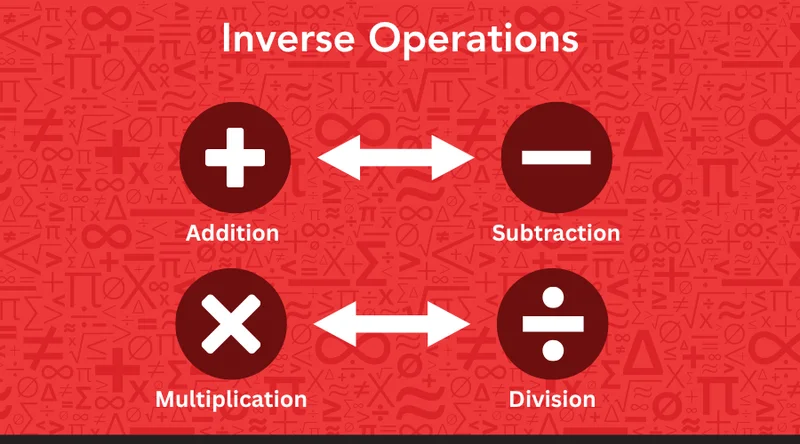
There's one rule that never changes. Whatever we do to one side of the equation, we have to do to the other side too, so the equation stays balanced.
Let's work through each type.
1. Addition Equations
An addition equation has a number added to the variable, so we subtract that same number from both sides to undo it.
Let's solve.
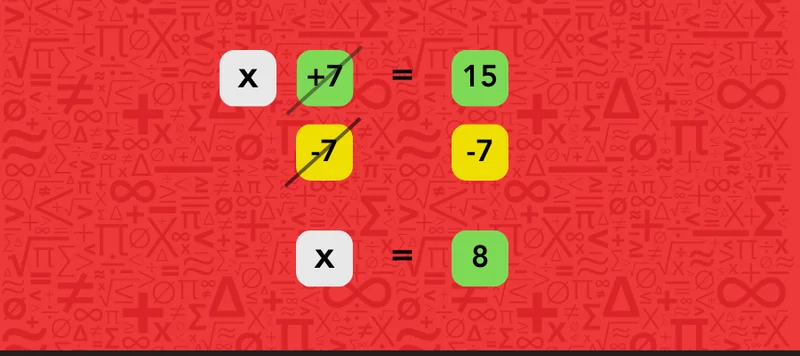
x + 7 = 15
Step 1: Identify the operation attached to the variable
We can see that 7 is added to the x. What operation undoes that?
Subtraction.
Step 2: Apply the inverse operation to both sides
Since we look at the equation as a balanced scale, we subtract 7 from both sides.
x + 7 − 7 = 15 − 7
Step 3: Simplify both sides
On the left, 7 − 7 cancels out, leaving just x. On the right, 15 − 7 gives us 8.
x = 8
Step 4: Check the answer
We substitute 8 back into the original equation. 8 + 7 = 15, so our answer holds.
📕 You May Also Like: What Are Inverse Operations? A Complete Overview
2. Subtraction Equations
Now let's flip that around. In a subtraction equation, a number is taken away from the variable, so addition is what brings it back.
Let's solve.
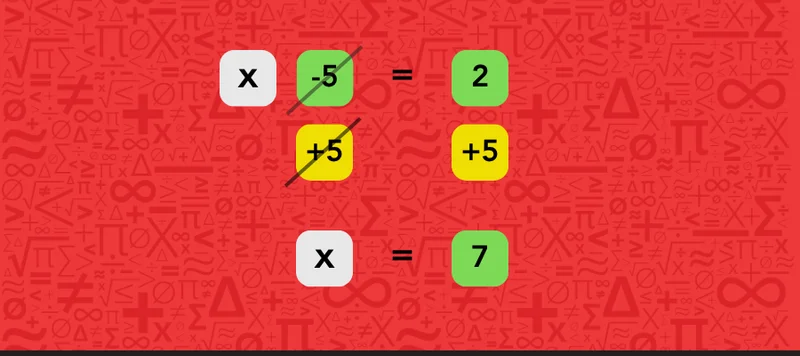
x − 5 = 2
Step 1: Identify the operation attached to the variable
We subtract 5 from x here, so we apply addition.
Step 2: Apply the inverse operation to both sides
We add 5 to both sides.
x − 5 + 5 = 2 + 5
Step 3: Simplify both sides
The −5 and +5 on the left cancel out, leaving x alone. On the right, 2 + 5 comes out to 7.
x = 7
Step 4: Check the answer
Plugging 7 back in, 7 − 5 = 2. Correct.
📕 You May Also Like: What Are Inverse Operations? A Complete Overview
3. Multiplication Equations
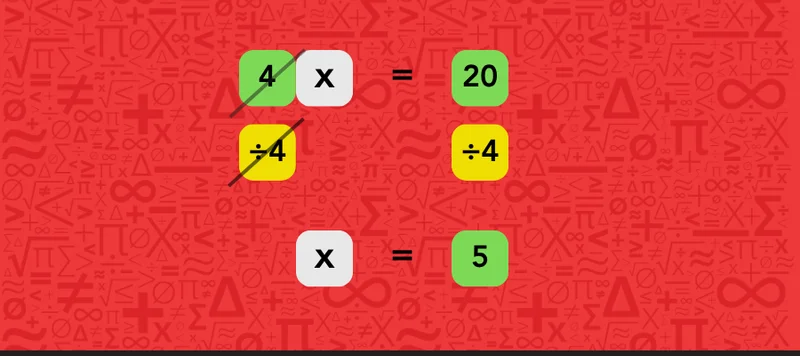
A multiplication equation has a number multiplied by the variable, so we divide both sides by that same number to undo it.
4x = 20
Step 1: Identify the operation attached to the variable
Multiplication is at work here, which means we use division to undo it.
Step 2: Apply the inverse operation to both sides
Dividing both sides by 4 keeps things balanced.
4x ÷ 4 = 20 ÷ 4
Step 3: Simplify both sides
4 divided by 4 leaves just x. On the right, 20 divided by 4 leaves 5.
x = 5
Step 4: Check the answer
4 × 5 = 20, matches the original equation.
📕 You May Also Like: Mental Math Tricks for Multiplying by 5, 9, 11, and 25
4. Division Equations
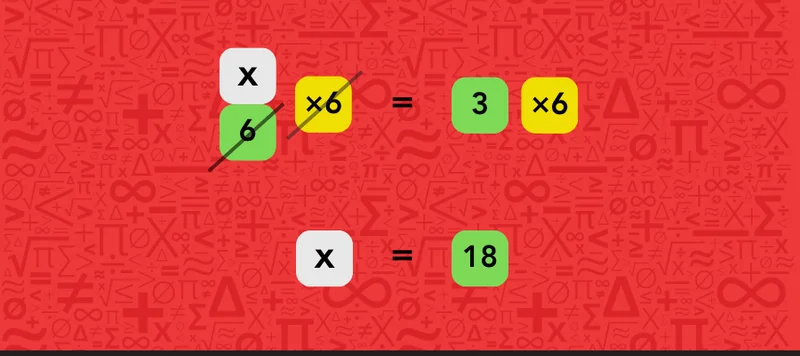
A division equation has the variable divided by a number, so we multiply both sides by that same number to bring it back together.
Let's solve.
\(\Large\frac{x}{6} = 3\)
Step 1: Identify the operation attached to the variable
Division is the operation attached to x here, and a fraction is just another way to write division.
Step 2: Apply the inverse operation to both sides
Multiplying both sides by 6 keeps things balanced.
On the left side, we write 6 as a fraction too, so both sides stay in the same form.
\(\Large\frac{x}{6} × \Large\frac{6}{1} = 3 × 6\)
Step 3: Simplify both sides
On the left, the numerator and denominator cancel out, leaving just x. On the right, 3 × 6 gives us 18.
x = 18
Step 4: Check the answer
Plugging 18 back in, \(\Large\frac{18}{6} = 3\). Correct.
📕 You May Also Like: How to Do Algebra With Fractions? A Simple Guide
Your Turn: Solve These One-Step Equations
Our tutors at Mathnasium put together four problems, one for each type we covered. Work through each one carefully.
Problem 1: x + 9 = 14
Problem 2: x − 6 = 8
Problem 3: 5x = 35
Problem 4: \(\Large\frac{x}{4} = 9\)
Take as much time as needed on each problem. The answers are at the bottom of the guide.

Mathnasium tutors bring algebra to life through clear explanations and step-by-step instruction.
How Mathnasium Helps Students Master Algebra
Mathnasium is a math-only learning center dedicated to helping K–12 students of all skill levels learn and master math.
Whether a student needs to build a foundation with one-step equations or is ready to move into two-step and multi-step problems, we teach for lasting understanding.
To get there, we use a proprietary teaching approach called the Mathnasium Method™.
Here's how it works in practice:
-
Diagnostic Assessment and Personalized Learning Plans: Every student begins with a diagnostic assessment that identifies both visible skill gaps and the reasoning patterns behind them. From that starting point, we build a personalized learning plan tailored to their needs and goals.
-
Teaching for Understanding: Our specially trained tutors use plain, everyday language and a mix of verbal, visual, mental, tactile, and written techniques so concepts like inverse operations make sense to every student.
-
Problem-Solving and Critical Thinking: When a concept feels challenging, we break it down into manageable parts and guide students through both the how and the why. Over time, this builds the problem-solving skills and critical thinking they can use in math and everyday life.
-
An Engaging and Fun Learning Environment: Our sessions are often game-based and hands-on, and we celebrate every bit of progress. Over time, students build a more positive relationship with math and greater confidence in their own abilities.
The results reflect that approach:
-
94% of parents report an improvement in their child's math skills and understanding
-
93% of parents report an improved attitude toward math after attending Mathnasium
-
90% of students saw an improvement in their school grades
We operate over 1,100 centers across North America, bringing our proven approach to communities everywhere.
Families across Nora, Broad Ripple, and Meridian Hills can visit Mathnasium of Nora, a trusted local center with a proven record of building confident math thinkers.
Whether your child is looking to catch up, keep up, or get ahead in math, our team is happy to help!
📅 Schedule a Free Diagnostic Assessment at Mathnasium of Nora
Not near Nora?
📍 Find a Mathnasium Learning Center Near You
Pssst! Check Your Answers Here
Here are the answers. How did you do?
Problem 1: x = 5.
Problem 2: x = 14.
Problem 3: x = 7.
Problem 4: x = 36.


 (317) 733-9100