Math can become difficult for reasons that aren't always obvious at first. When a student brings home a poor grade, it's easy to assume the issue started with a missed class or a single difficult test.
Behind the scenes, however, a different kind of barrier is often what gets in the way of a child's progress, going unnoticed by both parents and teachers.
Today, we'll look at four common, easily overlooked obstacles that can make math harder than it needs to be, along with practical ways you can help your learner work through them.

1. Gaps in Foundational Skills
If your child misses a few lessons about ecosystems, they can still follow along when the class moves to a new science topic. Math doesn't work that way. It's cumulative, which means new concepts build directly on skills your child has already learned.
After following children’s early number skills over time, a longitudinal study on early calculation development found that gaps in early number skills predict difficulty with later math achievement, unless those gaps are addressed early.
Fractions are one of the recognizable examples, and this is something we often see at our center. When a learner has a shaky grasp of fractions, that gap can affect their work with ratios, algebra, and other concepts built on proportional reasoning.
Tip 1: Find and Fill the First Gap
Instead of guessing where things went off track, use this quick three-step approach:
-
Ask the teacher: Find out which specific foundational skill supports the topic your child is currently struggling with.
-
Test the prior skill: Give them two or three simple problems on that concept and ask them to explain how they solved them.
-
Target the missing piece: If they hesitate, spend just 10 minutes reviewing that single concept using drawings, physical objects, or a number line.
For example, if your child is struggling with ratios, check whether they can recognize equivalent fractions and basic multiplication relationships first.
Target that specific gap directly instead of trying to review an entire grade's worth of math. This will keep the catch-up work manageable and protect their confidence.

2. Working Memory Affects Math Learning
The ability to hold a few pieces of information in mind at once while working with them is called working memory.
In practice, it looks like this: when your learner solves a math problem, they have to keep the numbers in mind, track which operation comes next, remember a rule from three steps ago, and keep the original question in mind, all at the same time.
Research gives us another reason to pay attention to this part of learning. A longitudinal meta-analysis found children with math difficulties performed lower on working-memory tasks than their peers.
This pattern appeared across several types of tasks, suggesting that for some learners, simply keeping track of everything a math problem asks them to remember can make the problem harder to solve.
On a more positive note, a study of middle school students with learning difficulties found that working-memory training was associated with improvements in math performance. This means that your child's ability to manage these demands can improve with the right support and practice.
Tip 2: Move the Steps Onto Paper
Ask your child to write down one step at a time instead of trying to track the whole problem mentally. Have them circle the operation, keep intermediate answers visible, and check off each completed step before they move on.
For example, with a word problem, they can write:
This "offloads" information from working memory. Instead of struggling to remember every detail, your child can focus entirely on the actual math.
📕 You May Also Like: How to Use Model Drawing for Word Problems
3. Math Anxiety Can Get in the Way of Problem-Solving
Math anxiety is the worry or fear a child feels when doing, or even thinking about, math. Beyond just making the subject stressful, that tension can interfere with the mental processes learners need to solve math problems.
From a study of secondary school students, we find that students with high math anxiety scored lower on math tasks than their less-anxious peers, even when the two groups were matched on age, vocabulary, and general anxiety levels.
Sometimes, parents assume that math anxiety is rare or reserved for students who are already behind, but it isn't.
A study by researcher Colleen Ganley has put the figure at roughly 20 to 25 percent of kids experiencing moderate to high levels of it. Also, it is not tied to age either, showing up in a seven-year-old just as easily as a teenager.
Tip 3: Lower the Pressure and Build a Small Win
If your child becomes anxious, pause instead of pushing them to finish. Say, “It’s okay not to know yet. Let’s find one part you do understand.”
Then work through one manageable problem without a timer. Praise the strategy they tried or the question they asked, rather than how quickly they answered, and increase the challenge gradually as their confidence grows.
This is the approach we like to use at our centers because it creates a supportive environment where mistakes are treated as part of learning and not something to fear.
📕 You May Also Like: How to Spot & Help Your Kid's Math Anxiety
4. Classroom Pace Doesn't Match Every Student's Pace
A classroom has one pace, but every student learns math at their own pace. That's not a flaw in the teacher or the student.
Your child's teacher plans a lesson, a unit, and a full-year curriculum around a single timeline, because there's no realistic way to run twenty-five individual timelines in one room at once.
In a widely cited 1984 study, educational psychologist Benjamin Bloom compared students in conventional classrooms to students receiving one-on-one, mastery-based instruction paced to their own progress.
The tutored students ended up outperforming the vast majority of their conventionally taught peers, a gap so large that Bloom treated closing it at scale as one of education's defining open problems.
A fixed classroom pace can also mean that students spend time on material they have already mastered. If your learner understands a skill well, repeating it can make math feel repetitive rather than giving them an opportunity to move forward.
Both learners benefit when the pace gives them what they need. Sometimes it is more time when a concept hasn't clicked yet, and sometimes it is a new challenge when they're ready to move forward.
Tip 4: Know When the Gap Needs Outside Support
You can see where your child started to fall behind through a conversation with their teacher or a pattern in their test mistakes. The harder part can be closing that gap while keeping up with the rest of their schoolwork.
That's where structured support can help. At Mathnasium, every student starts with a diagnostic assessment that identifies their current skill level and how they learn best, not just the concept they missed.
From there, we build a personalized learning plan. It is built around what your learner needs most, which helps make math feel more manageable.
If your child's math struggles have started to feel bigger than one specific skill, that's usually a sign that it's time for a plan built specifically around them, not just more practice at home.
📕 You May Also Like: 4 Ways Personalized Tutoring Builds Math Confidence

Mathnasium tutors use personalized learning plans and proven teaching techniques to help students become confident math thinkers.
How Mathnasium Helps Students Overcome Any Math Challenge
Mathnasium is a math-only learning center dedicated to helping K–12 students of all skill levels catch up, keep up, and get ahead in math.
Math can become harder when gaps build up, working memory gets overloaded, anxiety gets in the way, or the pace of instruction doesn't leave enough room for a child to fully grasp a concept.
To help students work through these challenges and keep building their skills, Mathnasium provides personalized support that adapts to each learner's needs, pace, and current level of understanding.
We do this through the Mathnasium Method™, our proprietary teaching approach.
Each student begins with a diagnostic assessment that identifies current skills and knowledge gaps. From those findings, we build a personalized learning plan tailored to their goals.
Our specially trained tutors deliver face-to-face instruction in a caring and fun group environment, both in-center and online.
We use natural language and a mix of verbal, visual, mental, tactile, and written techniques so each math concept lands before we move forward.
Our students have time to work through problems independently. That productive struggle helps them learn to trust their own reasoning. When we do step in, we explain both the how and the why behind each answer, so students build problem-solving and critical thinking skills they can use in math class and beyond.
Fun is an integral part of our approach, incorporated through game-based activities and ample rewards. This keeps students engaged, motivated, and aware of how much they've accomplished, building their confidence with each session.
The results speak for themselves:
-
94% of parents report an improvement in their child's math skills and understanding
-
93% of parents report their child's improved attitude toward math after attending Mathnasium
-
90% of students saw an improvement in their school grades
With more than 1,100 learning centers across North America, there is likely a Mathnasium close to you.
Families located near North Frisco and McKinney, TX, can visit Mathnasium of North Frisco, a trusted local center with a proven record of building confident math thinkers.
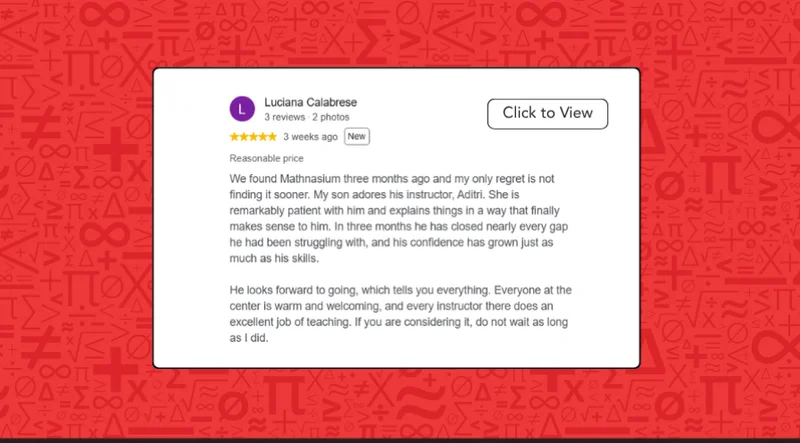
Here’s what one parent had to share about our center:
Whether your student needs help filling a gap, more time to master a concept, or a new challenge to keep moving forward, our team is happy to assist!
Ready to take the first step?
📅 Schedule a Free Assessment at Mathnasium of North Frisco
Not near North Frisco or McKinney?
📍 Find a Mathnasium Learning Center Near You


 (469) 248-8844
 (469) 248-8844